
Lowest Price Guaranteed
Slides
177
Last Updated
June 2026
View Count
13401
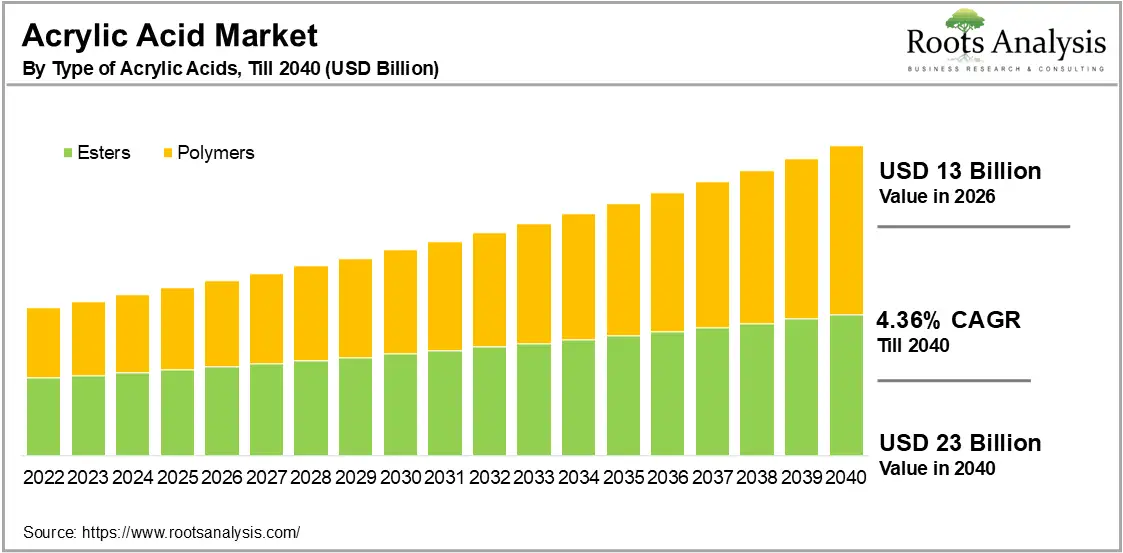
The acrylic acid market size is projected to grow from USD 13 billion in 2026 to USD 23 billion by 2040, representing a CAGR of 4.36% during the forecast period 2026-2040.
To learn more about this report, request a free sample copy
The new research study consists of industry trends, detailed market analysis, key market trends of the acrylic acid market, SWOT analysis and value chain analysis.
Acrylic acid is a colorless liquid with a characteristic smell. It has the chemical formula of C3H4O2 and is produced by propylene. Apart from being water miscible, this chemical also mixes well with chemical reagents such as alcohol, acetone and chloroform. Among its various uses, it is also used as a feedstock for manufacturing acrylate, acrylic esters and resins, which are further utilized in adhesives and coating applications. In addition to this, it is also being used in water treatment chemicals, detergent surfactants, and oil treatment chemicals.
The global acrylic acid market is experiencing an exponential surge due to the rising demand for polymers, paints and coatings, and personal care products. Key factors that are driving the record rise in superabsorbent polymer demand includes, unprecedented growth in the personal care sector, expansion within the construction industry, and the increasing adoption of water-based adhesives. These are some of the prominent factors propelling the growth of the acrylic acid market. Due to the growing demand for acrylic acid and its derivatives, manufacturers are collaborating with other players to increase their production. For instance, recently, Lummus Technology, signed an agreement with Air Liquide Engineering & Construction to acquire the rights to license and market ester grade acrylic acid technology as well as light and heavy acrylates process.
The market report presents an in-depth analysis of the various service providers that are involved in the acrylic acid market, across different segments, as defined in the table below:
| Key Report Attributes | Details | |
| Historical Trend | Since 2022 | |
| Base Year | 2025 | |
| Forecast Period | Till 2040 | |
| Market Size Value in 2026 | $ 13 Billion | |
| Market Size Value by 2040 | $ 23 Billion | |
| Growth Rate | CAGR of 4.36% from 2026 to 2040 | |
| Type of Acrylic Acid |
|
|
| Type of Derivative |
|
|
| Type of Grade |
|
|
| Areas of Application |
|
|
| Type of Distribution Channels |
|
|
| Company Size |
|
|
| Geographical Regions |
|
|
| Leading Market Players |
|
|
| PowerPoint Presentation (Complimentary) |
|
|
| Customization Scope |
|
|
| Excel Data Packs (Complimentary) |
|
|
The global acrylic acid market is segmented into various types of acrylic acid, such as esters and polymers. According to our analysis, the esters segment will dominate with the largest market share during this forecast period. This can be attributed to their versatile nature of applications across various industries including surface coatings and adhesives. On the other hand, it is worth highlighting that the polymers segment will be experiencing the fastest CAGR. This can be attributed to an increase in urbanization and changing lifestyles, leading to rising preferences for convenience products like disposable diapers, followed by the boost in demand for superabsorbent polymers. The growth of personal care, agriculture and medical care industries has further driven the demand for superabsorbent polymers.
The global acrylic acid market is split into different types of derivatives, such as 2-ethylhexyl acrylate, butyl acrylate, ethyl acrylate, glacial acrylic acid, methyl acrylate, and superabsorbent polymer. Among the categories, the superabsorbent polymer is expected to gain the maximum market share. This can be attributed to its properties, including water absorption which further helps in elevating the demand of adult incontinence pads, baby diapers, controlled released drugs, and absorbent medical dressings. In addition to that, these polymers are prepared by utilizing raw materials such as acrylic acid and sodium hydroxide to form polyacrylic acid. However, it is worth mentioning that the 2-ethylhexyl acrylate segment is expected to witness the fastest CAGR in the forecast period. This can be attributed to its ability to produce fast swelling and highly porous superabsorbent hydrogels, as it is a flexible liquid.
The global acrylic acid market is fragmented into multiple types of grades, namely food grade, glacial acrylic acid and technical/ industrial grade. The glacial acrylic acid segment is anticipated to dominate with the highest market share over this forecast period. This can be attributed to its extensive use in personal care products, particularly the superabsorbent polymer section, which is widely used in diapers. However, it is also worth highlighting that the food grade segment will be witnessing the fastest CAGR. This popularity is a result of rising consumer awareness regarding food safety testing, and the high demand in food-grade materials in a wide range of applications, including food packaging and processing.
The global acrylic acid market is fragmented into multiple areas of applications namely adhesives and sealants, agriculture, diapers, paints and coatings, paper coating, plastic sheets, sanitary products, surfactants, and textiles. The diapers segment is anticipated to dominate with the highest market share over this forecast period. This can be attributed to the increasing demand for superabsorbent polymers used in personal hygiene products. Further, it’s also interesting to note that the adhesives and sealants segment will have the fastest CAGR. This growth is the result of expanding construction and automotive industry where acrylic-based adhesives are excessively used for their superior bonding properties and versatile usage in various applications.
The global acrylic acid market is fragmented into multiple types of distribution channels namely direct sales, distributors, and online retailers. The direct sales segment is anticipated to dominate with the highest market share over this forecast period. This can be attributed to its effectiveness in establishing strong relationships between manufacturers and end-users, particularly in industries with high volume requirements. However, it is worth highlighting that the online retailers’ segment is expected to witness the fastest CAGR in the forecast period. This demand is being fueled by the increasing trend of e-commerce.
The global acrylic acid market is fragmented into multiple enterprise types, namely large enterprises and small and medium enterprises. The large enterprise segment is anticipated to dominate the segment with the highest market share over this forecast period. However, small and medium enterprises segment is expected to witness the fastest growth rate until 2035. This is ascribable to their increased affordability, niche market opportunities, flexibility and government support.
This segment highlights the distribution of the acrylic acid market across various geographical regions such as North America, Europe, Asia, Latin America, Middle East, North Africa, and the rest of the world. According to our analysis, Asia Pacific exhibits dominance in the market as it has the largest demand for both baby and adult diapers. Further, it is also projected to drive the market at a higher CAGR during this forecast period due to increasing growth and innovations in the industry and consolidations between acrylic acid manufacturers.
The “Acrylic Acid Market Till 2035: Industry Trends and Global Forecasts.” This report features an extensive study of the current market landscape, market size and future opportunity within the market, during the given forecast period. The market report highlights the efforts of several stakeholders involved in this rapidly emerging segment of the service providers industry. Key takeaways of the market report are briefly discussed below.
The rise in the demand for superabsorbent polymers (SAP) is a key contributor to the acrylic acid market growth. Their super absorption property makes them an ideal choice for water-absorbing applications, including baby diapers, adult incontinence pads, absorbent medical dressings etc. The SAPs account for approximately 31% of the total acrylic acid demand in the global market scenario. The feminine hygiene market including tampons, sanitary napkins, menstrual cup and vaginal health products, significantly contribute to the SAP market.
With the presence of several small and large companies, the market is experiencing intense competition and changing market dynamics. From large multinational companies to local players, companies are striving to enhance their competitive edge. In terms of market share, large enterprises and multinational companies are dominating the market. The key players are using strategies such as partnerships, acquisitions, ventures, innovations, R&D and geographical expansions in an attempt to solidify their position in the industry.
Despite the exceptional growth, the acrylic acid market is facing a few challenges. The most prominent ones include the acute toxicity and air exposure limits. Being a volatile organic compound, acrylic acid has the tendency to form photo-chemical smog. NIOSH and ACGIH have also added a skin notation to their recommended workplace air exposure limits for acrylic acid.
Asia Pacific currently holds a substantial share in the market. This dominance can be attributed to the region’s robust research and development ecosystem, along with increasing demands for adhesives, paints and coatings, which is further due to the growing investments in the construction and infrastructure sectors.
Examples of key service providers involved in the acrylic acid market (which have also been captured in this market report, arranged in alphabetical order) include Arkema, BASF SE, Cargill, China Petroleum & Chemical, Dow Chemical Company, Evonik, Formosa Plastics, Hexion, Huntsman, Kemira Oyi, LG Chem, Lucite, Merck, Mitsubishi Chemical, Myriant, Nippon Shokubai, PJSC Sibur Holding, Sasol, Satellite Chemical, Shanghai Huayi Acrylic Acid, Shenyang Chemical, Taixing Jurong Chemical, The Lubrizol, Wanhua, and SunVic. This market report includes an easily searchable excel database of all the companies that offer acrylic acid products.