


 Download Free Sample
 Buy Now
Market Size
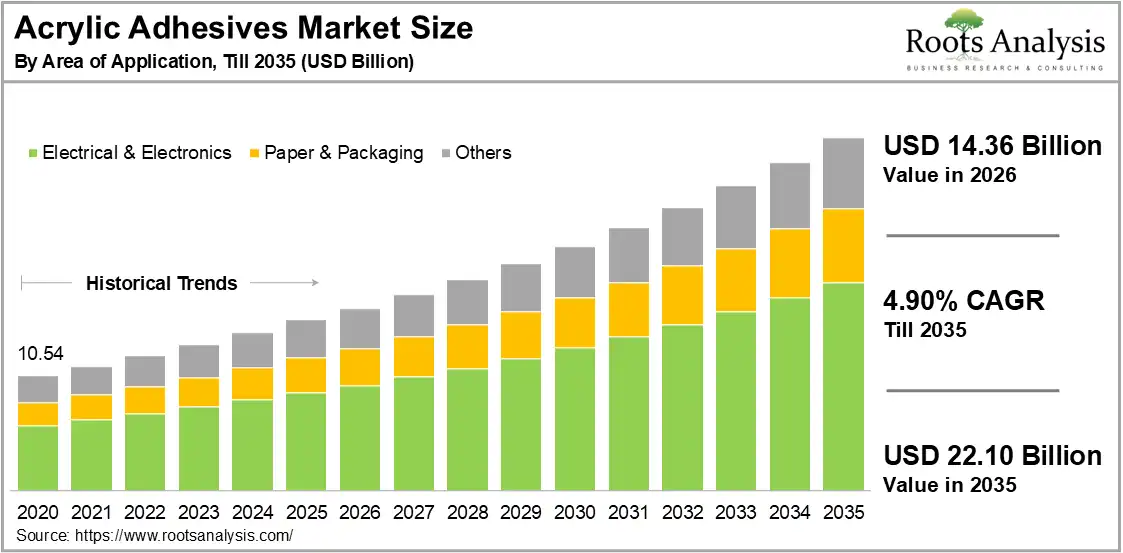
The global acrylic adhesives market, valued at USD 14.36 billion in 2026, is projected to reach USD 18.25 billion in 2030 and USD 22.10 billion by 2035, representing a CAGR of 4.90% during the forecast period.
See What’s in the Full Report - Request Your Complimentary Insights!
Market Overview
Acrylic adhesives are adhesives formulated from acrylic polymers. These adhesives are known for their versatility and wide range of applications across various industries. Acrylic adhesives offer several key properties, including high bonding strength, excellent durability, and resistance to environmental factors such as moisture, heat, and chemicals. They also typically exhibit fast curing times, enabling efficient assembly processes in manufacturing environments.
The acrylic adhesives market is experiencing significant growth, fueled by rising demand in sectors such as automotive, construction, electronics, and packaging. These adhesives are favored for their quick-curing abilities, strong bonding, and adaptability, making them a preferred choice over traditional fasteners and solvent-based options. The shift towards lightweight materials in automotive and aerospace is further driving market expansion, as acrylic adhesives enhance performance and reduce weight.
Recent Industry Developments
- In April 2025, Trinseo launched a high-performance solution (an all-acrylic latex binder), LIGOS A 9210, for flexible flooring adhesives.
- In March 2025, Thermax teamed up with OCQ for a breakthrough chemical venture which will boost Thermax and OCQ’s global presence as well as produce acrylic resins to be used in adhesives.
- In February 2025, LG Chem launched the prototype production of 100% bio-acrylic acid and intends to commercially produce it later this year. The eco-friendly raw materials are derived from vegetable oils and can be applied to various materials including electronics manufacturing adhesives and vehicles.
Pay Only for What You Need – The Best Way to Optimize
Market Share Insights
Which Type of Technology Will Dominate the Acrylic Adhesives Market?
When it comes to the acrylic adhesives products market, the water-borne acrylic adhesives segment is set to take the lead, holding a significant share of 50.21% of the market. In addition, it is also the fastest growing segments with a CAGR of 8%.
The dominance of this segment is largely a result of superior environmental credentials, cost-effectiveness, and compliance with strict regulations on volatile organic compounds (VOCs). These adhesives are widely used across industries such as construction, packaging, footwear, and consumer goods due to their strong bonding properties and ease of application
How is the Acrylic Polymer Emulsion Segment Dominating Types of Acrylic Adhesives?
Among the types of acrylic adhesives, the acrylic polymer emulsion segment really stands out as the leading segment holding a market share of 44%. In addition, it is also the fastest growing segments with a CAGR of 8.8%.
Their dominance is largely due to their eco-friendly, water-based formulations, which align well with tightening environmental regulations and the growing demand for sustainable adhesive formulations. These water-based acrylic adhesives are widely used in industries such as packaging, construction, woodworking, and textiles, making them the most prevalent choice globally.
Which Area of Application Will have the Fastest CAGR?
When it comes to the global acrylic adhesives market, the electrical & electronics segment is set to witness the fastest CAGR (8.7%) during the forecasted period. The growth can be attributed to the surging demand for electronic devices and the need for advanced high-strength bonding solutions in miniaturized and high-performance electronics.
On the other hand, it is worth highlighting that the paper & packaging segment is expected to dominate the market with a significant share of 37% during the forecasted period due to the high demand for packaging industry adhesives.
Why is Asia Leading the Acrylic Adhesives Market?
According to our acrylic adhesives market by region analysis, the Asian acrylic adhesives market exhibits dominance by capturing 49.86% of the overall current market share. This is mainly because of rising industrialization and growth in major industries like construction, automotive, and electronics in China, India and Japan.
The construction boom in India continues to drive demand for acrylic adhesives in infrastructure projects where bonding materials such as glass, metal, and wood will be extensively used. The growth of the automotive sector across Asia-Pacific has expanded applications of acrylic adhesives in lightweight bonding, further strengthening leadership in the region.
Want Information on Specific Region / Segment?
Key Market Insights
Key Market Drivers
- Sustainability and Regulatory Compliance: Rising demand for sustainable, low-VOC, and water-based adhesive solutions due to stricter environmental regulations and consumer preferences.
- Expansion in End-Use Industries: Rapid growth in sectors such as packaging, automotive, electronics, and construction, fueled by trends like e-commerce and lightweight manufacturing.
- Technological Advancements: Ongoing innovation in adhesive technologies, including bio-based acrylic polymers derived from bio-acrylic acid and advanced performance features, is driving the market to meet evolving industrial and regulatory needs.
What are the Key Factors for Acrylic Adhesives in Automotive Lightweighting?
- Material Compatibility: Bonds lightweight materials like aluminum, composites, and plastics.
- Structural Integrity: Provides high strength without the need for heavy fasteners.
- Multi-Material Design: Adheres well to dissimilar substrates for advanced vehicle designs.
- Manufacturing Efficiency: Offers fast curing and streamlined assembly processes.
- Corrosion and Impact Resistance: Enhances durability and safety of lightweight structures.
Comparison of UV-curable vs. Solvent-based Acrylic Adhesives?
UV-curable acrylic adhesives cure rapidly under UV light, enabling high-speed production and offering low VOC emissions for better environmental safety, while solvent-based acrylic adhesives require longer drying times, emit VOCs, but can perform better at higher temperatures.
What are the Best Practices for VOC-compliant Adhesive Manufacturing?
- Formulation: Use low VOC, water-based, or 100% solids adhesives to minimize solvent content.
- Application Methods: Employ high-efficiency equipment like HVLP or electrostatic spray systems to boost transfer efficiency and reduce emissions.
- Process Controls: Implement pollution prevention practices and regular equipment maintenance to limit waste and fugitive VOCs.
- Emission Controls: Install capture and add-on control systems, such as solvent recovery or thermal oxidizers, where needed.
- Compliance and Monitoring: Adhere to VOC emission limits, maintain records, and routinely monitor processes for regulatory compliance.
- Raw Material Selection: Choose additives and raw materials with low or no VOC content and prioritize biobased or biodegradable options when possible.
What is the Role of Acrylic Adhesives in Renewable Energy Projects?
Acrylic adhesives play a crucial role in renewable energy projects by providing strong, durable, and weather-resistant bonds for solar panels, wind turbines, and other components. Their fast curing and compatibility with automated processes enhance manufacturing efficiency and support lightweight, innovative designs.
What is the impact of AI on adhesive formulation optimization?
AI significantly accelerates adhesive formulation optimization by using machine learning to predict ideal ingredient combinations, reducing the need for extensive trial-and-error experiments. It enables rapid development of adhesives with tailored properties such as improved strength, durability, or environmental compliance.
What are the Key Strategies Used by Companies to Gain Acrylic Adhesives Market Share?
Acrylic adhesives companies are using smart strategies to stay ahead. Big players are focusing on acrylic adhesives market opportunities in emerging economies, partnerships, acquisitions, joint ventures, and innovations to strengthen their position while also investing in R&D to bring innovative and novel products to the market. Launching new technologies and expanding into regions where industry automation is growing are key moves helping them capture more market share.
What are the Technical Challenges in the Acrylic Adhesives Market?
The acrylic adhesives market, despite its rapid growth and potential, is facing several challenges which are acting as obstacles to the market’s growth.
- Raw Material Price Volatility: Fluctuating prices of petrochemical-based raw materials lead to unpredictable production costs and impact profit margins.
- Stringent Environmental Regulations: Increasingly strict VOC emission regulations and hazardous chemicals regulations require ongoing reformulation and compliance efforts.
- High R&D and Supply Chain Disruptions: Significant investment in research and development is needed for innovation, while global supply chain disruptions can affect material availability and timely delivery.
What are the Limitations in Raw Material Sourcing for Acrylic Adhesives?
Key challenges in raw material sourcing for acrylic adhesives include supply shortages and unpredictable delivery times due to global supply chain disruptions, logistics complications, and extreme weather events. Price volatility and rising transportation costs further strain sourcing, while dependence on finite resources and geopolitical tensions exacerbate availability issues.
Your Business is Unique – Why Shouldn’t Your Report Be?
Acrylic Adhesives Market: Scope of the Report
| Key Report Attributes | Details | |
| Historical Trend | Since 2020 | |
| Forecast Period | Till 2035 | |
| Market Size 2026 | $ 14.36 Billion | |
| Market Size 2035 | $ 22.10 Billion | |
| CAGR till 2035 | 4.90% | |
| Type of Technology |
|
|
| Type of Acrylic Adhesives |
|
|
| Area of Application |
|
|
| Type of Enterprise |
|
|
| Geographical Regions |
|
|
| Key Players Profiled |
|
|
| PowerPoint Presentation (Complimentary) | Available | |
| Customization Scope | 15% Free Customization | |
| Excel Data Packs (Complimentary) |
|
|


