


 Download Free Sample
 Buy Now
Market Size
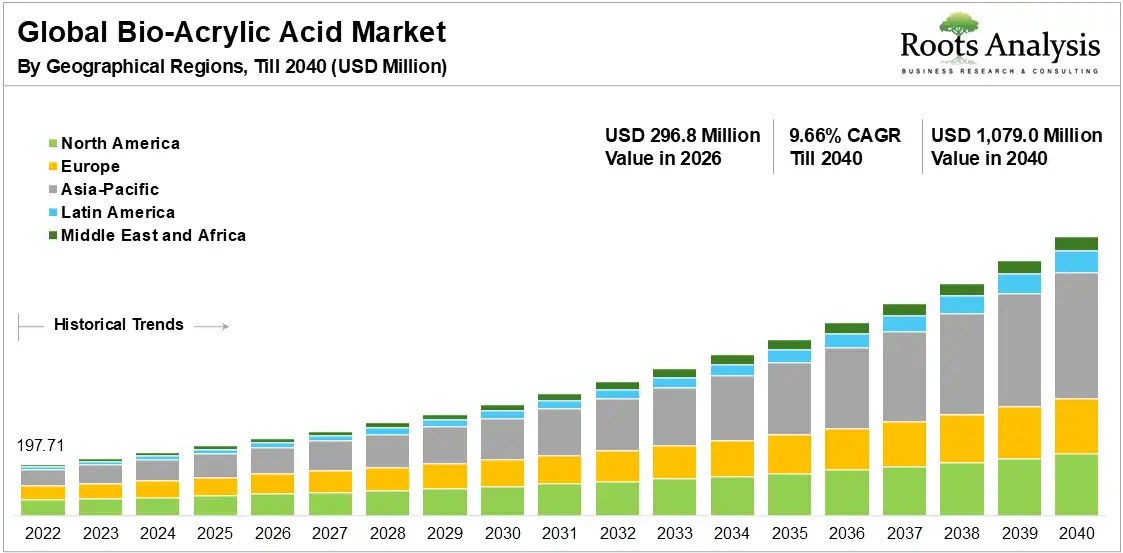
The global bio-acrylic acid market is projected to reach USD 296.8 million in 2026 and USD 1,079.0. million by 2040, representing a CAGR of 9.66% during the forecast period 2026 to 2040.
See What’s in the Full Report – Request Your Complimentary Insights!
Market Overview
Bio-acrylic acid, produced from renewable feedstocks, such as glycerol, sugars, or plant-based materials via fermentation or catalytic processes, represents a critical shift in the chemical industry toward sustainability. This bio-based variant maintains the functional properties of conventional acrylic acid (such as high reactivity, polymerization ease, and versatility while offering reduced carbon footprints) and has broad applications in superabsorbent polymers (SAPs) for diapers and hygiene products, paints and coatings for construction and automotive sectors, adhesives and sealants, surfactants, and textiles.
Market value is increasingly defined by the transition toward decarbonized supply chains, as brand owners and regulatory bodies prioritize bio-based alternatives to reduce carbon footprints for essential chemical outputs. Heightened corporate sustainability mandates and intensifying regulatory pressure to move away from fossil fuel-based chemicals are the key bio-acrylic acid market growth drivers.
The current focuses of the market players are on enhancing feedstock efficiency and optimizing catalytic conversion to achieve price parity with conventional acrylic acid. A structural pivot toward non-food-competing feedstocks, specifically lignocellulosic biomass, is enhancing both economic viability and feedstock security. The industry outlook remains positive as strategic collaborations between biotech firms and major chemical manufacturers work to elevate pilot projects to commercial-scale production levels.
Market Report: Key Takeaways
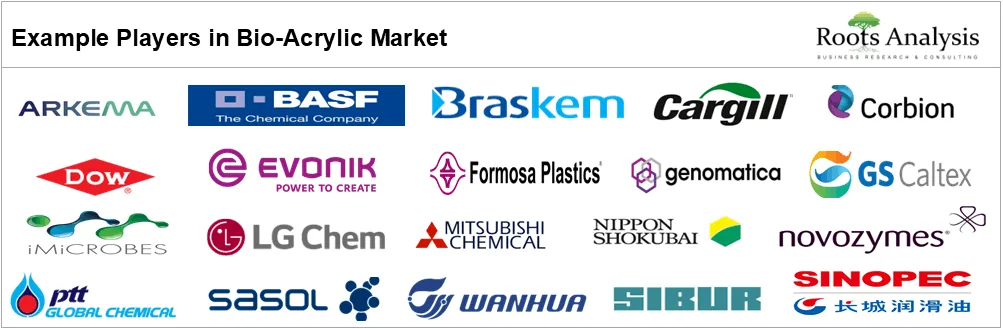
- Leading Players in Industry: Major players including LG Chem, BASF, Dow, Arkema, and Låkril Technologies are employing several initiatives, such as R&D partnerships for commercialization of bio-acrylic acid, strategic capacity expansions, corporate sustainability initiatives, and long-term supply agreements.
- Startup Ecosystem: Startups are transforming the market by introducing proprietary catalysts and raw materials that significantly improve production efficiency and sustainability. Låkril Technologies (US) focuses on lactic acid dehydration, raising USD 7M total by 2025 for kilogram-scale production. Kemvera (formerly New Iridium) advances bio-acetic acid as a precursor. Others like Jord BioScience integrate microbial tech, raising USD 16.4 Mn.
- Core Growth Drivers: Expansion of green chemistry policies, corporate sustainability mandates from consumer package goods giants, and technological innovations are the key bio-acrylic acid market growth drivers.
- End User Analysis: The personal care & hygiene sector stands as the primary anchor of the market, holding 76.4% market share in 2026. While this segment remains the volume leader due to the deep integration of bio-based superabsorbent polymers (SAP) and the premiumization of hygiene products, its market share is projected to moderate to 72.5% by 2040.
- Partnerships and Collaborations: The bio-acrylic acid market is a collaborative ecosystem where biotechnology firms, chemical giants, and research entities are actively initiating partnerships. BASF with Sinopec for bio-integration, LG Chem with GS Caltex for 3HP, Evonik with biotech firms for Antwerp expansion, and P&G with Cargill for commercialization are some of the latest examples of collaborations in the industry. These partnerships are primarily focused on scaling production and expanding footprint globally.
- Regional Dynamics: The geographical dynamics of the bio-acrylic acid market is shifting toward regions that offer a combination of feedstock abundance and supportive regulatory frameworks. While Europe is the global hub for sustainable innovation, driven by the EU Green Deal and the Circular Bio-based Europe Joint Undertaking (CBE JU), Asia-Pacific is expected to grow at a higher CAGR.
- Funding and Investment Momentum: Venture capital and strategic corporate funding are flowing into the bio-acrylic acid space as a means of securing future-ready supply chains.
- Future Opportunities: Increasing adoption of bio-based monomers in paints, coatings, and SAPs, with companies like Arkema and BASF emphasizing certified bio-content for low-VOC products. Bio-acrylic derivatives are differentiating in personal care and high-end coatings. Shift to microbial fermentation and catalytic dehydration, with triple-digit capacity growth forecasted. Waterborne and low-emission alternatives are rising due to regulations.
Pay Only for What You Need – The Best Way to Optimize
Recent Industry Development
- January 2026: Låkril Technologies announced the successful startup of its first continuous pilot plant for bio-based acrylic acid production. This facility transitioned their proprietary catalytic dehydration process from batch-scale to kilogram-scale production.
- October 2025: Chemify raised USD 50 million in Series B funding round to scale up its proprietary bio-based acrylic acid manufacturing process, targeting applications in paints, adhesives, and coatings.
- September 2025: Industrial Microbes (iMicrobes) achieved commercial-scale production of 100 percent bio-based acrylic acid.
Market Dynamics
Key Market Drivers
- Corporate Sustainability Mandates from CPG Giants: Based on the global bio-acrylic acid market outlook, major consumer packaged goods (CPG) companies are increasingly committing to ambitious decarbonization targets and require bio-based inputs to achieve them. This top-down pressure on their value chain, particularly for high-volume products like diapers and hygiene items, drives demand for bio-acrylic acid as a feedstock for superabsorbent polymers (SAPs).
- Expansion of Green Chemistry Policies and Carbon Taxes: Regulatory bodies, particularly in Europe and North America, are implementing stringent policies like carbon border adjustments and extended producer responsibility schemes. These regulations increase the cost burden on fossil-fuel-derived products, creating a competitive advantage for bio-based alternatives by internalizing the environmental cost of conventional manufacturing processes.
- Advancements in Fermentation and Dehydration Technologies: Recent technological breakthroughs have significantly improved the yield and purity of bio-acrylic acid processes, particularly in fermentation processes for bio-based monomers and subsequent dehydration steps. This evolution reduces production costs and enhances product quality, making bio-acrylic acid a commercially viable drop-in replacement for specific high-volume applications like SAP manufacturing.
- Growing Consumer Demand for Sustainable Products: Our recent bio-acrylic acid industry research report highlights that consumer preference in developed markets shows a clear shift toward products with verifiable sustainability claims and bio-based content. Brands are increasingly leveraging third-party certifications (e.g., USDA BioPreferred) to justify a green premium for products containing bio-acrylic acid, driving adoption in premium segments of the hygiene and coatings markets.
Market Restraints
- Economic Resilience Against Fluctuating Crude Oil Prices: According to the bio-based feedstock sources and cost analysis, achieving long-term price parity remains a significant hurdle, as the economic viability of bio-acrylic acid is heavily sensitive to the cost of traditional propylene. A sharp decline in energy prices can eliminate the justification for a "green premium," undermining the investment cases required for ongoing operational profitability.
- Complexity of Fragmented Global Regulatory Frameworks: The absence of harmonized global standards for bio-based claims and environmental impact assessment of bio-acrylic acid creates a complex landscape of conflicting regional mandates and industry certifications. Navigating this fragmentation increases the administrative burden for multinational corporations and complicates the deployment of standardized, global bio-based product lines.
- Consistency Challenges in High-Purity Refinement: For high-end industrial applications, maintaining consistent purity levels from fermentation-based processes is a critical technical challenge. Eliminating trace impurities that affect polymerization and end-product aesthetics requires continuous R&D investment and process optimization to ensure industrial-grade reliability.
- Operational Obstacles in Biomass Sourcing and Logistics: Unlike the highly optimized petroleum value chain, bio-acrylic acid production depends on decentralized and often seasonal feedstock supplies. Developing the infrastructure for the reliable collection and transport of renewable biomass presents significant operational hurdles that differ fundamentally from established chemical logistics.
Get an Instant Quote in 10 Minutes. Lowest Price Guaranteed
Market Share Insights
Sanitary Products Dominate the Current Industry
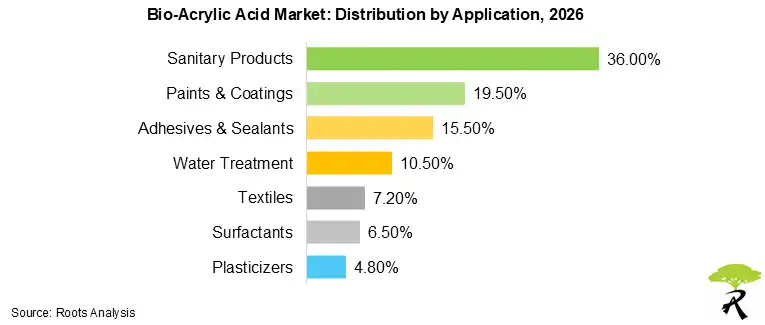
- Based on the bio-acrylic market share analysis by application, sanitary products currently hold the highest share (36.0%) of the market. This leadership is sustained by tightening ESG mandates in the hygiene sector, transition to bio-based superabsorbent polymers (SAPs) to manufacture compostable diapers, and circularity in adult incontinence products.
- While sanitary products remain the volume leader, surfactants represent the fastest-growing sub-segment with an expected 11.2% CAGR. This unprecedented growth is driven by clean label household trends and the expansion of bio-based fatty acid acrylate derivatives.
- The paints & coatings application is projected to reach a 21.0% share by 2040 as industrial resins decarbonize and OEMs adopt green-tiering strategies. This transition was notably catalyzed in May 2025 by the European Commission’s Packaging and Packaging Waste Regulation (PPWR) milestones, which triggered a surge in strategic investments for bio-acrylic acid applications in coatings and adhesives.
- Conversely, water treatment, textiles, and plasticizers are projected to experience relative share losses to 7.0%, 4.5%, and 2.2% respectively, as these price-sensitive value chains face higher adoption barriers and competition from recycled fossil alternatives or bio-polyesters.
Regional Insight: Europe Dominates the Bio-Acrylic Acid Industry
According to the bio-acrylic acid market share analysis, Europe currently holds the highest market share at an estimated 34.0%. Europe’s leadership is anchored in a mature SAP manufacturing infrastructure and robust regulatory tailwinds, such as the February 2025 update to the EU’s Ecodesign for Sustainable Products Regulation (ESPR) and high carbon pricing via CBAM.
In order to meet regulatory compliance and sustainable sourcing, major brands in European region are transitioning 15-20% of product lines to sustainable formulations. In addition, the increasing adoption in polymer production, rising demand for bio-acrylic acid in detergent powders and liquid cleaning agents are driving the market growth in this region.
Asia-Pacific Region Expected to be the Fastest Growing Region
Asia-Pacific region is expected to capture 32.0% of the market by 2040, projected to be the fastest-growing sub-segment with an estimated CAGR of 11.9%. This growth is fueled by a strategic surplus of crude glycerine feedstock and the January 2025 expansion of the China National Bio-based Materials Initiative, which allocated USD 2.2B in subsidies to bolster bio-monomer capacity.
Based on the global bio-acrylic acid capacity expansion projects and pipeline analysis, the key companies, such as BASF, LG Chem, and GS Caltex are expanding their production facilities in Asian countries. For instance, BASF's Zhanjiang complex, and LG Chem and GS Caltex demonstration plant in Yeosu, South Korea. China is particularly important as a manufacturing hub, which is likely to capture the attention of market players in the future.
Want Information on Specific Region / Segment?
Market Ecosystem Insights
Bio-Acrylic Acid Competitive Landscape
The bio-acrylic acid market is highly competitive, presenting compelling investment opportunities to market platers. These lucrative opportunities are characterized by strong regulatory guidelines, technological maturation, and growing corporate commitments with 60% of major producers setting verified bio-based integration targets. Competitive advantage is increasingly defined by the ability to integrate vertically and master green technologies.
Sustainable chemical industry insights also highlight that the leading players are undertaking several initiatives to strengthen their market position.
- BASF: The company is leveraging biomass-balance approach for bio-based ethyl acrylate, focusing on waterborne coatings.
- Arkema: This company holds specialization in high-performance biopolymers. Recently, Arkema announced the construction of a new Rilsan® clear transparent polyamide unit in Singapore to produce bio-based acrylic thickeners for coatings and increase production capacity by 50%.
- Dow Chemical: The company is investing in bio-based feedstock diversification and sustainable adhesives.
Bio-Acrylic Industry Trends and Market Opportunities
- Strategic Expansion in Sustainable Superabsorbent Polymers (SAPs): The hygiene sector, specifically SAPs used in diapers and adult care represents the primary growth engine for bio-acrylic acid. As CPG leaders transition toward renewable portfolios, bio-based intermediates offer a high-value opportunity to secure a dominant share of the high-volume SAP market through certified sustainable product differentiation.
- Transition Toward Second-Generation Feedstock Diversification: Future market expansion is increasingly tied to the utilization of non-food biomass, such as lignocellulosic waste, agricultural residues, or glycerol byproducts. Transitioning to these cost-effective, second-generation feedstocks improves the life-cycle assessment (LCA) profile of bio-acrylic acid and decouples production from food security concerns.
- Diversification into Bio-Based Acrylate Ester Derivatives: Beyond base acrylic acid, there is substantial potential for bio-based esters like butyl and methyl acrylate. These derivatives are essential for high-performance coatings, sealants, and adhesives, allowing bio-based producers to capture value in specialized industrial segments like construction and automotive.
- Early-Mover Advantage in Emerging Regional Markets: While adoption has been led by Western markets, emerging economies are rapidly implementing local environmental standards and industrial greening initiatives. Establishing a manufacturing footprint in high-growth regions like Southeast Asia enables producers to capitalize on evolving regional compliance frameworks and meet the rising demand for sustainable infrastructure materials.
Your Business is Unique – Why Shouldn’t Your Report Be?
Bio-Acrylic Acid Market: Scope of the Report
| Key Report Attributes | Details | |
| Historical Trend | Since 2022 | |
| Forecast Period | Till 2040 | |
| Market Size 2026 | $ 296.8 Million | |
| Market Size 2040 | $ 1079.0 Million | |
| CAGR (Till 2040) | 9.66% | |
| Segments Covered |
|
|
Market Segmentation
Based on the research, we have segmented the bio-acrylic acid market into type of derivative product, type of raw material, type of technology, application, type of feedstock, end use industry, geographical regions, and key players.
Market Share by Type of Derivative Product
- Methyl Acrylate
- Butyl Acrylate
- Ethyl Acrylate
- 2-Ethylhexyl Acrylate
- Glacial Acrylic Acid
- Super Absorbent Polymers
Market Share by Type of Raw Material
- Acrylonitrile
- Propylene
- Acrylic Acid
Market Share by Type of Technology
- Liquid Phase Oxidation
- Gas Phase Oxidation
Market Share by Application
- Sanitary Products
- Adhesives & Sealants
- Paints & Coatings
- Water Treatment
- Textiles
- Surfactants
- Plasticizers
Market Share by Type of Feedstock
- Bio-based Glycerol
- Bio-based Propylene
- Bio-based Sugars / Carbohydrates
Market Share by End Use Industry
- Personal Care & Hygiene
- Construction
- Automotive
- Water Management
Market Share by Geographical Regions
- North America
- US
- Canada
- Mexico
- Rest of North America
- Europe
- Austria
- Belgium
- Denmark
- France
- Germany
- Ireland
- Italy
- Netherlands
- Norway
- Russia
- Spain
- Sweden
- Switzerland
- UK
- Rest of Europe
- Asia-Pacific
- Australia
- China
- India
- Japan
- New Zealand
- Singapore
- South Korea
- Rest of Asia-Pacific
- Latin America
- Brazil
- Chile
- Colombia
- Venezuela
- Rest of Latin America
- Middle East and Africa (MEA)
- Egypt
- Iran
- Iraq
- Israel
- Kuwait
- Saudi Arabia
- UAE
- Rest of MEA


