
Lowest Price Guaranteed
Slides
179
Last Updated
August 2026
View Count
10996
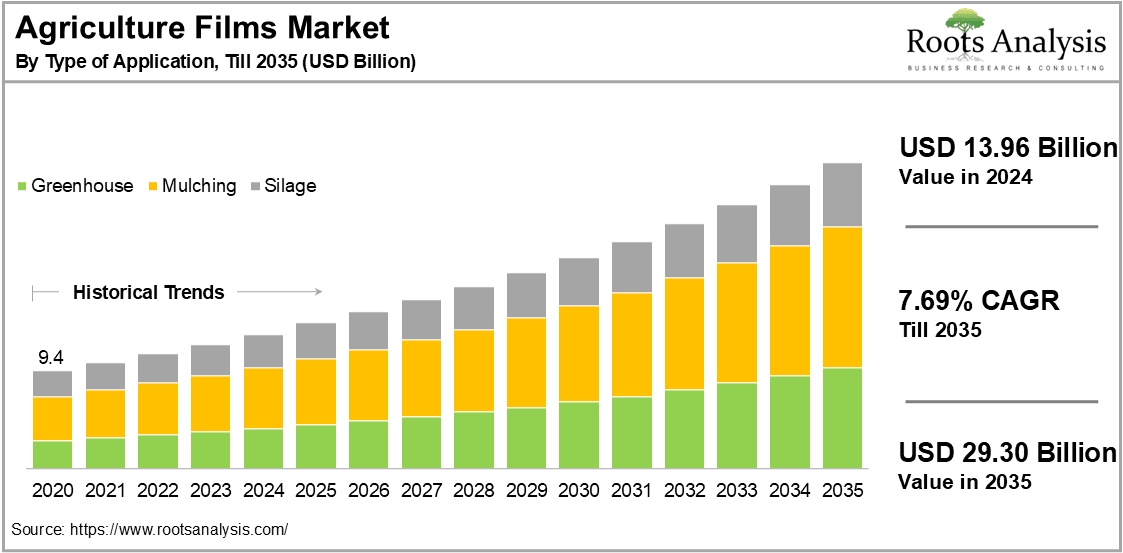
The global agriculture films market size is projected to grow from USD 13.96 billion in 2025 to USD 29.30 billion by 2035, representing a CAGR of 7.69%, during the forecast period till 2035.
 |
To learn more about this report, request a free sample copy
The new research study consists of agricultural films industry analysis, detailed market forecast analysis, and providing actionable strategic recommendations.
According to the US Department of Agriculture about 90% of crop losses are related to weather factors, such as temperature and moisture. To overcome the losses, agriculture films have emerged as viable solution. Thin sheets of agricultural plastic films coupled with advanced functionalities such as temperature and moisture control, have played a pivotal role in the growth of the market. These low-density polyethylene sheets are used to protect crops from diseases and pests.
The biodegradable agricultural films are designed to be tilled into the soil after use, marking an advancement in sustainable farming practices. It is worth highlighting that agriculture films are favored for their enhanced precision, modular design, advanced crop protection solutions that consist of UV rays filtering and anti-fog systems. These feature the ability of providing plants with healthy sunlight and better vision for farmers in low-temperature areas. Further, agricultural films market trends are fueled by rising demand in organic food and crops.
The global agriculture films demand is expected to grow significantly over the forecast period due to the rapid population growth in emerging economies, like China and India. Additionally, agricultural film applications are used to overcome the impact of climate change on agriculture by minimizing the temperature. One of the agriculture films innovations and advancements include development of agricultural films for soil moisture retention, which allows for healthy growth and improved crop yield. This has become pivotal in the future of agriculture films in modern farming components that offers creation of microclimate ideal for greenhouse plants’ growth. Additionally, agricultural film innovations, such as vertical farming and agricultural films with thermic effects are driving the market growth.
Recently, Sobkowicz-Kline, Principal Investigator at UMass Lowell Plastic Engineering mentioned that as the climate changes, more droughts occur. Therefore, retaining soil moisture is increasingly important, especially in arid areas, agriculture films will help to address these aspects of environmental sustainability.
The global agriculture films market research report presents an in-depth analysis of the various companies that are involved in offering agriculture films, across different segments, as defined in the table below:
| Key Report Attributes | Details | |
| Historical Trend | Since 2020 | |
| Forecast Period | Till 2035 | |
| Current Market Size | $ 13.96 Billion | |
| Market Size Value by 2035 | $ 29.30 Billion | |
| CAGR (Till 2035) | 7.69% | |
| Type of Material |
|
|
| Type of Application |
|
|
| Type of Functionality |
|
|
| Type of Thickness |
|
|
| Geographical Regions |
|
|
| Leading Market Players | ||
| PowerPoint Presentation (Complimentary) |
Available | |
| Customization Scope | 15% Free Customization | |
| Excel Data Packs (Complimentary) |
|
|
Based on the type of material, the global agriculture films market is split into EVA/EBA, HDPE, LDPE, LLDPE and reclaims. Currently, according to our analysis, the linear low-density polyethylene (LLDPE) is augmenting the segment's growth with over 40% market share. Further, this segment is also expected to grow with a relatively higher (8.37%) CAGR in the near future. This can be attributed to its easy availability, inexpensiveness, durability and exceptional impact resistance.
On the basis of the type of agriculture film applications, the agriculture films market is bifurcated into greenhouse, mulching and silage. The mulch film market is anticipated to dominate the segment with more than 45% of market share in 2025. This can be attributed to its mulch film benefits of working as a versatile tool, such as propagation of weeds, enhancing soil temperature and preventing moisture loss making it ideal for improving crop yield.
On the other hand, the greenhouse films segment is expected to witness a relatively faster (8.88%) agricultural films market growth rate by 2035. This can be attributed to rapidly growing demand for organic crops and its capability of regulating temperature and humidity as well as pests and diseases.
Further, the ability of creating a microclimate is boosting greenhouse films market trends.
Based on the type of functionality, the global agriculture films market is split into anti-fog films, thermal films and UV protection films. Currently, according to our analysis UV protection films is augmenting the segment's growth with over 40% of the market share. This can be attributed to its ability to filter UV rays from the sunlight and allows crops to nurture with healthy sunlight.
Further, the anti-fog film segment is expected to grow with a relatively higher (7.94%) CAGR in the near future due to their capability of preventing condensation from forming and helping in better visibility.
On the basis of the type of thickness, the agriculture films market is bifurcated into medium films, thick films and thin films. The thick film segment is anticipated to dominate the segment with more than 50% of market share in 2025. Additionally, this segment is expected to witness a relatively faster agriculture films market growth rate (8.32%) until 2035. This can be ascribed to their ability to be easily recycled and minimizing pollution.
This segment highlights the distribution of the agriculture films market across various geographical regions such as North America, Europe, Asia, Latin America, Middle East, North Africa, and the rest of the world. According to our market analysis of agricultural films, Asia exhibits dominance in the market with over 45% of the agriculture films market share in the global marketplace. This can be attributed to its high population that demands more food. Additionally, government initiatives for promoting agricultural techniques and rapid awareness of organic agriculture are other growth drivers.
However, North America is also projected to grow with a relatively higher CAGR (8.64%) in the forecasted period. Primary reasons for this growth include development of advanced biodegradable and durable films. Moreover, surging demand for greenhouse crops have played a pivotal role in growth of agriculture films in the region.
The “Agriculture Films Market, Till-2035: Industry Trends and Global Forecasts” report features an extensive study of the current market landscape, market size and future opportunity within agriculture films market, during the given forecast period. The market report highlights the efforts of several stakeholders involved in this rapidly emerging segment of the service providers industry. Key takeaways of the global agricultural films market report are briefly discussed below.
An increasing demand for organic crops and greenhouse agricultural techniques is majorly driving the agriculture films industry. Further, rising adoption of covering crops for better outcomes, specifically, increasing crop yield is one of the major key drivers of the domain. Moreover, features provided by agriculture films, such as controlling temperature and moisture, propagating weeds and exceptional impact resistance are playing pivotal role in growth of the market. Further, advanced features, such as UV rays filtering and anti-fog systems have further propelled market growth.
With the presence of several small and large agriculture films companies, the market is experiencing intense competition and changing market dynamics. From large multinational companies to local agriculture films players, companies are striving to enhance their competitive edge. In terms of market share, large enterprises and multinational companies are dominating the market. While small agriculture films players are continuously improving their products to cater to niche markets, or they are offering specialized services. These industry players are focusing on adopting competitive strategies, such as developing innovative solution techniques, forming strategic alliances and partnerships to expand their portfolios and global footprint, investing in recent developments and new feature launches to enhance their agriculture films offerings.
Despite strong market growth projection, the agriculture films market faces numerous challenges. The most common challenge is dynamic costs of raw materials are increasing production costs of agriculture films. Further, the ban of use of plastic products has affected market and led to inconsistent product availability.
Asia currently holds a substantial share of approximately 45% in the agriculture films market opportunities. This dominance can be attributed to several factors, including adoption of precision farming practices, supportive government regulations and awareness of organic agricultural techniques. Further, the presence of major players, including Sumitomo chemicals, enhances the region's market position through innovation and competition. Notably, substantial investments in research and development, leading to the creation of superior film materials is one of the major governing reasons for growth in agricultural film demand in this region. Additionally, large population has demanded large production of food, to achieve this Asians are using agricultural films to increase crop yield.
Examples of key player involved in the agriculture films market (which have also been captured in this market report, arranged in alphabetical order) include Armando Alvarez, Barbier, BASF, Berry Global, Coveris, Dow, Exxon Mobil, Geminor, Kuraray, Novamont, Plastika Kritis, Rani, RKW, Sigma Plastics and Trioworld. This market report includes an easily searchable excel database of all the companies who have adopted the agriculture films market.
The market report presents an in-depth analysis, highlighting the capabilities of various companies engaged in this domain, across different segments. Amongst other elements, the market report includes:
At Roots Analysis, we genuinely care about your success and understand that your business requirements are unique. While our market research reports provide valuable insights, we recognize that they might not cover every aspect you need to make well-informed strategic decisions. To account for that, we offer 15% free report customization tailored to your specific needs. Whether you require additional quantitative analysis, qualitative insights, or any other information related to the agriculture films market, reach out us today at: support@rootsanalysis.com