
Lowest Price Guaranteed
Slides
217
Last Updated
May 2026
View Count
12576
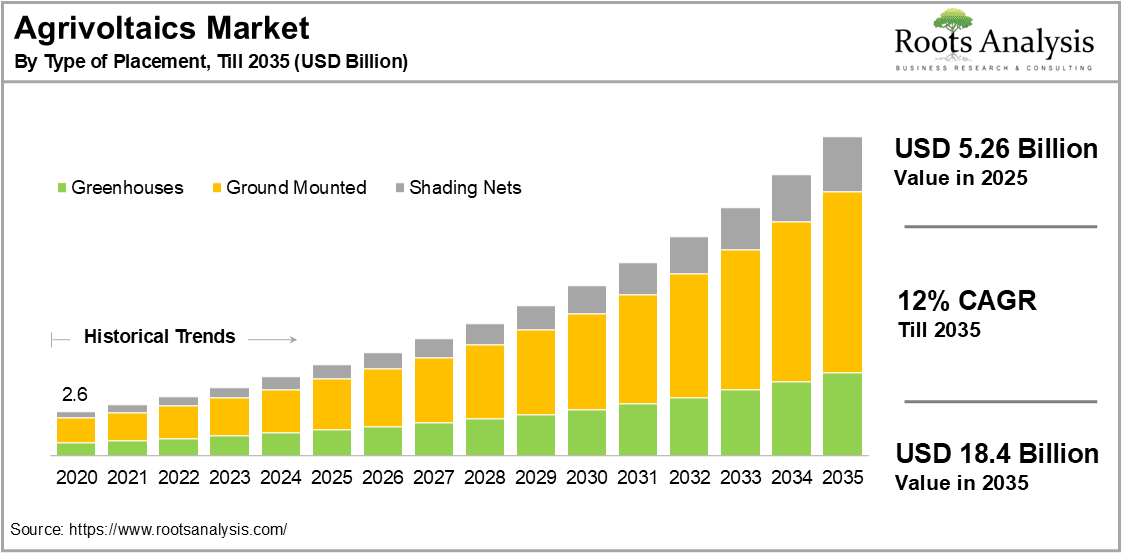
The global agrivoltaics market, valued at USD 4.56 billion in 2024, is projected to reach USD 5.26 billion in 2025 and USD 18.4 billion by 2035, representing a CAGR of 12% during the forecast period.
 |
The new research study consists of agrivoltaics industry analysis, detailed market forecast analysis and providing actionable strategic recommendations.
Agrivoltaics, also known as agrophotovoltaics, or dual-use solar, is the simultaneous use of land for both solar energy production and agricultural activities. This innovative approach integrates solar panels with farming, offering a sustainable solution for energy production and agriculture. Notably, the advantages of agrivoltaics include enhancing crop yields, protecting crops and animals from harsh conditions, and diversify income streams for farmers.
The ability to generate solar power while maintaining agricultural productivity is a major driver for the increased adoption of agrivoltaics systems. Furthermore, agrivoltaics can help farmers meet their energy demands, reducing dependence on unreliable grid power. Therefore, the global agrivoltaics market is expected to grow significantly over the next decade.
Agrivoltaics in the farming industry are increasingly vital, particularly for detecting and locating objects underwater. Some of the advancements in agrivoltaics technology include innovative designs, such as solar greenhouses and photovoltaic modules installed between crop rows. Notably, data analytics and IoT integration are also playing a significant role, with sensors and IoT devices collecting real-time data on crop health, microclimate, and energy production and transforming this data into actionable insights for farmers. Additionally, innovations in solar panel design are yielding more efficient and durable PV panels optimized for agrivoltaics, allowing for optimized light transmission and shading to minimize impacts on crop yields.
The agrivoltaics market research report presents an in-depth analysis of the various companies that are involved in offering agrivoltaics , across different segments, as defined in the table below:
| Key Report Attributes | Details | |
| Historical Trend | Since 2020 | |
| Forecast Period | Till 2035 | |
| Current Market Size | $ 5.26 Billion | |
| Market Size Value by 2035 | $ 18.4 Billion | |
| CAGR (Till 2035) | 12% | |
| Type of System Design |
|
|
| Type of Technology |
|
|
| Type of Crop |
|
|
| Type of Placement |
|
|
| Type of Application |
|
|
| Geographical Regions |
|
|
| Leading Market Players |
|
|
| PowerPoint Presentation (Complimentary) |
Available | |
| Customization Scope | 15% Free Customization | |
| Excel Data Packs (Complimentary) |
|
|
Based on the type of system design, the global agrivoltaics market is split into dynamic panel and fixed panel. According to our analysis the dynamic panel segment will augment the segment's growth with over 70% of the agrivoltaics market share during this forecast period. This can be attributed to their ability to optimize both solar energy generation and crop yields by adjusting to track the sun, maximizing sunlight exposure for crops.
However, the fixed panel segment is expected to grow with a relatively higher (13.34%) CAGR in the near future. This can be ascribed to their suitability for permanent installations, are weather-resilient, require little maintenance, and are cost-effective.
On the basis of the type of technology, the agrivoltaics market is bifurcated into bifacial solar panels, monofacial solar panels and translucent photovoltaics. The monofacial solar panels segment is anticipated to dominate the segment with more than 45% of agrivoltaics market size in 2025. Further, this segment is expected to witness a relatively faster agrivoltaics market growth rate of (13.87%) until 2035. This can be ascribed to their cost-effectiveness and reliable solution for integrating solar energy into agricultural settings.
The market is fragmented into multiple types of crop namely fruits, root crops, vegetables and other crops. Currently, the root crops segment is anticipated to dominate the segment with 45.34% of the market share of agrivoltaics. Further, this segment is expected to witness a relatively higher (14.78%) growth rate until 2035. This is largely due to their ability to thrive in the partially shaded environment created by solar panels. Their underground growth reduces the need for direct sunlight and benefits from the soil's temperature-regulating properties, protecting them from overheating.
The market is fragmented into type of placement namely greenhouses, ground mounted and shading nets. Currently, the ground mounted segment is anticipated to dominate the segment with 55.24% of the market share. Further, this segment is expected to witness a relatively higher (13.38%) growth rate until 2035. This is ascribable to their suitability for locations with ample open space and low sun exposure, where agrivoltaics systems may not be feasible. Ground-mounted systems also offer greater flexibility in orientation and tilt, allowing for optimized energy production.
The market is fragmented into type of application namely grassland farming, horticulture and arable farming, indoor farming and pollinator habitat. Currently, the pollinator habitat segment is anticipated to dominate the segment with 45.24% of the market share. Further, this segment is expected to witness a relatively higher (13.98%) growth rate until 2035. This can be attributed to increased awareness of pollinator decline, the enhanced sustainability and ecological benefits they bring to solar energy projects, and their relatively lower costs compared to other applications of agrivoltaics in sustainable farming.
This segment highlights the distribution of the agrivoltaics market across various geographical regions such as North America, Europe, Asia, Latin America, Middle East, North Africa, and the rest of the world. According to our agrivoltaics market analysis, North America exhibits dominance in the market with over 35% of the agrivoltaics market share in the global marketplace. However, Asia is projected to grow with a relatively higher CAGR of 14.24% in the forecasted period. Primary reasons for this fastest pace growth are rising climate change awareness, the need for sustainable agricultural practices, and government initiatives supporting renewable energy.
The “Agrivoltaics Market, Till-2035: Industry Trends and Global Forecasts” report features an extensive study of the current market landscape, market size and future opportunity within agrivoltaics market, during the given forecast period. The market report highlights the efforts of several stakeholders involved in this rapidly emerging segment of the service providers industry. Key takeaways of the global agrivoltaics market report are briefly discussed below.
The agrivoltaics market is driven by various drivers including government support and initiatives promoting benefits of dual-use land for agriculture and solar energy, growing awareness of climate change. Notably, other driving factors include the need for sustainable agricultural practices, and technological advancements in solar panel design and energy storage systems. Moreover, the need for land use optimization, coupled with socio-economic opportunities for farmers to generate additional income, further propels the market's expansion.
With the presence of several small and large agrivoltaics companies, the market is experiencing intense competition and changing dynamics. From large multinational companies to agrivoltaics players, companies are striving to enhance their competitive edge. In terms of market share, large enterprises and multinational companies are dominating the market. While small agrivoltaics players are continuously improving their products to cater to niche markets, or they are offering specialized services. These industry players are focusing on adopting competitive strategies, such as developing innovative solution techniques, forming strategic alliances and partnerships to expand their portfolios and global footprint, investing in recent developments and new feature launches to enhance their agrivoltaics offerings.
Despite strong market growth projection, the market share of agrivoltaics market faces numerous challenges. The most common challenges include the absence of a clear, harmonized definition of agrivoltaics, which complicates policy frameworks. Additionally, high initial capital costs for elevated solar panel installations and the necessity for potentially expensive ongoing maintenance can be a financial disincentive. Moreover, Complex operational requirements also translate to higher labor expenses, as agrivoltaics demands technical expertise that may exceed the competence of most farmers.
North America currently holds a substantial share of approximately 35% in the agrivoltaics market opportunities. This dominance can be attributed to combination of factors including strong government support and incentives for renewable energy, technological advancements in both agriculture and solar technologies. Further, North America's strong research commitment to sustainability and climate change mitigation, decreasing availability of arable land, and the potential for increased revenue streams for farmers without disrupting agricultural production.
Examples of key player involved in the agrivoltaics market (which have also been captured in this market report, arranged in alphabetical order) include Agrivoltaic Solution, BayWa, Chint New Energy Technology, Enel Green Power, Insolight, JA Solar Holdings, Mackin Energy, Mirai Solar, Next2Sun, Ombrea, REM TEC, SunAgri and Suntech Power. This market report includes an easily searchable excel database of all the companies who have adopted the agrivoltaics market.
The market report presents an in-depth analysis, highlighting the capabilities of various companies engaged in this domain, across different segments. Amongst other elements, the market report includes:
At Roots Analysis, we genuinely care about your success and understand that your business requirements are unique. While our market research reports provide valuable insights, we recognize that they might not cover every aspect you need to make well-informed strategic decisions. To account for that, we offer 15% free report customization tailored to your specific needs. Whether you require additional quantitative analysis, qualitative insights, or any other information related to the agrivoltaics market, reach out us today at: support@rootsanalysis.com