
Lowest Price Guaranteed
Slides
214
Last Updated
May 2026
View Count
11829
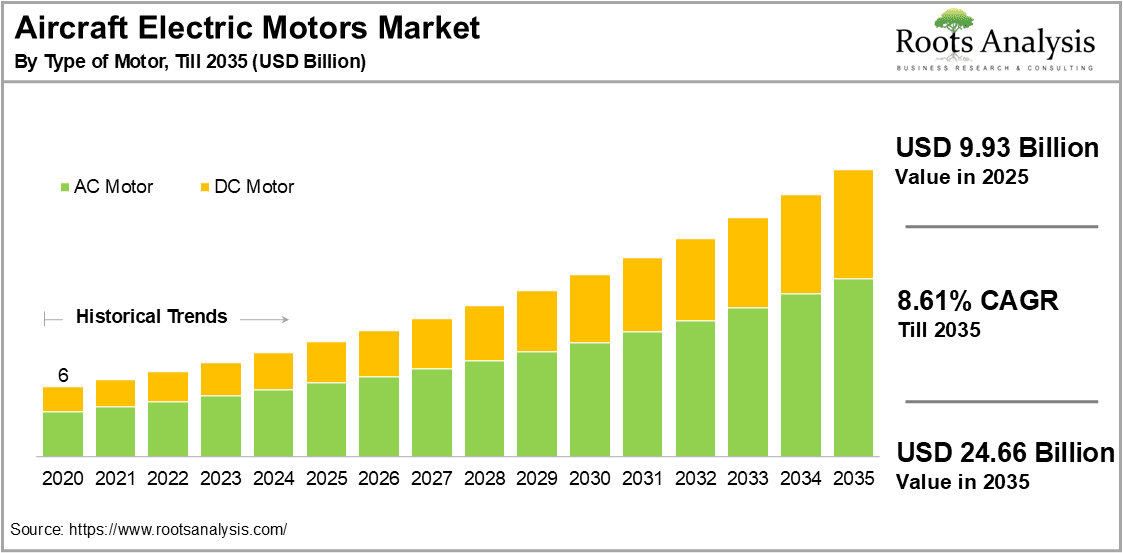
The aircraft electric motors market size is projected to grow from USD 9.93 billion in 2025 to USD 24.66 billion by 2035, representing a CAGR of 8.61%, during the forecast period till 2035.
 |
The new research study consists of aircraft electric motors industry analysis, detailed market forecast analysis and provides actionable strategic recommendations.
Aircraft electric motors represent a significant advancement in aviation technology, defined as motors powered by electricity, typically sourced from batteries. These motors utilize electromagnetic forces to convert electrical energy into mechanical energy, driving various components or providing thrust for flight. Notably, advantages of aircraft electric motors include as they offer higher efficiency of electric propulsion systems, with electric drivetrains achieving over 90% efficiency compared to traditional combustion engines, which range from 35% to 55% efficiency.
Electric motors improve reliability and safety, making them suitable for various applications, including hybrid systems that optimize performance. Therefore, the global aircraft electric motors market is expected to grow significantly over the forecast period. Further, Asia is expected to grow with rapid pace owing to rapid industrialization, increasing demand for renewable energy sources, and government initiatives promoting sustainable aviation sector.
Electric propulsion systems in aviation industry are becoming increasingly vital, particularly as the sector moves towards sustainable and efficient flight solutions. Some of the aircraft electric motors product innovations and advancements include lower carbon emissions, reduced noise levels, and improved operational efficiency compared to conventional jet fuel engines. Notably, innovations in distributed propulsion allow for the strategic placement of multiple smaller motors across an aircraft's wings or fuselage, enhancing energy efficiency and performance during flight. Additionally, as electric propulsion systems evolve, they promise to revolutionize air travel, paving the way for a future with zero emissions commercial flights.
The aircraft electric motors market research report presents an in-depth analysis of the various companies that are involved in offering aircraft electric motors , across different segments, as defined in the table below:
| Key Report Attributes | Details | |
| Historical Trend | Since 2020 | |
| Forecast Period | Till 2035 | |
| Current Market Size | $ 9.93 Billion | |
| Market Size Value by 2035 | $ 24.66 Billion | |
| CAGR (Till 2035) | 8.61% | |
| Type of Motor |
|
|
| Type of Aircraft |
|
|
| Type of Output Power |
|
|
| Type of Application |
|
|
| Geographical Regions |
|
|
| Leading Market Players |
|
|
| PowerPoint Presentation (Complimentary) |
Available | |
| Customization Scope | 15% Free Customization | |
| Excel Data Packs (Complimentary) |
|
|
Based on the type of motor, the global aircraft electric motors market is split into AC motor and DC motor. According to our analysis the AC motor segment will augment the segment's growth with over 65% of the aircraft electric motors market share during this forecast period. This can be attributed to their efficiency, reliability, and scalability, which are essential for various aviation applications.
However, DC motor segment is expected to grow with a relatively higher (9.34%) CAGR in the near future. This can be ascribed to their suitability for emerging demand for electric aircraft technologies, where lightweight materials for electric aircraft are critical.
On the basis of the type of aircraft, the aircraft electric motors market is bifurcated into advanced air mobility, fixed wing, rotary wing and unmanned aerial vehicles. The unmanned aerial vehicles segment is anticipated to dominate the segment with more than 35% of aircraft electric motors market size in 2025. This can be attributed to their rapid adoption across diverse applications such as logistics, agriculture, surveillance, and emergency services.
However, advanced air mobility segment is expected to witness a relatively faster aircraft electric motors market growth rate of (9.87%) until 2035. This can be ascribed to the increasing demand for sustainable and efficient urban transportation solutions.
The market is fragmented into multiple types of output power namely 10-200 kW, above 200 kW and Up to 10 kW. Currently, the 10-200 kW segment is anticipated to dominate the segment with 45.34% of the market share. Further, this segment is also expected to witness a relatively higher (9.78%) growth rate until 2035. This is ascribable to its versatility and applicability in emerging aviation technologies, particularly in regional and urban air mobility aircraft.
The market is fragmented into type of application namely business and general aviation, commercial aviation and military aviation. Currently, the commercial aviation segment is anticipated to dominate the segment with 45.24% of the market share. Further, this segment is expected to witness a relatively higher (9.78%) growth rate until 2035. This is ascribable to its extensive fleet size and the increasing demand for fuel efficiency and sustainability in air travel.
This segment highlights the distribution of the aircraft electric motors market across various geographical regions such as North America, Europe, Asia, Latin America, Middle East, North Africa, and the rest of the world. According to our aircraft electric motors market analysis, North America exhibits dominance in the market with over 40% of the aircraft electric motors market share in the global marketplace. However, Asia is projected to grow with a relatively higher CAGR in the forecasted period. Primary reasons for this fastest pace growth, fueled by rapid advancements in aircraft electric motor technology and increasing demand for fuel-efficient aircraft. Countries like China and India are investing heavily in urban air mobility and electric propulsion technologies, positioning themselves as emerging leaders in the market.
The “Aircraft Electric Motors Market, Till-2035: Industry Trends and Global Forecasts” report features an extensive study of the current market landscape, market size and future opportunity within aircraft electric motors market, during the given forecast period. The market report highlights the efforts of several stakeholders involved in this rapidly emerging segment of the service providers industry. Key takeaways of the global aircraft electric motors market report are briefly discussed below.
The aircraft electric motors market is driven by various drivers including growing emphasis on environmental sustainability, supported by government regulations on aviation emissions and incentives aimed at reducing carbon emissions. Moreover, the rising demand for short-haul flights and urban air mobility solutions, along with the economic benefits of lower operational costs and maintenance requirements, further propel this shift.
With the presence of several small and large aircraft electric motor companies, the market is experiencing intense competition and changing dynamics. From large multinational companies to aircraft electric motors players, companies are striving to enhance their competitive edge. In terms of market share, large enterprises and multinational companies are dominating the market. While small aircraft electric motor players are continuously improving their products to cater to niche markets, or they are offering specialized services. These industry players are focusing on adopting competitive strategies, such as developing innovative solution techniques, forming strategic alliances and partnerships to expand their portfolios and global footprint, investing in recent developments and new feature launches to enhance their aircraft electric motor offerings.
Despite strong market growth projection, the market share of aircraft electric motors market faces numerous challenges. The most common challenges include the low energy density of current battery technologies compared to traditional fuels, which limits operational range. Additionally, optimizing weight and power density in electric motors is difficult due to stringent aviation weight constraints. Further, infrastructure limitations, such as inadequate charging facilities at airports, complicate integration into the existing aviation ecosystem.
North America currently holds a substantial share of approximately 35% in the aircraft electric motors market opportunities. This dominance can be attributed to its strong presence of major aviation companies, increasing demand for modern aircraft, and a significant shift towards electrification in aviation. Further, the region benefits from government support and regulations promoting sustainable aviation solutions, as well as rapid technological advancements in electric motor design and efficiency.
Examples of key player involved in the aircraft electric motors market (which have also been captured in this market report, arranged in alphabetical order) include Allied Motion Technologies, Ametek, Collins Aerospace, H3X Technologies, Honeywell International, Magni X, Maxon, Moog, Pipistrel, Raytheon Technologies, Rolls-Royce, Safran, Siemens, Windings and Woodward. This market report includes an easily searchable excel database of all the companies who have adopted the aircraft electric motors market.
The market report presents an in-depth analysis, highlighting the capabilities of various companies engaged in this domain, across different segments. Amongst other elements, the market report includes:
At Roots Analysis, we genuinely care about your success and understand that your business requirements are unique. While our market research reports provide valuable insights, we recognize that they might not cover every aspect you need to make well-informed strategic decisions. To account for that, we offer 15% free report customization tailored to your specific needs. Whether you require additional quantitative analysis, qualitative insights, or any other information related to the aircraft electric motors market, reach out us today at: support@rootsanalysis.com