
Lowest Price Guaranteed
Slides
246
Last Updated
March 2026
View Count
15267
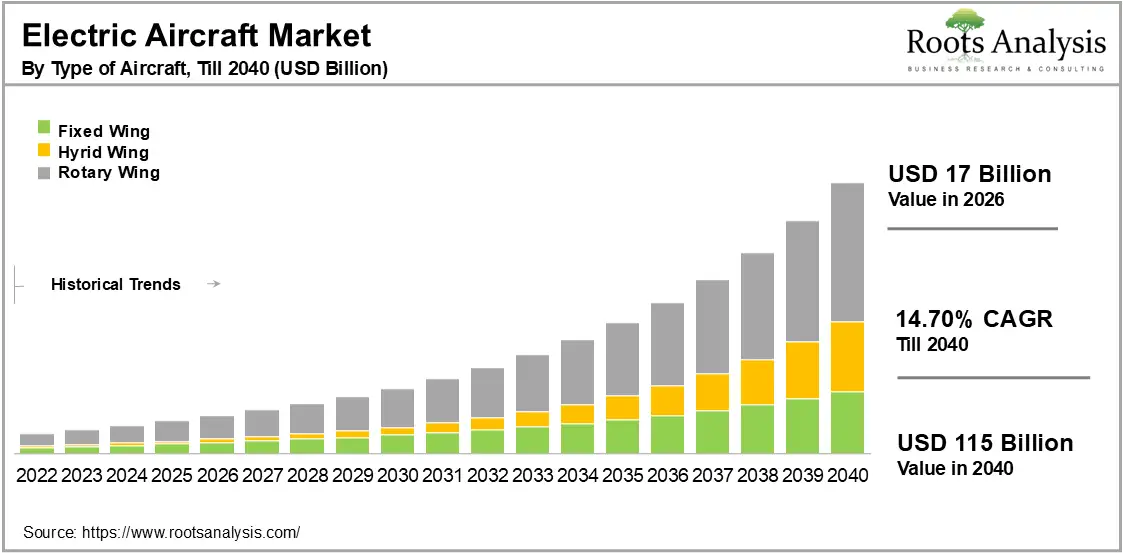
The electric aircraft market size is projected to grow from USD 17 billion in 2026 to USD 115 billion by 2040, representing a CAGR of 14.70%, during the forecast period till 2040.
 |
To learn more about this report, request a free sample copy
The new research study consists of electric aircraft industry analysis, detailed market forecast analysis, and providing actionable strategic recommendations.
The growing need for sustainable air travel is driven by the aviation industry, which contributes nearly 2.5% of global carbon dioxide emissions. Electric aircraft utilize lithium-ion batteries to power electric motors, which generate thrust through propellers or fans to eliminate reliance on fossil fuels. It is worth highlighting that electric aircraft are favored for their lower noise levels, improved handling, and the potential for various configurations, such as hybrid engine systems.
Further, growth in the electric aviation industry is fueled by rising demand in urban air mobility, cargo transport, and pilot training. Recently, Robert Isom, Chief Executive Officer of American Airlines mentioned to facilitate the shift of commercial aviation towards a low-carbon future, it is essential to invest in innovative technologies, such as alternative propulsion systems.
The future of electric aircraft market is expected to grow significantly over the forecast period due to stringent regulation to implement sustainability in the aviation industry. Additionally, some of the electric aircraft product innovations and advancements in manufacturing include improved battery performance and hybrid-electric propulsion technology. The shift toward emission-free aviation is driving demand for lightweight, high-efficiency aircraft electric motors that can deliver consistent power without compromising performance.
Notably, growing environmental concerns regarding green gas emission have motivated authorities and regulatory bodies across various nations to initiate the utilization of electric aircraft, while maintaining aviation safety. For example, in September 2024, Loganair partnered with Heart Aerospace for the integration of hybrid aircraft solution into its operations. This collaboration aimed to support Loganair's goal of achieving net zero emissions by 2040 while aiding in the development of Heart's ES-30 aircraft.
The global electric aircraft market research report presents an in-depth analysis of the various companies that are involved in offering electric aircraft, across different segments, as defined in the table below:
| Key Report Attributes | Details | |
| Historical Trend | Since 2022 | |
| Forecast Period | Till 2040 | |
| Market Size Value by 2026 | $ 17 Billion | |
| Market Size Value by 2040 | $ 115 Billion | |
| CAGR (Till 2040) | 14.70% | |
| Type of Aircraft |
|
|
| Type of Power Source |
|
|
| Type of Technology |
|
|
| Type of Platform |
|
|
| Type of Application |
|
|
| Type of Range |
|
|
| Type of Enterprise |
|
|
| Geographical Regions |
|
|
| Leading Market Players |
|
|
| PowerPoint Presentation (Complimentary) |
Available | |
| Customization Scope | 15% Free Customization | |
| Excel Data Packs (Complimentary) |
|
|
Based on the type of aircraft, the global electric aircraft market is split into fixed wing, hybrid wing and rotary wing. According to our analysis the rotary wing segment is augmenting the segment's growth with over 55% market share in 2024. Further, this segment is expected to grow with a relatively higher (18.52%) CAGR in the near future. This can be attributed to their vertical takeoff and landing (VTOL) capabilities, which enable operation in congested urban environments without the need for traditional runways.
On the basis of the type of power source, the electric aircraft market is bifurcated into battery, fuel cells, solar cells and others. The battery segment is anticipated to dominate the segment with more than 65% of market share in 2040. Further, this segment is expected to grow with a relatively higher CAGR. This can be attributed to advancements in technology, particularly in energy density and safety. Innovations like lithium-sulfur batteries enhance flight range and reduce weight, making electric aircraft more viable.
On the basis of the type of technology, the electric aircraft market is bifurcated into conventional take-off & landing (CTOL), short take-off & landing (STOL) and vertical take-off and landing (VTOL). The conventional take-off & landing (CTOL) segment is anticipated to dominate the segment with more than 40% of market share in 2026. This can be attributed to its compatibility with existing airport infrastructure, which minimizes operational barriers and costs for airlines.
However, vertical take-off and landing (VTOL) segment is expected to witness a relatively faster electric aircraft market growth rate until 2035. This can be ascribed to their ability to operate in urban environments with minimal infrastructure, addressing the increasing demand for efficient urban air mobility solutions.
On the basis of the type of platform, the electric aircraft market is bifurcated into business jets, light & ultralight aircraft and regional transport aircraft. The business jets segment is anticipated to dominate the segment with more than 60% of market share in 2040. This can be attributed to their suitability for short-haul flights, which allows for significant reductions in operational costs and carbon emissions.
However, the regional transport electric aircraft segment is expected to witness a relatively faster (19.38%) electric aircraft market growth rate until 2040. This can be ascribed to battery technology advancements and electric propulsion systems enhancing their feasibility. Further, government incentives and regulatory support aimed at reducing carbon emissions further drive adoption.
Recently, Kempegowda International Airport in Bengaluru unveiled plans for electric flying taxis in partnership with Sarla Aviation. The initiative aimed to introduce seven-seater eVTOL aircraft to provide rapid and eco-friendly transportation, significantly reducing travel times in congested urban areas.
On the basis of the type of application, the market is bifurcated into civil, military and others. The civil / commercial electric aircraft market growth is anticipated to dominate the segment with more than 60% of the market share in 2040. This can be ascribed to environmental concerns and regulatory pressures to reduce carbon emissions. Airlines are increasingly seeking sustainable options like electric aircraft for their lower operational costs and reduced noise pollution, particularly for short-haul flights amid growing air traffic.
On the basis of the type of range, the electric aircraft market is bifurcated into less than 500 km and more than 500 km. The less than 500 km segment is anticipated to dominate the segment with more than 70% of market share in 2026. Additionally, this segment is expected to witness a relatively faster market growth rate until 2040. This can be ascribed to increasing environmental concerns and regulatory pressures aimed at reducing aviation emissions. The convergence of regulatory, technological, and market factors positions the less than 500 km in driving seat of the market.
Based on the types of enterprise, the global electric aircraft market is segmented into large and small and medium enterprise. According to our analysis, the Large electric aircraft companies hold nearly 75% of the market share and are expected to grow at the fastest CAGR during the forecast period. This can be attributed to its capacity to invest in electric aircraft technologies, benefit from substantial resources, increase economies of scale and drive business growth.
This segment highlights the distribution of the electric aircraft market across various geographical regions such as North America, Europe, Asia, Latin America, Middle East, North Africa, and the rest of the world. According to our global market analysis, North America exhibits dominance in the market with over 40% of the electric aircraft market share in the global marketplace. This can be attributed to robust aerospace infrastructure, strong government support and funding, significant technological advancements in battery and propulsion systems, and the presence of major airlines committed to sustainability.
However, Asia is also projected to grow with a relatively higher CAGR in the forecasted period. Primary reasons for this growth include increasing air travel demand and proactive government policies promoting sustainable air travel. Countries like China and India are investing heavily in research and development for advancements in battery technology, and the increasing need for efficient short-haul flights.
An increasing demand for short-range regional flights and expansion of overall aviation sector is majorly driving the electric aircraft industry trends. The rise in preferences for environmentally friendly options is influencing manufacturers to innovate and expand their offerings. Further, stricter environmental regulations and government incentives are pushing airlines to adopt SAF and electric aircrafts, which can significantly reduce carbon emissions.
Moreover, rapid urbanization and economic growth in emerging economies, such as India, China and Japan have favored air travel over other mode of transportation. Additionally, major airlines and corporations are investing heavily in green aviation technologies that have further propelled market growth. Recently, VoltAero entered in a partnership with Kawasaki Motors to enhance the development of hybrid-electric and hydrogen-electric regional aircraft at the Farnborough air show.
With the presence of several small and large electric aircraft manufacturing companies, the market is experiencing intense competition and changing market dynamics. From large multinational companies to local electric aircraft manufacturing players, companies are striving to enhance their competitive edge. In terms of market share, large enterprises and multinational companies are dominating the market.
While small electric aircraft manufacturing players are continuously improving their products to cater to niche markets, or they are offering specialized services. These industry players are focusing on adopting competitive strategies, such as developing innovative solution techniques, forming strategic alliances and partnerships to expand their portfolios and global footprint, investing in recent developments and new feature launches to enhance their electric aircraft offerings.
Despite the strong electric aircraft market growth projection, the market faces numerous challenges. The most common challenge is limited range and payload capacity. Few of the other challenges include complex regulatory certification processes, insufficient supportive policies and lack of substantial investment in infrastructure, such as charging stations and maintenance facilities tailored for electric aircraft. Further, competition from alternative sustainable technologies, such as hydrogen fuel cell technology in aviation and synthetic fuels, poses additional hurdles for electric aircraft to gain a foothold in the aviation market.
North America currently holds a substantial share of approximately 40% in the electric aircraft market opportunities. This dominance can be attributed to several factors, including robust infrastructure, significant investments in research and development, and strong regulatory support for sustainable aviation. Further, the presence of major players such as Boeing enhances the region's market position through innovation and competition. Notably, the region benefits from continuous advancements in battery technology and hybrid-electric systems and promotes sustainable aviation through government incentives are major governing reasons for growth in this region.
Examples of key player involved in the electric aircraft market (which have also been captured in this market report, arranged in alphabetical order) include AeroVironment, Airbus, Boeing, Duxion, EHang, Elbit Systems, Embraer, Eve Air Mobility, Eviation, Groupe Gorge, Heart Aerospace, Joby Aviation, Pipistrel Aircraft, Rolls Royce, Vertical Aerospace, Volocopter, Wright Electric and ZeroAvia. This market report includes an easily searchable excel database of all the companies who have adopted the electric aircraft market.