


 Download Free Sample
 Buy Now
Artificial Photosynthesis Market Outlook
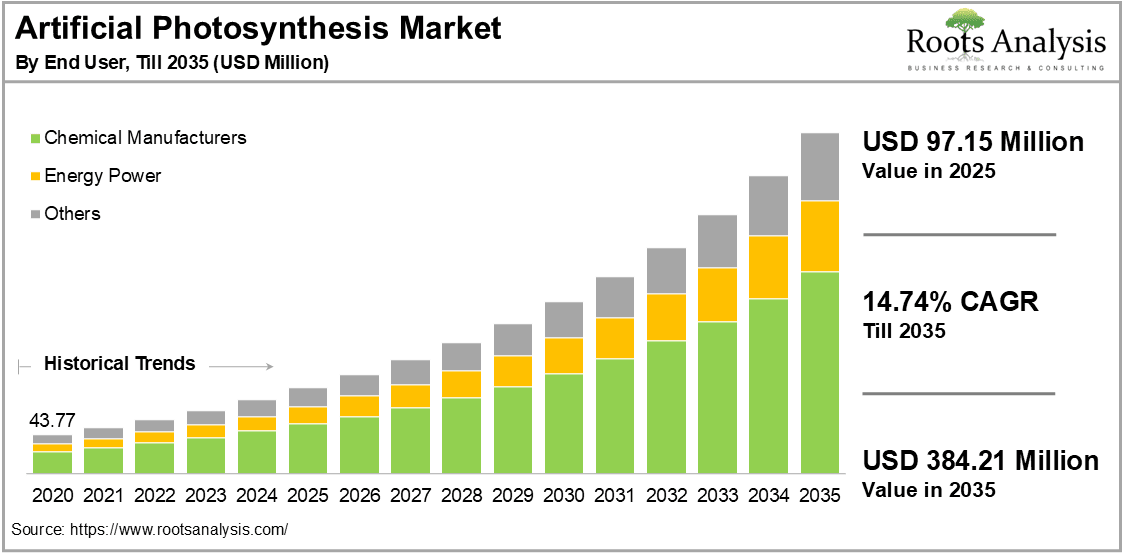
The global artificial photosynthesis market, valued at USD 97 million in 2025, is projected to reach USD 221 million in 2030 and USD 384 million by 2035, with a CAGR of 14.74% during the forecast period 2025 to 2035.
See What’s in the Full Report – Request Your Complimentary Insights!
Artificial photosynthesis is a highly advanced synthetic process that mimics nature's means of harnessing sunlight, water, and carbon dioxide, to produce usable solar and renewable energy. By storing solar power and energy in chemical form, it offers a pathway to generate carbon-neutral or carbon-negative energy, positioning itself as a sustainable alternative to fossil fuels and a possible solution for climate change mitigation.
The artificial photosynthesis market is emerging at the nexus of clean solar energy innovation and green technology. Notably, innovation is not confined to electricity generated by solar energy but expands to include the design of advanced photoelectrochemical cells, the development of multifunctional catalysts, and the creation of scalable systems capable of industrial application.
Investors' interest in sustainable fuel artificial photosynthesis market is growing steadily as research transitions from proof-of-concept systems to more efficient, stable, and commercially viable solutions. Dr. Katharina Brinkert (a leading scientist in this area) points to the larger picture, stating "the knowledge we will gain from designing and manufacturing these devices can possibly assist us in coping with the green energy challenge on Earth. Artificial photosynthesis devices can well become a central element of accomplishing it."
Looking ahead, the artificial photosynthesis technology market is set for rapid growth, driven by technological advances, rising demand for carbon neutral energy, and strong global investment in sustainable solutions. As it moves from research to large-scale commercial use, it is poised to become a vital part of the clean energy ecosystem, delivering both environmental benefits and significant market potential.
Recent Developments in the Artificial Photosynthesis Market
- In February 2025, PhenoVation introduced the Cf2Go sensor, an advanced device that measures the photosynthesis efficiency of crops in real-time.
- In January 2025, Chinese astronauts (members of the Shenzhou-19 crew who resided aboard China's Tiangong space station) made first-of-its-kind artificial photosynthesis in space to produce oxygen and rocket fuel.
Market Share Insights
Co-Electrolysis Technology to Drive the Market
The co-electrolysis segment is set to dominate the current market. This is due to promising applications of co-electrolysis technology in the production of green hydrogen via photosynthesis, a clean and sustainable energy carrier, alongside other carbon-based fuels and chemicals.
Further, the photo-electro catalysis sub-segment is expected to witness the fastest CAGR during the forecast period, till 2035. The ongoing advancements in nanotechnology and materials science are enhancing the efficiency and durability of photo-electrocatalytic systems, thereby presenting significant growth opportunities.
Semiconductor Catalysts to Shape the Future of Artificial Photosynthesis Technology Market
The semiconductor catalysts sub-segment will have the fastest growth during the forecast period due to their wide applicability in various energy applications, particularly in photocatalysis for water splitting and solar-to-chemical conversion technology. The growing demand for renewable energy is further fueling the market.
Sustainable Fuel Production Dominates the Industry
Among the different applications across the globe, sustainable fuel artificial photosynthesis market (particularly the hydrocarbon segment) holds the largest market share. This growth is fueled by the increasing usage of hydrocarbon for heating, producing electricity and as fuels. The versatility and high energy density of hydrocarbons make them ideal and practical for many end-use applications, including feedstock for petrochemical plants, chemicals and synthetic rubber.
Moreover, this trend is unlikely to change during the forecast period as the hydrogen generation artificial photosynthesis market witnesses the fastest growth rate. This growth is a result of the increasing demand for green hydrogen via photosynthesis and clean fuel alternatives.
Chemical Manufacturers Key Role in Artificial Photosynthesis Industry
Chemical manufacturers accounted for the largest market share during the forecast period. This sub-segment dominates the market due to the increase in demand for advanced solar-to-chemical conversion technology and chemicals, such as hydrocarbons. This makes chemical industry the largest potential user of artificial photosynthesis technology to create more sustainable and environmentally friendly feedstock for their production processes.
On the other hand, the energy power segment is expected to witness the fastest CAGR. The growth is due to the technological breakthroughs in catalysts, nanotechnology, and photoelectrochemical systems. Further, strong government funding, rising investments, and the growing hydrogen economy contribute to the rapid growth of this sub-segment.
North America Leads Photochemical Fuel Generation
Regional distribution of the market suggests that North America dominates the market by capturing 39.70% in 2025. The growth is driven by the encouraging policies and programs of the North American government for long-term modernization and development plans.
The growing demand for sustainable solutions in the region further fuels the North America's artificial photosynthesis market growth during the forecast period. On the contrary, the artificial photosynthesis market trends in Asia-Pacific suggest its fastest growth (CAGR of 15.85%) during the forecast period.
Want Information on Specific Region / Segment?
Market Key Takeaways
Competitive Landscape of Key Market Players
The competitive landscape of the artificial photosynthesis industry is characterized by a mix of established multinational corporations and innovative startups focused on advancing conversion of solar energy to electrical energy.
These companies invest heavily in research and development for improving efficiency, durability, and scalability of synthetic photosynthesis for carbon capture. Additionally, collaborations between academic, industry, and government research centers fuel innovation.
Regional leaders, particularly in North America, Asia-Pacific, and Europe, are pushing for advancements in catalysts, photoelectrochemical cell systems, and integrated systems to accelerate commercialization and address climate and energy challenges.
Commercial Viability of Artificial Photosynthesis Tech
- Artificial photosynthesis holds immense promise for a carbon-neutral economy.
- By mirroring natural photosynthesis, these technologies can offer a sustainable and potentially carbon-negative energy source.
- Further research and development, coupled with strategic investments and collaborative efforts, will be crucial for realizing the commercial potential of artificial photosynthesis.
Artificial Photosynthesis in Carbon Capture Solutions
Artificial photosynthesis carbon capture technology takes CO2 from the atmosphere and converts it to beneficial fuels and chemicals, making carbon-neutral or negative emissions possible. It offers a two-fold advantage of clean energy generation and keeping climate change in check.
Barriers to Scaling Artificial Photosynthesis Systems
- Large investment and operating expenses
- Low energy conversion efficacy when compared to natural photosynthesis
- Challenges regarding the durability and stability of catalysts and materials
- Challenge of scaling from laboratory to industrial scale
Emerging Startups in Artificial Photosynthesis Sector
Startups concentrate on new catalysts, nanomaterials, and system integration which increases efficiency while cutting costs. Some examples include Twelve, SunHydrogen, and Solaronix, which are responsible for driving technology from laboratories to market.
Policy Drivers for Artificial Photosynthesis Investment
- Global climate goals driving solar power clean energy penetration
- Government subsidies and incentives for clean technologies
- Growing restraints on carbon emissions
- R&D funding and pilot programs to spur innovation
Photoelectrochemical Cells Market Growth
The photoelectrochemical cell systems, key to artificial photosynthesis, are expanding fast through enhanced material science and the rapid growth of the synthetic solar fuel market. They facilitate hydrogen production and utilization of CO2.
Nanomaterials in Artificial Photosynthesis Investment
Nanomaterials are transforming artificial photosynthesis by dramatically improving light absorption, charge separation, and catalytic performance in solar fuel production. Their unique properties, including tunability and nanoscale dimensions, help optimize the efficiency of solar-to-fuel conversion processes in next-generation energy systems.
Investing in nanomaterials for artificial photosynthesis presents significant opportunities for developing clean energy technologies and reducing carbon emissions. Advanced nanomaterial platforms enable solar energy storage and hydrogen fuel generation, offering sustainable alternatives to fossil fuels and addressing key climate change challenges.
Unlock Deeper Insights – Schedule Your Personalized Workshop Today!
Artificial Photosynthesis Market Dynamics
Market Drivers
- Urgent Global Push for Clean Energy and Net-Zero Carbon Goals: Artificial photosynthesis, with its ability to convert CO2, water, and sunlight directly into renewable fuels or chemicals, aligns perfectly with zero-carbon and sustainability goals, driving adoption in energy, chemical, and environmental sectors.
- Advancements in Photocatalysis, Materials Science, and System Integration: Breakthroughs in nanomaterials, metal-organic frameworks, and integrated photoelectrochemical systems are dramatically improving the efficiency and scalability of artificial photosynthesis devices. These advances are making technology increasingly viable for commercial applications in green hydrogen production, synthetic fuels, and carbon capture artificial photosynthesis.
- Surge in Government and Institutional R&D Investments: Governments across North America, Europe, and Asia Pacific are heavily funding research, pilot projects, and demonstration plants. Grants, tax incentives, and public-private partnerships, such as major DOE initiatives in the U.S., are catalyzing rapid innovation and helping startups transition from lab-scale prototypes to commercial-scale deployment.
Market Challenges
- High Initial Capital and Technology Development Costs: Developing artificial photosynthesis technologies involves significant R&D expenses, high infrastructure investment, and complex pilot plant setups. For many firms, these financial barriers can slow progress and limit early commercial deployment.
- Challenges in Catalyst Optimization and Device Stability: The efficiency of light harvesting, catalyst stability, and long-term device operation remain technical bottlenecks. Achieving consistent, scalable, and durable performance in real-world environments is still an ongoing research challenge.
- Scale-Up and Commercialization Barriers: While laboratory and pilot-scale demonstrations have proven promising, moving to mass production and widespread adoption requires overcoming hurdles in cost-effective manufacturing, system integration, and supply chain logistics.
Pay Only for What You Need – The Best Way to Optimize
Artificial Photosynthesis Market: Scope of the Report
Key Report Attributes
| Key Report Attributes | Details | |
| Historical Trend | Since 2020 | |
| Forecast Period | Till 2035 | |
| Market Size 2025 | USD 97 Million | |
| Market Size 2035 | USD 384 Million | |
| CAGR (Till 2035) | 14.74% | |
| Technology |
|
|
| Catalyst |
|
|
| Application |
|
|
| End User |
|
|
| Geographical Regions |
|
|
| Key Players Profiled | ||
| PowerPoint Presentation (Complimentary) | Available | |
| Customization Scope | 15% Free Customization | |
| Excel Data Packs (Complimentary) |
|
|


