


 Download Free Sample
 Buy Now
Market Size
The global automotive cybersecurity market, valued at USD 5.46 billion in 2025, is projected to reach USD 6.60 billion in 2026 and USD 62.31 billion by 2040, with a 17.39% CAGR during the forecast period 2026 to 2040.

See What’s in the Full Report - Request Your Complimentary Insights!
Key Takeaways
- In terms of form, in-vehicle security secures the highest overall revenue share (61.25%) of the global market.
- In terms of application, infotainment holds the largest share of automotive cybersecurity market.
- In terms of leading region, Asia-Pacific holds the largest share while North America holds the second largest revenue.
Market Overview
Automotive cyber security refers to the suite of technologies, processes, and practices designed to protect vehicle electronic systems, communication networks, and data from unauthorized access, malicious attacks, and integrity breaches in increasingly interconnected environments.
These protections apply across intra-vehicle networks, such as securing electronic control units (ECUs) and driver assistance systems, and extend to inter-vehicle communications, including vehicle-to-everything (V2X) protocols that enable real-time data exchange for autonomous driving and fleet management. Security patterns address inward-facing vulnerabilities like onboard feature exploits and outward-facing risks from telematics and infotainment interfaces, ensuring safe operation amid sophisticated inward and outward data flows.
Market growth stems from the rapid digitization of vehicles through autonomous driving, electrification, and software-defined architectures, which exponentially expand attack surfaces via telematics, over-the-air (OTA) security updates for vehicles, and backend servers. Regulatory frameworks like UNECE R155 and ISO / SAE 21434 mandate lifecycle cybersecurity integration, compelling manufacturers to embed threat detection, encryption and secure gateways in automotive systems from design stages. Escalating remote attack vectors, including API breaches over Wi-Fi and 5G, further intensify the need for AI-driven defenses and industry-wide knowledge sharing to counter evolving threats. This also fueled the growth of automotive embedded security market.
Pay Only for What You Need – The Best Way to Optimize
Recent Developments
- In November 2025, Panasonic Automotive Systems evolved its VERZEUSE series of automotive cyber security innovations to be compatible with software-defined vehicles, which protects the entire vehicle life cycle in the Cockpit and HPC Era.
- In August 2025, Panasonic automotive systems and VicOne expanded security innovations for next-generation vehicle cockpit systems, with its security software xCarbon, which detect and protect under cyber-attacks.
- In June 2025, Accenture LearnVantage and IIT Madras’s CAAR collaborated to skill talent for software-defined vehicles having automotive OEMs and GCCs.
- In March 2025, Deloitte Spain and PlaxidityX entered a joint venture to deliver transformative automotive cyber security solutions.
Market Dynamics
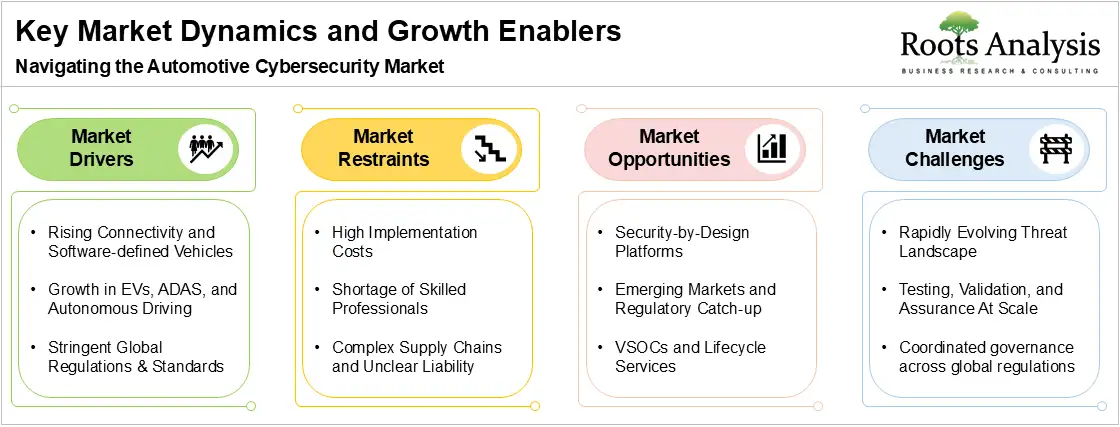
The industry is set to witness a lucrative growth phase, with the automotive cybersecurity market shaped by a dynamic interplay of drivers, restraints, opportunities, and challenges that will influence its trajectory in the coming years.
Market Segmentation
The automotive cybersecurity market report presents an in-depth analysis of the various companies that are involved in offering vehicle cybersecurity solutions, across different segments, as in the figure below:

Market Share Insights
In-Vehicle Security Sub-Segment to Dominate the Automotive Cybersecurity Industry
As per our industry analysis, the in-vehicle network security market is expected to hold the largest share of 61.25%. This growth is due to the proliferation of electronic control units (ECUs), V2X communications, and autonomous systems requiring real-time internal network protection against exploits. Further, this segment’s lead stems from vehicles’ complex onboard architectures, where securing intra-vehicle data flows and software-defined functions prevents direct control system compromises. This provides in-vehicle network (CAN, LIN, Ethernet) protection.
On the other hand, the external security sub-segment is expected to witness a CAGR of 19.67% driven by cloud-based services for OTA testing, fleet monitoring, and V2X connectivity, which demand scalable remote threat detection amid rising telematics adoption. External solutions grow rapidly as vehicles integrate with broader ecosystems, like cloud-based automotive security operations centers (vSOC) necessitating centralized analytics over distributed in-vehicle defenses.
Infotainment to Gain the Highest Market Share for Application Segment
The market estimates suggest that infotainment is the dominating application sub-segment for automotive cybersecurity with a market share of 34.64%. This is due to its extensive connectivity features like smartphone integration, media streaming, and third-party apps that create high exposure to cyber threats and necessitate robust data privacy protections.
Telematics exhibits the fastest CAGR through 2040, propelled by surging demand for remote diagnostics, OTA updates, and V2X and V2V communication security in connected and fleet vehicles, which amplify external attack vectors requiring scalable cloud-based security.
Regional Forecast Estimates: North America Holds the Second Largest Market Share, Fueled by High Adoption Rates of Autonomous Vehicles
Automotive cybersecurity market forecast suggests that North America is expected to have the second largest share market share. A high adoption rate of connected and autonomous vehicles in North America increases the demand for robust cybersecurity measures along with the growth of connected car security market.
In addition, the region consists of several technology companies that are at the forefront of adopting advanced automotive technologies, which drives the market growth. Moreover, the rising cyberattacks on connected cars and EVs in North America is pushing OEMs and regulatory bodies to strengthen cybersecurity frameworks.
Want Information on Specific Region / Segment?
Which are the Top Players in Automotive Cybersecurity Market?
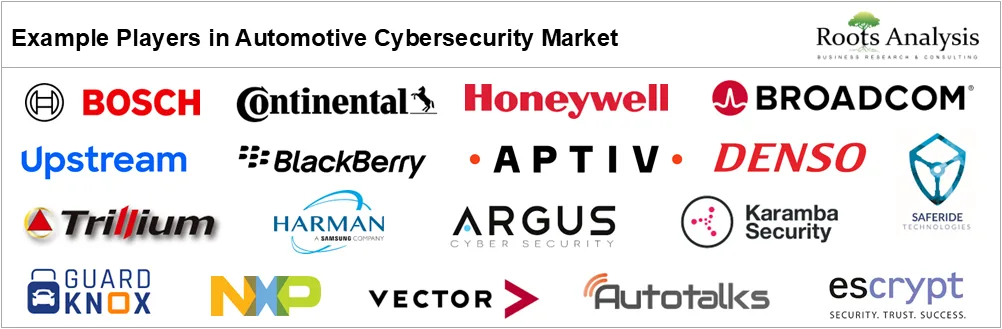
Examples of leading automotive cybersecurity manufacturers (which have also been captured in this market report, arranged in alphabetical order) include Aptiv, Argus Cyber Security (formerly known as PlaxidityX), BlackBerry, Broadcom, Continental, Denso, GuardKnox Cyber-Technologies, Harman International, Honeywell, Karamba Security, NXP Semiconductors, Robert Bosch, SafeRide Technologies, Trillium Secure, Upstream Security, Vector Informatik.
What Strategies are the Companies Using to Gain Automotive Cybersecurity Market Share?
The competitive landscape of the automotive cybersecurity market is characterized by a combination of established automotive suppliers and specialist cybersecurity firms driving innovation and compliance. Continental stands out with its comprehensive cybersecurity offerings including intrusion detection and prevention systems for vehicles, along with secure gateway solutions tailored for major OEMs such as BMW and Ford.
Robert Bosch plays a pivotal role in the automotive cyber threat protection market by integrating robust cryptographic security and over-the-air firmware update protections within their automotive electronic control units, leveraging its deep expertise in vehicle electronics. Aptiv differentiates itself through advanced vehicle-to-everything (V2X) security frameworks and AI-enabled threat detection, supporting cyber security for connected and autonomous vehicles.
These leading firms, along with others like Harman International and Karamba Security, are intensely focused on multi-layered defense strategies driven by tightening global regulations like UNECE R155 and collaborative ecosystem models that include semiconductor and automotive cybersecurity software.
Automotive Cybersecurity Solutions for Connected and Autonomous Vehicles (CAVs) and Over-the-Air (OTA) Updates
The automotive cybersecurity market segment for CAVs and OTA updates is expanding rapidly due to rising vehicle connectivity via automotive V2X and telematics, which heightens risks of remote hacks and data breaches. Solutions include embedded hardware like secure gateways and cloud-based platforms for real-time OTA protection, with the embedded deployment holding the largest share in 2024. Cloud segments grow fastest, supporting fleet-wide threat detection and scalable updates without recalls. Market drivers include 5G integration and EV adoption.
Have Questions? Let’s Get Them Answered
In-Vehicle Network Security for CAN, Ethernet, and V2X Communication Systems Against Cyberattacks
In-vehicle network security targets vulnerabilities in CAN, LIN, Ethernet, and V2X protocols, which are prone to intrusions disrupting critical functions like braking and steering. Key solutions feature hardware-based firewalls, intrusion detection systems, and encryption to safeguard communication channels, with in-vehicle segments expected at 61.25% market share. This area dominates due to the shift to Ethernet for high-bandwidth needs in SDVs and AVs. Rising cyber incidents fuel demand for anomaly detection tailored to automotive networks.
Compliance With UNECE WP.29, ISO/SAE 21434, and Global Automotive Cybersecurity Regulations
Regulatory compliance drives a significant portion of the automotive cybersecurity market, mandating CSMS under UNECE WP.29 (R155) and ISO/SAE 21434 for lifecycle threat management. These standards require OEMs to implement risk assessments and continuous monitoring, boosting demand for compliant software and services. Europe leads adoption, with global OEMs investing heavily to avoid penalties amid connected vehicle mandates.

Automotive Cybersecurity Market: Scope of the Report
| Key Report Attributes | Details | |
| Historical Trend | Since 2022 | |
| Forecast Period | Till 2040 | |
| Market Size in 2026 | $ 6.60 Billion | |
| Market Size in 2040 | $ 62.31 Billion | |
| CAGR (Till 2035) | 17.39% | |
| Segments Covered |
|
|
Unlock Deeper Insights – Schedule Your Personalized Workshop Today!
Market Segments
Based on the research, we have segmented the automotive cybersecurity market into component, form, security type, vehicle type, application, geographical regions, and leading players.
By Component
- Hardware
- Software
- Services
By Form
- External Security
- In-Vehicle Security
By Security Type
- Application
- Cloud
- Data
- Endpoint
- Hardware
- Network
- Wireless Network
- Others
By Vehicle Type
- Electric Vehicles
- Fuel-based Vehicles
By Application
- ADAS & Safety Systems
- Body Control & Comfort Systems
- Communication Channels
- Infotainment
- On-Board Diagnostics
- Powertrain
- Telematics
- Others
By Geographical Regions
- North America
- US
- Canada
- Mexico
- Rest of North America
- Europe
- Austria
- Belgium
- Denmark
- France
- Germany
- Ireland
- Italy
- Netherlands
- Norway
- Russia
- Spain
- Sweden
- Switzerland
- UK
- Rest of Europe
- Asia-Pacific
- Australia
- China
- India
- Japan
- New-Zealand
- Singapore
- South Korea
- Rest of Asia-Pacific
- Latin America
- Brazil
- Chile
- Colombia
- Venezuela
- Rest of Latin America
- Middle East and Africa (MEA)
- Egypt
- Iran
- Iraq
- Israel
- Kuwait
- Saudi Arabia
- UAE
- Rest of MEA


