
Lowest Price Guaranteed
Slides
179
Last Updated
March 2026
View Count
13975
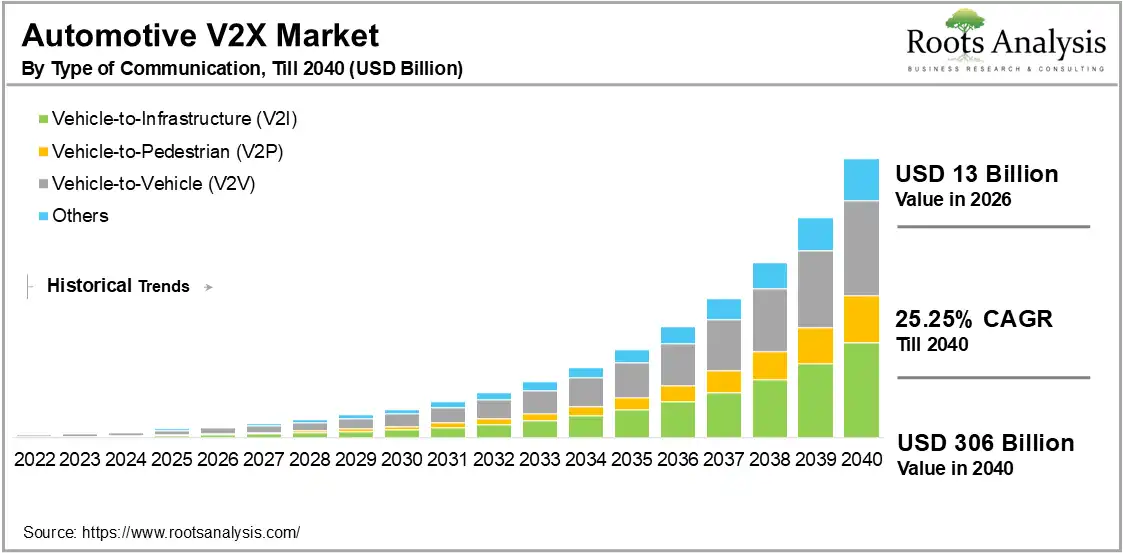
The automotive V2X market size is projected to grow from USD 13 billion in 2026 to USD 306 billion by 2040, representing a CAGR of 25.25%, during the forecast period till 2040.
 |
To learn more about this report, request a free sample copy
The new research study consists of automotive vehicle-to-everything industry analysis, detailed market forecast analysis, and providing actionable strategic recommendations.
According to the World Health Organization (WHO), approximately 1.19 million people lose their lives in road accidents each year. To overcome these hazardous rates, automotive Vehicle-to-Everything technology (V2X) has emerged as a crucial component. These services use cameras, sensors, and wireless connections so that the car can communicate with the driver.
Additionally, the technology supports advanced functions such as line-of-sight communication, non-line-of-sight detection, and vehicle data analytics. Furthermore, automated driver-assistance systems can notify drivers about surrounding vehicles and road conditions as well as fully drive the car on its own. Moreover, it provides features such as fleet and asset management, thereby allowing organizations to track their connected vehicles.
The global automotive V2X market size is expected to grow significantly over the forecast period due to the rapid urbanization in emerging economies like China and India. Easy implementation and effectively designed technology have played a pivotal role in the future of automotive connectivity.
Additionally, one of the automotive V2X technology advancements includes development of cruise control, lane-change assistance and blind spot detection, which allows for the vehicle to keep driving on a certain speed and safely interchange between the lanes. Further, the services provide V2X cyber security solutions that acquire security against hacking and data breaches. Moreover, real-time data exchange and automotive IoT applications have fostered the evolution of V2X communication protocols.
Recently, Dr. Robert Hampshire, chief science officer at the US Department of Transportation mentioned the power of V2X technology is transformative, it is a critical tool we use to mitigate and eliminate crashes across the nation.
The global automotive V2X market research report presents an in-depth analysis of the various companies that are involved in offering automotive V2X, across different segments, as defined in the table below:
| Key Report Attributes | Details | |
| Historical Trend | Since 2020 | |
| Forecast Period | Till 2040 | |
| Market Size Value in 2026 | $ 13 Billion | |
| Market Size Value by 2040 | $ 306 Billion | |
| CAGR (Till 2040) | 25.25% | |
| Type of Connectivity |
|
|
| Type of Communication |
|
|
| Type of Vehicle |
|
|
| Type of Propulsion |
|
|
| Type of Technology |
|
|
| Geographical Regions |
|
|
| Leading Market Players |
|
|
| PowerPoint Presentation (Complimentary) |
Available | |
| Customization Scope | 15% Free Customization | |
| Excel Data Packs (Complimentary) |
|
|
On the basis of the type of connectivity, the automotive V2X market is bifurcated into DSRC and Cellular. The dedicated short-range communications (DSRC) segment is anticipated to dominate the segment with more than 60% of market share in 2026, this can be attributed to easy automated V2X application, effectively designed technology and verified data security standards.
On the other hand, the cellular segment is expected to witness a relatively faster (41.37%) market growth rate by 2040. Due to its ability to work effectively in low-range and short-range connectivity over a wide area. Additionally, greater capability and high safety are major ascendancy of cellular automotive connectivity solutions.
Based on the type of communication, the global automotive V2X market is split into Vehicle-to-Infrastructure (V2I), Vehicle-to-Pedestrian (V2P), Vehicle-to-Vehicle (V2V) and others. Currently, according to our analysis the vehicle-to-vehicle (V2V) segment is augmenting the segment's growth with over 50% market share. Additionally, development of adaptive cruise control, lane-change assistance, driver assistance system and blind spot detection have spurred the growth of connected vehicle technology.
On the other hand, the vehicle-to-infrastructure (V2I) segment is expected to grow with a relatively higher (40.61%) CAGR in the near future. This can be attributed to its improved safety, convenience and efficiency. Further, automated toll payment and e-parking systems have helped in adoption of infrastructure-to-vehicle communication.
On the basis of the type of vehicle, the market is bifurcated into commercial vehicle, passenger cars and others. The passenger cars segment is anticipated to dominate the segment with more than 60% of market share in 2025. Further, this segment is expected to witness a relatively faster (42.61%) automotive V2X market growth rate by 2040. This can be attributed to its heavy presence and continuous high demand. Briefly, most of the population prefers travelling in owned vehicles that forwardly raises the demand for autonomous driving technology.
Based on the types of propulsion, the global automotive V2X market report is segmented into electric vehicles (EVs) and ICE vehicles. According to our analysis, the internal combustion engines (ICE) vehicles is leading the segment with the major market share (60%). This can be attributed to their domination in the market as the majority are still driving cars gasoline-powered vehicles and demand for the same. Additionally, for better traffic management solutions and control emission, vehicle-to-network systems are introduced.
However, the electric vehicle (EV) segment is expected to grow with the relatively faster (41.67%) CAGR in the forecasted period. This can be ascribed to their rapidly growing demand and eco-friendly transportation solutions.
Based on the types of vehicle communication technologies, the global automotive V2X market report is segmented into automated driver assistance, emergency vehicle notification, fleet & asset management, intelligent traffic system, line of sight, non-line of sight, parking management system, passenger management system and others. According to our analysis, the automated driver assistance is leading the segment with the major market share (50%) and is expected to grow with a relatively high CAGR of 43.51%.
This technology uses sensors, cameras and radars to detect any obstacle or object on the road. Further, providing secure driving experience and minimizing risks of road accidents. It is worth highlighting that its accuracy and reliability has originated smart city integration in automative V2X industry.
This segment highlights the distribution of the market across various geographical regions such as North America, Europe, Asia, Latin America, Middle East, North Africa, and the rest of the world. According to our automotive V2X market analysis, Asia exhibits dominance in the market with over 40% of the automotive V2X market share in the global marketplace.
This can be attributed to its quick adoption of newly deployed technology and high numbers of vehicle particularly in countries like South Korea, India, Taiwan, and China. However, North America is projected to grow with a relatively higher CAGR (43.68%) in the forecasted period. Primary reasons for this growth include favored automotive V2X s for vehicles and investments in automated driver assistance vehicles such as Tesla.
An increasing demand for intelligent transportation systems is majorly driving the automotive V2X industry. Further, rising adoption of automotive safety features such as collision avoidance, traffic signal prioritization and pedestrian detection has contributed to expansion of vehicle-to-network (V2N). Moreover, development of adaptive cruise control, lane-change assistance, driver assistance system and blind spot detection have spurred the growth of connected device technology. To enhance situational awareness, many V2X-enabled systems are now designed to synchronize with acoustic alerting technologies for better safety in urban settings.
With the presence of several small and large automotive V2X companies, the competitive landscape of the automotive V2X industry is experiencing intense competition and changing market dynamics. From large multinational companies to local automotive V2X players, companies are striving to enhance their competitive edge. In terms of market share, large enterprises and multinational companies are dominating the market. While small automotive V2X players are continuously improving their products to cater to niche markets, or they are offering specialized services.
These industry players are focusing on adopting competitive strategies, such as developing innovative solution techniques, forming strategic alliances and partnerships to expand their portfolios and global footprint, investing in recent developments and new feature launches to enhance their automotive V2X offerings.
Despite strong market growth projection, the automotive V2X market faces numerous challenges. The most common challenge is that they are highly prone to hacking as they work on the internet. Additionally, security and privacy issues and lack of trust hamper market growth, while its entangled and unclear responsibility add further complexity.
Asia currently holds a substantial share of approximately 40% in the automotive V2X market opportunities. This dominance can be attributed to several factors, including supportive government regulations, intelligent transport system adoption and advantages of automotive V2X. Further, Asia is a big market for vehicles due to high population and rapidly growing economies such as India and China. Notably, substantial automotive V2X vehicle-to-everything investments analysis in research and development have rapidly increased rates of urbanization and wireless communication in automotive in Asia.
Examples of key player involved in the automotive V2X market (which have also been captured in this market report, arranged in alphabetical order) include Autotalks, Cisco Systems, Cohda, Continental, Delphi Automotive, Denso, Ford, Harman International, Huawei Technologies, Infineon Technologies, Kapsch TraficCom, LG Electronics, NXP Semiconductors, Qualcomm, Robert Bosch and Toyota. This market report includes an easily searchable excel database of all the companies who have adopted the market.