
Lowest Price Guaranteed
Slides
211
Last Updated
August 2025
View Count
12512
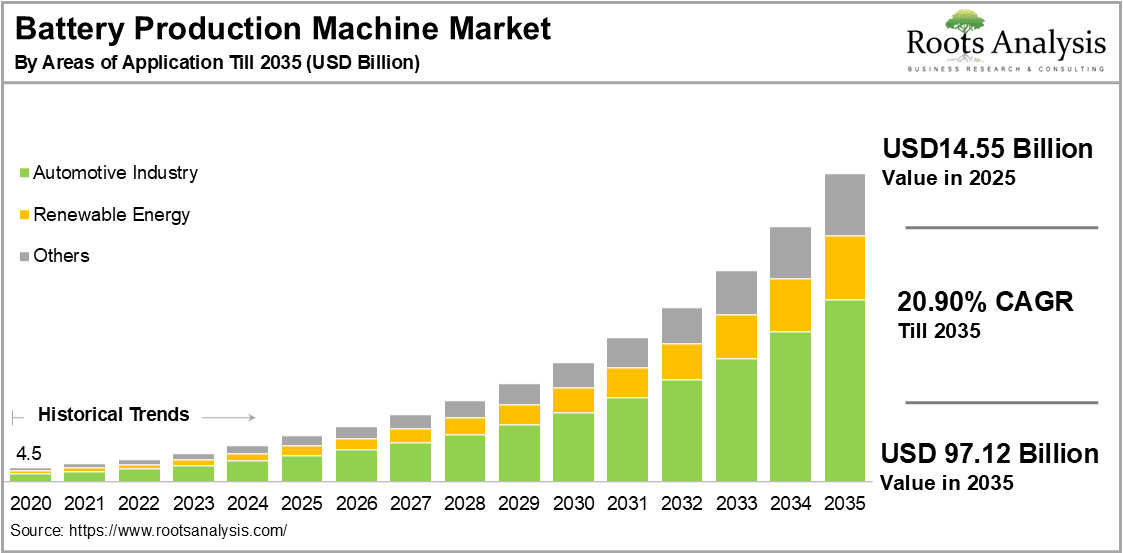
The global battery production machine market, valued at USD 11.5 billion in 2024, is projected to reach USD 14.55 billion in 2025 and USD 97.12 billion by 2035, representing a CAGR of 20.90% during the forecast period. The new research study consists of detailed market analysis, mega trends, patent analysis, porter five forces, SWOT analysis, value chain analysis and other strategic frameworks.
 |
To learn more about this report, request a free sample copy
Battery production machines are key players in the battery manufacturing world, making the production process more efficient and precise. These machines automate several stages of battery creation, such as preparing electrodes, assembling components, testing, and packaging. With advanced technologies like robotics and precision control systems, they ensure that the batteries produced are consistent in quality.
As the demand for batteries surge, especially in sectors like automotive, energy storage, and consumer electronics, these machines are becoming increasingly vital. They help manufacturers ramp up production capacity while also enhancing product quality and cutting down on costs. This is particularly important as more people turn to electric vehicles (EVs) and renewable energy solutions.
The market report on battery production machine presents an in-depth analysis of the various companies that are involved in offering battery manufacturing equipment across different segments, as defined in the table below:
| Key Report Attributes | Details | |
| Historical Trend | Since 2020 | |
| Forecast Period | Till 2035 | |
| Market Size 2025 | $ 14.55 Billion | |
| Market Size 2035 | $ 97.12 Billion | |
| CAGR till 2035 | 20.90% | |
| Type of Machine |
|
|
| Type of Battery |
|
|
| Areas of Application |
|
|
| Type of Enterprise |
|
|
| Geographical Regions |
|
|
| Leading Market Players |
|
|
| PowerPoint Presentation (Complimentary) |
Available | |
| Customization Scope | 15% Free Customization | |
| Excel Data Packs (Complimentary) |
|
|
The key segments for the battery production machine industry are defined below.
The global market for battery production machine is segmented into various types of machines such as assembling & handling machines, calendaring machines, coating & drying machines, dryers, formation & testing machines, formers, electrode stacking machines, laminators, mixing machines, slitting machines, and stackers.
According to our global battery production machine market analysis, the formation and testing segment is set to take the lead with the largest market share of over 34.56% by the next decade. These machines play a crucial role in making sure battery cells are properly charged and conditioned, which directly affects how well they perform and how long they will last. With the growing popularity of electric vehicles (EVs), manufacturers are trying their best to deliver top-notch batteries that meet strict safety and performance standards with the help of EV battery manufacturing machines, which further makes the role of these machines important in the production process.
All these factors are contributing to the dominance of formation and testing machines as they play a crucial role in helping manufacturers keep up with demand while ensuring their products are reliable and efficient.
The market is segmented into various types of battery such as flow batteries, lead-acid batteries, lithium-ion batteries , lithium iron phosphate, nickel-cadmium batteries, nickel cobalt aluminum, nickel manganese cobalt, and nickel-metal hydride batteries. According to our battery production machine growth forecast, the lithium-ion batteries segment is expected to see the fastest growth (21.78%) in the forecasted period, thanks to their widespread adoption and versatility.
They’re becoming the most preferable choice for industries like electric vehicles (EVs) and renewable energy storage because of their high energy density, efficiency, and steadily decreasing production costs. What’s fueling the lithium-ion battery production equipment market growth further is the rapid EV production by automakers as the government pushes for stricter emissions regulations. On top of that, advancements like solid-state battery technology are making lithium-ion batteries even more efficient and safer.
The market is fragmented into various areas of application, namely automotive industry, consumer electronics, energy storage, industrial, marine applications, medical devices, and renewable energy where the automotive industry segment is gaining the highest traction. According to our analysis, this segment will increase the market share by 32.34% during the forecast period.
The increasing traction of this segment is largely due to the skyrocketing demand for electric vehicles. With more consumers and manufacturers shifting towards EVs, the need for high-performance batteries, particularly lithium-ion ones, has surged. The automotive sector not only benefits from advancements in battery technology but also from government incentives aimed at promoting cleaner transportation options.
According to our regional analysis, Asia currently exhibits a dominance holding 37.69% battery production machine market share. This dominance is largely due to the rapid growth in the electric vehicle (EV) industry, especially in powerhouses like China and South Korea. These countries have heavily invested in building battery manufacturing facilities, which is driving up the demand for specialized production machines. Plus, supportive government policies and a wealth of raw materials and skilled labor make it even easier for these nations to maintain their top position.
With automation in gigafactories on the rise and continuous improvements in production technology, Asia is well-positioned to keep its lead in this booming market for years to come.
The “Battery Production Machine Market, till 2035: Industry Trends and Global Forecasts” report features an extensive study of the current market landscape, market size and future opportunity within the market forecast period. The market report highlights the efforts of several stakeholders involved in this rapidly emerging segment of the service providers industry. Key takeaways of the global battery production machine market report are briefly discussed below.
The market for battery production machine is bustling with exciting trends that are shaping its future. One of the biggest drivers is the surge in electric vehicles (EVs), which is pushing manufacturers to invest in cutting-edge machinery capable of producing high-performance batteries. With the market gaining high traction, it's clear that companies are racing to keep up with demand.
Another key trend is the integration of automation and AI in battery production. This means using robotics and smart inspection systems to speed up manufacturing while ensuring top-notch quality.
The global battery production machine industry is being driven by several key factors, with the rise of electric vehicles (EVs) being the biggest game-changer. EVs require large-scale, high-quality battery production, and as their popularity continues to soar, manufacturers are heavily investing in advanced machinery to keep up with demand.
Another major driver is the growth of renewable energy storage systems, which rely on efficient and durable batteries to store power from sources like solar and wind. Governments worldwide are also playing a huge role by introducing incentives and policies that promote clean energy and electric mobility.
Companies involved in battery production are using smart strategies to stay ahead. Big players are focusing on partnerships, acquisitions, joint ventures, and innovations to strengthen their position while also investing in R&D to bring innovative and novel products to the market. Launching new technologies and expanding into regions where adoption of electric vehicles is growing are some of the key moves helping them capture more market share.
For instance, in September 2024, Impact launched a battery production line for heavy-duty EV batteries in Poland, allowing the production line to produce a complete battery system for a heavy-duty EV every 11 minutes. In reference to this, Ireneusz Kazimierski, CEO of Impact Clean Power Technology stated that their battery systems for heavy transport stand out in the market for their energy density and high level of safety. These are further complemented by their proprietary BMS, ensuring maximum integration and optimization of the entire system’s performance, and protecting it from the latest threats.
Despite the strong market growth projection, there are several challenges in the battery production machine market. One of the biggest hurdles is the availability of raw materials, such as lithium, cobalt, and nickel, which are essential for battery manufacturing. As demand for batteries skyrockets, these materials are becoming scarcer, leading to supply chain disruptions and price volatility.
Additionally, the industry is grappling with labor shortages and the complexities involved in developing gigafactories to scale up production effectively. Quality control is another critical issue; ensuring that batteries meet stringent safety and performance standards can be tricky, especially when producing at large volumes.
Examples of leading battery production machine manufacturers (which have also been captured in this market report, arranged in alphabetical order) include Arvigon, Beijing Jiarui Hengfeng Technology, Buhler, DMG MORI, Doosan Machine Tools, Durr Group, Fives Sylepse, Fristam Pumpen, Giga Presse, Hanwha Precision Machinery, Hitachi, KMT Waterjet Systems, KUKA, Lead Intelligent Equipment, Manz, Nordson, Rosendahl Nextrom, Sachuler, Schuler, Shenzhen Yinghe, Shibaura Machine, Sodick, Tesla, Wuxi Lead Intelligent Equipment.
The market report presents an in-depth analysis, highlighting the capabilities of various companies engaged in this domain, across different segments. Amongst other elements, the market report includes:
At Roots Analysis, we genuinely care about your success and understand that your business requirements are unique. While our battery production machine market research reports provide valuable insights, we recognize that they might not cover every aspect you need to make well-informed strategic decisions. To account for that, we offer 15% free report customization tailored to your specific needs. Whether you require additional quantitative analysis, qualitative insights, or any other information related to the battery production machine market, reach out us today at: support@rootsanalysis.com
Lead Author: Anmol Bali
Chief Editor: Ronit Sharma