


 Download Free Sample
 Buy Now
Biodegradable Mulch Film Market Overview
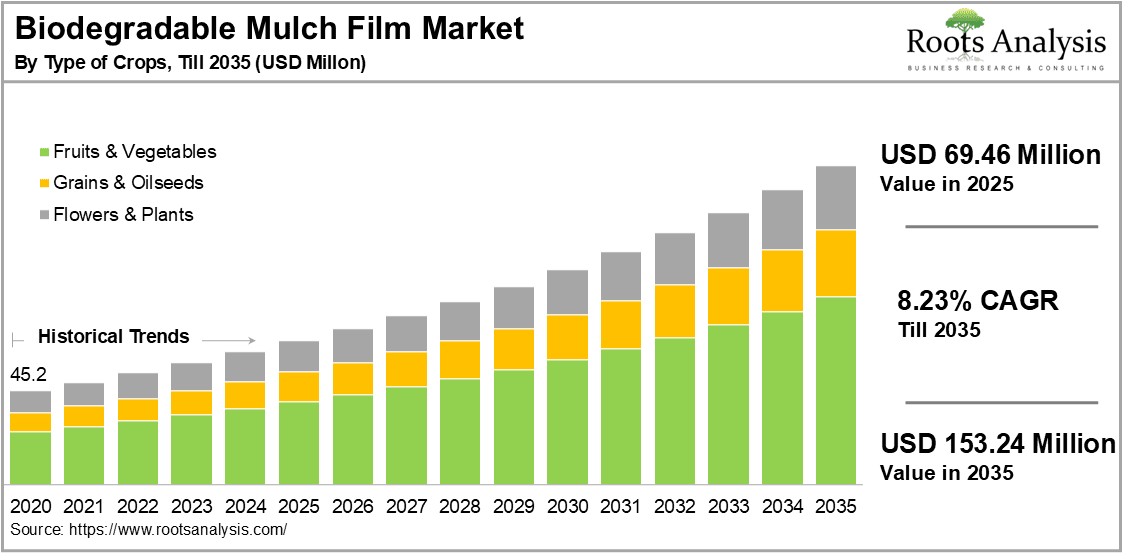
The global biodegradable mulch film marketis projected to rise from USD 69.46 million in 2025 and USD 153.24 million by 2035, representing a CAGR of 8.23% during the forecast period. The new research study consists of global biodegradable mulch film analysis, mega trends, patent analysis, porter five forces, SWOT analysis, value chain analysis and other strategic frameworks.
 |
To learn more about this report, request a free sample copy
Biodegradable mulch films are eco-friendly alternatives to traditional plastic mulch films designed to degrade naturally over time which helps in reducing the environmental impact of plastic waste. These films are primarily used in agricultural practices like weed control methods using biodegradable film, retain soil moisture and enhance crop yields while also offering the benefit of eliminating the need for film removal after harvest unlike conventional plastic mulch film.
The market is experiencing significant growth driven by growing environmental sustainability awareness and the detrimental effects of plastic waste on ecosystems. Additionally, law makers worldwide are implementing government regulations on plastic use in agriculture promoting the adoption of biodegradable alternatives. The increasing demand for sustainable farming practices, the need for enhanced soil health and the desire to reduce dependency on single-use plastics is further contributing to the market’s expansion. Based on these views, Jonas Baltrusaitis, an associate professor in the Department of Chemical and Biomolecular Engineering at Lehigh University stated that traditional plastic mulch film have a detrimental impact on the environment. By developing biodegradable alternatives, we can help reduce plastic pollution, improve soil health, and promote sustainable farming practices.
Get an Instant Quote in 10 Minutes. Lowest Price Guaranteed
Biodegradable Mulch Film Market Share Insights
The biodegradable mulch film market report presents an in-depth analysis of the various companies that are involved in offering products, across different segments, as defined in the table below:
Biodegradable Mulch Film Market: Report Attributes / Market Segmentations
| Key Report Attributes | Details | |
| Historical Trend | Since 2020 | |
| Forecast Period | Till 2035 | |
| Market Size 2025 | $ 69.46 Million | |
| Market Size 2035 | $ 153.24 Million | |
| CAGR (till 2035) | 8.23% | |
| Type of Raw Material |
|
|
| Type of Crop |
|
|
| Type of Enterprise |
|
|
| Geographical Regions |
|
|
| Leading Market Players | ||
| PowerPoint Presentation (Complimentary) | Available | |
| Customization Scope | 15% Free Customization | |
| Excel Data Packs (Complimentary) |
|
|
Biodegradable Mulch Film Market Segmentation Insights
Which Type of Raw Material Will Dominate the Biodegradable Mulch Film Market?
When it comes to the global biodegradable mulch film market, the thermoplastic starch (TPS) segment is set to take the lead, holding a significant market share of over 56.78% for the next decade. The thermoplastic starch market is growing largely as a result of its ability to degrade into harmless products when placed in soil. Furthermore, the growing environmental concerns regarding the use of conventional synthetic polymers in the production of agricultural films are shifting the focus towards the use of biodegradable materials. These factors are increasing the demand for thermoplastic starch in starch-based biodegradable film production.
Which Type of Crop Will Witness the Fastest Growth Rate?
The market is segmented into various crops, such as flowers & plants, fruits & vegetables and grains & oilseeds. According to our analysis, the fruit & vegetables segment is all set to have the fastest growth rate of around 10.6% during the forecast period. What exactly is helping them score a faster growth rate is the fact that using biodegradable mulch film reduces fruit rot by preventing contact between the fruit & soil, improving the product quality.
Why is Asia Leading the Biodegradable Mulch Film Market?
According to our industry analysis, the Asian biodegradable mulch film market currently exhibits dominance with 37.69% of overall market share. This is mainly because of its strong agricultural foundation and growing emphasis on sustainable farming practices. Key agricultural nations like India, Thailand, and Vietnam heavily rely on plastic mulch to boost crop yields and minimize soil erosion. However, the widespread use of plastic mulch has created significant environmental challenges including soil degradation and plastic waste accumulation. Hence, governments and agricultural sectors in these countries are increasingly adopting biodegradable mulch film as a sustainable solution to the negative impacts of plastic mulch.
Want Information on Specific Region / Segment?
Biodegradable Mulch Film Market Key Takeaways
The “Biodegradable Mulch Film Market, Till 2035: Industry Trends and Global Forecasts” report features an extensive study on how to evaluate the growth of the biodegradable mulch film market, biodegradable mulch film market size and future opportunity within the global biodegradable mulch film market forecast period. The market report highlights the efforts of several stakeholders involved in this rapidly emerging segment of the service providers industry. Key takeaways of the market report are briefly discussed below.
Market Drivers and Trends
What are the Key Drivers for the Adoption of Biodegradable Film in Agriculture?
The biodegradable mulch film market is significantly driven by several key factors. One major influence is the impact of government initiatives on the biodegradable mulch film industry growth, as many countries are implementing regulations to reduce plastic usage in agriculture. These initiatives encourage farmers to adopt biodegradable alternatives, enhancing market demand. Additionally, the benefits of using polylactic acid in biodegradable agricultural applications play a crucial role, as PLA not only decomposes naturally but also improves soil health by adding organic matter back into the earth. Furthermore, future trends in sustainable agriculture practices are shifting towards eco-friendly mulch solutions, which will likely increase the demand for biodegradable mulch film. As farmers seek to comply with environmental standards and improve crop yields sustainably, the adoption of these innovative materials is expected to rise.
Have Questions? Let’s Get Them Answered.
What Strategies are Companies Using to Gain Biodegradable Mulch Film Market Share?
Companies in the biodegradable mulch film market are using smart strategies to stay ahead. Big players are focusing on partnerships, acquisitions, joint ventures, and innovations to strengthen their position while also investing in R&D as a guide to understanding the benefits of biodegradable mulch over traditional plastic film. This will help them in bringing innovative and novel products to the market. Launching new technologies and expanding into regions with innovations in agricultural sustainability are the key moves helping them capture more market share.
What Are the Challenges Faced by Manufacturers in Producing Biodegradable Mulch Film?
The biodegradable mulch film market faces several challenges that hinder its growth. One of the primary obstacles is the high production cost compared to traditional plastic mulch, which can deter farmers from making the switch, especially in regions with tight profit margins. The initial investment required for specialized equipment to apply these films adds to the financial burden. Additionally, there are concerns regarding inconsistent product performance in varying environmental conditions, which can lead to doubts about their reliability among users. This unpredictability can create hesitation among farmers who depend on consistent crop yields.
Furthermore, limited availability and supply chain disruptions have also impacted the market, making it difficult for farmers to access biodegradable options when needed. These factors collectively pose significant barriers to the widespread adoption of biodegradable mulch film in agriculture.
Your Business is Unique-Why Shouldn’t Your Report Be?
Who Are the Key Players in the Biodegradable Mulch Film Market?
Examples of leading biodegradable mulch film manufacturers (which have also been captured in this market report, arranged in alphabetical order) include AB Rani Plast, AEP Industries, AL-PACK Enterprises, Armando Alvarez, Balson Polyplast, BASF SE, BioBag International, British Polythene Industries, Kingfa Sci & Tech, Novamont, Olive Industries, Organix, RKW, Shanghai Yifu Packing Products, SOLOS POLYMERS, The Dow Chemical Company, Tilak Polypack, Ved Industries.
Recent Developments in Biodegradable Mulch Film Market
- In April 2025, Sirmax announced the completion of open-field testing of BioComp, a biodegradable mulch film used for controlling weeds.
- In November 2024, Thai Wah, a Thai firm, offered tapioca-based thermoplastic starch (TPS) for its consumer food packaging as a sustainable option for the food industry.
- In April 2024, BASF introduced industrial compostable biopolymers for greenhouse twines. Apart from these BASF’s biopolymers portfolio for sustainable agriculture solutions and food production also included the certified soil-biodegradable grade ecovio M 2351, specifically developed for ecovio mulch film used in agriculture.
Glossary
- Aliphatic Aromatic Copolyesters (AAC): These are synthetic polymers created by reacting diacids with diols, known for their biodegradability and used in biodegradable mulch films.
- Biodegradable Mulch Film: A type of agricultural film made from biodegradable materials that helps suppress weeds, retain soil moisture, and improve crop yields while decomposing naturally after use.
- Biopolymer: A type of polymer produced from natural sources, such as plants or microorganisms, often used in biodegradable products due to their ability to break down into non-toxic components.
- Compostable: Refers to materials that can decompose into organic matter under specific conditions, breaking down into nutrient-rich compost without leaving harmful residues.
- Starch Blended with Polyhydroxyalkanoate (PHA): This combination utilizes starch blended with PHA, which is produced by microbial fermentation, enhancing the biodegradability and mechanical properties of mulch films.
- Starch Blended with Polylactic Acid (PLA): This refers to a mixture of starch with PLA, a biopolymer derived from renewable resources. This blend improves performance while maintaining biodegradable characteristics.
- Thermoplastic Starch (TPS): TPS is produced by processing starch with plasticizers to make it moldable and flexible, serving as a biodegradable alternative in mulch film applications.
Pay Only for What You Need–The Best Way to Optimize
Biodegradable Mulch Film Market Report Coverage
The market report presents an in-depth analysis, highlighting the capabilities of various companies engaged in this domain, across different segments. Amongst other elements, the market report includes:
- A preface providing an introduction to the full report, biodegradable mulch film market, 2020-2024 (Historical Trends) and 2025-2035 (Forecasted Estimates).
- An outline of the systematic research methodology adopted to conduct the study on the biodegradable mulch film market, providing insights on the various assumptions, methodologies, and quality control measures employed to ensure the accuracy and reliability of our findings.
- An overview of economic factors that impact the overall biodegradable mulch film market, including historical trends, currency fluctuation, foreign exchange impact, recession, and inflation measurement.
- An executive summary of the insights captured during our research. It offers a high-level view of the current state of the biodegradable mulch film market and its likely evolution in the mid-long term.
- A detailed assessment of the biodegradable mulch film market landscape, based on several relevant parameters, including year of experience, company size, location of headquarters, and ownership structure.
- Elaborate profiles of prominent players engaged in the biodegradable mulch film market, featuring information on their year of establishment, location of headquarters, company size, company mission, company footprint, management team, contact details, financial information, operating business segments, biodegradable mulch film market portfolio, moat analysis, recent developments, and an informed future of biodegradable mulch film.
- A qualitative assessment of the various megatrends ongoing in the biodegradable mulch film market, including environmental awareness and sustainability initiatives, expansion of organic farming and biodegradable film, and technological advancements.
- An analysis highlighting the key unmet needs across biodegradable mulch film market industry, featuring market research on biodegradable mulch film industry insights generated from real-time data on unmet needs as identified from social media posts, recent publications, industry blogs and the views of key opinion leaders expressed on online platforms.
- An in-depth analysis of various patents that have been filed / granted related to biodegradable mulch film market and its components, based on various parameters, such as type of patent, patent publication year, patent age and leading players
- A detailed analysis of recent developments in the biodegradable mulch film market domain, based on relevant parameters such as year of initiative, type of initiative (partnerships and collaborations, expansions, funding and product launches), geographical distribution and most active players (in terms of number of recent developments).
- Key winning strategies framework that helps in analyzing the level of competition within an industry, by tracing the key market activities including partnership, funding, expansion of leading players
- A qualitative analysis, highlighting the five competitive forces prevalent in biodegradable mulch film market industry, including threats for new entrants, bargaining power of suppliers, bargaining power of customers, threats of substitution and rivalry among existing competitors.
- A discussion on affiliated global biodegradable mulch film trends, key drivers and challenges, under a SWOT framework, which are likely to impact the industry’s evolution, along with a Harvey ball analysis, highlighting the relative effect of each SWOT parameter on the overall biodegradable mulch film market.
- A value chain analysis featuring a discussion on various stakeholders involved in the development of the biodegradable mulch film market, from suppliers to end-users.
- A detailed estimate of the current market size and the potential future trends in sustainable agricultural practices and their effect on mulch film demand over the next decade. Based on multiple parameters we have provided an informed estimate on the market evolution during the forecast period 2025-2035. The report also features the likely distribution of the current and forecasted opportunity within the biodegradable mulch film market. Further, in order to account for future uncertainties and to add robustness to our model, we have provided three forecast scenarios, namely conservative, base, and optimistic scenarios, representing different tracks of the industry’s growth.
- Detailed projections of the current and future market across various type of raw material such as aliphatic aromatic copolyesters (AAC), starch blended with polyhydroxyalkanoate (PHA), starch blended with polylactic acid (PLA), and thermoplastic starch (TPS).
- Detailed projections of the current and future market across various types of crops such as flowers & plants, fruits & vegetables, grains & oilseeds.
- Detailed projections of the current and future market across various types of enterprises such as large enterprises and small and medium enterprises.
- Detailed projections of the current and future biodegradable mulch film market across various geographical regions, such as North America (US, Canada, Mexico and other North American countries), Europe (Austria, Belgium, Denmark, France, Germany, Ireland, Italy, Netherlands, Norway, Russia, Spain, Sweden, Switzerland, UK and other European countries), Asia (China, India, Japan, Singapore, South Korea and other Asian countries), Middle East and North Africa (Egypt, Iran, Iraq, Israel, Kuwait, Saudi Arabia, UAE and other MENA countries), Latin America (Brazil, Chile, Colombia, Venezuela and other Latin American countries) and rest of the world (Australia, New Zealand and other countries).
About Authors
Lead Author: Anmol Bali
Lead Reviewer: Prachi Bhalla
Chief Editor: Ronit Sharma
Customization Opportunities
At Roots Analysis, we genuinely care about your success and understand that your business requirements are unique. While our market research reports provide valuable insights, we recognize that they might not cover every aspect you need to make well-informed strategic decisions. To account for that, we offer 15% free report customization tailored to your specific needs. Whether you require additional quantitative analysis, qualitative insights, or any other information related to the market, reach out us today at: support@rootsanalysis.com


