Biophotonics Market: Industry Trends and Global Forecasts, Till 2035- Distribution by Process (In-Vitro and In-Vivo), Technology / Technique (Fluorescence Spectroscopy and Optical Coherence Tomography), Application, End User (Hospitals & Clinics, Laboratories, Research Institutions, Government, and Others), and Geographical Regions (North America, Europe, Asia-Pacific, Latin America, and Middle East & Africa)
Biophotonics Market Size and Outlook
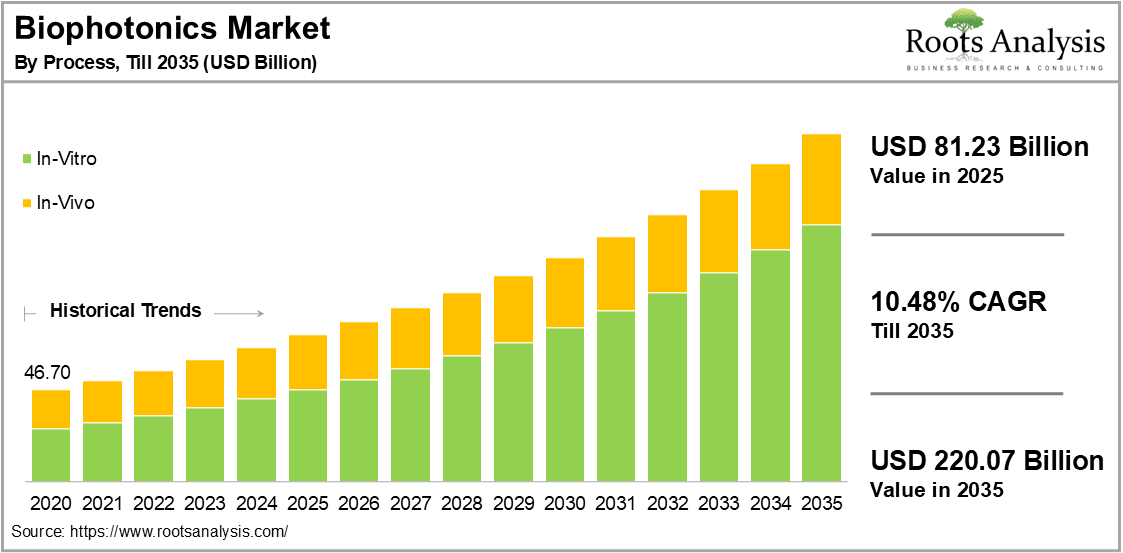
The global biophotonics market size is expected to rise from USD 81.23 billion in 2025 to USD 147.72 billion by 2030, and USD 220.07 billion by 2035, representing an overall CAGR of 10.48% till 2035.
See What’s in the Full Report - Request Your Complimentary Insights!
Biophotonics is an interdisciplinary science at the nexus of biology and photonics, involving the use of photons (as the source of light) to image, detect, and manipulate biological systems. It encompasses a wide spectrum of optical techniques that allow detailed investigation and intervention at the cellular and molecular levels without damaging the biological structures involved.
Unlike traditional diagnostic methods, biophotonics offers a non-invasive, real-time window into biological processes, enabling early disease detection and personalized treatments.
A unique aspect of biophotonics is its ability to integrate emerging innovations, such as AI-driven image analysis and advanced nanophotonic materials, which amplify diagnostic accuracy and therapeutic precision. This integration is not only expanding biophotonics’ traditional clinical applications, like early cancer detection and ophthalmic imaging, but also opening new frontiers in personalized medicine by enabling continuous, real-time monitoring tailored to individual patient profiles.
This shift is particularly vital in the context of aging populations and rising chronic disease burdens worldwide, where rapid, accurate, and patient-friendly solutions are increasingly sought. As investment surges across academia, industry, and governments, biophotonics stands as a cornerstone technology with transformative potential to redefine approaches to health, environment, and biological science in the coming decades.
Recent Developments in the Biophotonics Market
- In June 2025, Teradyne acquired Quantifi Photonics, a leader in photonic IC testing, enabling Teradyne to deliver scalable photonic integrated circuit (PIC) test solutions.
- In June 2025, Coherent showcased innovative products, technologies and thought leadership at Laser World of Photonics 2025
- In May 2025, ZEISS partnered with Alpenglow Biosciences to jointly develop an inverted light-sheet microscope and bioinformatics pipeline tailored for clinical applications.
- In April 2025, Hamamatsu Photonics unveiled a new Si APD S17353 series sensor for enhanced low light measurement.
- In April 2025, Hamamatsu Photonics and Sirona Dx (SDX) announced strategic partnership to expand technology access program.
Biophotonics Market Segmentation Insights
The biophotonics market report presents an in-depth analysis of the various companies that are involved in offering biophotonic solutions across different segments, as defined in the table below:
Biophotonics Market: Report Attributes / Market Segmentations
| Key Report Attributes | Details | |
| Historical Trend | Since 2020 | |
| Forecast Period | Till 2035 | |
| Market Size 2025 | $ 81.23 Billion | |
| Market Size 2035 | $ 220.07 Billion | |
| CAGR (till 2035) | 10.48% | |
| Process |
|
|
| Technology / Technique |
|
|
| Application |
|
|
| End User |
|
|
| Geographical Regions |
|
|
| Leading Market Players |
|
|
| PowerPoint Presentation (Complimentary) | Available | |
| Customization Scope | 15% Free Customization | |
| Excel Data Packs (Complimentary) |
|
|
Pay Only for What You Need–The Best Way to Optimize
Biophotonics Market Share Insights
In-Vitro Sub-segment Dominating the Biophotonics Market
Our biophotonics market forecast suggests the dominance of in-vitro sub-segment in the current year, with a share of 77.96%. Notably, this trend is unlikely to change in the coming years. The growth of in-vitro biophotonics instrumentation can be attributed to its critical role in disease diagnostics, biomarker detection, and pharmaceutical research.
Recent innovations in this sector include laser-based biosensing technology, such as fluorescence, optical biosensors, and Raman spectroscopy, which enable ultra-sensitive, real-time analysis of biological samples. These photonic solutions for biomedical imaging systems allow researchers and healthcare professionals to gain deeper insight into physiological and pathological processes.
Which Technology/Technique Will Have the Fastest Growth?
In the biophotonics market, the optical coherence tomography biophotonics will have the fastest growth (12.89%) during the forecast period due to their widespread use in ophthalmology for diseases like age-related macular degeneration, diabetic retinopathy, and glaucoma. Further, innovation like AI integration, handheld devices, and new imaging technologies are also supporting the optical coherence tomography market expansion.
Spectro Molecular Applications Sub-segment Dominates the Biophotonics Market
Among the applications, the spectro molecular sub-segment holds the largest market share of 27.34%. This growth is fueled by the progress in various integrated technologies and architecture (such as miniaturization, automation, and the integration of machine learning and artificial intelligence that improve the sensitivity and accuracy) of spectroscopic devices.
These technologies are crucial for molecular level diagnostics, enabling accurate detection of biochemical markers relevant for biophotonic techniques for early disease detection. Further, with the increasing popularity of precision medicine biophotonics solutions, there is a growing need for diagnostic tools which provide comprehensive molecular details. This is also playing a significant role in fueling the segment growth.
On the other hand, the see-through imaging segment is expected to witness the fastest CAGR (10.67%).
Hospitals & Clinics Dominate the End User Segment of Biophotonics Market Size
Hospitals & clinics accounted for the largest biophotonics technology market share of 43.12%, owing to the widespread adoption of biophotonics in diagnostic imaging, surgical guidance, and phototherapy.
Clinicians are further utilizing this technology in outpatient diagnostics, dermatology centers, and cancer treatment facilities, enabling faster, more accurate clinical decision-making.
On the other hand, laboratories sub-segment is expected to witness the fastest CAGR (11.23%) during the forecast period. The growth is driven by the increasing focus of North American academic institutions and national research programs on life sciences and biomedical innovation.
Which Regions are Expected to See the Highest Biophotonics Market Demand?
According to our regional analysis of biophotonics market demand, North America is likely to contribute the largest. The high demand is driven by advances in imaging technology and rising investments in research and development, that have significantly increased biophotonics adoption in emerging healthcare markets and environmental monitoring.
In fact, the North American biophotonics market exhibits dominance by capturing 34.78% of the share within the current global market. On the contrary, the biophotonics market in Asia-Pacific is set to witness the fastest CAGR (12.85%) during the forecasted period.
Want Information on Specific Region/Segment?
Biophotonics Market Trends and Key Takeaways
The “Biophotonics Market: Industry Trends and Global Forecasts, Till 2035” report features an extensive study of the current market landscape, market size, and future opportunity within the global biophotonics market forecast period. The market report highlights the efforts of several stakeholders involved in this rapidly emerging segment of the service providers industry. Key takeaways of the market report are briefly discussed below.
Competitive Landscape and Key Players in Biophotonics Market
The competitive landscape of the biophotonics market is characterized by several major global players who dominate through strong R&D, innovation, and diverse application portfolios. Key companies include Hamamatsu Photonics, Carl Zeiss, Thermo Fisher Scientific, Danaher, Coherent, and Nikon.
These leaders leverage advanced technologies such as optical coherence tomography, fluorescence imaging, and biosensors to address growing biophotonics applications in healthcare. Competition focuses on technological innovation, strategic partnerships, and expanding applications in non-invasive diagnostics, personalized medicine, and minimally invasive therapies, driving rapid market expansion.
Biophotonics Market Drivers and Challenges
What are the Main Drivers Fueling Market Growth in Biophotonics Industry?
The biophotonics market growth is due to several key drivers. Here are some significant factors contributing to this expansion:
- Rising Demand for Non-Invasive Diagnostics and Early Disease Detection: Biophotonics technologies, such as optical coherence tomography (OCT), fluorescence imaging, and biosensors, enable real-time, high-precision, and non-invasive diagnostics. The global shift toward early detection and monitoring of cancer, cardiovascular, and age-related diseases is driving demand of biophotonic imaging for early disease detection, especially as healthcare systems look for cost-effective ways to improve patient outcomes.
- Technological Advances in Photonics, Nanotechnology, and AI Integration: The integration of nanotechnology-enabled photonic devices with artificial intelligence and machine learning is further enhancing data analysis and image interpretation. They are making diagnostics faster and more accurate and supporting new applications in personalized / precision medicine.
- Aging Global Population and Prevalence of Chronic Diseases: With the world’s population over 60 years old expected to double from 12% to 22% between 2015–2050, there is growing demand for advanced diagnostic, monitoring, and therapeutic tools. Biophotonics plays a crucial role in ongoing care and disease management for the elderly, further fueling long-term market expansion.
What Challenges Limit Large-Scale Adoption of Biophotonics?
The current biophotonics market outlook suggests that players active in this domain are striving to overcome various everlasting challenges, which are as follows:
- High Costs of Devices and Advanced Systems
- Regulatory Complexities and Clinical Validation Hurdles
- Technical Challenges with Integration and Standardization
Advancements in Biophotonic Sensors for Healthcare
Advancements in biophotonic sensors for healthcare have led to highly sensitive, optical point-of-care biophotonic diagnostics that enable rapid, non-invasive detection of diseases at cellular and molecular levels.
Biophotonic Technology for Cancer Screening
Biophotonic technology plays a vital role in cancer screening, leveraging advanced imaging techniques, such as optical coherence tomography (OCT) and fluorescence imaging to enable early and accurate tumor detection without invasive biopsies.
Optical Biosensors in Biophotonic Platforms
Optical biosensors within biophotonic platforms deliver highly specific and sensitive detection of biomolecules and pathogens. This improves signal precision, enabling applications in personalized medicine and early disease screening, which further fuels the biosensors biophotonics market.
Miniaturized Biophotonic Devices for Point-of-Care Testing
- Offer portable and low-cost diagnostic solutions.
- Provide rapid turnaround times for test results.
- Utilize technologies like lab-on-a-chip biosensors.
- Played a critical role in managing outbreaks such as COVID-19.
- Enable timely and efficient disease detection outside traditional laboratory settings.
Biophotonics for Personalized Medicine Applications
- Integral to precision diagnostics through single-cell analysis and gene sequencing.
- Use AI-enhanced optical biosensors for biomarkers detection.
- Support tailored therapeutic interventions.
- Enable continuous health monitoring for personalized care.
Biophotonics Market Report Coverage
The market report presents an in-depth analysis, highlighting the capabilities of various stakeholders in the biophotonics industry, across different geographies. Amongst other elements, the market report includes:
- An Infographic Executive Summary
- Market Landscape of Leading Players
- Company Competitiveness Analysis
- Startup Ecosystem Analysis
- Value Chain Analysis
- Company Profiles
- Key Winning Strategies
- In-depth View of Recent Developments
- Mega Trends
- Unmet Needs Analysis
- Patent Analysis
- Market Forecast and Opportunity Analysis
- Porter’s Five Forces Analysis
- SWOT Analysis
Your Business is Unique–Why Shouldn’t Your Report Be?
Glossary
- Macular Degeneration: A medical condition causing loss of vision at the center of the visual field, often detected and monitored using biophotonic imaging techniques.
- Multispectral Imaging: An imaging method that captures data at different wavelengths across the electromagnetic spectrum to provide detailed biological or material information.
- Ophthalmic Imaging: Optical imaging techniques, such as OCT, used to visualize and diagnose eye structures and diseases non-invasively.
- Point-of-Care Biophotonic Diagnostics: Portable, rapid biophotonic devices used for medical testing and disease detection at or near the patient’s location.
- Raman Spectroscopy: A non-invasive optical technique that identifies molecular composition by analyzing scattered light from a sample.
- Spectroscopic Devices: Instruments that analyze light interaction with substances to determine their molecular or chemical properties, widely used in biophotonics for diagnostics.
Customization Opportunities
At Roots Analysis, we genuinely care about your success and understand that your business requirements are unique. While our market research reports provide valuable insights, we recognize that they might not cover every aspect you need to make well-informed strategic decisions. To account for that, we offer 15% free report customization tailored to your specific needs. Whether you require additional quantitative analysis, qualitative insights, or any other information related to the market report, reach out us today at: support@rootsanalysis.com


