
Lowest Price Guaranteed
Pages
190
Last Updated
December 2025
View Count
12591
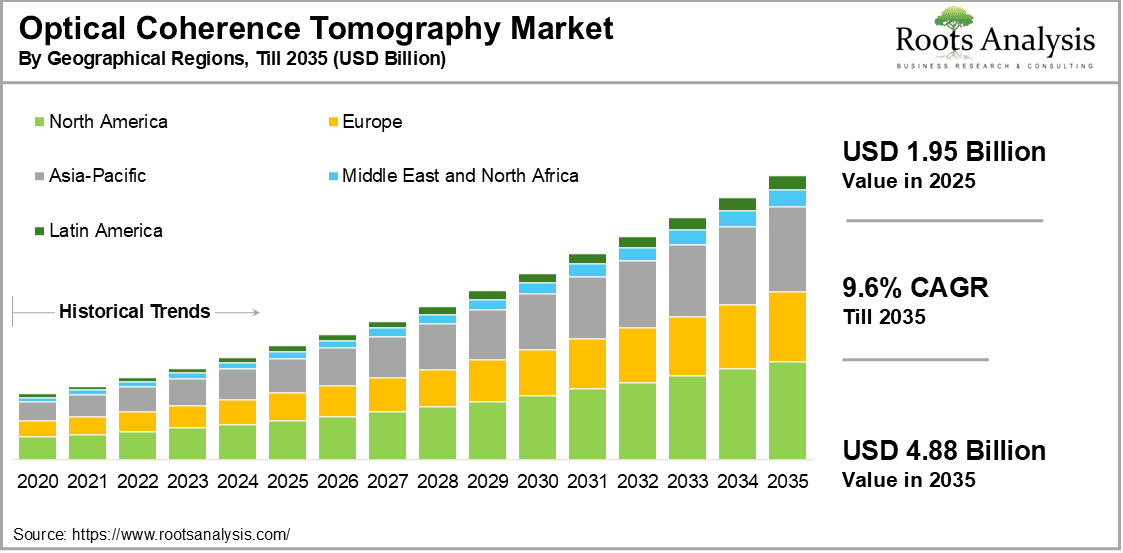
The global optical coherence tomography market, valued at USD 1.74 billion in 2024, is projected to reach USD 1.95 billion in 2025 and USD 4.88 billion by 2035, representing a CAGR of 9.6% during the forecast period.
To learn more about this report, request a free sample copy
Optical coherence tomography is a non-invasive imaging testing procedure that utilizes light waves to capture cross-sectional images of retina for detailed examination of distinct layers and eye parts. With rising prevalence of eye disorders, such as visual impairment, vision loss and diabetic retinopathy, there is a surge in the demand for optical coherence tomography for comprehensive analysis.
Optical coherence tomography is based on fiber optics, and it can be integrated with instruments, such as surgical probes, endoscopes and laparoscopes, enabling the precise image for diagnosis and monitoring. The market for optical coherence tomography is further driven by the rising demand for non-invasive medical imaging techniques for early disease diagnosis and monitoring. Additionally, optical coherence tomography plays a significant role in diagnosing disorders, such as age-related macular diseases, eye cancer and posterior vitreous detachment.
Driven by the requirement of advanced optical coherence tomography, several industrial players are aiming for advancing cutting-edge technologies for faster and accurate diagnosis. For instance, in June 2024, NIDEK launched RS-1 Glauvas Optical Coherence Tomography (an OCT system) with up to 250 kHz scan speed, deep area imaging and high-quality wide to streamlined diagnostics for retinal vascular and glaucoma.
Furthermore, several government organizations are aiming to initiate the OCT program to reduce hospital visits. For instance, in November 2024, National Health Services (NHS), England announced an OCT program to reduce annual visit for patients with diabetic retinopathy. Driven by the ongoing initiatives, it is expected that the optical coherence tomography market will remain investible and expand at a substantial pace during the forecast period.
The market report provides comprehensive information on optical coherence tomography manufacturers who are currently active across various segments of the industry as mentioned in the table below.
| Key Report Attributes | Details | |
| Historical Trend | Since 2020 | |
| Forecast Period | Till 2035 | |
| Market Size 2025 | USD 1.95 Billion | |
| Market Size 2035 | USD 4.88 Billion | |
| CAGR (Till 2035) | 9.6% | |
| Type of Technology |
|
|
| Type of Optical Coherence Tomography Device |
|
|
| Application Area |
|
|
| Geographical Regions |
|
|
| Key Companies Profiled |
|
|
| PowerPoint Presentation (Complimentary) |
Available | |
| Customization Scope | 15% Free Customization | |
| Excel Data Packs (Complimentary) |
Available | |
One of the key objectives of the optical coherence tomography (OCT) market report was to estimate the current size, opportunity, and the market growth potential, over the forecast period, till 2035. We have provided informed estimates on the likely evolution of the market for the forecast period.
The global optical coherence tomography market analysis report also features the likely distribution of the current and forecasted opportunity within the market across various segments, such as type of technology (time domain OCT (TDOCT), frequency domain OCT (FD-OCT), spatial encoded frequency domain OCT (fourier domain OCT (FDOCT) and others)), type of optical coherence tomography (catheter based OCT devices, doppler OCT devices, handheld OCT devices and tabletop OCT devices), application area (ophthalmology, cardiovascular, oncology, dermatology and others), geographical regions (North America, Europe, Asia-Pacific, Middle East and North Africa, and Latin America) and leading players.
In order to account for future uncertainties associated with some of the key parameters and to add robustness to our model, we have provided three market forecast scenarios, namely conservative, base, and optimistic scenarios, representing different tracks of industry’s evolution.
All actual figures have been sourced and analyzed from publicly available information forums and primary research discussions. The financial figures mentioned in this market report are in USD, unless otherwise specified.
Based on the type of technology, the global market is segmented into time domain OCT (TDOCT), frequency domain OCT (FD-OCT), spatial encoded frequency domain OCT (fourier domain OCT (FDOCT) and others). According to our optical coherence tomography market analysis, presently the frequency domain OCT holds 38% share of the market and is likely to remain dominant during the forecast period. Frequency domain technology offers high imaging speed up to 50 times, making it ideal for receiving large number of diagnostic images per unit area.
However, the time-domain OCT segment is likely to register a higher CAGR during the forecast period. The time-domain OCT allows examination of retinal thickness by quickly analysis of the distance between highest hyper-reflective band and internal limiting membrane. This technique is greatly adopted by ophthalmologists to diagnose retinal conditions, such as macular holes, vitreomacular traction and macular pucker, which is expected to rise its demand in the future.
This segment highlights the distribution of global market across different types of optical coherence tomography, such as catheter based OCT devices, doppler OCT devices, handheld OCT devices and tabletop OCT devices. Presently, handheld OCT devices segment is dominating the market for optical coherence tomography by holding 47% share. This can be attributed to the fact that handheld OCT devices are easy to use and combine 3D imaging with microelectromechanical systems that aid in early detection of eye disorders, including glaucoma, macular degeneration and diabetic retinopathy.
However, it is worth mentioning that doppler OCT segment is expected to register higher CAGR during the forecast period. This is primarily due to the widespread usage of doppler OCT technology in clinical areas, such as ophthalmology, gastrointestinal endoscopy, dermatology and cardiology.
This global market is categorized across different application areas, such as ophthalmology, cardiovascular, oncology, dermatology and others. Currently, the ophthalmology segment accounts for the largest optical coherence tomography market share (56%). This can be attributed to the expanding usage of optical coherence tomography for diagnosis eye disorders.
However, in the long run, the dermatology segment is likely to register higher CAGR during the forecast period. This dominance is due to the expanding usage of line-field confocal optical coherence tomography for diagnosing skin conditions, such as skin tumors.
Based on the geographical regions, the global market is distributed across North America, Europe, Asia-Pacific, Middle East and North Africa, and Latin America. Among these, North America is dominating the optical coherence tomography (OCT) market by holding 35% share. This can be attributed to the rising prevalence of eye disorders and heightened demand for advanced technologies for early diagnosis of eye-related diseases.
In Asia-Pacific, the market is expected to grow at a higher CAGR during the forecast period. This can be attributed to the growing demand for early diagnosis technologies for diagnosing eye-related diseases. Additionally, the increasing government initiatives to drive the development of advanced technologies.
The “Optical Coherence Tomography Market: Industry Trends and Global Forecasts, till 2035” market report features an extensive study of the current market landscape, market size, market share, market growth, market trends, market value, market forecast, market outlook, statistics, and future opportunities for optical coherence tomography manufacturers. Key takeaways of the market report are briefly discussed below.
Presently, the market landscape is highly competitive, featuring the presence of several small, mid-sized and large industrial players. Majority of the industrial players focus on technological innovations and integration of artificial intelligence in OCT for real-time imaging capabilities and exploring optical coherence tomography beyond eye examination.
In order to leverage competitive edge, currently market players are undertaking strategic initiatives, such as collaborations and partnerships. For instance, in December 2024, the USF Health Morsani College of Medicine, Department of Dermatology and Cutaneous Surgery entered into a collaboration with James A. Haley Veterans Hospital to implement breakthrough Line-Field Confocal Optical Coherence Tomography (LC-OCT) system to provide 3D images of skin layers for diagnosing skin cancer in real-time.
Driven by the rising partnerships, we believe this market for optical coherence tomography will remain competitive during the forecast period.
The market for optical coherence tomography is expected to be driven by the rising prevalence of eye disorders and heightened demand for early disease diagnosis technologies. Notably, optical coherence tomography plays a significant role in diagnosis eye-related disorders, such as age-related macular degeneration, diabetic retinopathy and glaucoma with higher precision, which is expected to rise its demand for early diagnosis. Additionally, the increasing demand for non-invasive technologies or non-contact technologies for eye disorder examination is likely to be a key driver for the market.
Despite high demand, the optical coherence tomography market stands to witness several challenges that may impede its growth. Some of the potential challenges include high cost associated with the implementation of optical coherence tomography. Furthermore, the optical coherence tomography system requires regular maintenance, which further limits the adoption of optical coherence tomography. Additionally, the stringent guidelines associated with approval of optical coherence tomography technologies may hinder the market progress.
The market is consistently witnessing an upward trajectory driven by the growing technological advancements and demand for OCT applications in ophthalmology beyond early diagnosis. Currently, the industrial players are focusing on the emerging trends in OCT technology, such as high-resolution cross-sectional image processing and real-time cross-sectional imaging technologies.
Additionally, the industrial players are aiming for the development of non-invasive optical techniques for diagnosis of eye cancer. These technologies help in providing images of complex tissues of the eyes where conventional imaging technologies are unable to capture images.
Furthermore, the industrial players are focusing on the development of portable optical coherence tomography devices for diagnosis wide range of applications, such as cancer diagnostics including non-melanoma skin cancer, and age-related macular degeneration.
The global optical coherence tomography market size 2025 is estimated to be USD 1.95 billion and is poised to reach USD 4.88 billion by 2035, representing a CAGR of 9.6% during the forecast period. This dominance is likely to be the result of growing exploration of coherence tomography beyond eye disorder diagnosis.
Additionally, the market players are focusing on the development of advanced optical coherence tomography. For instance, in October 2024, Siloton successfully raised £8,60,000 to develop its Akepa optical coherence tomography chip technology that aids in diagnosing eye related disorders, such as age-related macular degeneration and sight loss.
Examples of key players engaged in this domain (which have also been captured in this report) include Agfa Healthcare, Agiltron's, Abbott, BaySpec, Bausch Health, Carl Zeiss Meditec, Canon, Edmund Optics, Heidelberg Engineering, Imalux, Leica Microsystems, Michelson Diagnostics, MOPTIM, MedLumics, Metall Zug, Novacam Technologies, Nikon Instruments, Novartis, NIDEK, Optovue, OPTOPOL Technology, Topcon Medical Systems, Thorlabs and TomeyUSA.
This market report includes an easily searchable excel database of all the companies focusing on the development of optical coherence tomography systems.
The market report presents an in-depth analysis, highlighting the capabilities of various companies engaged in this domain across different segments. Amongst other elements, the market report includes:
Several recent developments have taken place in the field of optical coherence tomography. We have outlined some of these recent initiatives below.