
Lowest Price Guaranteed
Slides
176
Last Updated
February 2025
View Count
16455
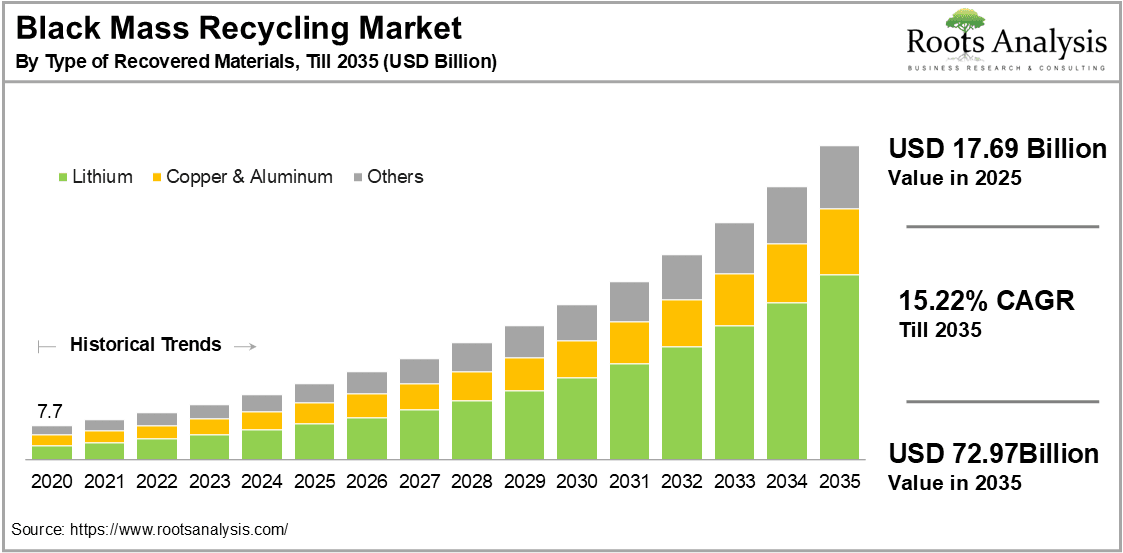
The black mass recycling market size is projected to grow from USD 17.69 billion in 2025 to USD 72.97 billion by 2035, representing a CAGR of 15.22% during the forecast period till 2035.
 |
To learn more about this report, request a free sample copy
The new research study consists of black mass recycling market and trends analysis, detailed market forecast analysis, and provide actionable strategic recommendations.
The global shift towards sustainable practices has made the recycling process more relevant especially, in the industrial sector. Worldwide, the bourgeoning adoption of electric vehicles and electronic devices continues to create a serious concern of increasing e-waste. According to a UNITAR report, the global annual generation of e-waste is growing by 2.6 million tonnes and is projected to reach 82 million tonnes by 2030. This waste significantly includes spent batteries which can have several health and environmental issues.
Black mass recycling is becoming an emerging trend in electronic waste management that can potentially tackle these challenges. Black mass recycling is a method of recovering valuable material from end-of-life batteries similar to lithium-ion, lead-acid, and others. In this recycling process, spent batteries are mechanically crushed and shredded then turned into a fine black powder-like substance called Black Mass. The impressive environmental benefits as well as recovering valuable materials are paving the path for the black mass recycling market outlook. Apart from its ecological benefits that prevent hazardous materials from entering landfills, its economic advantages through resource recovery of expensive materials like lithium, cobalt, and nickel that can support meeting demand for EV batteries, are escalating the market prospects.
Several key drivers, such as strict government regulations and initiatives to promote battery recycling and circular economy are also expected to push the market forward. By acknowledging these factors, stakeholders are actively striving to capitalize on the soaring demand for critical materials by expanding their recycling facilities. For instance, in September 2024, Cirba Solutions opened its expanded black mass facility in Ohio. The company planned to open a hydrometallurgical plant in Lancaster by 2026, aiming to produce enough battery salts to power up to 250,000 EVs. As a consequence, the increasing importance of sustainable practices in electronics manufacturing and technological advancements in lithium-ion battery recycling processes are poised to drive the market growth during this forecast period.
The black mass recycling market report presents an in-depth analysis of the various companies that are involved in offering black mass recycling, across different segments, as defined in the table below:
| Key Report Attributes | Details | |
| Historical Trend | Since 2020 | |
| Forecast Period | Till 2035 | |
| Current Market Size | $ 19.69 Billion | |
| Market Size Value by 2035 | $ 72.97Billion | |
| CAGR (Till 2035) | 15.22% | |
| Type of Battery |
|
|
| Type of Recovered Materials | ||
| Type of Technology |
|
|
| Type of Battery Source |
|
|
| Geographical Regions |
|
|
| Leading Market Players |
|
|
| PowerPoint Presentation (Complimentary) |
Available | |
| Customization Scope | 15% Free Customization | |
| Excel Data Packs (Complimentary) |
|
|
Based on the type of component, the market is fragmented into multiple types of batteries including lead-acid, lithium-ion, and nickel-cadmium. As per our black mass recycling industry analysis, the lithium-ion segment is anticipated to hold the highest (~47%) of the market share by 2035. The segment will likely lead the market due to its extensive range of applications like EVs, consumer electronics, and energy storage systems.
Apart from this, Li-ion batteries contain valuable and scarce metals similar to lithium, cobalt, and nickel which are pivotal for manufacturing new batteries. However, lead-acid batteries are also gaining traction in the market owing to their widen use in automotive and industrial equipment that provide uninterrupted power supplies. Therefore, the lead-acid battery segment is estimated to foster market growth at a steady (16.01%) CAGR during this forecast period.
On the basis of the type of recovered material, the market is split into cobalt, copper and aluminum, graphite, lithium, nickel, and others. As per market research, the lithium material is projected to capture a maximum of (~42%) of the market share by 2035. The extensive use of lithium-ion batteries is a leading factor behind the segment’s growth as these batteries are preferred for energy storage solutions for electric vehicles and energy storage systems. In addition, lithium-ion batteries are also commonly used in consumer electronics which contain plenty of lithium, cobalt, and nickel material.
Moreover, the copper and aluminum segment is likely to grow at a substantial CAGR of (17.34%) during this forecast period. During the black mass recycling, copper is the common recovered material as it is highly used in batteries. Furthermore, cobalt is one of the essential metals for lithium-ion batteries that are used with chemistries like NMC ( Nickel-Manganese-Cobalt) and NCA (Nickel-Cobalt-Aluminum) due to its role in improving battery stability and energy density, thereby, advancing the market growth.
This segment of the black mass recycling market features a variety of technologies, including hydrometallurgy, mechanical recycling, and pyrometallurgy. As per market research, hydrometallurgy technology is likely to hold the highest (~44%) of the market share by 2035. The key factor in the segment’s growth is the high recovery rates and cost-effectiveness. Hydrometallurgical methods achieve high recovery efficiencies for valuable metals like lithium, cobalt, and nickel from black mass with minimal loss. Whereas the pyrometallurgy technology segment is poised to witness a faster (17.88%) CAGR over this projection timeframe. The key aspect of the technology that involves high-temperature smelting to recover metals is commonly used for bulk metal recovery.
Based on the type of battery source, the market is divided into automotive, consumer electronics, industrial equipment, and power. According to our projection, the automotive segment is predicted to occupy the largest (~46%) of the market share and will likely continue to dominate the market till 2035. The spike in electric vehicle production is a critical aspect of this dominance. As EV adoption grows, more lithium-ion batteries reach the end of their life, creating a substantial supply of waste batteries for recycling. Also, the propelling demand for black mass recycling in electric vehicles driven by a heightened emphasis on sustainable practices to comply with stringent regulations is fueling the market growth.
While the consumer electronics segment is expected to rise at a higher CAGR of (17.55%) during this forecast period. The main factor of this growth can be the widespread use of lithium-ion batteries in consumer electronics from smartphones and laptops to wearables and power tools that provide higher energy with lightweight properties.
This segment highlights the distribution of the black mass recycling market across various geographical regions, such as North America, Europe, Asia, Latin America, the Middle East and North Africa, and the rest of the world. In terms of revenue, North America is expected to hold the largest (~45%) of the market and will likely lead the market by 2035. Furthermore, Asia is estimated to grow at an excellent CAGR of (18.05%) throughout this forecast period.
This outstanding growth can be attributed to several factors such as high battery production particularly, in China and South Korea which are globally known as the leading manufacturers of lithium-ion batteries. Along with this, the rising acceptance of electric vehicles, and increasing government initiatives promoting battery recycling and sustainability reinforce the market scope in the Asian region. For instance, in July 2024, LOHUM, an Indian battery recycling firm partnered with Recyclus to take black mass. Through this partnership, Recyclus aims to reprocess and reintegrate the recovered material into the battery manufacturing supply chain.
The “Black Mass Recycling Market, Till-2035: Industry Trends and Global Forecasts” report features an extensive study of the current market landscape, market size and future opportunities within the black mass recycling market, during the given forecast period. The market report highlights the efforts of several stakeholders involved in this rapidly emerging segment of the service providers industry. Key takeaways of the black mass recycling market report are briefly discussed below.
One of the major key drivers for the global black mass recycling market growth is the mounting adoption of electric vehicles. The perpetuated growth of the electric vehicle industry is generating an ample volume of end-of-life lithium batteries which significantly forces the need for efficient recycling to recover critical materials and minimize landfill waste. Coupled with this, the growing awareness of the environmental benefits of battery recycling such as the recovery of nickel, cobalt, and lithium from these batteries which are crucial materials, has intensified the market demand. Additionally, increasing government regulations and sustainability goals to reduce e-waste and promote a circular economy are further anticipated to foster market expansion in the upcoming years.
Numerous global corporations and emerging technology firms are changing the market landscape dynamically. Key players such as Unicore, Glencore, Fotum, BASF, and others are the leading companies in black mass recycling market which stimulate market growth through their vast distribution network, technological innovation, and strategic partnership & collaboration. These industry players are constantly striving to expand their facilities to enlarge black mass production capacity. Additionally, they are following emerging industry trends such as focus on circular economy in battery production, sustainability goals and government funding that help them to boost their competitive edge.
In spite of the advantages of the technology, the market can be confined due to some constraints such as collection & logistics issues and high recycling costs. The complication in gathering end-of-life batteries driven by scattered collection networks, and the risk of damage, explosion, or chemical leakage that may destroy batteries, is a restraining factor. Also, processes like hydrometallurgical methods and pyrometallurgical methods require excellent energy, advanced technology, and infrastructure which can lead to a high operational cost. As a result, these factors may bring some challenges in black mass recycling technology and can slow down the market growth.
With regard to regional insight, North America is anticipated to continue to dominate the market for black mass recycling due to the remarkable growth of electric vehicle market in the region. The adoption rate of electric vehicles in North America has generated a significant volume of end-of-life lithium-ion batteries that require recycling, bolstering the market demand. Also, Federal and state-level government regulations to promote battery recycling infrastructure and encourage sustainable practices are also attributed to the region’s leading position. Besides this, strategic investment and funding for technological advancement in recycling technologies and facilities substantially contribute to driving the market growth in the region.
Examples of key players involved in the market for black mass recycling (which have also been captured in this market report, arranged in alphabetical order) include Akkuser Oy (Finland), Anglo American (UK), Aqua Metals (US), BASF (Germany), Boliden (Sweden), Cirba Solutions (US), Contemporary Amperex Technology (China), Epiroc (Sweden), Fortum (Finland), Glencore (Switzerland), Heraeus Holding (Germany), Li-Cycle (Canada), Lithion Technologies (Canada), Mestro (Sweden), RecycLiCo Battery Materials (Canada), Redwood Materials (US), Tenova (Italy), Umicore (Belgium), Vedanta Resources (UK), Ecograf (Australia), and TATA Chemicals (India). This market report includes an easily searchable excel database of all the companies who have adopted the black mass recycling market.
The market report presents an in-depth analysis, highlighting the capabilities of various companies engaged in this domain, across different segments. Amongst other elements, the market report includes:
At Roots Analysis, we genuinely care about your success and understand that your business requirements are unique. While our market research reports provide valuable insights, we recognize that they might not cover every aspect you need to make well-informed strategic decisions. To account for that, we offer 15% free report customization tailored to your specific needs. Whether you require additional quantitative analysis, qualitative insights, or any other information related to the black mass recycling market, reach out us today at: support@rootsanalysis.com