


 Download Free Sample
 Buy Now
Market Size
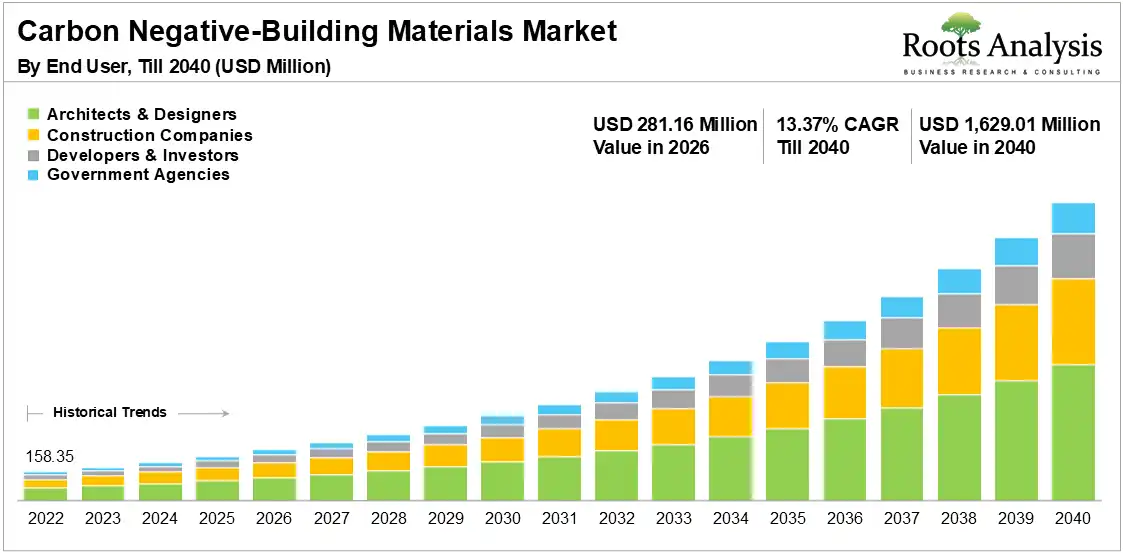
The global carbon-negative building materials market, valued at USD 243.57 million in 2025, is projected to reach USD 281.16 million by 2026 and USD 1,629.01 million by 2040, with a 13.37% CAGR during the forecast period 2026 to 2040.
See What’s in the Full Report – Request Your Complimentary Insights!
Key Market Trends and Enablers
- Rising Carbon Regulations and Building Codes: As the government is increasingly making lower embodied carbon mandatory, the adoption of carbon-negative materials is increasing, such as EU’s Levels framework.
- Corporate Net-Zero Commitments in Construction: This trend is enabling large developers and contractors, which are committed to carbon-neutrality, to have an increase in carbon-negative building materials market demand, for instance, Skanska’s carbon-negative building projects.
- Advances in Carbon Curing Technology: Improvement in CO2 curing methods for concrete enable scalable carbon capture, for instance, technologies, such as CarbonCure are expanding commercial installations.
- Growth of Bio-Based Materials R&D: Due to the rising innovations in bio-based building materials, such as hempcrete, and mycelium-based products and companies like MycoWorks producing sustainable composite, there is an improvement in cost and performance.
- Expansion of Green Finance and ESG Investment: The rising flow of funds in the market is increasing the carbon-negative building materials market growth while green bonds is increasing the sustainable infrastructure growth.
- Industry Attractiveness Index: The carbon-negative building materials market addresses a major unmet need: significantly reducing the carbon footprint of the construction sector. This emerging domain offers innovative solutions that not only decrease emissions during production and construction but also captures carbon for a long term, helping meet global climate targets and regulatory mandates for net-zero buildings. Private players have substantial capacity to get involved, ranging from startups innovating in raw material sourcing and carbon capture technologies, to large construction and manufacturing firms integrating these materials into mainstream supply chains.
Market Overview
The carbon-negative building materials market encompasses products and technologies that absorb more carbon dioxide than they emit throughout their lifecycle. This includes advanced carbon-absorbing building materials like carbon-sequestering concrete, bio-based composites, and recycled materials that contribute to climate mitigation and sustainable construction. The market offers significant opportunities to reduce the carbon footprint of building projects while aligning with growing environmental regulations and sustainability goals globally.
This market is gaining popularity due to advancements in bio-based and recycled carbon-negative materials, digital manufacturing, and carbon capture in construction, which are making carbon-negative materials increasingly viable and scalable. Growing regulatory pressure to reduce greenhouse gas emissions, along with rising consumer and corporate demand for greener buildings, is driving adoption.
According to our carbon-negative building materials market analysis, the market’s future potential is strong, supported by continuous innovation in eco-friendly composites, mineralization processes, and circular economy approaches, offering clear benefits over conventional building materials in carbon reduction and sustainability.
Pay Only for What You Need – The Best Way to Optimize
Market Share Insights
Market Share by Material Type: Mineral-Based Materials to Lead the Market Due to Due to their Seamless Integration with Existing Construction Practices
- In the carbon-negative building material market, mineral-based materials, especially carbon-negative concrete, are currently having the highest share (41.5%) while also witnessing the fastest CAGR during the forecast period.
- Unlike bio-based alternatives requiring supply chain overhauls, carbon-negative concrete serves as a drop-in replacement for traditional concrete, enabling rapid adoption without disrupting workflows or retraining workers. This is leading to massive market growth for this segment.

Market Share by Key Geographical Regions: Asia-Pacific to Have the Highest Market Share Due to Early Adoption of Green Building Standards
- The carbon-negative building materials market forecast suggests that Asia-Pacific is expected to be the region with the highest market share. On the other hand, North America will be witnessing the fastest CAGR in the forecasted period.
- Factors such as rapid industrialization, rising growth of green building materials market, and strong government incentives for carbon-negative construction materials are fueling the market growth of the region. Further, substantial investments in low-carbon infrastructure across emerging economies like China, India, Indonesia, and Vietnam, smart city projects, stricter building codes, and rising environmental awareness drive high demand for materials like carbon-negative concrete.
Want Information on Specific Region / Segment?
Research Milestones Augmenting Carbon-Negative Building Material Industry
- In May 2025, Low Carbon Materials, a UK-based startup, achieved the PAS 2080 certification validating the sustainability credentials of OSTO, a carbon-negative aggregate derived from waste streams and biochar. The company also secured 3 million in growth funding, in September 2024, to accelerate expansion and production of OSTO.
- In February 2025, Organisation for Economic Co-operation and Development (OECD), issued a policy roadmap for zero-carbon buildings which details government plans to standardize embodied carbon reporting, financially support carbon-negative material pilot deployments, and set incremental carbon reduction targets for new construction through 2030.
- In October 2024, Microsoft announced the construction of its first datacenters using mass timber and carbon-negative composites, signaling investment in scalable low-embodied-carbon structural materials as well as fueling the cross-laminated timber market.
Carbon-Negative Building Material Market Ecosystem
The current landscape of the sustainable carbon-negative building materials market is strongly influenced by both leading academic institutes and innovative companies, each playing critical roles that complement one another.
Academic institutions are pioneering groundbreaking research on bio-based binders, carbon sequestration mechanisms in concrete, and sustainable material synthesis methods. Their contributions drive fundamental innovations that enhance the performance and environmental impact of CNBMs.
Meanwhile, companies dominate the commercialization front, translating these discoveries into scalable, market-ready products and leveraging advanced production technologies.

Top 5 Academic Institutes Driving Innovation
Northwestern University
Northwestern University in the USA is a front-runner in scalable carbon-negative construction materials.
Key Contribution: In March 2025, researchers of this university, in collaboration with Cemex, developed a novel method to create carbon-negative materials using seawater and electricity.
In this context, Alessandro Rotta Loria, the professor leading this research, stated that “Cement, concrete, paint, and plasters are customarily composed of or derived from calcium- and magnesium-based minerals, which are often sourced from aggregates, what we call sand. Currently, sand is sourced through mining from mountains, riverbeds, coasts and the ocean floor. In collaboration with Cemex, we have devised an alternative approach to source sand, not by digging into the Earth but by harnessing electricity and CO2 to grow sand-like materials in seawater.”
Helmholtz Centre for Environmental Research
A Germany-based pioneer in carbon-negative building materials with multiple carbon dioxide removal technologies.
Key Contribution: In July 2025, researchers from this university have developed CarbonFiberStone which combines bio-based carbon fiber, enhanced rock weathering, biochar insulation for cost-effective carbon-negative building panels.
University of South California
This USA based University is an innovator of coral-inspired carbon-negative construction composites.
Key Contribution: In March 2025, the research team at USC created 3D-printed polymer scaffolds which mimicked coral’s organic templates. These materials were fire-resistant mineral polymer composites with carbon-negative footprints.
Aalto University and VTT
Situated in Finland, these universities are innovators in bio-based and mineral-based cement alternatives.
Key Contribution: In October 2024, researchers at Aalto University and VTT Technical Research Centre successfully developed a bio-based binder material which can significantly reduce carbon emissions from infrastructure construction.
University of Pennsylvania
This USA based university is a pioneer in developing integrated building systems designed to capture and store carbon, aiming for a fully carbon-negative architecture.
Key Contribution: In June 2022, Penn received $2.4 million funding for multidisciplinary research focused on turning entire buildings into carbon storage systems through novel construction materials and design; ongoing collaborations with material scientists and engineers.
Top 5 Players Pioneering Progress in Carbon-Negative Building Materials Market
Plantd
Based in USA, Plantd is an advanced production tech company transforming grass into carbon-negative building materials.
Key Contribution: In September 2025, the company raised $22M to scale carbon-negative materials and transform waste stream into new market growth. The raise doubles Plantd’s valuation since its Series A and marks a pivotal milestone in the company’s mission to redefine sustainability through American-made innovation.
Adaptavate
Based in Australia, Adaptavate is a low-carbon construction technology innovator.
Key Contribution: In April 2025, the company secured 2.7 million in a pre-series A round to accelerate global scale-up of low-carbon construction technology.
Mango Materials
A California-based biomanufacturing company, Mango Materials is an innovator in carbon-negative materials using microbes.
Key Contribution: In July 2024, in collaboration with Lawrence Berkeley National Lab, the company converted methane into biodegradable polymer called polyhydroxyalkanoate by using a special mixture of methane-eating microorganisms.
GreenJams
Based in India GreenJams is an incubated startup developing carbon-negative bricks.
Key Contribution: In December 2022, GreenJams became the world’s first construction materials manufacturer to make carbon-negative building brick, “Agrocrete”, made of crop residues and industrial by-products.
National Renewable Energy Laboratory (NREL)
Based in USA. NREL is a leader in developing technologies to transform buildings into carbon sinks.
Key Contribution: In July 2022, NREL was selected to receive over $5.4 million from the U.S. Department of Energy Advanced Research Projects Agency-Energy (ARPA-E) for the development of technologies that transform buildings into carbon storage structures.
Have Questions? Let’s Get Them Answered.
Investor’s Edge
Roots Analysis’ View on Investment Opportunities in Carbon-Negative Building Materials Industry
Investing in the carbon-negative building materials market offers promising opportunities but requires careful consideration of its emerging, specialized nature. Here are key strategic insights for potential investors:
- Carbon-Negative Building Materials Market Growth Driven by Regulatory Policies: Stringent policies and building codes worldwide are increasingly mandating carbon footprint management and reductions and favoring carbon-negative or low-carbon insulation market. Investors benefit from early positioning as widespread adoption becomes mandatory.
- Climate Impact and ESG: Investing aligns with environmental, social, and governance (ESG) goals, increasingly prioritized by institutional investors and corporate clients demanding sustainable supply chains and green construction practices. Additionally, the positive impact of carbon-sequestering concrete on building materials market is also fueling the growth.
- Technological Innovation: Emerging materials such as carbon-sequestering concrete, bio-based composites, and waste-derived components are transitioning from R&D to commercial scale, offering disruptive innovation with substantial market adoption potential.
Market Access Challenges
Lack of Awareness and Education
Many architects, engineers, contractors, and developers remain unfamiliar with the range and applications of carbon-negative materials. Overcoming this knowledge gap requires education, training, and demonstration projects to build trust and acceptance within the industry.
Building Codes and Standards
Existing building codes and standards often lag behind innovative carbon-negative materials, creating hurdles in certification and regulatory approval. New entrants must navigate evolving regulatory frameworks and contribute to code updates to ensure market access.
Challenges in Carbon-Negative Building Materials Supply Chain and Certification
Establishing reliable, scalable supply chains is challenging due to limited production capacity, sustainable raw material sourcing, and logistics. Without robust supply networks, delivering consistent quality and volume at competitive prices remains difficult.
Market Segmentation
Carbon-Negative Building Materials Market: Scope of the Report
| Key Report Attributes | Details | |
| Historical Trend | Since 2020 | |
| Forecast Period | Till 2040 | |
| Market Size 2026 | $ 281.16 Million | |
| Market Size 2040 | $ 1,629.01 Million | |
| CAGR (Till 2040) | 13.37% | |
| Segments Covered |
|
|
Market Segments
Based on the research, we have segmented the carbon-negative building materials market into material type, application, end user, geographical regions, and key players.
Market Share by Material Type
- Bio-based Materials
- Hybrid Materials
- Mineral-based Materials
- Recycled Materials
Market Share by Application
- Commercial Buildings
- Industrial Buildings
- Residential Buildings
Market Share by End User
- Architects & Designers
- Construction Companies
- Developers & Investors
- Government Agencies
Market Share by Geographical Regions
- North America
- US
- Canada
- Mexico
- Rest of North America
- Europe
- Austria
- Belgium
- Denmark
- France
- Germany
- Ireland
- Italy
- Netherlands
- Norway
- Russia
- Spain
- Sweden
- Switzerland
- UK
- Rest of Europe
- Asia-Pacific
- Australia
- China
- India
- Japan
- New-Zealand
- Singapore
- South Korea
- Rest of Asia-Pacific
- Latin America
- Brazil
- Chile
- Colombia
- Venezuela
- Rest of Latin America
- Middle East and Africa (MEA)
- Egypt
- Iran
- Iraq
- Israel
- Kuwait
- Saudi Arabia
- UAE
- Rest of MEA


