
Lowest Price Guaranteed
Slides
187
Last Updated
March 2026
View Count
14969
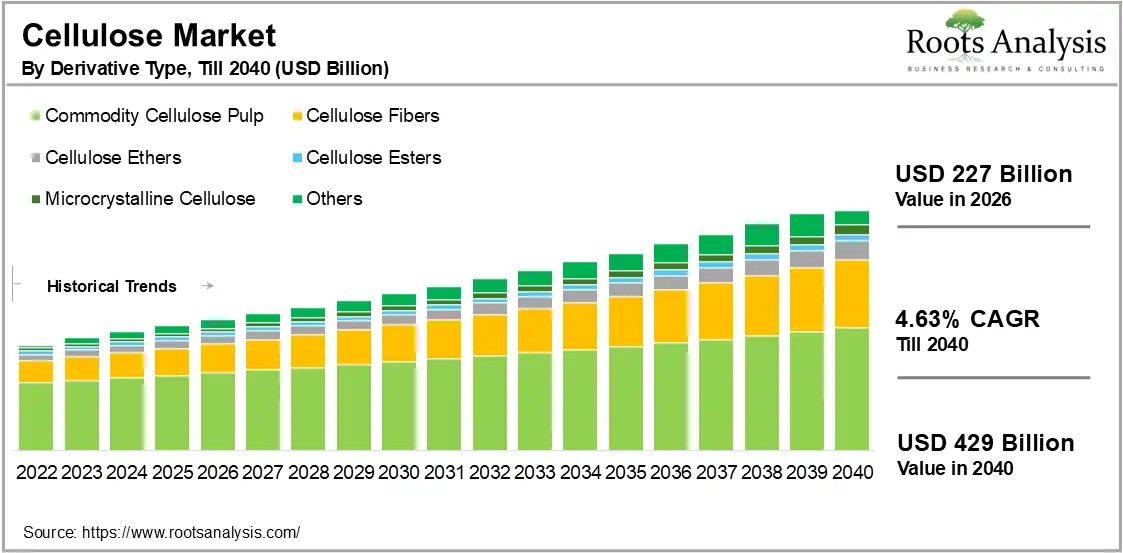
The global cellulose market is expected to grow from USD 227 in 2026 billion to USD 429 billion by 2040, representing a higher CAGR of 4.63% during the forecast period.
 |
To learn more about this report, request a free sample copy
The new market study report provides in-depth details on industry size, trends, growth scenarios, drivers, challenges, opportunities, SWOT analysis and value chain analysis.
In recent years, the demand for cellulose has significantly increased in various industrial sectors that is anticipated to propel the market in the upcoming years. Cellulose is a long-chain polymer naturally produced from plant wood pulp and widely used across multiple industrial applications. Being an eco-friendly, breathable and durable material, it is widely adopted in textile and other industries for manufacturing apparel and other cellulose based products.
In addition to the textile industry, cellulose derivatives such as cellulose fiber, cellulose ethers, cellulose esters and microcrystalline cellulose have become a primary choice in many food manufacturing companies. It acts as an ice cream binder, emulsifier, fat replacer in gels and also an important part of digestive system.
Furthermore, cellulose fiber is immensely popular as biodegradable packaging and non-woven materials. The cosmetic industry has also taken a shift towards cellulose material for the manufacturing of beauty and skin care products , which is an essential growth driver for the market.
Given the growing demand for cellulose across various industries, several industrial leaders are focusing on the development of cellulose based material that is sustainable, cost-effective and biodegradable. Considering the key trend, Birla Cellulose revealed Birla Viscose (Intellicolor) at Bharat Text event.
This advanced dyeing process uses basic or cationic dyes, eliminating the requirement of soda ash and salt in the dyeing process of textiles. Similarly, various industrial leaders are stepping ahead to develop next generation cellulose, regenerated cellulose and its derivatives that can be used for variety of applications in paper, textile and other industry. Owing to the ongoing efforts, we believe the cellulose market will grow at a substantial rate during the forecast period.
| Key Report Attributes | Details | |
| Historical Trend | Since 2022 | |
| Base Year | 2025 | |
| Forecast Period | 2026-2040 | |
| Market Size 2026 | $227 billion | |
| Market Size 2040 | $429 billion | |
| Market Growth Rate |
CAGR of 4.63% from 2026-2040 |
|
| Distribution by Derivative Type |
|
|
| By Source |
|
|
| Distribution by Modification Type |
|
|
| Distribution by Manufacturing Process |
|
|
| Distribution by Purity |
|
|
| Distribution by Application |
|
|
| Company Size |
|
|
| Business Model |
|
|
| Distribution by End User |
|
|
| Key Geographical Region |
|
|
| Key Companies Profiled |
(A full list of key companies captured is available in the report) |
|
| PowerPoint Presentation Complimentary) |
Available | |
| Customization Scope | 15% Free Customization | |
| Excel Data Packs (Complimentary) |
|
|
Based on the type of derivatives, the cellulose market is segmented into commodity cellulose pulp, cellulose fibers, cellulose ethers, cellulose esters, microcrystalline cellulose, nitrocellulose and others. According to our projection, presently, commodity cellulose pulp accounts for the highest share of the market. The highest share is likely due to the extensive use of cellulose in various industries as packaging material and products. Owing to the growing shift towards microcrystalline cellulose, we believe this segment will grow at a higher CAGR rate in the upcoming years.
Based on the type of source, the global cellulose market is segmented into natural and synthetic. According to our market study, currently natural sources of cellulose account for the largest share of the market. This highest share is attributed to the high demand for eco-friendly and biodegradable material for the manufacturing of apparel, paper and packaging material. It is worth noting that recently the demand for natural fiber has significantly increased in pharmaceutical and personal care industry. The key trend highlights the ongoing shift towards the growing demand for advanced natural cellulose which is anticipated to grow at a higher CAGR in the long run.
Based on the modification type, the global cellulose market is segmented into modified and unmodified cellulose. On the basis of our projection, currently modified cellulose accounts for the highest share of the market. Modified cellulose is widely adopted in the food, cosmetic and pharmacy industry.
This is likely due to modifications such as cross-linking, etherification, and esterification increases its characteristic property making it suitable for wide range of applications. Owing to the specialized property, it is used as stabilizer, thickener, film-formers and binders. It is worth noting here that with the growing shift towards modified cellulose, this segment is likely to grow at a higher CAGR during the forecast period.
Based on the modification process, the global cellulose market is segmented into viscose, esters and ethers. According to our market study, currently viscose accounts for the highest share of the market. The highest share is likely due to the increasing demand for viscose or rayon in the textile industry for manufacturing apparel. It is highly breathable, versatile and gives a silk-like feel. It is worth noting that the viscose segment will grow at higher CAGR during the forecast period. The highest growth CAGR is due to the fact that viscose is a highly stable, cost-effective and versatile substance, which makes it ideal option for wide range of applications.
Based on the purity, the global cellular market is segmented into above 95%, 85%-95% and below 85%. Each form of cellulose catered to the different form of industrial sectors. According to our projection, presently, above 95% pure cellulose accounts for the highest share of the market. This is likely due to the growing use of pure form of cellulose in pharmaceutical and paper industry. However, in the long run, the growth trend is likely to remain unchanged.
This segment highlights the distribution of global cellulose market in food, pharmaceutical, paper, cosmetics, textile, and paint and coating based on application. According to our market analysis, currently, the paper industry accounts for the highest share of the market. The highest growth share is due to the fact that cellulose is a fundamental raw material for the paper industry.
Cellulose is used for manufacturing high quality paper, drafting paper and printing paper which further raises the demand for these materials in the paper industry. However, in the long run, pharmaceuticals will grow at a higher CAGR during the forecast period owing to the growing usage of cellulose derivatives in the manufacturing of tablets.
This segment highlights the distribution of global cellulose market in large enterprises and small and medium enterprises based on company size. Based on our market study, currently, large enterprises account for the highest share of the market. The largest growth share is due to the increasing development efforts for the manufacturing of cellulose derivatives to expand its usage across various other applications. Notably, these large companies will dominate the market during the upcoming years driven by their broad portfolio and ability to expand their distribution across the globe.
This segment highlights the distribution of global cellulose market in textile industry, pharmaceutical industry, cosmetic industry, paper industry, and paint and coatings manufacturers based on end user. Based on our market analysis, currently the paper industry accounts for the largest share of the market. The largest share is likely to be the result of high demand for cellulose in the paper industry. It is interesting to note here that cellulose is the basic material for the production of paper and there is a high demand for paper-based products made with cellulose such as tissues, napkins and wet wipes.
This segment highlights the distribution of global cellulose market into North America, Europe, Asia-Pacific, Latin America, Middle East and North Africa and the rest of the world based on the key geographical regions. According to our analysis, currently Asia-Pacific occupies the largest share of the market. Asia is considered as the epicenter for industrial activities such as chemicals, textiles and production which rises the demand for cellulose in the Asian market. The market for cellulose in North America is likely to grow at a higher CAGR owing to the growing R&D process in cellulose applications across pharmaceutical and paper industry.
Currently, the market landscape features the presence of several well-established and new entrants with the required expertise to manufacture cellulose. Overall, the cellulose market seems highly fragmented into small, medium-sized and large companies. In order to leverage a competitive edge, the key players of the industry are taking key initiatives such as collaboration, partnerships and acquisition to expand their product portfolio of cellulose derivatives.
For instance, in May 2025, Colorcon and ASHA Cellulose launched ASHAKOTE, a new 30% aqueous ethyl cellulose dispersion. The product is designed as a breakthrough excipient for taste-masking and sustained-release applications in pharmaceutical and nutraceutical formulations.. As more players enter into the partnership, we believe that cellulose market will expand at a steady rate during the forecast period.
Cellulose is a plant-based material that naturally degrades in the environment, making it an eco-friendly alternative to synthetic materials. Being an eco-friendly material, various industrial leaders have begun to use cellulose for manufacturing products which is anticipated to be a key driver of the market. Furthermore, government organizations are enforcing strict guidelines to use sustainable packaging products for reducing carbon footprints.
These guidelines have shifted industries towards bio-based chemical products like cellulose which are anticipated to be a key driver of the cellulose market growth. In addition, the growing demand for cellulose fiber, ester and ethers across textile, food, pharmaceutical and paper industry has further raised the demand for these products which is likely to drive the market at steady rate.
Some of the significant challenges that impede the growth of cellulose market is growing competition from other synthetic materials and environmental concerns. Synthetic materials such as nylon and polyester are frequently being adopted due to lower cost and higher durability as well as resistance to shrinkage property. Owing to its exclusive properties, synthetic material is gaining the attention of industrial leaders such as packaging providers and textile industry. It is worth noting here that cellulose based products have been derived from plants’ wood pulp. Due to growing environmental concerns such as deforestation and climate change, limited availability of raw material may restrain market growth.
Some of the potential opportunities that are accelerating the growing of the cellulose market are the growing shift towards bio-based chemicals such as acetone, butanol, bioplastics and ethanol in various industries. It is worth noting that cellulose based products can be recycled easily which significantly reduces the wastage amount that is sent for landfilling. Moreover, recycled material reduces carbon emission and energy commission, which further supports the demand for cellulose in different industries. Therefore, with growing focus on circular economy initiatives, several industrial leaders are increasing their initiatives for the manufacturing of next generation cellulose which is anticipated to bring enormous opportunities for the industrial leaders to drive innovation in this field.
Examples of key players who are currently active in the cellulose industry (which have also been captured in this market report, arranged in alphabetical order) include Ashland, Akzo Nobel N.V., Borregaard, CP Kelco, China RuiTai International Holdings, Dow, DKS, Daicel Corporation, Fenchem, J. RettenmaierandSöhne GmbH + Co.Kg, LOTTE Chemical Corporation, Lotte Fine Chemical, MAZRUI INTERNATIONAL, Reliance Cellulose Products, Rayonier, Shin-Etsu Chemical, SE Tylose GmbH and Co. Kg, Shandong Head, Tembec and. Zhejiang Kehong Chemical. This market research report includes an easily searchable Excel database of all the companies providing cellulose products worldwide.
Several recent developments have taken place in the field of cellulose market. We have outlined some of these recent initiatives below. These developments, even if they took place post the release of our market report, substantiate the overall market trends that have been outlined in our analysis.