
Lowest Price Guaranteed
Slides
179
Last Updated
February 2026
View Count
14216
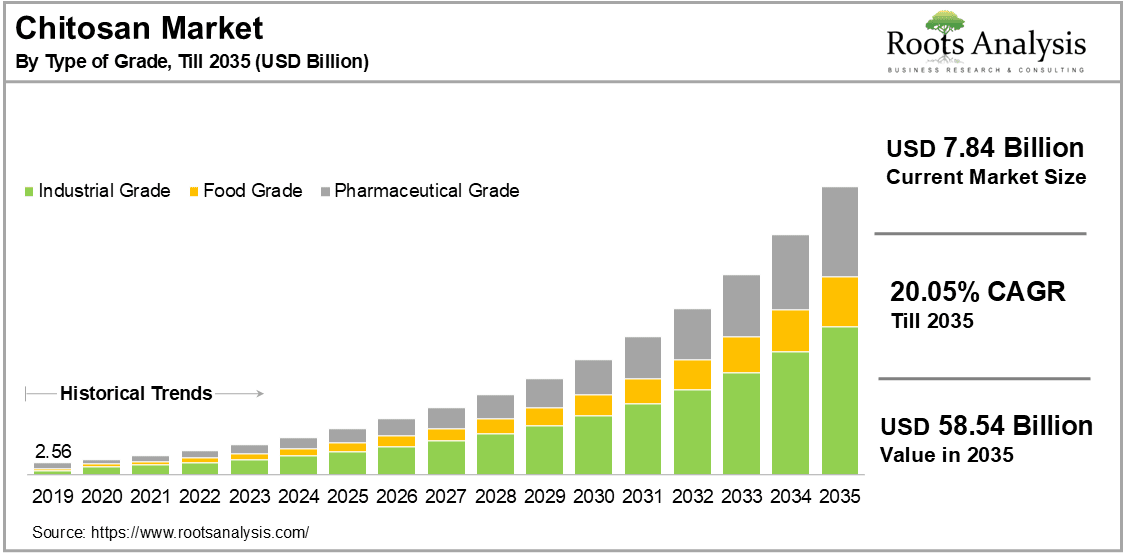
The global chitosan market is estimated to grow from USD 7.84 billion in 2024 to USD 58.54 billion by 2035, representing a higher CAGR of 20.05% during the forecast period.
 |
To learn more about this report, request a free sample copy
The new research report highlights the in-depth details of industry size, growth trends, drivers, challenges, SWOT analysis, value chain analysis and future opportunities.
Chitosan is gaining popularity in commercial sectors such as pharmaceutical, food & beverage and agriculture owing to its characteristics properties such as anticoagulant, biodegradability and biocompatibility. It is a polysaccharide (a sugar bio-product) that is obtained from chitin present in the outer skeleton of shellfish, including lobster, crab and shrimp. This fibrous substance has very appealing properties comprising non-toxicity, hydrophobicity and has reactive amino (-NHs and hydroxyl (-OH) ground in its chemical structure, making it ideal for wastewater treatment.
The food & beverage industry also adopted chitosan as a thickening and clarifying agent that further raises its demand. In order to fulfill the growing demand, various industrial leaders have taken initiatives for the expansion of their product portfolio and manufacturing capacities. It is interesting to note here that recently researchers have developed chitosan nanoparticles which can be used as a novel technique for gene transformation within plant tissues. Similarly, a lot of research initiatives have been taken by industrial leaders to explore its application across various industries. Owing to the ongoing efforts and growing demand in industries, we believe the chitosan market will grow at a steady rate during the forecast period providing enormous opportunities to established and new entrants to make considerable investment.
The market study report highlights the presence of industrial leaders who are active in this growing industry across various segments as mentioned in the table below.
| Key Report Attributes | Details | |
| Historical Trend | 2019-2023 | |
| Base Year | 2023 | |
| Forecast Period | 2024-2035 | |
| Market Size 2024 | $7.84 billion | |
| Market Size 2035 | $58.54 billion | |
| Market Growth Rate | CAGR of 20.05% from 2024-2035 | |
| Distribution by Source |
|
|
| Grade |
|
|
| Distribution by Application |
|
|
| Company Size |
|
|
| Business Model |
|
|
| Distribution by End User |
|
|
| Key Geographical Region |
|
|
| Key Companies Profiled |
(A full list of key companies captured is available in the report) |
|
| PowerPoint Presentation (Complimentary) |
Available | |
| Customization Scope | 15% Free Customization | |
| Excel Data Packs (Complimentary) |
|
|
One of the key objectives of this market report is to provide a detailed market forecast analysis in order to estimate the existing market size and future opportunities for chitosan market players over the next decade. Based on several parameters, likely industry trends, partnerships, and primary validation, we have provided an informed estimate of the market evolution during the forecast period 2024-2035. The market report also features the likely distribution of the current and forecasted opportunity within the chitosan market based on various relevant parameters, such as distribution by Source (Crabs, Prawns, Shrimps, Squids and Others), Grade (Industrial Grade, Food Grade and Pharmaceutical Grade), Application (Waste Water Treatment, Cosmetic Products, Dietary Supplements, Pharmaceutical and Biomedical Products, Food & Beverages, Biopesticides and Other), Company Size (Large Enterprises, Small and Medium Enterprises), Business Model (B2B, B2C and B2B2C), End User (Agriculture, Pharmaceutical, Dietary Supplement, Cosmetics, Water Treatment and Others) and Geographical Region (North America, Europe, Asia-Pacific, Latin America, Middle East and North Africa and Rest of the World); Industry Size and Future Trends.
In order to account for future uncertainties with some of the key parameters and to add robustness to our model, we have provided three market forecast scenarios, namely conservative, base, and optimistic scenarios, representing different tracks of the industry's evolution.
All actual figures have been sourced and analyzed from publicly available information forums and primary research discussions. The financial figures mentioned in this market report are in USD unless otherwise specified.
This segment highlights the distribution of global chitosan market into crabs, prawns, shrimps, squids and others based on type of source. In our market study analysis, Roots Analysis authors found that currently shrimps are holding the largest share of the market. The highest share is likely because shrimp shells waste is present in abundance and is a primary source for chitosan. Moreover, the lower cost of shrimp shell and eco-friendly nature made it the first choice for the manufacturing of cosmetic additives, water treatment and textile treatment to reduce antimicrobial activity. However, in the long run, squid-based chitosan is estimated to grow at a lucrative CAGR. This can be attributed to the higher biocompatibility, molecular weight and higher degree of acetylation that makes it an excellent option for the production of pharmaceutical products and biomedical research.
On the basis of grade type, the global chitosan market is segmented into industrial grade, food grade and pharmaceutical grade. Based on our projection, researchers predicted that currently industrial grade chitosan holds the highest share of the market. Chitosan is extensively used in wastewater treatment and the food & beverage industry as clarifying agent which increases its demand in these sectors. Furthermore, the trend towards natural preservatives and growing awareness of environmental concerns are the major factors for its dominance. The pharmaceutical grade chitosan will grow at a higher CAGR during the forecast period. This can be attributed to its widespread adoption for the production of drug delivery molecules and tissue engineering.
This segment highlights the segmentation of the chitosan market into wastewater treatment, dietary supplement, cosmetic products, dietary supplements, pharmaceutical and biomedical products, food & beverages, biopesticides and other. In our market analysis, Roots Analysis researchers predicted that wastewater treatment occupies the highest share of the market. This can be attributed to the growing use of chitosan as a flocculant to reduce microbial contamination from municipal wastewater. It is worth noting here that key players like G.T.C Bio Corporation and Primex are offering high quality chitosan to municipal wastewater management plants. However, in the long run, the demand for chitosan to manufacture pharmaceutical and biomedical products is likely to increase driven by its unique characteristic properties such as biocompatibility and biodegradability. The growth has been fueled by the increasing demand for chitosan for wound care and tissue engineering, which is anticipated to drive this segment at higher CAGR during the upcoming year.
One the basis of company size, the global chitosan market is segmented into large enterprises and small and medium enterprises. According to our projection, currently large enterprises account for the highest share of the market. This can be attributed to the increasing R&D efforts, extensive product portfolio and large-scale production capabilities of large players. Driven by the growing demand, various startup companies are also proliferating into the chitosan market, which is estimated to show lucrative growth potential during the upcoming years and is likely to expand at a steady CAGR. Advanced Biopolymers AS and Panvo Organic are some of the leading startup companies who are taking initiatives to accelerate the production of chitosan.
This segment highlights the distribution of the global chitosan market into North America, Europe, Asia-Pacific, Latin America, Middle East and North Africa and the rest of the world. On the basis of our recent analysis, currently North America accounts for the highest share of the market. This dominance is likely due to the growing demand for bio-derived cosmetics or skin care products. In addition to consumer demand for organic skincare products, North American government is taking considerable initiatives for water purification using naturally derived non-toxic products like chitosan which is expected to drive the demand for the chitosan-based material in this region. Further, the market for chitosan in Asia-Pacific is likely to grow at a higher CAGR during the upcoming years. This can be attributed to the increasing cosmetic industry that is using chitosan for the manufacturing of skin and hair care products. Additionally, the Asian countries like India, China and Japan are making huge investment in bio-derived chemicals for the treatment of municipal wastewater.
The “Global Chitosan Market Forecast Till 2035, Distribution by Source (Crabs, Prawns, Shrimps, Squids and Others), Grade (Industrial Grade, Food Grade and Pharmaceutical Grade), Application (Waste Water Treatment, Dietary Supplement, Cosmetic Products, Pharmaceutical and Biomedical Products, Food & Beverages, Biopesticides and Other), Company Size (Large Enterprises, Small and Medium Enterprises), Business Model (B2B, B2C and B2B2C), End User (Agriculture, Pharmaceutical, Cosmetics, Water Treatment and Others) and Geographical Region (North America, Europe, Asia-Pacific, Latin America, Middle East and North Africa and Rest of the World); Industry Size and Future Trends; report features an extensive study of the current market landscape, market size and future opportunity within the chitosan industry, during the given forecast period. The market report highlights the efforts of several stakeholders involved in this rapidly emerging segment of the service providers industry. Key takeaways of the chitosan market report are briefly discussed below.
Presently, the chitosan market landscape features the presence of several well-established and new entrants with required expertise and technological support. These key companies are practicing strategic initiatives for the expansion of the chitosan portfolio to target a wide range of industrial applications. In order to maintain a competitive edge, several small, medium size and large companies are making massive investment and entered into collaboration aiming to expand their product range. For instance, Advanced Biopolymers is a leading chitosan manufacturing company who is currently focusing on the production of chitosan for life science applications including drug delivery vehicle, wound care and sodium hydroxide (a key ingredient of tablets). As more market players enter into the competitive market, we believe the industry will grow at a substantial rate during the projected period.
Some of the top drivers of the market include growing demand for chitosan in wastewater management and pharmaceutical industry. Chitosan can act as a coagulating and flocculating agent, which is why wastewater treatment plants used it for reducing microbial contamination. Moreover, pharmaceutical companies are adopting chitosan for the drug delivery systems and wound care products, which is anticipated to be a key driver for the market.
Despite of the growing demand, the chitosan market is witnessing challenges that may impact its growth during the upcoming years. Some of the top challenges involve high production costs and growing competition from synthetic material. It is worth noting that the extraction process of chitosan is complex, and it requires high-end technical support as well as skilled labor which enhances the overall cost of production. In addition to high cost, there are various inexpensive alternatives of chitosan available in the market which disrupt its widespread adoption.
With growing focus on environmentally friendly alternatives for the development of a wide range of products, currently key players of this industry are expanding their research on chitosan to explore new applications. It is worth noting that chitosan is a bio-based product with higher biodegradability and antimicrobial property which makes it the best option for the development of biopesticides. In addition to the agriculture sector, chitosan has been widely adopted in cosmetic industry, food & beverage and pharmaceutical industry, which is opening new avenues for industrial leaders to drive innovation in this domain.
Examples of key companies involved in the chitosan market (which have also been captured in this market report, arranged in alphabetical order) include Advanced BIOPOLYMERS AS, Agratech, Austanz Chitin, CarboMer, Chitolytic, DuPont Corporation, Golden-Shell Pharmaceuticals, GTC Bio Corporation, Heppe Medical Chitosan GmbH, KIMICA Corporation, Kitozyme, Kraeber & Co. GmbH, Meron Group, Marshall Marine Products, Primex EHF, Panvo Organics, Qingdao Haijia Biology and Technology, Tidal Vision, Xianju Tengwang Chitosan Factory and Zhejiang Aoxing Biotechnology.
Several recent developments have taken place in the chitosan market. We have outlined some of these recent initiatives below. These developments, even if they took place post the release of our market report, substantiate the overall market trends that have been outlined in our analysis.
The market report presents an in-depth analysis, highlighting the capabilities of various companies engaged in this domain across different segments. Amongst other elements, the market report includes:
At Roots Analysis, we genuinely care about your success and understand that your business requirements are unique. While our market research reports provide valuable insights, we recognize that they might not cover every aspect you need to make well-informed strategic decisions. To account for that, we offer 15% free report customization tailored to your specific needs. Whether you require additional quantitative analysis, qualitative insights, or any other information related to the chitosan market, reach out to us today at support@rootsanalysis.com