


 Download Free Sample
 Buy Now
Market Size
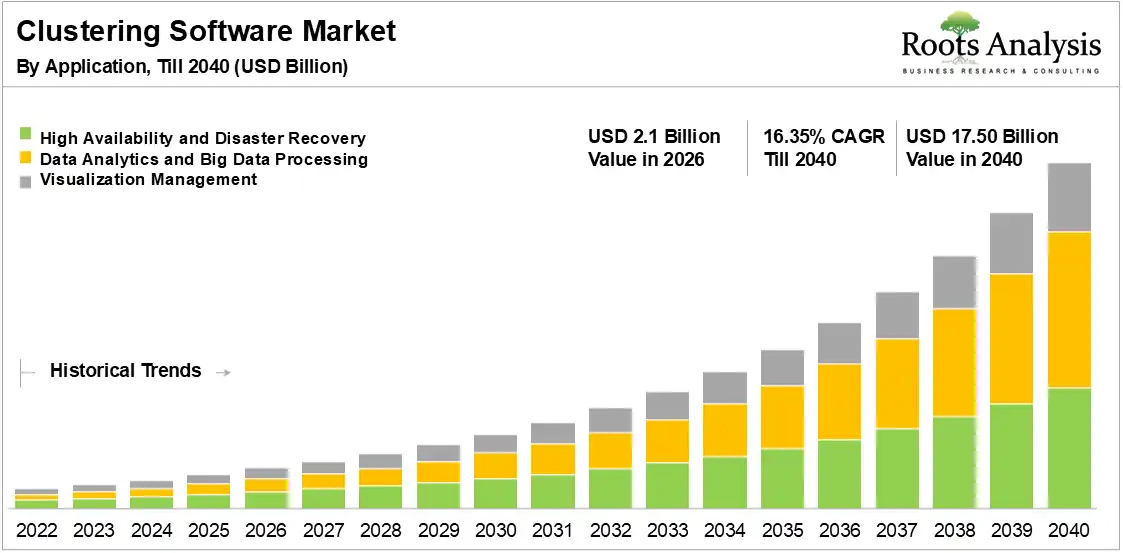
The global clustering software market is projected to reach USD 2.1 billion in 2026 and USD 17.50 billion by 2040, representing a CAGR of 16.35% during the forecast period 2026 to 2040.
See What’s in the Full Report – Request Your Complimentary Insights!
Market Report: Key Takeaways
- Leading Players Competitive Footprint: Leading players in the market include major technology companies and software providers with strong portfolios for clustering software. Notable examples include Google, Microsoft Azure, Databricks, and IBM.
- Innovation Hotspots: Integration of artificial intelligence, and edge clustering for operational technology (OT) environments are the key innovation hotspots for the market players.
- Regional Penetration Insight: While North America holds the highest share (34.5%), Asia-Pacific is likely to register higher CAGR, driven by advanced IT infrastructure, early AI adoption, and government-back investments.
- Market Growth Across Type of Deployment: Based on clustering algorithms market forecast, On-premise deployment dominates the market due to the preferences of organizations to manage sensitive or regulated workloads. Cloud-based clustering will grow at higher CAGR, driven by the elimination of upfront capital expenditure that align with operating budget cycles.
Market Overview
The clustering software market is undergoing a significant shift as organizations move from conventional analytical tools to AI-driven platforms that deliver real-time insights. Current industry dynamics emphasize continuous data processing rather than static segmentation, enabling more responsive and personalized outcomes. This transition reflects evolving market trends driven by rising volumes of unstructured data and advancements in machine learning. As a result, adoption trends increasingly favor automated, explainable clustering systems capable of handling streaming data across multiple sources, allowing enterprises to prioritize timely, actionable intelligence over traditional retrospective analysis.
Growth drivers are strongly linked to the rising demand for automated fraud detection and sophisticated customer segmentation across industries. The influence of generative AI is reshaping the ecosystem, positioning clustering software as a critical component for organizing complex data embeddings and improving retrieval accuracy. Recent developments highlight how major cloud providers are embedding clustering capabilities within database environments to support vectorized data management and personalization engines. This integration lowers deployment complexity, strengthens scalability, and expands usage across high-impact areas such as cybersecurity and predictive maintenance.
The growth outlook remains robust as innovation in explainable AI and real-time processing continues to evolve. Future direction centers on enhancing algorithm performance for high-dimensional and unstructured datasets, including multimedia formats. Broader industry dynamics indicate a shift toward democratizing advanced clustering tools within business intelligence platforms. Emerging developments, such as hybrid models combining time-series and geospatial data, are expected to unlock new efficiencies in supply chain optimization and operational decision-making.
Get an Instant Quote in 10 Minutes. Lowest Price Guaranteed
Clustering Software Market Size Estimation Methodology
- As a starting point, we identified clustering software solutions used for data grouping and unsupervised analysis. The market was then structured by key segments, including industry (BFSI, retail, healthcare, IT & telecom), application (customer segmentation, anomaly detection, data preprocessing), and deployment model (on-premises, cloud, and hybrid), forming the foundation for segment analysis.
- Thereafter, we examined the adoption trends and growth drivers. The study assessed how factors such as rising data volumes, need for customer insights, and operational efficiency are influencing adoption trends across industries. It also evaluated how different sectors adopt clustering software based on data usage, regulatory needs, and analytics maturity.
- Then, we collected historical shipment data. Past market data was gathered from reliable secondary sources, including company reports and industry publications. Key growth trends such as the shift to cloud-based solutions, integration into analytics platforms, and pricing impacts from open-source tools were examined to support the market forecast.
- Using these data and insights, we calculated the global clustering software market size by aggregating the revenue projections for all defined segments. Future market forecast projections were derived based on expected growth trends in data generation, AI / ML adoption, and expanding use cases.
- The overall future projections were derived by analyzing technology adoption curves specific to clustering software standards.
- .Finally, in order to assess the sensitivity of our assumptions, we conducted a multivariate sensitivity analysis on some of the most important parameters of our forecast methodology.
Market Share Insights
Market Share by Type of Clustering
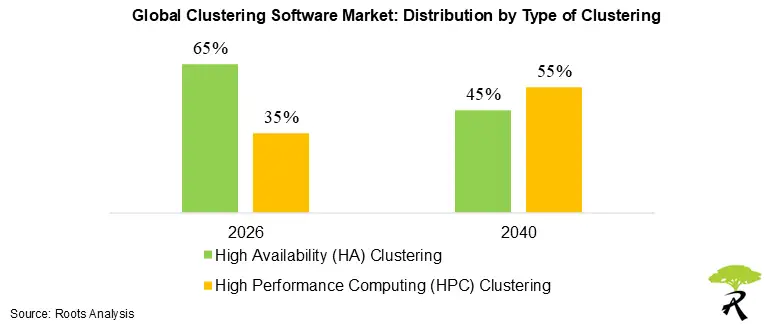
Based on the global clustering software market report, high availability (HA) clustering leads the market with a 65.0% share in 2026. This highest share is driven by its critical role in ensuring uptime, security, and consistent performance for mission-critical workloads.
Its dominance is reinforced by strong enterprise adoption, particularly among large organizations, and the continued reliance on on-premises infrastructure for regulatory compliance and data sovereignty. Mature ecosystems, stable operating environments, and ongoing product innovations further strengthen its position despite a gradual share decline.
Meanwhile, high performance computing (HPC) clustering emerges as the fastest-growing segment, representing a higher CAGR through 2040. This growth is fueled by exponential data generation, rising AI, deep learning and machine learning adoption, and increasing demand for real-time insights. Expanding use cases and sustained investment in scalable analytics platforms continue to accelerate adoption, reshaping competitive dynamics and long-term growth outlook.
Geographical Regions Insight: North America Leads the Market
North America leads the market by holding 34.5% of the market share in 2026. This is driven by advanced IT infrastructure, early AI adoption, and the strong presence of major cloud and hardware vendors. Its dominance is reinforced by mature supply chains, high enterprise spending on mission-critical systems, and sustained innovation in data-center technologies, as reflected in significant growth in clustering-enabling hardware demand.
Meanwhile, Asia-Pacific emerges as the fastest-growing segment, registering a CAGR of 17.2% through 2040, fueled by rapid digital transformation, expanding cloud adoption, and large-scale 5G deployment. Government-backed investments and rising enterprise demand for scalable computing are accelerating adoption trends, while commercialization of edge and AI-driven clustering solutions is unlocking new applications. This dynamic growth outlook highlights shifting competitive dynamics toward high-growth emerging markets.
Want Information on Specific Region / Segment?
Market Ecosystem Insights
Top 10 Market Leaders Shaping the Future of Clustering Software Industry
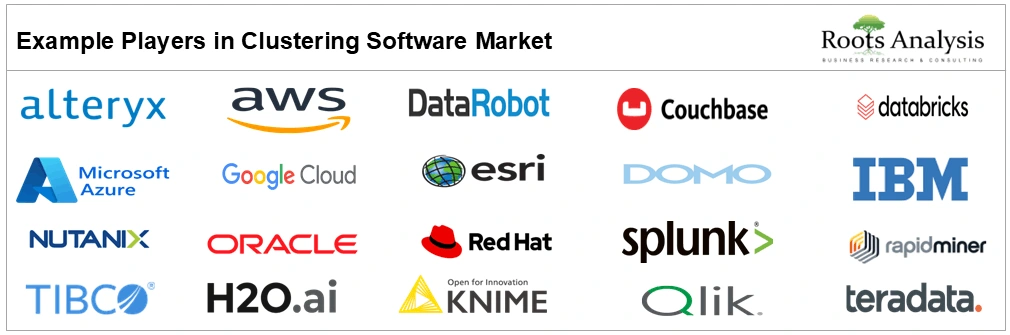
The competitive landscape of clustering software vendors is witnessing the presence of tech giants and software providers. These companies represent the active leadership of the clustering software market, characterized by significant research and development, and recent high-impact initiatives. Some notable examples of the industrial players and their key initiatives are listed below:
- Microsoft: In early 2026, Microsoft introduced advanced "confidential containers" for Azure Red Hat OpenShift, enabling secure multi-tenant clustering for regulated workloads.
- Amazon Web Services: Amazon’s strategic partnership with OpenAI (February 2026) involves building massive, dedicated clusters for AGI research.
- Google: Expanded the Google Cloud console in March 2026 to include native cluster provisioning for Red Hat OpenShift Dedicated, simplifying hybrid migrations.
- IBM: Following a USD 6 billion AI revenue surge in 2025, IBM is focusing on "hybrid data" platforms that unify data access and governance across distributed clusters.
Top 5 Startups Driving Innovation in Clustering Software Market
The startup ecosystem in the clustering software market has shifted focus from "application-level" AI to "infrastructure-level" performance. Venture capital is flowing toward companies that can optimize the high-density computing required for the next generation of models.
For instance, AI infrastructure and enterprise software captured approximately 50% of all global venture capital deployed, a record-breaking concentration that reflects investor confidence in the long-term structural demand for computing and data orchestration platforms.
Investment & Funding Trends
According to the clustering software industry trends analysis, clustering-adjacent startups and tech giants are biding big on AI compute infrastructure, GPU cluster management, distributed database platforms, and edge orchestration. Their strategic technological initiatives are attracting significant capital from both strategic investors (NVIDIA, Salesforce Ventures) and institutional VCs (General Catalyst, Kleiner Perkins, Andreessen Horowitz).
For instance, Together AI secured a USD 305 million Series B funding round led by General Catalyst, with participation from NVIDIA, Salesforce Ventures, and Kleiner Perkins. The company has secured 200 MW of power capacity and is deploying optimized clusters of NVIDIA Blackwell GPUs across multiple North American data centers. This represent a direct investment in the next generation of AI compute clustering infrastructure.
Market Access Considerations
Ecosystem Integration and Vendor Lock-in
Market access depends on seamless integration with enterprise IT ecosystems, including operating systems, databases, virtualization layers, and cloud platforms. Entry barriers remain high due to reliance on certifications and partnerships with dominant providers, shaping the competitive landscape and limiting new entrants’ reach.
Strong vendor lock-in further restricts adoption, as switching costs and risks to mission-critical systems favor established players. Commercial success requires certified interoperability, making ecosystem alignment a critical adoption driver and a key factor influencing long-term market access and expansion.
Total Cost of Ownership (TCO) and Pricing Dynamics
High total cost of ownership remains a major market access barrier, driven by licensing models tied to CPU cores or nodes and additional implementation costs. These pricing dynamics limit adoption among small and mid-sized enterprises and concentrate demand within large organizations with critical resilience needs.
The shift to cloud-based infrastructure is reshaping pricing dynamics by introducing flexible, pay-as-you-go models. This transition challenges traditional CapEx-heavy approaches, improves cost accessibility, and supports broader adoption, while intensifying competition across evolving commercialization models.
Data Sovereignty and Compliance Mandates
Market access in regulated industries is shaped by strict regulatory environments, including data sovereignty and compliance mandates such as GDPR, HIPAA, and PCI DSS. Solutions must ensure data residency and deliver robust high-availability capabilities to meet stringent regulatory expectations.
Failure to demonstrate certified compliance frameworks and verifiable data integrity leads to immediate procurement rejection. Vendors with proven expertise in compliance and strong vertical track records gain a clear advantage, strengthening their position within highly regulated segments.
Technical Complexity and Skill Availability
Technical complexity remains a key commercialization challenge, limiting market access due to the expertise required for deployment and management. A shortage of skilled professionals increases reliance on vendor support, raising costs and slowing adoption across enterprise environments.
Solutions that simplify operations through automation or infrastructure abstraction reduce skill barriers and improve adoption drivers. This shift enhances accessibility, lowers operational risk, and strengthens competitive positioning by aligning with enterprise needs for efficiency and scalability.
How Stakeholders Benefit from the Key Focus Areas of Our Clustering Software Market Research Report
The clustering software market is gaining momentum as organizations increasingly rely on data-driven decision-making and scalable analytics infrastructure. This report equips stakeholders with actionable insights to guide strategic planning, investment prioritization, and technology adoption. It enables informed decisions across commercialization, market expansion, and innovation initiatives.
- Unmet Needs and Market Gaps in Clustering Software Market: The report identifies critical gaps in scalability, integration capabilities, and real-time data processing across clustering solutions. These insights help stakeholders uncover underserved segments and emerging demand pockets. Strategy leaders can refine market entry approaches, while product teams can align development with unmet enterprise requirements. This supports differentiated positioning and faster commercialization.
- Funding and Investment Landscape in Clustering Software Market: The study provides a clear view of investment activity, funding patterns, and capital allocation across the ecosystem. It highlights high-growth segments attracting venture and institutional interest. Investors can assess risk-return profiles and identify scalable opportunities, while companies can align fundraising strategies with prevailing market trends. This strengthens financial planning and expansion decisions.
- Player Landscape and Competitive Dynamics in Clustering Software Market: The report maps key players, their strategic positioning, and competitive intensity across segments. It offers insights into market share distribution, innovation strategies, and differentiation factors. Stakeholders can benchmark performance, identify competitive threats, and refine go-to-market strategies. This enables stronger positioning within an evolving competitive landscape.
- Technology Innovation and Adoption Trends in Clustering Software Market: The clustering software market growth opportunities analysis track advancements in AI-driven clustering, cloud-native architectures, and automation capabilities. It highlights adoption drivers such as big data growth and demand for real-time analytics. Technology leaders can prioritize innovation pipelines, while businesses can align adoption strategies with future-ready solutions. This accelerates product evolution and long-term competitiveness.
- Partnerships and Collaboration Trends in Clustering Software Market: The report examines strategic alliances, ecosystem partnerships, and integration trends shaping the market. It identifies collaboration models that enhance product capabilities and market reach. Business development teams can leverage these insights to form high-impact partnerships, while companies can expand their ecosystem presence. This supports faster scaling and improved value delivery.
- Market Segmentation and Geographic Coverage in Clustering Software Market: The study provides detailed segmentation by deployment, application, and end-user industries, along with regional growth dynamics. It highlights high-potential markets and adoption patterns across geographies. Stakeholders can prioritize target segments, optimize resource allocation, and design region-specific strategies. This enables effective expansion and improved market penetration.
Your Business is Unique – Why Shouldn’t Your Report Be?
Clustering Software Market: Scope of the Report
| Key Report Attributes | Details | |
| Historical Trend | Since 2022 | |
| Forecast Period | Till 2040 | |
| Market Size 2026 | $ 2.1 Billion | |
| Market Size 2040 | $ 17.50 Billion | |
| CAGR (Till 2040) | 16.35% | |
| Segments Covered |
|
|
| Geographical Regions Covered |
|
|
| Key Sections Covered |
|
|
Market Segmentation
Based on the research, we have segmented the clustering software market into type of clustering, type of deployment, application, organization size, industry vertical, geographical regions, and leading players.
Market Share by Type of Clustering
- High Availability (HA) Clustering
- High Performance Computing (HPC) Clustering
Market Share by Type of Deployment
- On-Premise
- Cloud
Market Share by Application
- High Availability and Disaster Recovery
- Data Analytics and Big Data Processing
- Virtualization Management
Market Share by Organization Size
- Large Enterprises
- Small and Medium Enterprises (SMEs)
Market Share by Industry Vertical
- BFSI (Banking, Financial Services, and Insurance)
- IT and Telecom
- Government and Public Sector
- Healthcare
- Manufacturing
- Retail
Market Share by Geographical Regions
- North America
- US
- Canada
- Mexico
- Rest of North America
- Europe
- Austria
- Belgium
- Denmark
- France
- Germany
- Ireland
- Italy
- Netherlands
- Norway
- Russia
- Spain
- Sweden
- Switzerland
- UK
- Rest of Europe
- Asia-Pacific
- Australia
- China
- India
- Japan
- New Zealand
- Singapore
- South Korea
- Rest of Asia-Pacific
- Latin America
- Brazil
- Chile
- Colombia
- Venezuela
- Rest of Latin America
- Middle East and Africa (MEA)
- Egypt
- Iran
- Iraq
- Israel
- Kuwait
- Saudi Arabia
- UAE
- Rest of MEA


