


 Download Free Sample
 Buy Now
Market Size
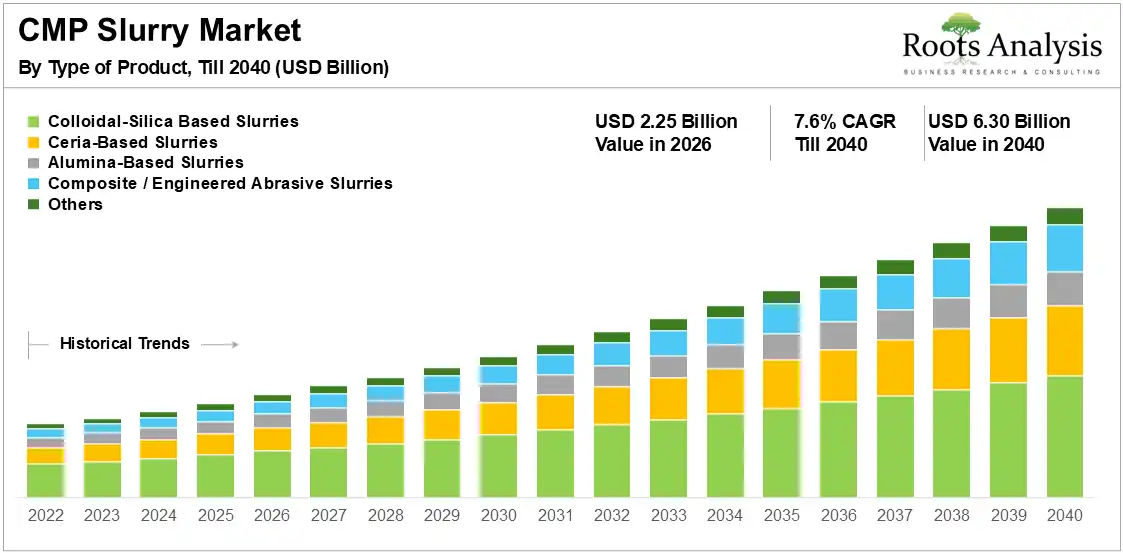
The global CMP slurry market reached USD 2.25 billion in 2026 and is projected to reach USD 6.30 billion by 2040, growing at a CAGR of 7.6% over the forecast period 2026 to 2040, driven by advanced-node logic, HBM, 3D NAND, and hybrid-bonding process complexity.
See What’s in the Full Report – Request Your Complimentary Insights!
Market Report: Key Takeaways
- Based on product type, colloidal silica-based slurries captures 46.0% market share in 2026, whereas composite / engineered abrasive slurries registers a 10.6% CAGR through 2040, driven by tighter hybrid-bonding and mixed-film requirements.
- On the basis of CMP process application, copper interconnect CMP captures 24.0% market share in 2026, whereas advanced packaging CMP registers a 14.6% CAGR through 2040, driven by hybrid bonding and chiplet integration.
- With respect to technology node / manufacturing context, mature-node semiconductor manufacturing captures 37.0% market share in 2026, whereas hybrid bonding / heterogeneous integration registers a 14.1% CAGR through 2040, driven by 3D integration and HBM scaling.
- Based on end-use device segment, logic semiconductors captures 27.0% market share in 2026, whereas advanced packaging / chiplets registers a 12.4% CAGR through 2040, driven by AI accelerator architectures.
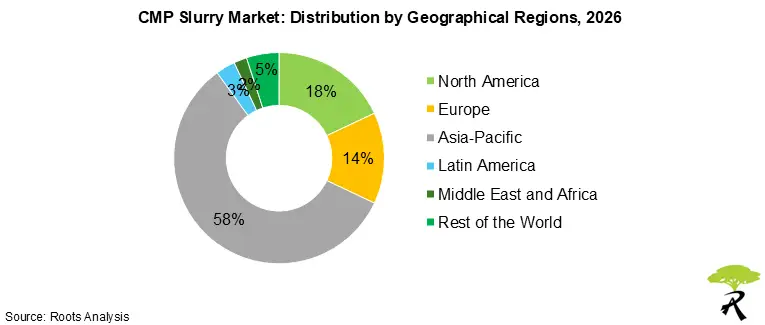
- Based on geography, Asia-Pacific is both the dominant and fastest-growing category, holding 58.0% share in 2026 and expanding at 8.1% CAGR through 2040, driven by concentrated foundry, memory, and advanced-packaging capacity.
CMP Slurry Market Outlook
The CMP slurry market is shifting from high-volume wafer polishing toward formulation-led process control. Demand now reflects advanced-node logic, HBM, 3D NAND, and hybrid-bonding complexity rather than mature-node volume alone. The market reached USD 2.25 billion in 2026 and will grow toward USD 6.30 billion by 2040. Asia-Pacific holds 58.0% share in 2026. Taiwan, South Korea, Japan, and China anchor foundry, memory, materials, and equipment ecosystems. This concentration improves qualification speed and supply assurance.
Current growth comes from more CMP steps per wafer, tighter defectivity limits, and stronger sustainability scrutiny around slurry chemistry and wastewater. Copper interconnect CMP still leads process demand with 24.0% share in 2026, while advanced packaging CMP grows fastest at 14.6% CAGR. Merck listed an October 2025 ICPT presentation on eco-friendly organic antimicrobials for microbial control in copper CMP slurries.
Through 2040, the CMP slurry market will remain progressive as hybrid bonding, chiplets, gate-all-around transistors, and HBM push planarization into front-end and packaging flows. Advanced packaging CMP rises from 6.0% share in 2026 to 14.5% by 2040. In September 2025, FUJIFILM launched advanced-packaging CMP slurry for hybrid bonding surfaces combining copper and oxide films. The long-term outlook remains positive, with qualification depth shaping supplier power.
CMP Slurry Market Size Estimation Methodology
- As a starting point, the CMP slurry market baseline reviewed public estimates between roughly USD 1.69 billion and USD 3.29 billion for 2025 to 2026. The final 2026 anchor of USD 2.25 billion avoided broader CMP consumables figures that included pads, tools, or adjacent materials. The model treated slurry-only revenue as the addressable scope. This prevented double counting of CMP pads, process tools, and post-CMP materials.
- Moving forward, the forecast normalized market growth around credible CAGR clusters between 6.4% and 8.1%. It rejected one estimate above USD 13 billion because that figure overstated slurry-only demand. Semiconductor fab output, wafer-start intensity, advanced-node process complexity, and materials production volumes shaped the final 7.6% CAGR used through 2040.
- Building on this, segment shares were allocated using CMP process application, abrasive type, end-use device segment, and regional semiconductor manufacturing concentration. Copper interconnect CMP, oxide CMP, STI, tungsten, and barrier CMP represented recurring wafer-level demand. Hybrid bonding, HBM, and gate-all-around manufacturing received higher growth weights because they increase planarization precision requirements.
- Drawing upon these, regional estimates used wafer fabrication concentration, memory production depth, supplier application-lab proximity, and materials qualification ecosystems. Asia-Pacific received 58.0% share in 2026 because Taiwan, South Korea, Japan, and China concentrate leading foundry and memory capacity. North America and Europe retained strong shares through advanced semiconductor research, specialty materials, and local manufacturing programs. These regions also support metrology, filtration, and equipment-linked process development.
- The projected value was then calculated by applying the 7.6% CAGR to the 2026 value through 2040. The model generated USD 6.30 billion by 2040, with annual values rising from USD 2.25 billion in 2026 to USD 3.08 billion in 2030. Share shifts were then reconciled with high-growth segments such as advanced packaging CMP and composite abrasive slurries.
- Finally, the forecast was cross-checked against supplier activity, product launches, and process-level examples from FUJIFILM, Qnity Electronics, JSR, AGC, Merck, and Semiconductor Digest. Recent developments helped confirm demand signals around hybrid bonding, HBM, advanced packaging, copper CMP sustainability, and regional qualification infrastructure. The methodology keeps the CMP slurry market forecast tied to verified market behavior rather than unsupported capacity assumptions.
CMP Slurry Market Share Insights
Market Share by Type of Product
According to our analysis, colloidal silica-based slurries segment dominates the market, accounting for 46% of the overall revenue share in 2026. Colloidal silica-based slurries lead because they offer balanced cost, defectivity control, and broad dielectric and copper-process compatibility. In September 2025, Fujifilm launched an advanced-packaging CMP slurry derived from copper-interconnect slurry technology for hybrid bonding.
Conversely, composite and engineered abrasive slurries segment is projected to grow at a CAGR of 10.6% during the forecast period 2026-2040. Composite and engineered abrasive slurries will grow fastest as hybrid bonding requires tighter flatness, copper control, and mixed-film planarization. In October 2025, Qnity Electronics highlighted advanced CMP and post-CMP innovations, including integrated slurry, pad, and cleans strategies.
Market Share by Application
According to our analysis, copper interconnect CMP occupies 24% of the global market share in 2026. Copper interconnect CMP leads because copper damascene processing remains embedded across logic, foundry, and memory interconnect stacks. Fujifilm stated in September 2025 that it holds the world’s top share in copper interconnect CMP slurry.
On the other hand, advanced packaging CMP will show robust growth at a CAGR of 14.6% through 2040. Advanced packaging CMP will grow fastest as hybrid bonding makes nanoscale surface planarity a back-end integration requirement. In September 2025, Fujifilm said its new advanced-packaging slurry was adopted by a major semiconductor device manufacturer for hybrid bonding.
Want Information on Specific Region / Segment?
Regional Analysis: Asia-Pacific Leads the Market and Likely to Register Higher CAGR
Presently Asia-Pacific leads the global market by holding 58.0% share in 2026. The region dominates because Taiwan, South Korea, Japan, and China concentrate foundry, memory, materials, and equipment ecosystems. Supplier proximity improves qualification speed, process customization, and supply assurance for high-volume wafer fabs. In January 2026, SK hynix announced a USD 12.9 billion advanced packaging plant in South Korea for AI memory demand.
Notably, Asia-Pacific, will continue to grow at 8.1% CAGR from 2026 to 2040. Growth will outpace other regions because HBM, advanced packaging, hybrid bonding, and foundry capacity expansions localize slurry demand. Regional suppliers and global materials firms will scale application labs near strategic semiconductor customers. In October 2025, Qnity Electronics and SK hynix signed a long-term CMP materials collaboration supporting advanced semiconductor manufacturing.
Market Ecosystem Analysis
CMP Slurry Market Competitive Landscape
The CMP slurry ecosystem remains supplier-concentrated, with Tier 1 materials platforms controlling copper, dielectric, post-CMP, pad, and cleans portfolios. The dominant consolidation dynamic is platform convergence, as slurry suppliers bundle pads, cleaners, filtration, analytics, and localized process validation. AI logic, HBM, hybrid bonding, and GAA transitions now reshape competition by forcing slurry qualification closer to leading fabs.
Tier 1 CMP Materials Platforms Localizing Capacity Near Advanced Fabs
Large CMP slurry suppliers are adding regional production and validation infrastructure to shorten qualification cycles and reduce supply risk.
- FUJIFILM announced in February 2025 a 4 billion yen investment in Belgium for CMP slurry and photolithography-related materials capacity. The move extends its CMP slurry production network to Europe and targets automotive, industrial, and advanced semiconductor demand. It improves supply continuity for European fabs and reduces customer dependence on Asian or US.
- FUJIFILM’s Belgium expansion was independently covered in February 2025 as a €25 million site investment in Zwijndrecht, Antwerp. The coverage confirms new CMP slurry production facilities and semiconductor-materials capacity. The market impact is stronger European supply resilience for CMP consumables used in chip fabrication
- JSR opened an Advanced Planarization Process Solutions Research Center in Taiwan in April 2026. The center uses Applied Materials CMP equipment for material testing, process validation, and next-generation CMP material development. It positions JSR closer to TSMC and accelerates slurry qualification for leading-edge nodes
Startup Companies and their Key Highlights
Startup companies and emerging entrants in the chemical mechanical planarization (CMP) slurry market are targeting the highly precise material and environmental demands of next-generation semiconductor nodes (such as sub-2nm architectures, 3D GAAs, and High Bandwidth Memory). While Tier-1 market players dominate high-volume mature nodes, agile startups focus their key initiatives on nanoparticle morphology engineering, such as producing highly uniform, non-agglomerated calcined ceria and functionalized colloidal silica particles to mitigate "killer scratch" defects on sensitive wafer substrates.
Further, these innovators are spearheading initiatives in chemical additive optimization, developing novel acceleration chemistries like hyperbranched or amine-functionalized polymers to dramatically increase polishing selectivity’s and material removal rates without requiring severe mechanical friction.
CMP Slurry Market Trends / Opportunities
Hybrid Bonding CMP Slurry Market Demand Strengthening Advanced Packaging Supplier Positions
Hybrid bonding is turning nanoscale planarity into a commercial requirement for AI semiconductor packaging. Advanced packaging CMP grows at 14.6% CAGR from 2026 to 2040. FUJIFILM launched a September 2025 slurry for copper and oxide hybrid-bonding surfaces, with adoption by a major device manufacturer. This trend rewards suppliers with proven copper control and packaging-specific surface conditioning.
HBM and chiplet integration are shifting slurry demand from front-end-only flows into heterogeneous integration. Advanced packaging and chiplets grow at 12.4% CAGR through 2040. SEMI’s July 2025 Advanced Packaging Summit highlighted hybrid bonding, glass substrates, and HBM-driven packaging technology. Suppliers that connect slurry, cleaning, and carrier-material know-how gain stronger account access.
Integrated CMP Slurry, Pad, and Clean Strategies Creating Platform Competition
CMP purchasing is moving toward integrated process performance, not isolated slurry price. Qnity Electronics said it would showcase CMP slurries, CMP pads, post-CMP cleans, and integrated slurry-cleans strategies at ICPT 2025. Platform breadth helps suppliers address defects, removal rates, and post-polish cleanliness in one account strategy.
Pad innovation affects slurry consumption and total process cost. Qnity Electronics launched the Emblem next-generation CMP pad platform in October 2025, citing lower slurry and disk consumption and longer pad lifetime. Slurry suppliers that align with pad and cleaner performance can defend margins through process-level value.
Your Business is Unique – Why Shouldn’t Your Report Be?
Market Access Considerations
Customer Qualification and Fab-Specific Process Windows
CMP slurry suppliers enter accounts through long qualification cycles because each slurry affects yield, corrosion, dishing, erosion, and defectivity. Customers validate abrasive distribution, oxidizer chemistry, pad matching, cleaner compatibility, and tool behavior before approval. The strongest market behavior is major manufacturer adoption, as seen in FUJIFILM’s September 2025 advanced-packaging slurry launch. Qualification depth slows new entrants, but it also protects incumbents after volume approval. It also raises switching costs because requalification can disrupt validated wafer recipes.
Regional Application-Lab Proximity to Leading Fabs
Market access improves when suppliers operate near foundry, memory, and advanced-packaging customers. Asia-Pacific holds 58.0% share in 2026 because Taiwan, South Korea, Japan, and China cluster wafer production and materials qualification. JSR’s April 2026 Hsinchu center shows how local CMP equipment and process-validation infrastructure support faster collaboration. Regional labs reduce sampling delays and strengthen competitive positioning with advanced-node customers. They also help suppliers tune slurries to local tool sets and customer wafers.
Integrated Consumables and Defect-Control Capability
Suppliers compete on combined slurry, pad, cleaner, filtration, and metrology performance rather than chemistry alone. Qnity Electronics’s ICPT 2025 showcase of slurries, pads, post-CMP cleans, and integrated strategies reflects this buying behavior. Access becomes easier for platform suppliers that diagnose yield loss across multiple consumables. Pure-play slurry entrants must prove compatibility across pads, post-CMP cleaners, and particle-control systems to win advanced accounts. This favors companies with application engineering teams and multi-consumable data.
Sustainability, Microbial Control, and Chemical Stewardship
Sustainability now affects access because customers scrutinize slurry wastewater, antimicrobial packages, and chemical stability. Merck’s October 2025 ICPT topic on eco-friendly organic antimicrobials for copper CMP slurries shows this shift. Suppliers must meet fab performance targets while reducing environmental and handling burdens. Strong stewardship can differentiate suppliers in copper CMP, where microbial contamination, corrosion control, and wastewater treatment directly affect operating risk. It can also shorten customer review when sustainability teams influence procurement.
How Stakeholders Benefit from the Key Focus Areas of Our CMP Slurry Market Report
The CMP slurry market matters now because AI memory, advanced-node logic, and hybrid bonding are raising planarization complexity. This report connects CAGR, segment share, supplier positioning, and technology adoption to practical strategy, investment, and product-roadmap decisions.
- Unmet Needs and Market Gaps in CMP Slurry Market: The report identifies gaps in hybrid-bonding slurries, composite abrasives, post-CMP cleaning integration, and regional validation support. Product teams can use these gaps to prioritize copper-oxide mixed-film control, defectivity reduction, and lower-consumption slurry systems. Commercial teams can decide where customer pain is strongest across advanced packaging, HBM, and gate-all-around process steps.
- Funding and Venture Investment Opportunities in CMP Slurry Market: The report highlights faster-growth pockets that can support investment screening, including advanced packaging CMP at 14.6% CAGR. Investors can compare composite abrasive slurries, slurry filtration, post-CMP cleaners, and particle-characterization systems against slower mature-node segments. This supports decisions on minority investments, acquisition targets, or materials-platform expansion.
- Technology Innovation and Adoption Trends: The report tracks adoption signals around hybrid bonding, HBM, gate-all-around transistors, and integrated slurry-pad-cleaner strategies. Technology leaders can see which process shifts create new formulation needs and which examples show customer validation. This supports decisions on R&D focus, application-lab investment, and product qualification sequencing.
- CMP Slurry Market Competitive Landscape and Industry Analysis: The report maps leaders, specialists, emerging suppliers, and adjacent ecosystem players across slurry chemistry, pads, tools, cleaners, and metrology. Strategy teams can benchmark FUJIFILM, Qnity Electronics, JSR, AGC, Saint-Gobain, Baikowski, Merck, Entegris, and Applied Materials by role. This supports partnership targeting, competitor monitoring, and account-based positioning.
- Mapping Strategic Partnerships and Ecosystem Synergies: The report links supplier moves to ecosystem behavior, including JSR’s Taiwan planarization center and Qnity Electronics’s integrated CMP portfolio positioning. Business development teams can identify where equipment, slurry, pad, cleaner, and packaging ecosystems overlap. This supports alliance planning, co-development discussions, and customer-specific qualification programs.
- CMP Slurry Market CAGR and Growth Trends: The report quantifies the market at USD 2.25 billion in 2026, rising to USD 6.30 billion by 2040. Planning teams can compare 7.6% market CAGR against higher-growth segments such as hybrid bonding, advanced packaging, and composite abrasives. This supports revenue planning, regional prioritization, and segment-level investment allocation.
CMP Slurry Market: Scope of the Report
| Key Report Attributes | Details | |
| Forecast Period | Till 2040 | |
| Market Size 2026 | USD 2.25 Billion | |
| Market Size 2040 | USD 6.30 Billion | |
| CAGR (Till 2040) | 7.6% | |
| Segments Covered |
|
|
| Geographical Regions Covered |
|
|
| Key Sections Covered |
|
|
Source: Roots Analysis
Market Segmentation
The CMP slurry market report presents an in-depth analysis, highlighting the capabilities of various stakeholders, based on different segments such as, product type, CMP process application, substrate wafer application, technology node / manufacturing context, ecosystem components, end use device, geographical regions, and leading players.
By Product Type
- Colloidal Silica-Based Slurries
- Ceria-Based Slurries
- Alumina-Based Slurries
- Composite / Engineered Abrasive Slurries
- Others
CMP Process Application
- Copper Interconnect CMP
- Barrier Metal CMP
- Tungsten CMP
- Oxide / Dielectric CMP
- STI / ILD CMP
- Front-End Transistor / HKMG CMP
- Advanced Packaging CMP
- Others
Substrate / Wafer Application
- Silicon Wafers
- Compound Semiconductor Substrates
- Optical Substrates
- Disk-Drive Components
- Other Microelectronic Surfaces
By Technology Node / Manufacturing Context
- Mature-Node Semiconductor Manufacturing
- Advanced-Node Semiconductor Manufacturing
- 3D NAND Manufacturing
- High-Bandwidth Memory Manufacturing
- Gate-All-Around Transistor Manufacturing
- Hybrid Bonding / Heterogeneous Integration
By Ecosystem Component
- CMP Slurries
- CMP Pads
- Post-CMP Cleaners
- Slurry Filtration and Delivery Systems
- CMP Process Tools
- Metrology and Particle-Characterization Systems
By End-Use Device
- Logic Semiconductors
- Memory Semiconductors
- Foundry Wafers
- Power Semiconductors
- Advanced Packaging / Chiplets
- MEMS and Sensors
- Optoelectronics
By Geographical Regions
- North America
- US
- Canada
- Mexico
- Rest of North America
- Europe
- Austria
- Belgium
- Denmark
- France
- Germany
- Ireland
- Italy
- Netherlands
- Norway
- Russia
- Spain
- Sweden
- Switzerland
- UK
- Rest of Europe
- Asia-Pacific
- Australia
- China
- India
- Japan
- New-Zealand
- Singapore
- South Korea
- Rest of Asia-Pacific
- Latin America
- Argentina
- Brazil
- Chile
- Colombia
- Venezuela
- Rest of Latin America
- Middle East and Africa (MEA)
- Egypt
- Iran
- Iraq
- Israel
- Kuwait
- Saudi Arabia
- UAE
- Rest of MEA
- Rest of the World


