


 Download Free Sample
 Buy Now
Market Outlook
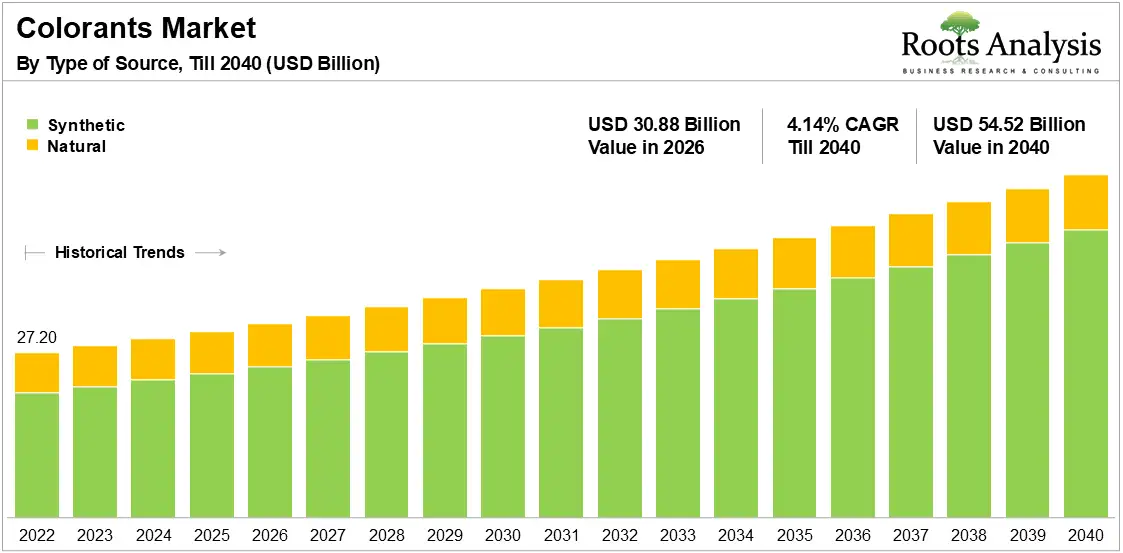
The global colorants market is projected to reach USD 30.88 billion in 2026 and USD 54.52 billion by 2040, representing a CAGR of 4.14% during the forecast period 2026 to 2040.
See What’s in the Full Report–Request Your Complimentary Insights!
The colorants market covers the manufacture and use of pigments and dyes that add colour to materials across industrial and consumer products. It spans synthetic chemical colorants including (organic and inorganic pigments), alongside a fast-growing set of natural and bio-based options, reflecting key natural colorants market trends. Within defined market boundaries, colorants deliver visual appeal, brand distinction, and functional performance (such as ultraviolet UV resistance and heat stability), making them integral to diverse substrates and production processes.
Market growth is fuelled by rising demand from coatings, plastics, textiles, and packaging where colorants are essential to both performance requirements and visual differentiation. Developing economies are witnessing the strongest momentum, as accelerating urbanization fuels construction growth and increases paints and coatings consumption. At the same time, regulatory forces are reshaping industry dynamics, the European Union’s stricter controls on certain heavy metal pigments, such as synthetic dyes, lead chromates, are compelling manufacturers to transition toward high-performance organic alternatives for industrial coatings and plastics.
Innovation across the colorants market is centred on sustainability and improved application performance, pointing to a clear shift away from hazardous chemistries toward non-toxic and bio-based solutions. This direction is reinforced by strategic investments, including capacity expansions for digital printing inks, which indicate a long-term move toward efficient and customized colour application in textiles and packaging. Further supported by formulation advances and regulatory compliance needs the industry outlook remains constructive.
Market Report: Key Takeaways
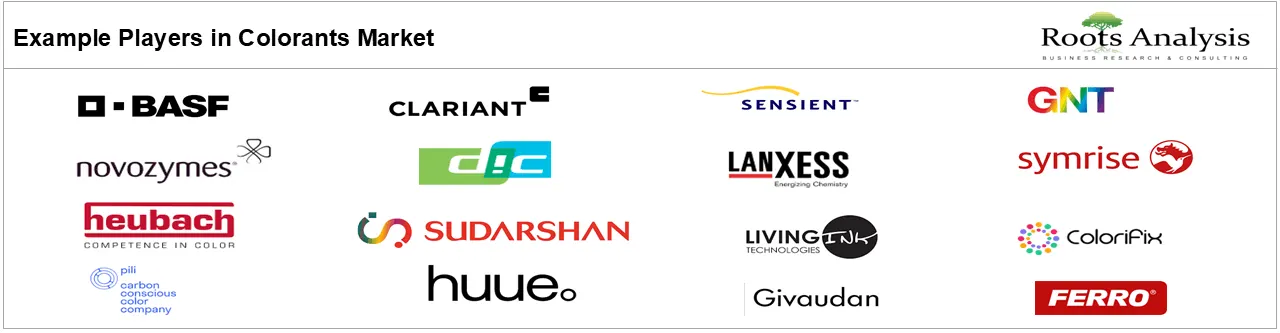
- Leading Players Competitive Footprint: Companies such as BASF, Ferro, Heubach Group, Clariant, Colorfix, DIC, Givaudan, GNT, Huue, LANXESS, Living Ink Technologies, Novozymes, Pili, Sensient Technologies, Sudarshan Chemical, Symrise hold strong market positions with extensive geographic presence in various regions.
- Startup Ecosystem and Innovation Hotspots: Early-stage companies are focusing on developing biotech innovations in sustainable, bio-based pigments and dyes, particularly as alternatives to synthetic options amid regulatory pressures. Companies are making advancements in areas, such as natural colorants from microbial fermentation, and algae.
- Regional Penetration and Adoption Trend: Asia-Pacific is witnessing strong adoption of colorants driven by rapid industrialization, a growing number of infrastructure projects, and expanding usage across multiple end-use industries, such as construction, packaging, textiles, and plastics. China and India dominate the regional market supported by large-scale manufacturing bases, rising urban development, and increasing need for advanced colorant formulations to meet performance and regulatory requirements.
- Factors Propelling Paints & Coatings Market Segment: Market research report on colorants industry indicates that paints & coatings segment accounts for the largest market share of 30%. This dominance is supported by steady construction activity, ongoing renovation demand, and rising connected vehicle production, which together sustain large-scale pigment consumption.
- Opportunities in Colorants Market: The colorants market offers strong growth opportunities in recyclable, circular economy-focused formulations and the development of multifunctional and smart colorants with enhanced performance. Rising demand for mass customization and on-demand digital printing is boosting adoption of advanced colorant systems, while increasing sustainability regulations and consumer preferences are accelerating the shift toward natural dyes and bio-based pigments.
Recent Industry Developments
- September 2025: Michroma and CJ CheilJedang announced a strategic partnership to scale up the commercial manufacturing of Michroma's innovative biotech based natural colorants using CJ Cheil Jedang's global manufacturing capabilities.
- March 2025: Dohler acquired Premier Juices, enhancing its portfolio of natural fruit-based products and solutions. This acquisition strengthens Dohler’s capabilities in blending, packaging, and quality control, while adding strategic operations in Delaware to improve supply chain efficiency and customer service across North America.
- February 2025: Oterra launched a new color blending and application center in India to directly supply natural food and beverage color shades (such as yellow, orange, red, and pink) to the growing markets in India, Asia Pacific, and the Middle East. This facility streamlines the supply chain, reduces lead times, and supports customers transitioning to natural colors.
- February 2025: Techmer PM acquired Colors for plastics; a business acquisition to enhance their offerings and better serve its diverse customer base.
Pay Only for What You Need – The Best Way to Optimize
Market Dynamics
Key Market Drivers
- Rapid Industrialization and Urbanization in Emerging Markets: Sustained economic expansion across Southeast Asia, Latin America, and Africa continues to accelerate urban development and industrial activity. This structural shift drives higher consumption of consumer goods, building materials, and textiles, directly increasing pigment demand across architectural coatings, plastics, and printing inks embedded throughout these value chains.
- Shift to Bio-based and Sustainable Colorants: According to the market research report on colorants industry, tightening environmental regulations alongside growing consumer preference for sustainable products are accelerating the shift away from petroleum-derived colorants. This transition is driving stronger demand for bio-based pigments and natural dyes particularly in food, cosmetics, and textiles, where clean-label positioning, non-toxicity, and regulatory compliance are critical factors influencing adoption.
- Evolution of Digital Printing Technology: The ongoing shift from analog to digital printing, especially inkjet-based systems is reshaping colorant demand across textiles, packaging, and commercial printing. Digital platforms require specialized inks and toners with high precision and consistency, creating incremental growth opportunities for suppliers capable of advanced, application specific formulations.
Market Challenges
- High Capital Costs for Transitioning Traditional Dyeing Processes: Established industries such as textiles rely on legacy, water-intensive dyeing systems. Shifting to sustainable or digital colorant solutions often requires substantial investment in new equipment and process redesign, creating adoption resistance driven by high upfront transition costs.
- Regulatory Uncertainty and R&D Risk: The global dyes and pigments market report indicates that the absence of harmonized standards for emerging colorant chemistries introduces significant development risk. Ongoing regulatory debate around restricted substances discourages long term investment in next-generation formulations, slowing innovation and extending commercialization timelines.
- Complex Formulations for Diverse End-Use Applications: Serving a wide range of end-use applications requires managing complex formulation portfolios with highly specific performance requirements. This diversity increases R&D intensity, complicates manufacturing standardization, and raises operational costs across the product lifecycle.
Market Share Insights
Market Share by Product: Pigments Hold the Largest Market Share
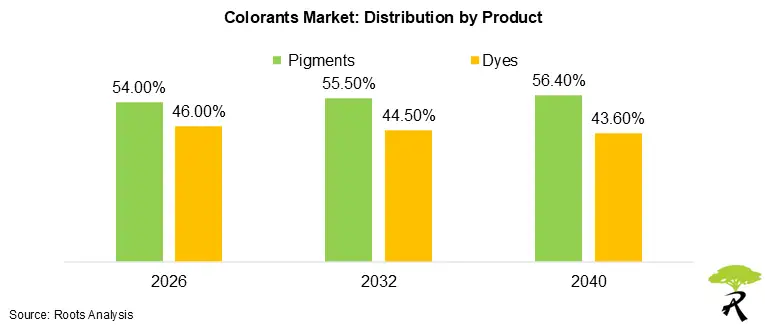
- According to our colorants market analysis, the pigments hold the largest market share of 54.00% in 2025. This growth is driven by their indispensable role in high-volume applications, such as paints, coatings, and plastics where durability, opacity, and lightfastness are critical performance requirements.
- Within pigments segment, inorganic pigments capture the maximum share of 55.0%, supported by their superior weather resistance and widespread use in construction and automotive coatings.
- Dyes on the other hand represent the fastest-growing segment, driven by rising adoption in food, beverages, and personal care as brands align with clean-label demands and sustainability commitments.
- The colorants market forecast suggests that there is demand in coatings, packaging, and construction, with innovations in sustainable formulations enhancing their appeal.
Market Share by Geographical Regions: Asia-Pacific to Dominate the Industry and Grow Rapidly Through 2040
- The regional analysis suggests that Asia-Pacific is expected to hold the largest colorants market share of 54.00%, whereas it is also expected to witness the fastest CAGR of 5% by 2040. The Asia-Pacific region’s dominance is driven by its strong presence in textiles, construction, packaging, and other intensive manufacturing industries.
- The colorants market growth in Asia Pacific is also supported by continued industrialization, expanding middle-class consumption, and the ongoing relocation of global production capacity to Asia. For instance, Heubach inaugurated a new high-performance pigment manufacturing plant in Germany to enhance production capacity for advanced colorants used in automotive and industrial coatings.
- Expanding cosmetics industry’s colorants consumption, combined with rapid growth in apparel, automotive, personal care, and processed food markets and sustained investments in pigment dispersion capacity, firmly establishes Asia-Pacific as the global colorants industry’s leading volume hub and fastest-growing region.
Want Information on Specific Region / Segment?
Market Ecosystem Insights
Leading Players Competitive Footprint
Competitive analysis of colorant manufacturers include giants such as BASF, Ferro, Heubach Group, Clariant, Colorfix, DIC, Givaudan, GNT, Huue, LANXESS, Living Ink Technologies, Novozymes, Pili, Sensient Technologies, Sudarshan Chemical, Symrise which hold strong market positions through their extensive product portfolios and global reach.
Collaborations, partnerships and expansions remain key growth strategies, with players like BASF launching a new range of effect pigments for e-mobility applications, targeting high-performance coatings for electric vehicle battery casings and components.
Startup Activity and Innovation Hotspots
The colorants market competitive landscape is rapidly evolving, marked by a surge in early-stage startup activity, particularly among biotech- and sustainability-focused ventures that are innovating beyond traditional petrochemical-based products. These companies are developing natural and bio-based alternatives to address regulatory pressures, rising demand for clean-label solutions, and broader environmental objectives.
Recent start up launches include companies, such as Living Ink Technologies, which use algae as a raw material to create bio-based black pigments, offering an alternative to traditional carbon black for inks and coatings. Similarly, Color fix employs a microbial fermentation process to create sustainable dyes for textiles, aiming to reduce the use of chemicals and water in conventional dyeing methods. Innovation hub spots are expanding rapidly mainly in the Asia-pacific driven by food security initiatives and supportive ecosystems that are enabling locally developed solutions to scale efficiently.
Funding and Investment Momentum
The colorants market has seen robust funding and investment momentum. Investment flows primarily from sustainability regulations, corporate venture capital, and strategic private equity. These funds cater to the expanding demand for accelerators and incubators focused on biotech pigments, boosting public-private grants, and corporate partnerships with established chemical giants.
Key investors, including companies such as Colorfix secured $2.4 million in seed funding from investors including H&M group ventures to accelerate the scaling of its sustainable bio-based dye technology. For instance, Givaudan acquired the food coloring business of DDW, The Color House, for an undisclosed amount, strengthening Givaudan's portfolio of natural food colorants and clean-label solutions.
Overall, sustained government initiatives and grant funding are strengthening the momentum of sustainability-driven investment in the colorants market. Europe’s focus on green chemistry, North America’s support for R&D through sustainability programs, and Asia-Pacific’s capital deployment toward textile capacity expansion amid rising energy needs collectively signal accelerating growth and a robust investment outlook for the sector.
Your Business is Unique – Why Shouldn’t Your Report Be?
Colorants Market: Scope of the Report
| Key Report Attributes | Details | |
| Historical Trend | Since 2022 | |
| Forecast Period | Till 2040 | |
| Market Size 2026 | $ 30.88 Billion | |
| Market Size 2040 | $ 54.52 Billion | |
| CAGR (Till 2040) | 4.14% | |
| Segments Covered |
|
|
Market Segmentation
Based on research, we have segmented the colorants market into product, type of source, application, geographical regions, and key players.
Market Share by Product
- Dyes
- Natural Dyes
- Synthetic Dyes
- Pigments
- Inorganic Pigments
- Organic Pigments
Market Share by Type of Source
- Natural
- Synthetic
Market Share by Application
- Food & Beverages
- Paints & Coatings
- Personal Care & Cosmetics
- Plastics
- Printing Inks
- Textiles
Market Share by Geographical Regions
- North America
- US
- Canada
- Mexico
- Rest of North America
- Europe
- Austria
- Belgium
- Denmark
- France
- Germany
- Ireland
- Italy
- Netherlands
- Norway
- Russia
- Spain
- Sweden
- Switzerland
- UK
- Rest of Europe
- Asia-Pacific
- Australia
- China
- India
- Japan
- New-Zealand
- Singapore
- South Korea
- Rest of Asia-Pacific
- Latin America
- Brazil
- Chile
- Colombia
- Venezuela
- Rest of Latin America
- Middle East and Africa (MEA)
- Egypt
- Iran
- Iraq
- Israel
- Kuwait
- Saudi Arabia
- UAE
- Rest of MEA


