


 Download Free Sample
 Buy Now
Market Outlook
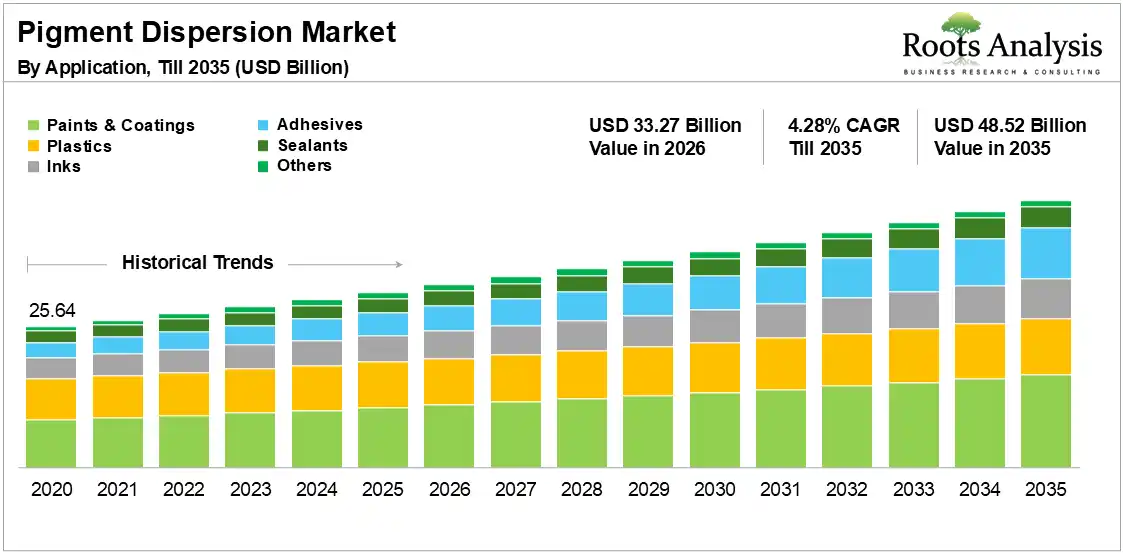
The global pigment dispersion market, valued at USD 33.27 billion in 2026, is projected to reach USD 39.34 billion by 2030 and USD 48.52 billion by 2035, with 4.28% CAGR during the forecast period 2026 to 2035.
See What’s in the Full Report - Request Your Complimentary Insights!
The pigment dispersion market encompasses the production, formulation, and commercialization of dispersed pigment products, where solid pigments are uniformly distributed by dispersing agents within various mediums, such as liquids or pastes. Dispersing agents help by coating pigment particles, making them spread evenly and staying apart. Examples include surfactants and polymeric dispersants, which keep pigments stable and improve color quality.
Presently, the pigment dispersion market caters to a diverse range of end-use industries such as automotive, packaging, construction, textiles, plastics, printing, and cosmetics. Within these sectors, pigment dispersions in paints and coatings, textile coloring, plastic masterbatches, printing inks, and cosmetic formulations are integral applications where achieving uniform color distribution, long-term stability, and enhanced visual appeal is critical.
Looking ahead, the market holds strong growth potential, driven by advancements in eco-friendly and high-performance pigment dispersion technology, such as water-based pigment dispersions and nanoscale pigment dispersions. According to the experts, the shift towards sustainable formulations, such as VOC-free and APEO-free polyurethane dispersants, and polymeric dispersants designed to reduce environmental impact, combined with rising demand in emerging economies will accelerate market expansion.
These developments in dispersing agent for pigments offer benefits over conventional dispersants, including improved durability, reduced VOC emissions, and enhanced color vibrancy, thereby positioning the pigment dispersion industry as vital for future industrial and consumer product trends, such as pigment dispersion trends in digital textile printing.
Key Takeaways
- Leading Players Competitive Footprint: Dominant players like BASF, DIC, and Sudarshan Chemical hold strong market positions with extensive geographic presence in various regions.
- Startup Ecosystem and Innovation Hotspots: Early-stage companies are focusing on catering to the increasing demand for eco-friendly and low-VOC pigment dispersions and digital printing pigment applications. The companies are making advancements in areas, such as bio-based dispersing agents, micro-fluidization technology (for finer, more uniform dispersions) and nanotechnology (to enhance optical properties and stability).
- Regional Penetration and Adoption Trend: Rapid industrialization, rising number of infrastructure projects, and expanding applications across various end-use sectors is leading the regional growth of pigment dispersion in Asia-Pacific. Notably, China and South Korea hold dominating position in Asia-Pacific due to expanding end-use sectors, such as construction, packaging, electronics, automotive coatings, and industrial infrastructure.
- Factors Propelling Paints and Coatings Market Segment: Due to the critical role of pigment dispersions for coatings, this segment is holding the maximum market share. Paints and coatings enhance the aesthetic appeal and provides surface protection in both residential and industrial applications.
- Opportunities and Unmet Market Needs: White space in this market exists in the development of eco-friendly and low-VOC pigment dispersions which are eligible in meeting stricter environmental norms. Additionally, there’s expansion potential in emerging sectors like sustainable packaging, 3D printing, and high-performance pigment dispersions in automotive coatings.
- Building and Construction Industry to Have the Highest Market Share: This sub-segment will have the largest market share owing to the usage of paint dispersants instruments in architectural coatings, including paints and decorative finishes for interior and exterior applications.
- Funding and Investment Momentum: The pigment dispersion industry sees steady investment from venture capitalists, private equity firms, and government grants, largely directed towards sustainable product innovation.
Recent Developments in Pigment Dispersion Industry
- June 2025: Krahn Chemie expanded its pigment partnership with Vibrantz Technologies to broaden its product portfolio. This has strengthened the companies’ presence in key European markets, highlighting their technical expertise in functional pigments.
- May 2025: DuPont and Artistri Digital Inks participated in the FESPA Global Print Expo 2025 to showcase their complete portfolio for textile, commercial, and packaging printing.
- March 2025: LANXESS showcased high-quality products for the paint and coatings industry at ECS 2025 with the Polymer Additives business unit offering aqueous pigment dispersion called Levanyl.
- February 2025: Lorama, a leading provider of color dispersions and bio-based additives, acquired colorant dispersions business of DCL Corporation to strengthen its position as a global leader in providing innovative color solutions to the paint and coating industry.
Market Dynamics
Key Market Drivers
- Construction Sector Expansion: The rise in construction activity due to urbanization and governmental policies, is fueling the need for decorative paints and consequently pigment dispersants solutions.
- Booming Packaging Industry: The increasing popularity of vibrant and sustainable packaging for food and consumer goods is increasing the demand for pigment dispersion solutions for packaging applications for visually appealing branding.
- Regulatory Push for Sustainability: Regulations related to VOCs and environmental impact are increasing the shift toward water-based and low-VOC dispersions, fueling the water-based pigment dispersion market.
Market Restraints
- Volatile Raw Material Prices: Price fluctuations in key raw materials, such as titanium dioxide and carbon black directly impact pigment dispersion manufacturing process costs and pricing strategies.
- Waste Management and Disposal: Solvent-based pigment dispersions generate hazardous byproducts, which present a major operational restraint, requiring costly treatment systems. Further, strict regulatory compliance for pigment dispersion ingredients makes the process operationally complex.
- Consistency and Batch Uniformity: Ensuring uniform color and quality in every batch is technically demanding, leading to production inefficiencies, increased rework, and higher costs in industries, such as automotive coatings and electronics.
Role of Titanium Dioxide Dispersion in High-Performance Coatings and Packaging
Titanium dioxide dispersion plays a crucial role in the pigment dispersion market because TiO2 is the most widely used white pigment globally, primarily valued for its outstanding brightness, opacity, and high refractive index. In coatings, it helps produce durable finishes that resist fading, UV damage, and weathering, which is ideal for automotive and protective paints.
In packaging, TiO2 enhances appearance and protects contents by blocking UV light and preventing discoloration. Proper dispersion ensures even particle distribution, maximizing pigment efficiency and product quality. These benefits make TiO2 dispersions essential for innovative, long-lasting, and environmentally compliant coatings and packaging solutions.
Your Business is Unique – Why Shouldn’t Your Report Be?
Market Share Insights
Market Share by Product: Inorganic Pigments Hold the Largest Market Share
- According to our pigment dispersion market analysis, the inorganic pigment dispersions segment held the largest market share of 58.7% in 2025. This growth is driven by their superior resistance to UV light, heat, and chemicals, making them ideal for demanding applications like automotive and industrial coatings.
- Their cost-effectiveness and smaller particle size enable easier, more uniform dispersion, enhancing product quality. Additionally, growing industrial demand for durable, high-performance colorants and ongoing technological advancements further strengthen their market position.
- The pigment dispersion market forecast suggests that the organic pigment dispersions segment is witnessing the fastest CAGR despite inorganic pigments’ durability because organic pigments deliver vibrant, bright, and customizable colors preferred in high-visibility applications (like inks, textiles, and coatings). Additionally, growing environmental regulations and consumer demand for eco-friendly, non-toxic, and sustainable products drive organic pigment dispersions’ growth.
Market Share by Geographical Regions: Asia-Pacific to Dominate the Industry While EU to Grow Rapidly through 2035
- The regional analysis suggests that Asia-Pacific is expected to hold the largest pigment dispersion market share of 38% while Europe is expected to witness the fastest CAGR.
- The Asia-Pacific region dominance is due to its rapid urbanization and expanding production base in countries, such as China and India with rapidly growing bases of pigment dispersions for plastics, paints and coatings. This positions them as key manufacturers and consumers of pigment dispersion.
- In the European Union, the pigment dispersion market is growing steadily due to strict EU regulations on VOC emissions and government incentives for sustainable manufacturing, which necessitate the need for eco-friendly, solvent-free dispersions and adoption of Industry 4.0 for process optimization.
Want Information on Specific Region / Segment?
Market Ecosystem Insights
Leading Players Competitive Footprint
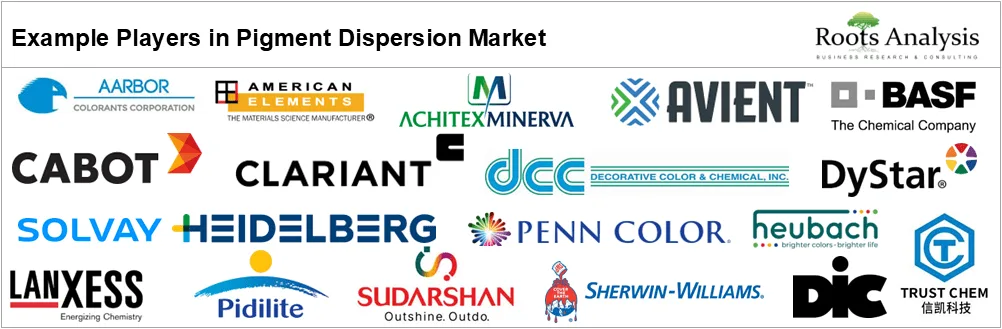
Leading players in the pigment dispersion domain include industry giants such as BASF, DIC, and Sudarshan Chemical Industries, which hold strong market positions through their extensive product portfolios and global reach.
Collaborations and expansions remain key growth strategies, with players like Cabot and Lanxess investing in sustainable and high-performance pigment dispersions for automotive, packaging, and construction sectors.
Startup Activity and Innovation Hotspots
The startup activity within the pigment dispersion domain is rapidly evolving with early-stage companies pioneering disruptive applications, primarily focused on sustainable pigment dispersion and high-performance pigment formulations. Innovators are launching functionalized pigments for improved UV resistance, and smart pigments that change color with temperature or light.
Recent launches include high-stability dispersions (by Lubrizol), for DTF printing and enhanced durability coatings designed for electric vehicles and sustainable packaging (by Chemours Ti-Pure), reflecting a broader push toward multifunctional, performance-driven solutions beyond just environmental compliance.
Besides the above ongoing advancements, startups are also leveraging AI automation for practicing customization in pigment dispersion for specialty applications and enhancing production efficiency. In North America, Pigment, an AI-powered business planning platform, is expanding rapidly driven by innovation in AI and dynamic modeling. Meanwhile, in Europe, regions like Germany and Austria see strong adoption of AI-driven solutions in pigment dispersion.
Funding and Investment Momentum
The pigment dispersion market has seen robust funding and investment momentum. Investment flows primarily come from venture capitalists, private equity firms, and government grants which not only focus on developing sustainable, low-VOC, and high-performance pigment dispersion technologies but also on dispersants and dispersing agents.
These funds cater to the expanding demand for pigment dispersions in textiles, coatings, automotive, and packaging sectors. Key investors include large chemical companies, such as PPG Industries, and Sherwin-Williams, which invest heavily in R&D and strategic acquisitions to bolster their market presence and innovate eco-friendly pigment dispersion solutions.
In addition, government initiatives and grants predominantly support sustainability-focused innovations by companies in Asia Pacific and Europe to reduce environmental footprints and comply with stricter regulations. For instance, India’s S&T PRISM Program under the Ministry of Mines offers grant up to INR 2 Crore for sustainable technologies and innovations in industrial applications.
Market Segmentation
Pigment Dispersion Market: Scope of the Report
| Key Report Attributes | Details | |
| Historical Trend | Since 2020 | |
| Forecast Period | Till 2035 | |
| Market Size 2026 | $ 33.27 Billion | |
| Market Size 2035 | $ 48.52 Billion | |
| CAGR (Till 2035) | 4.28% | |
| Segments Covered |
|
|
Based on the research, we have segmented the pigment dispersion market into type of pigment, formulation, application, end use industry, geographical regions, and key players.
Market Distribution by Type of Pigment
- Inorganic Pigment
- Organic Pigment
- Specialty Pigment
Market Distribution by Formulation
- Water-Based
- Solvent-Based
Market Distribution by Application
- Adhesives
- Paint and Coatings
- Inks
- Plastics
- Sealants
- Others
Market Distribution by End Use Industry
- Automotive
- Building & Construction
- Packaging
- Paper & Printing
- Textiles
- Others
Market Distribution by Geographical Regions
- North America
- US
- Canada
- Mexico
- Rest of North America
- Europe
- Austria
- Belgium
- Denmark
- France
- Germany
- Ireland
- Italy
- Netherlands
- Norway
- Russia
- Spain
- Sweden
- Switzerland
- UK
- Rest of Europe
- Asia-Pacific
- Australia
- China
- India
- Japan
- New-Zealand
- Singapore
- South Korea
- Rest of Asia-Pacific
- Latin America
- Brazil
- Chile
- Colombia
- Venezuela
- Rest of Latin America
- Middle East and Africa (MEA)
- Egypt
- Iran
- Iraq
- Israel
- Kuwait
- Saudi Arabia
- UAE
- Rest of MEA


