


 Download Free Sample
 Buy Now
Market Size
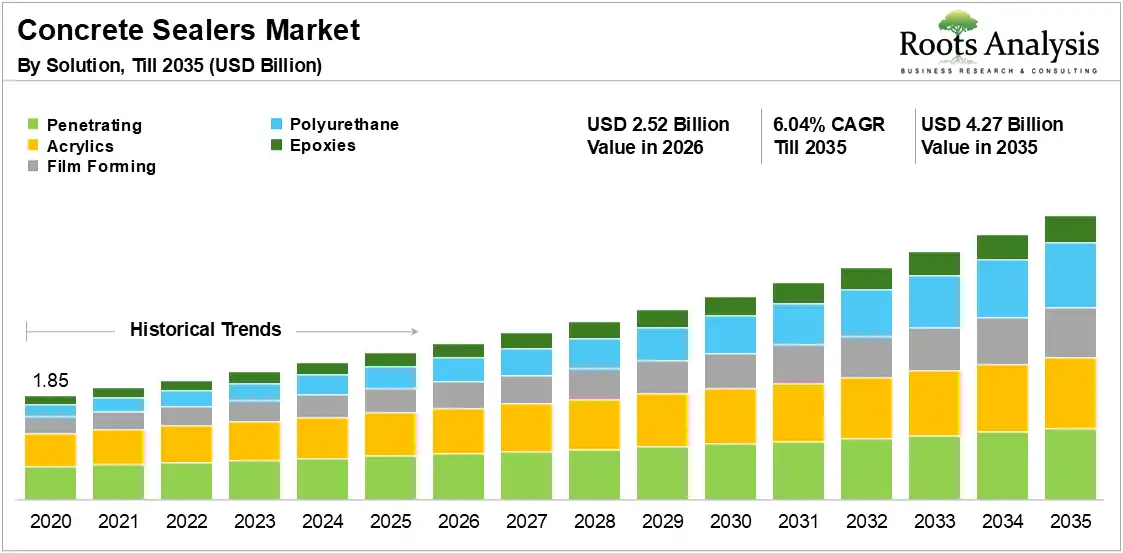
The global concrete sealers market size, valued at USD 2.52 billion in 2026, is projected to reach USD 3.38 billion in 2030 and USD 4.27 billion by 2035, with a 6.04% CAGR during the forecast period 2025 to 2035.
See What’s in the Full Report - Request Your Complimentary Insights!
Market Report: Key Takeaways
- In terms of application, commercial secures the highest overall share, 41.65% in the global market.
- On the basis of product, penetrating holds the largest share of concrete sealers market.
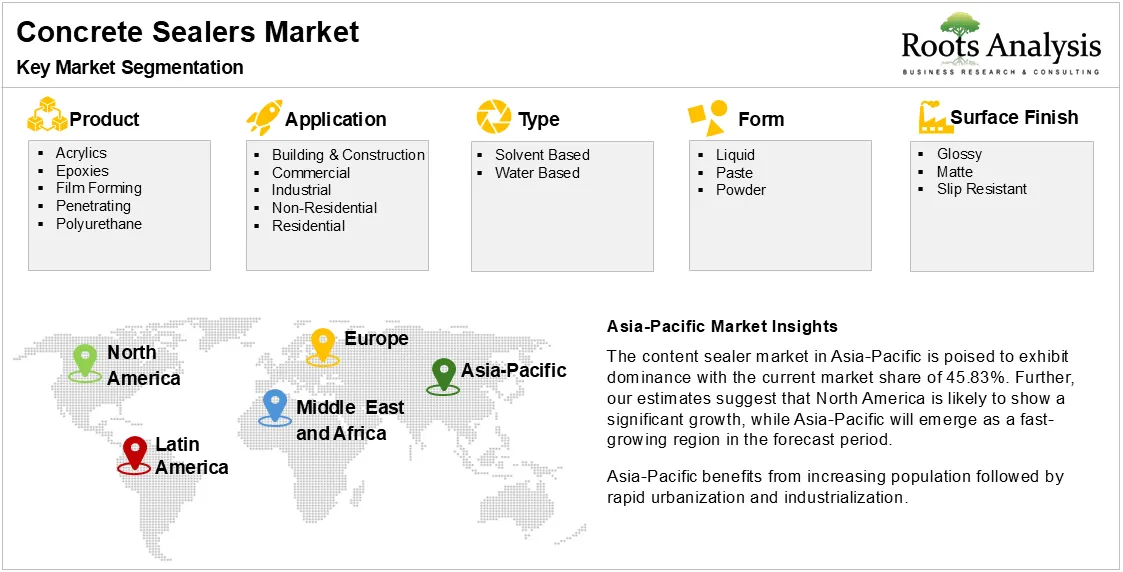
- According to regional analysis, Asia-Pacific holds the largest share, 45.83% of the market.
- Key market drivers include the growing push on sustainable and environmentally reliable mining practices.
Pay Only for What You Need – The Best Way to Optimize
Market Overview
Concrete sealers refer to a form of protective coatings applied to a concrete surface to enhance longevity, durability, and resistance to environmental factors (moisture, abrasion and strain). The inherent porosity of the concrete results in the absorption of chemicals, water and contaminant by the network capillaries, which damage the building materials. It can result in internal reinforcement rust, chemical corrosion and freeze-thaw cracking. These sealers act as a protective layer to prevent concrete surfaces from reduction of water and chemical ingress, thereby preventing corrosion and damage to the building and result in enhancement of the aesthetic appearance.
The applications of concrete sealers are varied and pivotal across several industrial sectors. Their demand for residential, commercial and industrial construction is observed due to evolving consumer preference for aesthetically-enhanced and low- maintenance surface and the desire to need sturdy and long-lasting infrastructure.
The growth of this domain is more with respect to penetrating sealer product segment, which includes silanes, siloxanes, silicates, siliconates. Penetrating sealers retain a natural looking finish whilst protecting the concrete surface from water and contaminants. These stain resistant concrete sealers are becoming a preferred choice, especially as a vital part of architectural coating, due to its minimal visual impact and effectiveness.
In order to leverage competitive edge, market players are undertaking strategic initiatives, such as product development, collaboration, and partnerships. In November 2025, BioBond was launched which is focused on offering anti-microbial coatings and sealers which can be used across various surface, such as metal, wood, ceramic, and concrete.
Recent Developments
- In November 2025, Froza launched FrozaBOND™ R160 Track Strip 5-minute epoxy. This is a next-generation bonding solution which is designed for construction flooring and manufacturing applications.
- In March 2025, BASF and Sika conjointly developed amine building block for hardening epoxy resin. It is not available commercially under BASF’s Baxxodur® EC 151 brand for construction industry, and flooring application.
- In March 2025, Evonik showed its innovative solutions for coatings, adhesives, sealants, and printing inks at European Coating Show.
Market Dynamics
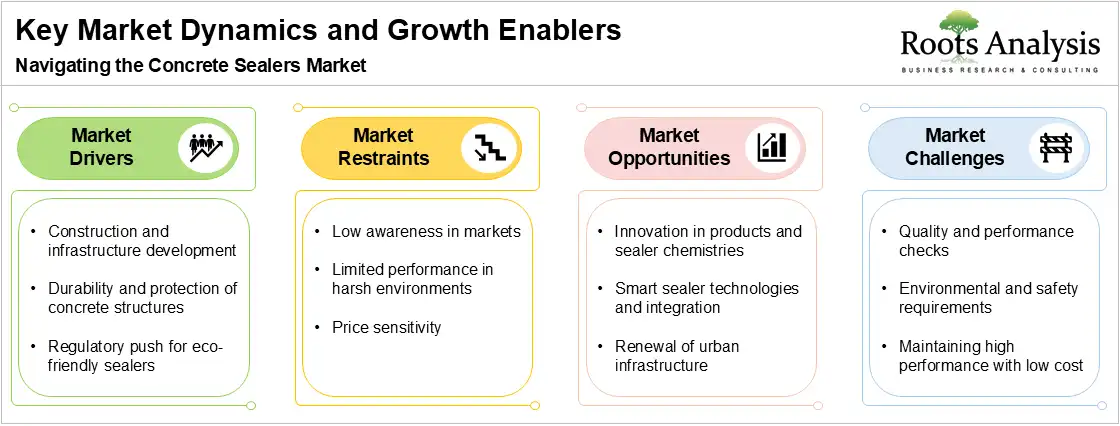
The industry is set to witness a lucrative growth phase, with the concrete sealers industry shaped by a dynamic interplay of drivers, restraints, opportunities, and challenges that will influence its trajectory in the coming years.
Market Segmentation
The concrete sealers market report presents an in-depth analysis of the various companies that are involved in offering concrete surface durability solutions, including acrylic sealers, polyurethane sealers, and penetrating sealers. These are contributors to growth for improving the strength and longevity of concrete while reducing maintenance costs, through applications in different segments, as in the figure below:
Market Share Insights
Penetrating Segment to Dominate the Concrete Sealers Market
As per our concrete sealers market analysis, the penetrating sealers are expected to hold the largest share of 33.45% during the period. This can be attributed to the demand of penetrating concrete sealers for infrastructure and transportation. With the extended life span of concrete against water, freeze-thaw cycles, these sealers offer moisture barrier concrete sealing. nThe permanent hydrophobic barrier formed due to chemical reaction with capillaries, results in a surface which cannot be peeled or can wear off.
Commercial to Gain the Highest Market Share for Application
On the basis of application, the commercial segment is estimated to dominate the concrete sealers market. The rapid rise in commercial construction projects, such as warehouses, retail stores, office buildings, has fueled the demand for concrete sealing solutions. Considerable growth of residential segment is anticipated in emerging economies, as there is rapid urbanization and greater disposal income. This is also due to the rise in demand for weather-resistant concrete sealers in these areas.
Regional Forecast Estimates: North America to Gain the Fastest Growth, Fueled by Heavy Industrialization
Concrete sealers market forecast suggests that North America is expected to witness the fastest growth during the forecast period. This growth is primarily driven by rising construction investments and the swelling housing demand (both single-family housing and multi-family housing). Moreover, it is also driven by heavy industrialization, improved infrastructure and consumer acceptance / awareness. However, the stringent environmental regulations on the volatile organic compounds (VOC), limits the use of solvent-based sealers. This has led the market to shift towards low-VOC and water-based formulations.
Which are the Top Players in Concrete Sealers Domain?
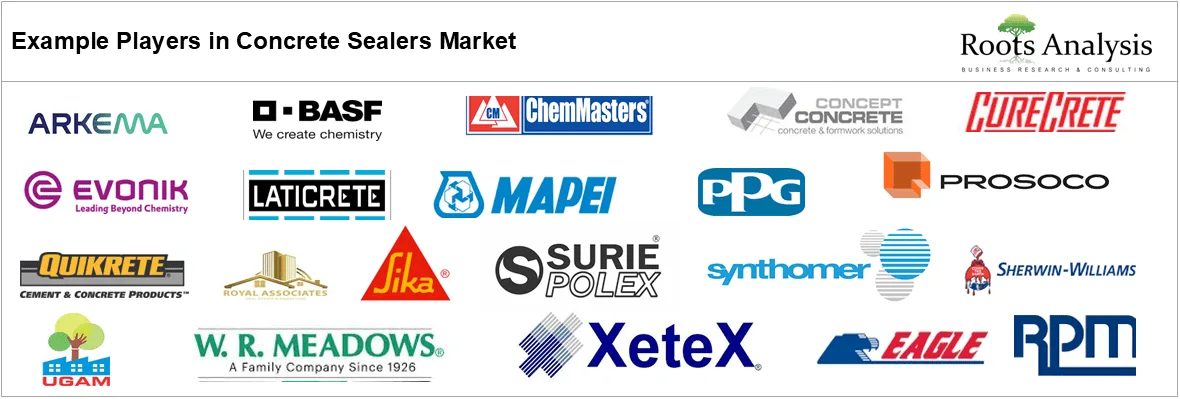
Key industry players of concrete sealers market (which have also been captured in this market report, arranged in alphabetical order) include Arkema, BASF, ChemMasters, Concept Concrete, Curecrete Distribution, Eagle Sealer, Evonik, Laticrete, Mapei , PPG , Prosoco, Quikrete, RPM International, Royal Associates, Sika, Surie Polex, Synthomer, Sherwin-Williams, Ugam Chemicals, W. R. Meadows, and XETEX.
Competitive Landscape of Concrete Sealers Market
The competitive landscape is dominated by both established players and new entrants. Through strong product portfolio, partnerships and regional expansion, these companies are growing in the domain. The companies are focused on investing heavily in innovation and customized formulations, so as to meet evolving needs of the customers. Moreover, these companies are aligning with green building standards, such as Leadership in Energy and Environmental Design (LEED), with focus on bio-based, low-VOC materials.
For instance, BASF provides binders for paintable sealants and gap fillers with significantly elastomeric adhesion properties, improved flexibility and desired rates. Such critical properties drive the demand of all relates segments, including silicate concrete sealer.
Through innovations in eco-friendly and non-toxic concrete sealer formulation, and amalgamation with technological advancements, the companies are anticipated to shape the global market trajectory.
What are the Regulatory Standards for VOC emissions in concrete sealers?
The regulatory standards for VOC emission are aimed to reduce the environmental impact and improve the air quality, with the reduced usage of harmful solvent content. CARB in the US has set a threshold for the usage of VOC content in the sealers. In the European region, EU’s Directive on Limitation of VOC has set the upper limit on the usage of VOC. Green building certifications and standards, such as BREAAM, LEED in the UK offer award credits to those using low-VOC materials. Such regulations have reshaped the concrete sealers industry towards sustainable construction and maintenance worldwide.
How Concrete Sealers are effective for Decorative and Stamped Surfaces ?
The most effective concrete sealers for decorative and stamped surfaces are the ones that enhance appearance, durability and provide protection. The stain-resistant concrete sealers are able to retain the color and texture of the surface. Products, such as acrylic based concrete sealers are popular in this domain for its color and provide glossy finish. Whereas polyurethane sealers for concrete are used in decorative surfaces due to their superior abrasion and chemical resistance, and longevity. These concrete sealers are used more in decorative surfaces but are not cost effective. Notably, epoxy concrete sealers are used in interior decorative floors which create a glass-like surface.

Concrete Sealers Market: Scope of the Report
| Key Report Attributes | Details | |
| Historical Trend | Since 2020 | |
| Forecast Period | Till 2035 | |
| Market Size in 2026 | $ 2.52 Billion | |
| Market Size in 2035 | $ 4.27 Billion | |
| CAGR (Till 2035) | 6.04% | |
| Segments Covered |
|
|
Unlock Deeper Insights – Schedule Your Personalized Workshop Today!
Market Segments
Based on the research, we have segmented the Concrete Sealers Market into technology, product form, application, end user, geographical regions, and leading players.
By Product
- Acrylics
- Epoxies
- Film Forming
- Penetrating
- Polyurethane
By Application
- Building and Construction
- Commercial
- Industrial
- Non-Residential
- Residential
By Type
- Solvent Based
- Water Based
By Form
- Liquid
- Paste
- Powder
By Surface Finish
- Glossy
- Matte
- Slip Resistant
By Geographical Regions
- North America
- US
- Canada
- Mexico
- Rest of North America
- Europe
- Austria
- Belgium
- Denmark
- France
- Germany
- Ireland
- Italy
- Netherlands
- Norway
- Russia
- Spain
- Sweden
- Switzerland
- UK
- Rest of Europe
- Asia-Pacific
- Australia
- China
- India
- Japan
- New-Zealand
- Singapore
- South Korea
- Rest of Asia-Pacific
- Latin America
- Brazil
- Chile
- Colombia
- Venezuela
- Rest of Latin America
- Middle East and Africa (MEA)
- Egypt
- Iran
- Iraq
- Israel
- Kuwait
- Saudi Arabia
- UAE
- Rest of MEA
Want Information on Specific Region / Segment?


