report-pricing-dollar

Epoxy Adhesives Market

Epoxy Adhesives Market by Type of Epoxy Adhesives (One-component and Two-component), End Use Industry (Aerospace, Automotive, Building and Construction, Electrical and Electronics, Footwear and Leather, Healthcare, Marine, Packaging, Transportation, Wind Energy, and Woodworking and Joinery), Curing Mechanism (Reactive, Solvent-borne, UV Cured Adhesives and Water-borne), Type of Enterprise, and Geographical Regions, and Leading Players – Trends and Forecasts 2026-2040

  • Lowest Price Guaranteed

  • Slides
    211

  • Last Updated
    April 2026

  • View Count
    11628

Epoxy Adhesives Market Overview

The global epoxy adhesives market is estimated to reach USD 11.05 billion in 2026 and is projected to reach USD 18.63 billion by 2035, and USD 23.66 billion by 2040, representing a CAGR of 5.59% during the forecast period.
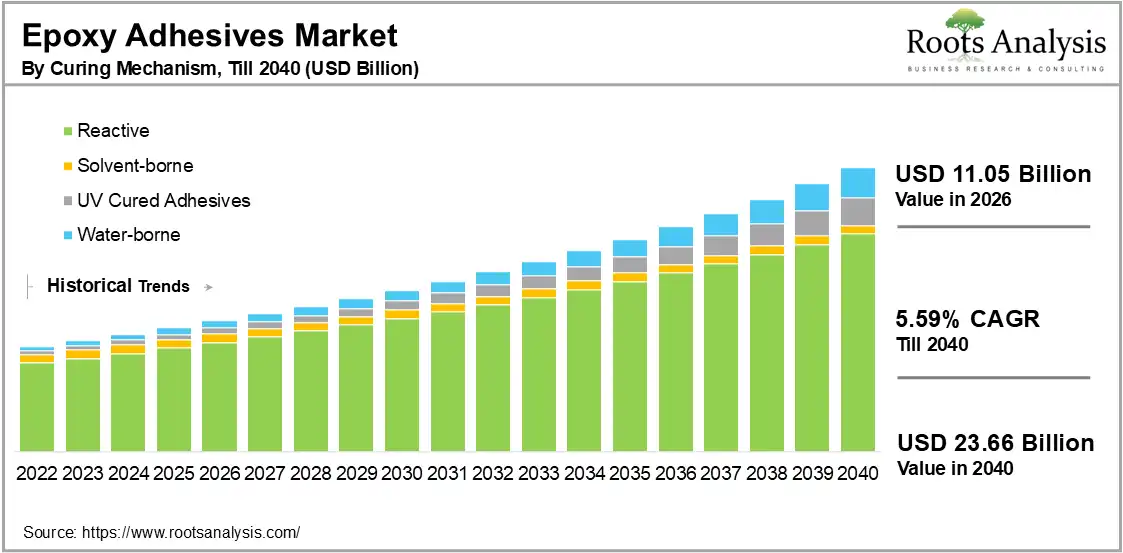
Epoxy Adhesives Market by Curing Mechanisms, 2040

To learn more about this report, request a free sample copy

The new research study consists of global epoxy adhesive industry analysis, mega trends, patent analysis, porter five forces, SWOT analysis, value chain analysis and other strategic frameworks.

Epoxy adhesives are a class of synthetic polymer adhesives formed by the reaction of epoxy resins and hardeners. They are known for their exceptional strength, durability, and resistance to heat, chemicals, and environmental stresses. Further, these adhesives are highly versatile and can bond a wide range of materials, including metals, wood, glass, stone, plastics, and composites, making them indispensable across numerous industries.

Epoxy adhesives find widespread application in construction for bonding concrete and steel, in automotive and aerospace sectors for assembling lightweight and durable components, in electronics for encapsulating and protecting sensitive parts. Apart from this, epoxy adhesives also find applications in the marine industry for bonding boat hulls, in the medical industry for assembling and repairing medical devices, and in the arts and crafts industry for making jewelry. Their ability to provide strong, long-lasting bonds even under harsh conditions has made them a preferred choice for both structural and non-structural uses.

Currently, market expansion is driven by increasing construction activity, rising automotive demand for lightweight bonding solutions, and innovation in electronics and renewable energy sectors.

Additionally, increasing focus on sustainability and the development of advanced, environmentally friendly formulations are further propelling market adoption and diversification. In fact, Ron Marshalik, Head of Engineering for Adhesives Operations-North America, Henkel states, to remain a market leader, we must consider both the quality of our products and the impact of our products. We should ask ourselves if our products align with our sustainability targets, are they being produced in a sustainable way and do our products help our customers and end consumers reduce their carbon footprint? Sustainability must be embedded across the entire product life cycle. That starts with the adhesive formulas Henkel develops and extends through engineering, production processes and packaging.

Epoxy Adhesives Market Share Insights

The epoxy adhesives market report 2025 presents an in-depth analysis of the various companies that are involved in offering epoxy adhesives solutions, across different segments, as defined in the table below:

Epoxy Adhesives Market: Report Attributes / Market Segmentations

Key Report Attributes Details
Historical Trend Since 2022
Forecast Period Till 2040
Market Size in 2026 $ 11.05 Billion
Market Size in 2040 $ 23.66 Billion
CAGR till 2040 5.59%
By Type of Epoxy Adhesives
  • One-component
  • Two-component
By End Use Industry
  • Aerospace
  • Automotive
  • Building and Construction
  • Electrical and Electronics
  • Footwear and Leather
  • Healthcare
  • Marine
  • Packaging
  • Transportation
  • Wind Energy
  • Woodworking and Joinery
By Curing Mechanism
  • Reactive
  • Solvent-borne
  • UV-Cured Adhesives
  • Water-borne
By Type of Enterprise
  • Large Enterprises
  • Small and Medium Enterprises (SMEs)
By Geographical Regions
  • North America
    • US
    • Canada
    • Mexico
    • Other North American countries
  • Europe
    • Austria
    • Belgium
    • Denmark
    • France
    • Germany
    • Ireland
    • Italy
    • Netherlands
    • Norway
    • Russia
    • Spain
    • Sweden
    • Switzerland
    • UK
    • Other European countries
  • Asia
    • China
    • India
    • Japan
    • Singapore
    • South Korea
    • Other Asian countries
  • Latin America
    • Brazil
    • Chile
    • Colombia
    • Venezuela
    • Other Latin American countries
  • Middle East and North Africa
    • Egypt
    • Iran
    • Iraq
    • Israel
    • Kuwait
    • Saudi Arabia
    • UAE
    • Other MENA countries
  • Rest of the World
    • Australia
    • New Zealand
    • Other countries
Leading Market Players
  • 3M
  • AdCo
  • Arkema
  • Ashland
  • Aremco Products
  • Ardex
  • Avery Denison
  • Bostik
  • DELO Industrie Klebstoffe
  • Dow
  • DuPont
  • Epotek
  • H.B. Fuller Company
  • Henkel
  • Hernon Manufacturing
  • Huntsman
  • Illinois Tool Works
  • Lord
  • MAPEI
  • Master Bond
  • MG Chemicals
  • Oligo Polymer
  • Panacol-Elosol
  • Parker Hannifin
  • Permabond
  • Pidilite Industries
  • Powerblanket
  • RPM International
  • Sika
  • Tesa
  • The Gorilla Glue Company
  • Wacker Chemie
  • Weicon
PowerPoint Presentation
(Complimentary)
Available
Customization Scope 15% Free Customization
Excel Data Packs
(Complimentary)
  • Competitive Landscape
  • Company Competitive Analysis
  • Patent Analysis
  • Funding Analysis
  • Recent Developments
  • Market Forecast and Opportunity Analysis

Epoxy Adhesives Market Segmentation

Which Type of Epoxy Adhesive Will Dominate the Market?

When it comes to the epoxy adhesives market by type, the two-components segment is set to take the lead, holding a significant share of 67.21% of the market.

This dominance is due to their versatile performance, strong adhesion to a wide range of substrates, and superior durability. Further, the high applicability of epoxy adhesives across various industries, such as construction, automotive, and electronics due to their high bonding strength, excellent thermal stability, and chemical resistance. Furthermore, their ability to bond a wide range of materials, including metals, composites, plastics, and ceramics, further drives widespread adoption

However, it is worth highlighting that the one-component segment is likely to witness the fastest CAGR (6%) during the forecast period

How is the Automotive Segment Dominating End Use Industries?

Among the end use industries, the automotive segment stands out as the leading segment, holding an overall market share of 34%.

According to our epoxy adhesives market analysis, increasing use of epoxy adhesives in vehicle assembly and EV battery production is driving market growth. This is likely due to the critical role of epoxy adhesives in battery assembly and structural bonding.

On the other hand, it is worth highlighting that the wind energy segment is likely to witness the fastest CAGR (6.3%) during the forecasted period.

Which Curing Mechanism Will have the Fastest CAGR?

Among the key curing mechanisms in the epoxy adhesives market, the UV-cured adhesives segment is projected to register the fastest CAGR of 6.7% over the forecast period. This strong growth is fueled by rising adoption of UV-curable epoxy adhesives in high-precision applications across aerospace, electronics, and medical devices, where fast, clean, and reliable bonding is critical. In these formulations, reactive diluents play a vital role by reducing viscosity, enabling higher solids content, and supporting rapid UV curing, which collectively improve line productivity and process efficiency.

The rapid expansion of UV-cured epoxy adhesives is further supported by core performance advantages such as instant or near-instant curing, excellent adhesion to diverse substrates (including metals, composites, and plastics), and suitability for high-speed, automated production lines. Incorporation of tailored reactive diluents in epoxy adhesive systems enhances wetting, flow, and crosslink density, enabling manufacturers to fine-tune open time, flexibility, and mechanical strength for demanding industrial applications.

Which Regions are Expected to See the Highest Demand for Epoxy Adhesives?

According to our regional analysis, the Asian epoxy adhesives market exhibits dominance by capturing 49.86% of the overall current market share.

This dominance is driven by rapid industrialization and urbanization in countries like China, India, and South Korea. Further, increasing urbanization and industrialization coupled with the robust growth in construction, automotive, and electronics sectors boosts the demand for epoxy adhesives.

Besides the above factors, the large-scale infrastructure projects, such as China’s Belt and Road Initiative, further fuel the market by region. Additionally, the presence of major epoxy adhesive manufacturers and low production costs contribute to Asia’s leadership.

Epoxy Adhesives Market Key Insights

Epoxy Adhesives Market Drivers and Challenges

What are the Key Epoxy Adhesives Market Drivers?

The market is experiencing robust growth due to several key drivers. Here are some significant factors contributing to this expansion:

  • Urbanization and Infrastructure Development: By 2045, the urban population is projected to reach 6 billion, more than doubling from 2022 levels. This significantly drives the global epoxy adhesives market by increasing demand for strong, durable, and versatile adhesives in various construction, transportation, and other infrastructure projects. This trend is particularly pronounced in emerging economies like China and India, where rapid population growth and infrastructure expansion fuel construction activities.
  • Technological Advancements and Sustainable Formulations: Innovations in bioadhesives and hybrid systems cater to environmental concerns, enhancing market appeal. Miniaturization and microelectronics also drive demand in electronics and manufacturing sectors.
  • Electric Vehicle Growth and Renewable Energy Infrastructure: Epoxy adhesives are crucial for lightweighting in EVs and for bonding components in renewable energy systems, such as wind turbines.
  • Aerospace Expansion and Advanced Composite Materials: Epoxy adhesives are essential for bonding lightweight, yet strong materials used in aircraft and spacecraft, and driving demand in this sector.
  • Regulatory Support and Sustainability Concerns: Increasing environmental regulations and consumer preference for sustainable products encourage the development and adoption of eco-friendly epoxy adhesives, further boosting market growth.

What are the Major Challenges Faced in the Epoxy Adhesives Market?

The epoxy adhesives market faces several major restraints and challenges that could hinder its growth despite strong demand and expanding applications. Key market restraints include:

  • Regulatory Hurdles and Environmental Concerns: Epoxy adhesives often contain chemicals that may pose environmental and health risks, necessitating compliance to stringent regulations on volatile organic compounds (VOCs) and hazardous substances. Compliance with these regulations increases production costs and limits formulation options.
  • Technological Limitations: While epoxy adhesives offer excellent mechanical, chemical, and electrical properties, they have limitations, such as sensitivity to high heat and ultraviolet (UV) light exposure, which can degrade their strength over time.
  • Economic Constraints and Price Volatility: The epoxy adhesives market is influenced by the fluctuating prices of raw materials, particularly epoxy resins and hardeners derived from petrochemicals. Feedstock price volatility can lead to unstable epoxy adhesive prices, affecting profitability for manufacturers and cost competitiveness for end users.

What are the Key Strategies Used by Companies to Gain Competitive Edge in Epoxy Adhesives Market Share?

Leading players in the epoxy adhesives market are focusing on market opportunities in emerging economies by using smart strategies to stay ahead and gain a competitive edge. The companies are opting for various strategic partnership agreements, acquisitions, joint ventures, and technological innovations to strengthen their position in the epoxy adhesives competitive landscape 2025 while also investing in R&D to bring novel products to the market.

Recent Developments in the Epoxy Adhesives Market

  • In February 2026: Henkel Adhesive Technologies announced a strategic collaboration with Sekab to accelerate the transition from fossil-based to bio-based chemicals. The initiative focuses on replacing fossil-based ethyl acetate with a bio-based alternative for use in industrial adhesive production, including the packaging division.
  • In January 2026: 3M Company expanded its U.S. production and launched new epoxy and acrylic grades of high-strength structural adhesives. These products were specifically developed for the automotive and aerospace sectors, featuring improved heat resistance for demanding manufacturing environments.
  • In January 2026: Henkel AG acquired a specialty adhesive technology firm to bolster its portfolio of UV-curing and pressure-sensitive adhesives. This move was intended to enhance the company's technical offerings in the electronics and packaging sectors.
  • January 2026: Mitsubishi Industries Limited accelerated the launch of advanced epoxy and silicone adhesives. These materials were designed for high-reliability applications in the electronics and automotive industries, supported by regional demand in Japan for precision bonding.

Frequently Asked Questions

What are epoxy adhesives?

Epoxy adhesives are a class of synthetic polymer adhesives formed by the reaction of epoxy resins and hardeners, known for their exceptional strength, durability, and resistance to heat, chemicals, and environmental stresses.

What is the current size of the global epoxy adhesives market?

Currently, the epoxy adhesives market size and forecast is estimated to be worth $11.05 billion.

What is the expected growth rate of the epoxy adhesives market?

The market is forecasted to grow at a compound annual growth rate (CAGR) of 5.59% during the forecasted period.

Which are the leading players in the epoxy adhesives market globally?

3M, AdCo, Arkema, Ashland, Aremco Products, Ardex, Avery Denison, Bostik, DELO Industrie Klebstoffe, Dow, DuPont, Epotek, H.B. Fuller Company, Henkel, Hernon Manufacturing, Huntsman, Illinois Tool Works, Lord, MAPEI, Master Bond, Masterbond, MG Chemicals, Oligo Polymer, Panacol-Elosol, Parker Hannifin, Permabond, Pidilite Industries, Powerblanket, RPM International, Sika, Tesa, The Gorilla Glue Company, Wacker Chemie, Weicon.

What are the main types of epoxy adhesives available?

Key types include one-component (heat-curable, moisture-curable), two-component (epoxy resin and hardener systems, fast-curing, slow-curing), and other types such as conductive, structural, and acrylic-modified epoxy adhesives.