


 Download Free Sample
 Buy Now
Market Size
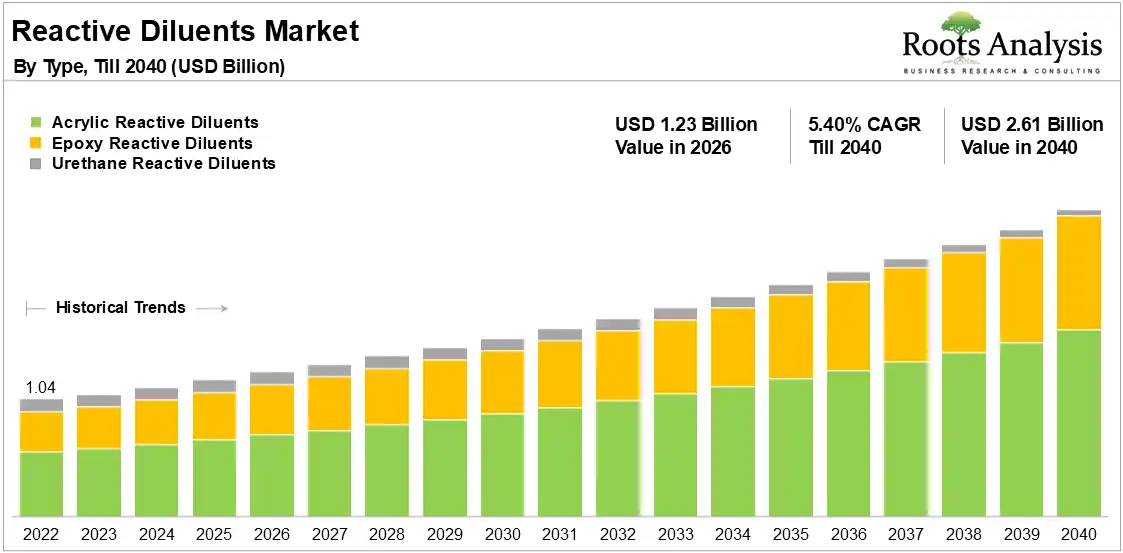
The global reactive diluents market is projected to reach USD 1.23 billion in 2026 and USD 2.61 billion by 2040, representing a CAGR of 5.40% during the forecast period 2026 to 2040.
See What’s in the Full Report - Request Your Complimentary Insights!
Market Overview
The global reactive diluents market involves high-performance specialty chemicals designed to reduce viscosity in epoxy, polyurethanes, and acrylate resin systems. Unlike solvents, these agents chemically integrate into the polymer matrix during curing, significantly reducing VOC emissions while enhancing critical performance metrics, including structural flexibility and substrate adhesion. These additives are indispensable for formulating solvent-free coatings, structural adhesives, and sealants, allowing industrial and automotive sectors to optimize processing while adhering to strict regulatory compliance.
Market trajectory is defined by the rapid adoption of low-VOC technologies, driven by rigorous environmental mandates across North America and Europe. Key growth verticals include protective infrastructure coatings, automotive refinishing, and high-performance composites for aerospace and wind energy. To satisfy this demand, leading chemical manufacturers are strategically expanding production capacities for aliphatic reactive diluents, supporting the automotive industry's transition toward durable, high-solids resin systems.
Innovation is increasingly centered on sustainable and bio-based reactive diluents to address decarbonization goals and raw material circularity. This shift is redirecting R&D capital toward renewable alternatives that reduce environmental impact without compromising coating performance. The outlook remains robust as the industry systematically replaces conventional volatile solvents with safer, eco-efficient resin modifiers.
Market Report: Key Takeaways
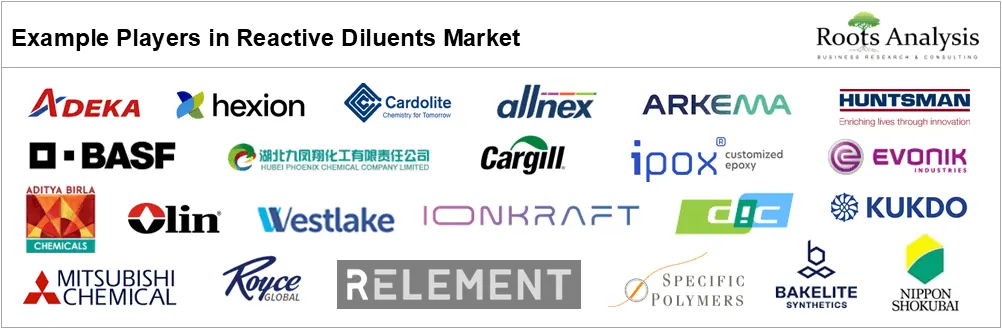
- Leading Players Competitive Footprint: Key players include Adeka, Aditya Birla Chemicals, Allnex, Arkema, Aditya Birla Chemicals, Bakelite Synthetics, BASF, Cardolite, Cargill, DIC, Evonik Industries, Hexion, Hubei Phoenix Chemical Company, Huntsman, Ipox, Kukdo, Mitsubishi Chemical, Nippon Shokubai, Olin, Royce Global, and Westlake. These firms hold strong market positions with extensive geographic presence in various regions.
- Startup Ecosystem and Innovation Hotspots: Agile startups are challenging chemical incumbents by commercializing bio-based reactive diluents derived from renewable feedstocks. These innovators aim to replace petrochemical glycidyl ethers, capturing high-value niche markets and commanding premium pricing for sustainable epoxy solutions.
- Regional Penetration and Adoption Trend: Rapid industrialization, booming infrastructure projects, and surging demand across construction, automotive, coatings, and electronics sectors drive Asia-Pacific's dominance in the reactive diluents market. Notably, China, India, and Japan lead due to massive chemical production capacities, urbanization, and expanding end-use applications like low-VOC paints and composite materials.
- Market Share by Type: Epoxy reactive diluents hold the highest market share of 55.20%. This dominance is driven by their critical role in viscosity reduction for epoxy resin systems, supported by robust supply chains and superior chemical compatibility.
- Market Share by Application: In the reactive diluents market, coatings applications hold a dominant 58.5% market share. Market expansion is underpinned by global construction necessitating durable, low-VOC formulations that deliver enhanced substrate adhesion and optimized rheological control.
- Market opportunities in reactive diluents center on developing bio-based sustainable formulations. These innovations meet stricter VOC regulations and emerging ESG mandates, catering to evolving demands in coatings, adhesives, and advanced composites.
Get an Instant Quote in 10 Minutes. Lowest Price Guaranteed
Recent Industry Developments
- July 2025: Royce Global introduced toughened epoxy resins and mercaptan curing agents at CAMX 2025 expanding their reactive diluents portfolio for high-performance composites.
- April 2025: Arkema introduced a new range of bio-based specialty rheology additives in Europe. These additives, designed for sustainable coatings and adhesives, offer up to 30% bio-based content and a reduced carbon footprint, supporting the industry's shift toward renewable formulations.
- April 2025: Huntsman Corporation unveiled bio-based I-BOND® resins (MDI-based) specifically for the composite wood and furniture industries, rather than automotive epoxies. Launched ahead of LIGNA 2025, these resins feature renewable content to significantly lower the embodied carbon of industrial wood products.
- January 2025: Kuraray showcased Isoprenyl Methacrylate (IPEMA), a low-viscosity, UV-curable reactive diluent, at the European Coatings Show (ECS) 2025. Unlike a January launch, this innovation was a key highlight at the March event, marketed for its ability to improve durability and scratch resistance in hard coatings.
Market Dynamics
Reactive Diluents Market Growth Drivers
- Regulatory Pressure to Reduce VOC Emissions: Stringent environmental regulations from agencies such as the environmental protection agency (EPA) and registration, evaluation, authorization and restriction of chemicals (REACH) are driving demand for low-VOC formulations in coatings, adhesives and sealants. Reactive diluents help reduce solvent use by lowering viscosity in high-solids systems, ensuring regulatory compliance while preserving application performance.
- Accelerated Demand for High-Performance Industrial Coatings: The growth of end-user industries like construction, marine, and aerospace is fueling demand for coatings with enhanced durability, chemical resistance, and weatherability. Reactive diluents are critical components in formulating high solids epoxy and polyurethane systems used in protective coatings for infrastructure, shipping vessels, and aircraft, where they ensure proper film formation and structural integrity.
- Growth in Additive Manufacturing and 3D Printing Technologies: Reactive diluents are essential for controlling the viscosity of photopolymer resins used in stereolithography (SLA) and digital light processing (DLP) 3D printing. They allow for finer resolution and faster printing speeds by enabling easier resin flow and facilitating efficient curing under UV light, driving adoption as additive manufacturing expands into industrial applications.
Reactive Diluents Market Growth Challenges
- Difficulty in Product Differentiation and Commoditization Pressure: Many standard reactive diluents are viewed as commodity chemicals, leading to intense price competition and limited opportunities for product differentiation based solely on performance. Suppliers struggle to maintain profit margins unless they invest heavily in developing highly specialized RDs for niche applications or offer strong technical support and customized blends.
- Complex Supply Chain Management and Sourcing Risks: The reactive diluents value chain relies on specialized chemical intermediates, often sourced from a limited number of global producers. Supply chain consolidation and geopolitical events can lead to significant disruptions and sourcing risks, requiring end users to manage inventory levels carefully and diversify their supplier base to mitigate potential shortages.
- Integration Challenges with New Polymer Systems: As new polymer technologies emerge (such as advanced polyaspartics and different epoxy hardeners), ensuring compatibility and optimized performance with existing reactive diluent chemistries requires significant R&D investment. Formulators often face challenges integrating RDs into these new systems without compromising cure speed, pot life, or final product characteristics, slowing adoption in emerging applications.
Pay Only for What You Need – The Best Way to Optimize
Market Share Insights
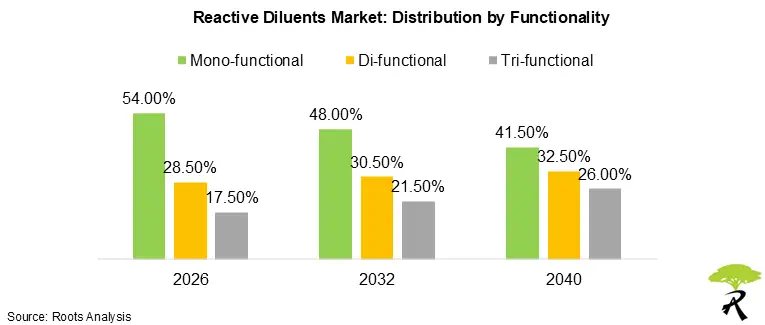
Market Share by Functionality: Mono-functional Reactive Diluents Hold the Largest Market Share, While Tri-functional Reactive Diluents to Drive Growth Through 2040
- According to our reactive diluents market analysis, the mono-functional reactive diluents dominate the current market, capturing the largest market share of 54.00%. This leadership is primarily attributed to their superior cost-effectiveness and efficiency in viscosity reduction for epoxy resin systems.
- By possessing a single reactive site and lower molecular weight, mono-functional diluents offer a sharper reduction in viscosity compared to di- or multifunctional alternatives, significantly improving flow properties and surface wetting in coatings, adhesives, and sealants without inducing excessive crosslinking.
- While monofunctional types lead in market share, the tri-functional reactive diluents are poised to grow the fastest, with a forecast CAGR of 7.8% through 2040. This growth trajectory is driven by the paradigm shift toward advanced composite materials and electronics, where higher crosslink density is required to achieve superior mechanical strength, thermal stability, and chemical resistance.
Market Share by Geographical Regions: Asia-Pacific to Dominate the Industry and Grow Rapidly through 2040
- The Asia-Pacific region leads the global sector, securing a 43.80% market share and is projected to register the highest CAGR through 2040. This expansion is anchored by established production hubs in China, Japan, and India, which collectively control over one-third of global epoxy resin capacity. Consequently, the region functions as both a primary manufacturer and consumer, effectively minimizing supply chain risks for critical industrial applications.
- Growth is further catalyzed by government-led infrastructure initiatives and smart city projects, alongside accelerating demand in renewable energy (specifically wind turbine composites) and electronics manufacturing.
- Reflecting this trajectory, major industry players are scaling operations to meet local requirements. For instance, Sumitomo Bakelite recently expanded its production facilities in China to support the surging demand for semiconductor-grade epoxy materials, underscoring the region's strategic pivot toward high-performance, value-added formulation ingredients.
Want Information on Specific Region / Segment?
Market Ecosystem Insights
Key Players in Reactive Diluents Market
Leading industry participants, including Adeka, Arkema, BASF, Evonik, Huntsman, Kukdo Chemical, Mitsubishi Chemical, Olin, and Westlake, maintain market dominance through extensive global supply chains and diversified high-performance portfolios.
These incumbents actively consolidate their positions through strategic acquisitions and targeted expansions into high-growth regional markets. For instance, Westlake Corporation fortified its leadership in the epoxy value chain by acquiring Hexion’s global epoxy business, subsequently rebranding the division as Westlake Epoxy to unify its coating and composite solutions.
Recent market activity highlights a pivot toward sustainability and regional localization:
- Evonik Industries: In 2023, the company expanded its sustainable portfolio by launching next generation Ancamine® and Ancamide® curing agents, formulated to remove hazardous components like phenol and reduce emissions. Concurrently, the company positioned its Epodil® reactive diluents to support low-VOC strategies, enabling customers to meet increasingly stringent environmental regulations in the high-performance coatings sector.
- Huntsman Corporation: In a major strategic pivot during 2023, Huntsman completed the divestiture of its Textile Effects division, sharpening its focus on its core Polyurethanes and Advanced Materials segments. This move allows the company to concentrate resources on high-growth industrial applications, including automotive lightweighting and energy-saving insulation.
- Kukdo Chemical: Following the successful operation of its Gujarat, India facility (completed in late 2020), Kukdo announced strategic plans in late 2025 to significantly expand this site’s capacity from 40,000 to 100,000 tonnes/year. This expansion is specifically targeted to meet the surging South Asian demand for electronics and aerospace composites, directly addressing the region's tech miniaturization trends and supply chain localization needs.
Startup Activity and Innovation Hotspots
The startup landscape within the reactive diluents market is defined by deep-tech ventures commercializing bio-based alternatives to petrochemical incumbents. These innovators are prioritizing high-precision applications, particularly energy-curable systems for additive manufacturing and electronic encapsulation, where purity and cure speed are paramount. By leveraging renewable feedstocks, these agile companies are addressing the performance gap in traditional green chemistries, offering functionalized monomers that improve crosslink density and thermal stability.
- Relement (Netherlands): A leading spin-off from TNO, Relement recently secured €5.4 million in seed funding (2025) to scale its proprietary bio-MPA (3-methylphthalic anhydride). Their novel bio-aromatics enable low-VOC alkyd coatings with up to 70% renewable content, matching the gloss and durability of fossil-based benchmarks while significantly reducing solvent reliance.
- Specific Polymers (France): This R&D-focused innovator has successfully commercialized vanillin- and cardanol-derived reactive diluents. Their recent launch of 100% bio-based DGEVA (diglycidyl ether of vanillic alcohol) provides a sustainable, non-endocrine-disrupting alternative to BPA-based resins for high-performance composites.
Innovation hotspots are increasingly consolidating in the Asia-Pacific region, specifically within the semiconductor supply chains of Taiwan and South Korea. Unlike Western markets focused primarily on architectural sustainability, Asian startups are pioneering functional monomers for advanced semiconductor packaging and 5G thermal management. These developments utilize AI-driven material informatics to optimize resin viscosity for 3D IC integration, positioning the region as the epicenter for technical-grade reactive diluent innovation.
Funding and Investment Momentum
The reactive diluents market is characterized by moderate but targeted investment momentum, driven primarily by strategic acquisitions and R&D allocation toward sustainable innovations rather than high-volume venture capital placements. Capital flows are increasingly concentrated on bio-based feedstocks and low VOC technologies, as major incumbents seek to align portfolios with evolving environmental regulations in the coatings and composites sectors.
Key institutional activity includes Astorg’s continued strategic backing of IGM Resins, which has accelerated its "Go Grow Green" initiative to expand the production of energy-curable reactive diluents and photoinitiators. Simultaneously, government initiatives in the Asia-Pacific region are pivotal; for instance, China’s National Natural Science Foundation (NSFC) and India’s SERB grants prioritized funding for green chemistry and self-reliant material supply chains in 2025.
In the startup ecosystem, venture capital is selectively targeting high-performance sustainability plays. Notable recent activity includes Ionkraft, which secured $3.6 million in equity funding in late 2024 to scale plasma-based barrier coatings, and Nfinite Nanotechnology, which raised $6.5 million to advance nanocoating solutions. These investments underscore a growing confidence in bio-based alternatives that can replace traditional petrochemical resin components in industrial applications.
Your Business is Unique – Why Shouldn’t Your Report Be?
Reactive Diluents Market: Scope of the Report
| Key Report Attributes | Details | |
| Historical Trend | Since 2022 | |
| Forecast Period | Till 2040 | |
| Market Size 2026 | $ 1.23 Billion | |
| Market Size 2040 | $ 2.61 Billion | |
| CAGR (Till 2040) | 5.40% | |
| Segments Covered |
|
|
Market Segmentation
Based on the research, we have segmented the reactive diluents market into type, application, functionality, geographical regions, and key players.
Market Share by Type
- Acrylic Reactive Diluents
- Epoxy Reactive Diluents
- Reactive Diluents
Market Share by Application
- Adhesives & Sealants
- Coatings
- Composites
- Pigment Concentrates
Market Share by Functionality
- Di-functional Reactive Diluents
- Mono-functional Reactive Diluents
- Tri-functional Reactive Diluents
Market Share by Geographical Regions
- North America
- US
- Canada
- Mexico
- Rest of North America
- Europe
- Austria
- Belgium
- Denmark
- France
- Germany
- Ireland
- Italy
- Netherlands
- Norway
- Russia
- Spain
- Sweden
- Switzerland
- UK
- Rest of Europe
- Asia-Pacific
- Australia
- China
- India
- Japan
- New-Zealand
- Singapore
- South Korea
- Rest of Asia-Pacific
- Latin America
- Brazil
- Chile
- Colombia
- Venezuela
- Rest of Latin America
- Middle East and Africa (MEA)
- Egypt
- Iran
- Iraq
- Israel
- Kuwait
- Saudi Arabia
- UAE
- Rest of MEA


