Connected Agriculture Market by Component (Services and Solution), Type of Solution, Type of Service, Platform (Application Enablement, Connectivity Management, and Device Management), Deployment Mode (Cloud and On-premises), Application (Farming Planning and Management, Livestock Monitoring, Precision Farming, Smart Irrigation, Smart Logistics, and Supply Chain Management), Geographical Regions, and Key Players – Trends and Forecast 2026-2035
Connected Agriculture Market Size
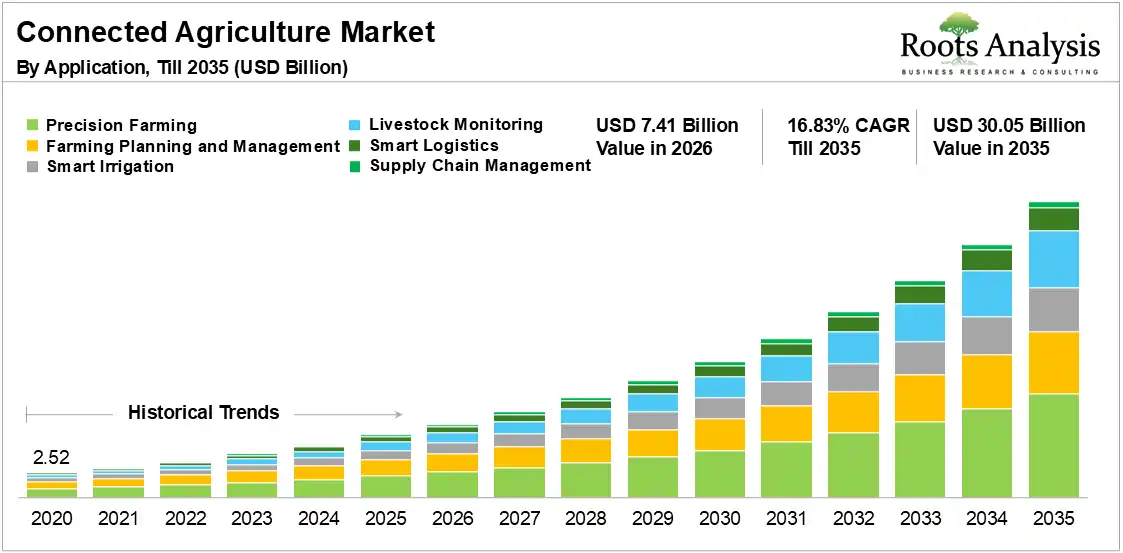
The global connected agriculture market, valued at USD 7.41 billion in 2026, is projected to reach USD 13.81 billion in 2030 and USD 30.05 billion by 2035, with a 16.83% CAGR during the forecast period 2026 to 2035.
See What’s in the Full Report - Request Your Complimentary Insights!
Connected Agriculture Market Report: Key Takeaways
- In terms of component, solution secures 73.40% of the overall revenue share of the global market.
- In terms of application, precision farming holds the largest share (38.35%) of smart agriculture market.
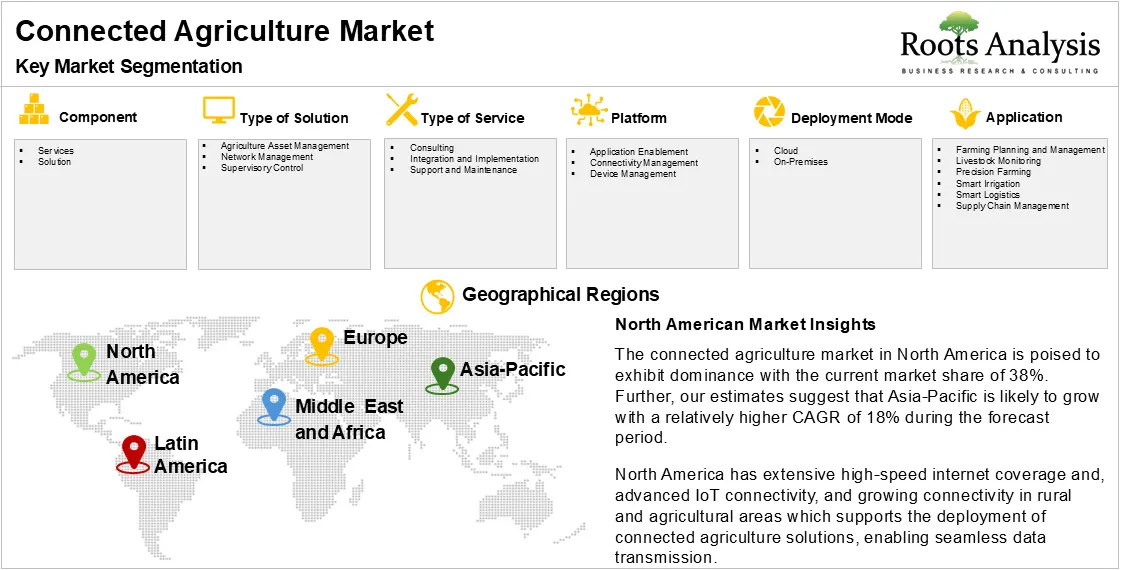
- In terms of leading region, North America holds the largest share with 38% share of the market.
- Key market driver is the increasing food production needs and resource optimization.
Connected Agriculture Market Overview
Connected agriculture, often referred to as smart connected farms or digital agriculture, represents the integration of advanced technologies such as the Internet of Things (IoT), cloud-based agriculture platforms, and data analytics into farming practices. This facilitates real-time data monitoring, sharing, and decision-making across agricultural networks. Additionally, this networked approach creates systems where farms, equipment, and stakeholders are linked. The usage of connected sensors for agriculture enables coordinated actions, efficient information exchange, automated farm equipment connectivity, and optimized resource management.
Connected agriculture entails a wide spectrum of applications including precision crop monitoring, real-time livestock monitoring, automated machinery, resource optimization, and market access. Technologies such as remote crop monitoring systems, weather, and plant health to adjust irrigation, fertilization, and pest control in real time, thereby enhancing productivity and sustainability. Livestock health is tracked through wearable devices, facilitating early disease detection and improving animal welfare. Small scale farmers benefit from mobile-based platforms and low-cost IoT-enabled farm management, which open avenues for improved yields, reduced losses, and streamlined market access.
The rapid adoption of connected agriculture is fueled by several key drivers. Continuous advances in connectivity, automation, and digital platforms are enabling farmers to make data-driven decisions, boost yields, and maximize efficiency. Growing awareness around sustainability and the need to conserve water and energy resources amid changing climate patterns, is pushing the sector towards resource-efficient practices and regulatory compliance.
Increased availability and affordability of digital farm productivity solutions (especially tailored for small farmers in emerging economies) further accelerates the adoption. Moreover, stakeholder networks and collaborative on-farm research projects are demonstrating tangible improvements in both productivity and environmental performance. This underscores the crucial role of integrated systems and shared knowledge.
Recent Developments
- In November 2025, University of Guelph and Creative Destruction Lab partnered together to support Agri-Food Entrepreneurs through a program which develops, tests and commercializes innovations in digital agriculture, biotechnology, etc.
- In October 2025, Cisco and Social Alpha launched Krishi Mangal 3.0, an accelerator program to support and scale 7 new-age Agri-tech startups.
- In May 2025, Microsoft and FFA help students use smart sensors and AI to learn about the future of farming and technology.
- In May 2025, University of Sharjah and IBM partnered together to launch My FarmWell, a mobile app designed to tackle water scarcity challenges and transform sustainable agriculture across UAE and MENA region.
Connected Agriculture Market Dynamics
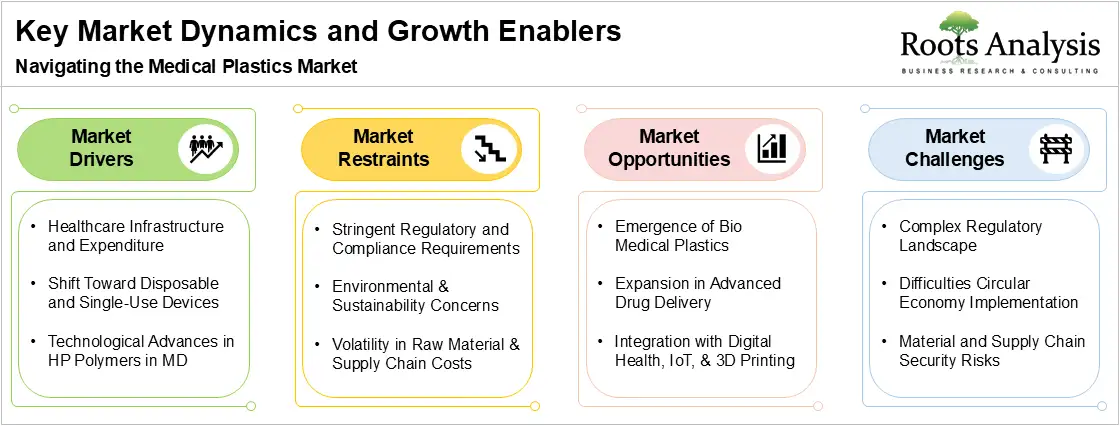
The industry is set to witness a lucrative growth phase, with the smart agriculture market shaped by a dynamic interplay of drivers, restraints, opportunities, and challenges that will influence its trajectory in the coming years.
Your Business is Unique – Why Shouldn’t Your Report Be?
Connected Agriculture Market Segmentation
The connected agriculture market report presents an in-depth analysis of the various companies that are involved in offering connected farming solutions and services, across different segments, as in the figure below:
Connected Agriculture Market Share Insights
Solution Sub-Segment to Dominate the Connected Agriculture Market
As per our connected agriculture market analysis, the solution sub-segment is expected to hold the largest share of 73.40% within the current global year.
The growth is attributed to the rising need for data-driven decision-making and the increased investment in AgTech startups. The need for real-time data and insights to make informed decisions about crop management, soil health, and weather conditions is driving the demand for integrated solutions that offer comprehensive data analysis and reporting.
Further, the services sub-segment is expected to witness the fastest CAGR (16.30%) in the forecast period. The increasing complexities and the advancements in technology are driving the segment’s growth. As agricultural technologies become more complex, farmers and agribusinesses increasingly rely on managed services to help with the implementation, maintenance, and optimization of connected solutions.
Precision Farming Gains the Highest Market Share for Application Segment
The connected agriculture applications market estimates suggest that the precision farming sub-segment is expected to hold the largest share of 38.35% within the current global year.
This dominance is driven by the increase in demand for food production efficiency and rising concerns about climate change. Precision farming technologies are helping in optimizing crop yields by using data-driven approaches to monitor and manage field conditions by using remote monitoring systems for crop and livestock management. This ensures that resources such as water, fertilizers, and pesticides are used effectively, enhancing overall productivity. Apart from this, it also helps in adapting to climate change by enabling farmers to monitor and respond to changing weather patterns and soil conditions.
Regional Forecast Estimates: Asia-Pacific to Gain the Fastest Growth, Fueled by Increasing Population and Rising Food Demand
Connected agriculture market forecast suggests that Asia-Pacific is projected to witness the fastest growth with a CAGR of 18% during the forecasted period. This growth is driven by the rising population and the demand for food. This drives the adoption of connected agriculture technologies to enhance productivity and meet the rising needs.
In addition to that, governments across the Asia-Pacific region are actively promoting the adoption of smart agriculture technologies through subsidies, grants, and supportive policies. These initiatives lower the financial barriers for farmers to invest in agriculture connectivity solutions.
Want Information on Specific Region / Segment?
Connected Agriculture Market Trends and Key Insights
Which are the Top Players in the Connected Agriculture Market?
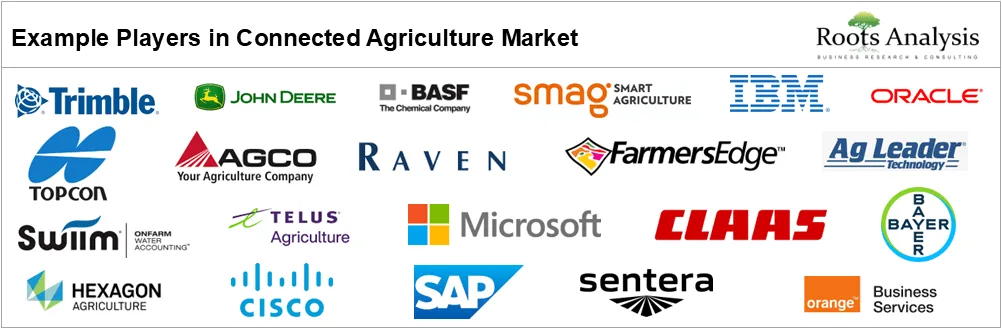
Examples of leading companies (which have also been captured in this market report, arranged in alphabetical order) include AGCO, Ag Leader Technology, BASF, Bayer, CLAAS, Cisco Systems, Farmers Edge, Hexagon Agriculture, IBM, John Deere (formerly known as Deere & Company), Microsoft, Orange Business Services, Oracle, Raven Industries, SAP, Sentera, SMAG, SWIIM System, TELUS Agriculture Solutions, Topcon, and Trimble.
What Strategies are the Companies Using to Gain Connected Agriculture Market Share?
The competitive landscape of the connected agriculture market is marked by intense innovation and strategic developments from key players who leverage advanced technologies like IoT in agriculture market, along with AI, and cloud computing to transform traditional farming. These companies emphasize delivering integrated solutions that enhance operational efficiency, optimize resource use, and improve farm productivity through real-time data analytics and automation.
Market competition drives continuous advancements in connectivity infrastructure, precision agriculture practices, and sustainability-focused applications, enabling broad adoption across diverse farm sizes and geographies. This evolving landscape fosters collaboration between technology providers, agricultural equipment manufacturers, and service platforms to build scalable, data-driven ecosystems that address both economic and environmental challenges in agriculture.
Pay Only for What You Need – The Best Way to Optimize
How is the Integration of AI and Machine Learning in Smart Agriculture Benefiting the Market?
The integration of machine learning and AI in agriculture drives real-time data analysis for higher crop yields, precision farming, and efficient resource utilization, thereby reducing costs and waste at the farm level. Predictive analytics support better decision-making for crop health, pest forecasts, and yield optimization, ensuring resilience against climate variations.
Automated machinery powered by AI improves operational efficiency, labor productivity, and scalability for both small and large-scale farms. Machine learning algorithms enable personalized recommendations and risk predictions for farmers, streamlining supply chain processes from production to market delivery. Additionally, AI-driven image recognition facilitates early detection of diseases and crop stress for timely intervention. This combination boosts profitability, sustainability, and competitiveness in the connected agriculture sector.
What are the Connectivity Challenges in Remote Agricultural Regions?
Key challenges include limited access to broadband infrastructure, high cost of deploying connectivity networks, and unreliable network performance in remote or rural locations. Difficult geography and sparse population densities further reduce the commercial incentive for telecom investment. Existing cellular and wireless networks often have coverage gaps, resulting in inconsistent data collection from smart devices and sensors.
Power availability remains a constraint for IoT-enabled smart farming solutions in connected agriculture and local network hubs. Complex topologies require specialized LPWAN or satellite solutions that can be expensive to scale. Regulatory restrictions and lack of interoperable standards also contribute to delayed rollout and adoption of connected solutions in these regions. Bridging the rural-urban connectivity divide is thus critical for inclusive digital agriculture.
What are the Connected Agriculture Market Trends in Rural Digitization?
Rural digitization is accelerating due to targeted government schemes, public-private partnerships, and affordable connectivity technologies (such as LPWAN, satellite, 5G, and rural broadband). Increased adoption of mobile apps, IoT platforms, and farmer advisory services is transforming traditional farming practices. Initiatives in digital literacy and tech training empower rural communities to leverage data-driven insights for productivity gains.
Affordable sensor networks for soil health and moisture in agriculture, smart irrigation systems, and mechanized farm equipment are propelling smart agriculture uptake among smallholders. Financial inclusion is also improving via mobile payments and agri-fintech platforms. Rural digital infrastructure expansion supports supply chain traceability and market access for remote farmers.
What are the Regulatory and Policy Frameworks for Connected Agriculture Technologies?
Governments are updating rural broadband policies, spectrum allocation, and IoT standards to support digital agriculture. Frameworks often address cybersecurity, data sovereignty, and privacy concerns, ensuring trusted platforms and secure device networks. Several regions incentivize precision farming, smart irrigation, and digital advisory services through subsidies and regulatory sandbox programs.
International organizations (e.g., FAO, ITU) are developing guidelines for data interoperability, sustainability, and environmental impact of connected solutions. Policy efforts actively promote public-private collaboration and pilot projects in smart agri-tech. Overall, streamlined regulatory pathways are essential for accelerating the adoption and responsible use of connected agriculture technologies.

Connected Agriculture Market: Scope of the Report
| Key Report Attributes | Details | |
| Historical Trend | Since 2020 | |
| Forecast Period | Till 2035 | |
| Market Size in 2026 | $ 7.41 Billion | |
| Market Size in 2035 | $ 30.05 Billion | |
| CAGR (Till 2035) | 16.83% | |
| Segments Covered |
|
|
Unlock Deeper Insights – Schedule Your Personalized Workshop Today!
Market Segments
Based on the research, we have segmented the connected agriculture market into component, deployment mode, platform, application, geographical regions, and leading players.
By Component
- Services
- Solution
By Type of Solution
- Consulting
- Integration and Implementation
- Support and Maintenance
By Type of Service
- Agriculture Asset Management
- Network Management
- Supervisory Control
By Deployment Mode
- Cloud
- On-Premises
By Platform
- Application Enablement
- Connectivity Management
- Device Management
By Application
- Farming Planning and Management
- Livestock Monitoring
- Precision Farming
- Smart Irrigation
- Smart Logistics
- Supply Chain Management
By Geographical Regions
- North America
- US
- Canada
- Mexico
- Rest of North America
- Europe
- Austria
- Belgium
- Denmark
- France
- Germany
- Ireland
- Italy
- Netherlands
- Norway
- Russia
- Spain
- Sweden
- Switzerland
- UK
- Rest of Europe
- Asia-Pacific
- Australia
- China
- India
- Japan
- New-Zealand
- Singapore
- South Korea
- Rest of Asia-Pacific
- Latin America
- Brazil
- Chile
- Colombia
- Venezuela
- Rest of Latin America
- Middle East and Africa (MEA)
- Egypt
- Iran
- Iraq
- Israel
- Kuwait
- Saudi Arabia
- UAE
- Rest of MEA
Have Questions? Let’s Get Them Answered.


