


 Download Free Sample
 Buy Now
Market Size
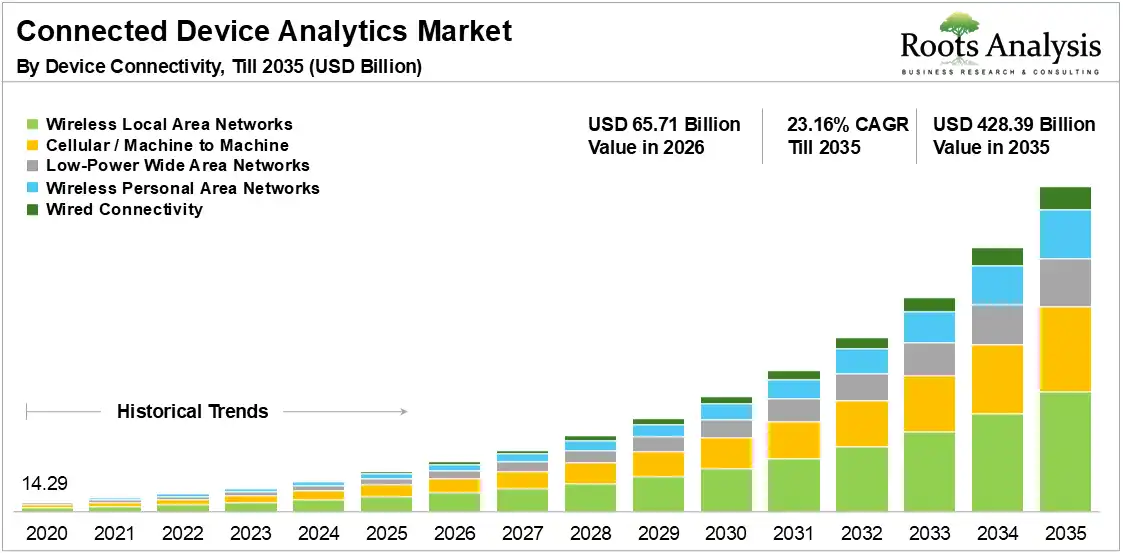
The global connected device analytics market, valued at USD 53.35 billion in 2025, is projected to reach USD 65.71 billion in 2026 and USD 428.39 billion by 2035, with a CAGR of 23.16% during the forecast period 2026 to 2035.
See What’s in the Full Report - Request Your Complimentary Insights!
Market Report: Key Takeaways
- In terms of type of application, security & emergency management secures 19% of the overall revenue share of the global market.
- In terms of end-user, BFSI holds the largest share (23%) of connected device analytics market.
- Based on the regional market distribution, North America holds the largest share, accounting for 37.23% of the overall market share.
- Key market driver is the growing demand for personalization and customer experience enhancement.
Market Overview
Connected device analytics refers to the process of collecting, analyzing, and interpreting data generated by connected devices, such as sensors, wearables, smart appliances, and industrial equipment, that communicate over networks like the Internet of Things (IoT).
It transforms raw streams of device data into meaningful insights, enabling organizations to monitor device health, optimize performance, anomaly detection in connected devices, enhance user experiences, and inform strategic decisions. This analytic capability is underpinned by advanced algorithms, machine learning models, and real-time analytics for IoT-connected device data tailored to handle the large volume, velocity, and variety of device-generated information.
The applications of connected device analytics span diverse sectors, including manufacturing for predictive maintenance, healthcare for remote patient monitoring, smart cities for resource management, retail for customer behavior analysis, energy for optimizing grid performance, automotive for device fleet management analytics, and AI-powered analytics for smart home device management.
By extracting actionable intelligence from device data, businesses can improve operational efficiency, reduce downtime, personalize services, and ensure compliance with regulatory requirements. The growth of this market is driven by the explosion of IoT device deployments, machine learning in IoT analytics, increasing demand for automation, and the digital transformation initiatives of enterprises.
Pay Only for What You Need – The Best Way to Optimize
Market Share Insights
Security & Emergency Management to Drive the Market
According to the connected device analytics market report, security & emergency management sub-segment is set to dominate the current market with a market share of 19%. This is due to the critical importance of security and emergency management in today’s interconnected world. Organizations across various industries are increasingly investing in connected device monitoring market to enhance their security postures, detect and respond to threats in real-time, and ensure the safety assets and personnel.
BFSI to Shape the Future of Connected Device Analytics Market
The BFSI sub-segment holds the maximum market share (23%) during the current year. This growth is being attributed to the critical role of connected device data analytics in the financial sector, where organizations are leveraging connected device analytics to enhance fraud detection, risk management, and customer experience. The BFSI industry heavily relies on real-time data insights to make informed decisions and ensure the security of financial transactions.
North America Leads Connected Device Insights Market
The connected device analytics market forecast suggests that North America dominates the market by capturing 37.23% within current global year. The growth is driven by early adoption of IoT technologies, a robust technological infrastructure, and a high level of digitalization across industries.
On the other hand, Europe shows significant growth due to the region’s emphasis on industrial automation, smart cities, IoT adoption in various sectors and, proliferation of edge analytics for connected devices are contributing to its market position.
Want Information on Specific Region / Segment?
Market Dynamics
Competitive Landscape of Key Market Players
The competitive landscape of the connected device analytics market is shaped by a blend of global technology leaders and innovative emerging firms specializing in real-time IoT device data analysis.
Key multinational corporations like Microsoft, IBM, Amazon Web Services, Oracle, Cisco Systems, SAP, Google, and Adobe invest heavily in developing scalable, AI- and ML-driven analytics platforms that enhance operational efficiency, predictive maintenance IoT analytics, and customer insights.
Strategic alliances and acquisitions accelerate innovation, while regional hubs in North America, Asia-Pacific, and Europe drive growth through investments in smart infrastructure, IIoT projects, and regulatory support, increasing the growth of the smart device analytics market.
The industry faces challenges in data integration, security, and interoperability, motivating continuous advancements in edge analytics solutions for industrial IoT devices and cloud integration to deliver seamless, actionable analytics across diverse connected ecosystems. This dynamic environment fosters ongoing competition focused on enhancing solution capabilities and expanding market reach.
Connected Vehicle Data Analytics in Telematics
Connected vehicle data analytics is rapidly expanding, driven by telematics adoption for improved safety, predictive maintenance, and driver behavior analysis. The market is driven by autonomous vehicle development, urban traffic management, and integration with fleet solutions. Advanced AI and machine learning enhance real-time device analytics, while telematics supports usage-based insurance models and smart city initiatives.
Scalable Cloud Infrastructure for Connected Device Analytics
Scalable cloud infrastructure from providers like AWS, Microsoft Azure, and Google Cloud underpins connected device analytics by offering elastic compute and storage capabilities to handle vast IoT data volumes. Cloud platforms enable real-time data processing, advanced AI analytics, and seamless updates for connected devices. This infrastructure supports flexible scaling as device numbers soar, facilitating cost-efficient operation and accelerating innovation in analytics solutions.
Regulatory Compliance for IoT Data Analytics Solutions
Regulatory compliance is critical for IoT data analytics, with major frameworks like GDPR and CCPA enforcing strict data privacy, security, and consent requirements. IoT solutions must embed data protection mechanisms, enable user control over personal data, and ensure secure communication protocols. Industry-specific regulations (e.g., automotive safety standards UN ECE R155 and ISO 21434) govern connected vehicles, mandating cybersecurity management across device lifecycle and data governance to protect consumer safety and privacy.
Key Market Drivers
- Explosion in IoT and Smart Device Adoption: As the rapid growth of IoT analytics market is generating vast amount of real-time data, analytical platforms are required by organizations to derive actionable insights and optimize operations from that data.
- Enterprise Focus on Predictive Maintenance and Operational Efficiency: Connected device analytics enable predictive maintenance, reducing equipment downtime, extending asset lifespans, and streamlining supply chain processes. Cross-industry adoption trends in connected device analytics, such as adoption in manufacturing, automotive, and energy are leveraging analytics to boost productivity and cost savings.
- Growing Demand for Personalization and Customer Experience Enhancement: Companies use connected device data to personalize products / services and improve user experience, driven by consumer expectations in applications like connected device analytics for healthcare monitoring systems, retail, insurance, and hospitality.
Market Challenges
- Managing Data Deluge and Complexity: The exponential rise in device-generated data strains storage, bandwidth, and analysis capabilities. Processing, aggregating, and interpreting diverse large-volume data in real-time remains a major technical challenge.
- Shortage of Skilled Talent: Skilled professionals in data engineering, data science, IoT architecture, and cybersecurity are in short supply, limiting organizations' ability to fully leverage connected device analytics solutions and achieve ROI.
- Regulatory Compliance and Evolving Data Laws: Privacy and security challenges in device analytics platforms and cross-border data transfer regulations add complexity to global deployments, increasing compliance costs and legal risks for providers and users of connected device analytics platforms.
Have Questions? Let’s Get Them Answered.
Market Segmentation
Connected Device Analytics Market: Scope of the Report
| Key Report Attributes | Details | |
| Historical Trend | Since 2020 | |
| Forecast Period | Till 2035 | |
| Market Size 2026 | USD 65.71 Billion | |
| Market Size 2035 | USD 428.39 Billion | |
| CAGR (Till 2035) | 23.16% | |
| Segments Covered |
|
|
| Key Players Profiled | ||
| PowerPoint Presentation (Complimentary) | Available | |
| Customization Scope | 15% Free Customization | |
| Excel Data Packs (Complimentary) |
|
|
Market Segments
Based on the research, we have segmented the connected device analytics market into type of component, device connectivity, applications, deployment mode, end use industry, organization size, geographical regions, and leading players.
Market Share by Type of Component
- Services
- Solutions
Market Share by Device Connectivity
- Cellular / Machine to Machine
- Low-Power Wide Area Networks
- Wired
- Wireless Local Area Networks
- Wireless Personal Area Networks
Market Share by Application
- Asset Management
- Building Automation
- Energy Management
- Inventory Management
- Predictive Maintenance
- Remote Monitoring
- Sales & Customer Management
- Security & Emergency Management
- Others
Market Share by Deployment Mode
- Cloud
- On-Premises
Market Share by End Use Industry
- BFSI
- Energy & Utilities
- Government & Defense
- Healthcare & Life Sciences
- Manufacturing
- Retail & E-Commerce
- Transportation & Logistics
- Others
Market Share by Organization Size
- Large Enterprise
- Small and Medium-Sized Enterprises (SMEs)
Market Share by Geographical Regions
- North America
- US
- Canada
- Mexico
- Rest of North America
- Europe
- Austria
- Belgium
- Denmark
- France
- Germany
- Ireland
- Italy
- Netherlands
- Norway
- Russia
- Spain
- Sweden
- Switzerland
- UK
- Rest of Europe
- Asia-Pacific
- Australia
- China
- India
- Japan
- New-Zealand
- Singapore
- South Korea
- Rest of Asia-Pacific
- Latin America
- Brazil
- Chile
- Colombia
- Venezuela
- Rest of Latin America
- Middle East and Africa (MEA)
- Egypt
- Iran
- Iraq
- Israel
- Kuwait
- Saudi Arabia
- UAE
- Rest of MEA


