


 Download Free Sample
 Buy Now
Market Size
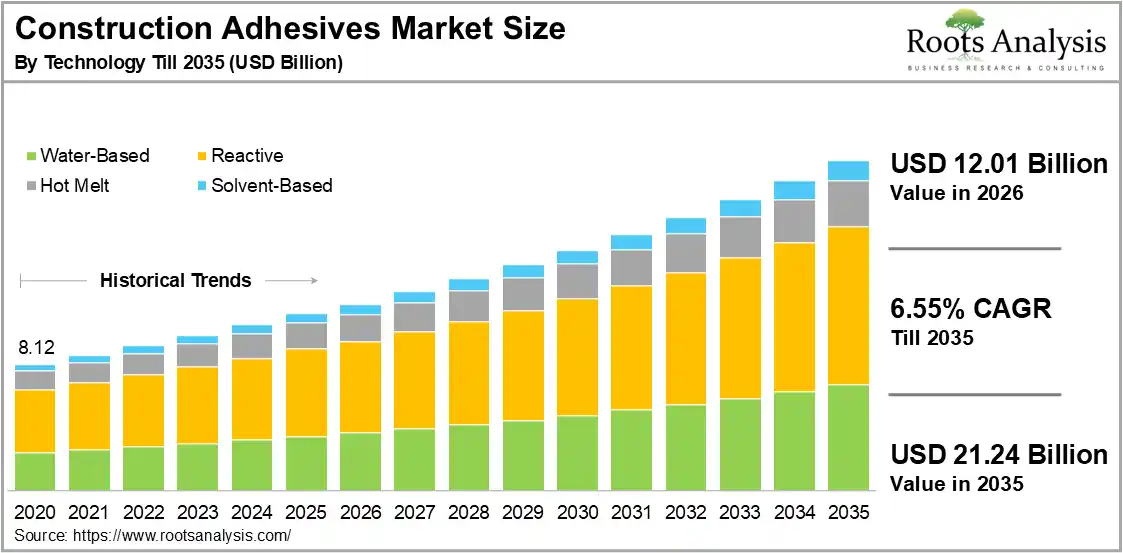
The global construction adhesives market, valued at USD 12.01 billion in 2026, is projected to reach USD 16.48 billion in 2030 and USD 21.24 billion by 2035, representing a CAGR of 6.55% during the forecast period.
See What’s in the Full Report - Request Your Complimentary Insights!
Market Overview
Construction adhesives are specialized bonding agents designed to attach a wide variety of building materials-such as drywall, tile, molding, and fixtures-to walls, ceilings, and floors. These adhesives are formulated to provide strong, durable bonds, often outperforming traditional mechanical fasteners in distributing loads and accommodating movement between dissimilar substrates.
The construction adhesives market has evolved significantly, driven by advances in chemistry and a growing emphasis on sustainability. According to Covestro’s Adhesives and Sealants team, “Our solutions aren’t just about sticking things together-they’re about building a more sustainable, secure, and connected world,” highlighting the industry’s focus on eco-friendly, high-performance products that meet modern construction demands.
The development of adhesives with low volatile organic compounds (VOCs) and bio-based raw materials reflects a broader shift toward green building practices, as stakeholders seek to minimize environmental impact without compromising on technical capabilities. This push for innovation is further supported by digital tools that track life cycle assessments and product carbon footprints, enabling transparent collaboration across the value chain.
Recent Industry Developments
- In April 2025, Bollywood actor Pankaj Tripathi joined the Euro Adhesives family as a National Brand Ambassador and unveiled a new campaign championing product superiority.
- In March 2025, Homesure TileEx entered into a partnership with Lucknow super giants as an official partner for the IPL season.
- In December 2024, Covestro and Selena partnered together to launch innovative adhesive for bricklaying which offers 90% carbon footprint reduction.
Your Business is Unique – Why Shouldn’t Your Report Be?
Market Share Insights
Which Type of Resin Will Dominate the Construction Adhesives Market?
When it comes to the construction adhesives market, the acrylic segment is set to take the lead, holding a significant share of 56.21% of the market. Their dominance is attributed to strong bonding properties, fast curing times, and versatility across materials like concrete, wood, and metal.
Acrylic adhesives are also favored for their resilience to sunlight, humidity, and temperature fluctuations, making them suitable for a wide range of construction applications, including roofing and panel installation. However, it is worth highlighting that the polyurethane adhesives segment is likely to witness the fastest CAGR (6%) during the forecast period.
Which Type of Technology Will have the Fastest CAGR?
When it comes to the global construction adhesives market, the reactive adhesives segment is set to witness the fastest CAGR (6.7%) during the forecasted period. These adhesives provide superior performance in demanding structural and specialty applications, offering strong, durable bonds even under challenging conditions such as high moisture or temperature variations.
On the other hand, it is worth highlighting that the water-based adhesives segment is likely to hold the largest market share of 56.8% during the forecast period.
Which Application Will Dominate the Construction Adhesives Market?
According to our construction adhesives industry analysis, the concrete segment is set to have the highest market share of about 35% during the forecasted period. This growth can be attributed to the fact that adhesives are essential for joining, repairing, and sealing concrete in both new construction and renovations. Their use ensures strong, durable joints and improved structural performance.
On the other hand, it is worth highlighting that the lamination flooring segment is likely to witness the fastest CAGR (6.9%) during the forecast period.
How is the Residential Segment Dominating End-Use Industries?
Among the end-use industries, the residential segment really stands out as the leading segment holding a market share of 64%. The residential construction adhesives growth is being driven by ongoing global housing demand, growing demand for adhesives for renovation, and the need for efficient installation of flooring, drywall, and fixtures.
Adhesives in this sector help reduce squeaks, increase installation strength, and minimize the use of nails and screws. On the other hand, it is worth highlighting that the industrial sector is expected to witness the fastest CAGR (7.6%) during the forecast period.
Which Regions or Countries Offer the Highest Growth Potential for Construction Adhesives?
According to our construction adhesives regional analysis, the Asian construction adhesives market exhibits dominance by capturing 49.86% of the overall current market share. This is mainly due to robust construction activity, rapid urbanization, and substantial infrastructure investments, particularly in China and India. Furthermore, the ongoing economic development, urban population growth, and increasing adoption of modern construction practices and materials are some more factors fueling the construction adhesives market growth in this region.
Want Information on Specific Region / Segment?
Key Market Insights
What are the Key Drivers for the Construction Adhesives Market?
- Global Construction Boom: Rapid urbanization, population growth, and increased demand for residential and commercial buildings are major drivers, especially in Asia-Pacific, which holds the largest market share and is projected to grow at the fastest CAGR.
- Infrastructure Investments: Massive government spending on infrastructure in countries like China, India, and the U.S. is boosting demand for adhesives in roads, bridges, and public buildings.
- Sustainability and Green Building: Growing regulatory and consumer focus on sustainable construction is driving innovation in low-VOC, bio-based, and eco-friendly adhesives.
- Rise of Modular and Prefabricated Construction: Adhesives for prefabricated buildings and modular building methods, which require efficient, high-performance bonding, are increasingly popular for their speed and sustainability.
- Renovation and Repair Activities: Ongoing renovation and retrofitting of aging infrastructure and buildings, particularly in developed markets, support steady adhesive demand.
- Technological Advancements: Innovations such as faster curing times, improved durability, and smart adhesives for digital construction workflows are attracting new users and expanding applications.
- Advantages Over Mechanical Fastening: Adhesives offer benefits like reduced weight, weatherproofing, and compatibility with a wide range of materials, supporting their adoption over traditional fasteners.
What is the Impact of Residential Construction Growth on Adhesives Demand?
The surge in residential construction-driven by urbanization, population growth, and rising living standards-directly boosts demand for infrastructure adhesives, as these products are essential for flooring, paneling, drywall, and fixture installation. The trend toward modular and sustainable homes further amplifies adhesive consumption, as adhesives offer efficiency and versatility over traditional fasteners.
What is the Role of Adhesives in Modular and Prefabricated Construction?
Adhesives are critical in modular and prefabricated construction, enabling rapid assembly, strong bonding of diverse materials, and improved structural integrity. Their use reduces reliance on mechanical fasteners, enhances design flexibility, and supports off-site manufacturing processes that prioritize speed and sustainability.
Comparison of Polyurethane vs Acrylic Construction Adhesives
Polyurethane construction adhesives offer superior flexibility, moisture resistance, and bonding strength, making them ideal for exterior and high-stress applications. Acrylic adhesives, while versatile and quick curing, are generally preferred for interior uses due to their strong adhesion to a variety of substrates and resistance to UV light. Polyurethanes are growing faster in adoption, especially for demanding environments.
What are the Advancements in Low-VOC and Sustainable Construction Adhesives?
The industry has made significant progress with low-VOC adhesives that use recycled or bio-based ingredients and comply with green building standards. Innovations include water-based, solvent-free, and hybrid chemistries that deliver both environmental benefits and high performance.
What are the Future Trends in Digital Construction and Adhesive Technologies?
Digitalization is transforming the adhesives market through the adoption of BIM, AI-driven design, and smart manufacturing, enabling precise adhesive selection and application. The future will see more integration of adhesives with digital construction workflows, real-time quality monitoring, and tailored formulations for advanced building techniques.
What are the Key Strategies Used by Companies to Gain Construction Adhesives Market Share?
Construction adhesives companies are using smart strategies to stay ahead. Big players are focusing on construction adhesives market opportunities in emerging economies, partnerships, acquisitions, joint ventures, and innovations to strengthen their position in the construction adhesives competitive landscape while also investing in R&D to bring innovative and novel products to the market.
What Challenges Do Manufacturers Face in the Construction Adhesives Market?
- Raw Material Price Volatility: Fluctuating prices for chemicals and resins impact production costs and profitability for manufacturers.
- Stringent Environmental Regulations: Compliance with evolving VOC limits and sustainability standards requires ongoing R&D and reformulation, increasing costs and complexity.
- Competition from Alternative Fastening Methods: Mechanical fasteners and bonding films still compete in some applications, especially where cost or tradition is a factor.
- Supply Chain Disruptions: Geopolitical tensions, resource shortages, and logistical challenges can disrupt supply chains and delay projects.
- Performance and Compatibility Issues: Ensuring adhesives perform reliably across diverse substrates and environmental conditions remains technically challenging.
- Market Fragmentation: The presence of many global and regional players leads to intense competition and pricing pressures.
Pay Only for What You Need – The Best Way to Optimize
Construction Adhesives Market: Scope of the Report
| Key Report Attributes | Details | |
| Historical Trend | Since 2020 | |
| Forecast Period | Till 2035 | |
| Market Size 2026 | $ 12.01 Billion | |
| Market Size 2035 | $ 21.24 Billion | |
| CAGR (till 2035) | 6.55% | |
| Type of Resin |
|
|
| Technology |
|
|
| Application |
|
|
| Type of Enterprise |
|
|
| End Use Industry |
|
|
| Geographical Regions |
|
|
| Key Players Profiled |
|
|
| PowerPoint Presentation (Complimentary) | Available | |
| Customization Scope | 15% Free Customization | |
| Excel Data Packs (Complimentary) |
|
|


