


 Download Free Sample
 Buy Now
Market Size
Data center cooling market size is forecasted to reach USD 147.08 billion by 2040, growing at a 13.8% CAGR from USD 24.07 billion in 2026.

Would Like to Preview the Actual Report?
Market Report: Key Takeaways
- Based on type of cooling, room-based cooling holds the highest share (61.70%) of the market.
- On the basis of data center size, large data centers dominate (44%) the current market, while mid-sized data centers is expected to experience the highest CAGR through 2040.
- In terms of cooling technology, liquid-based cooling leads the industry to grow at a high CAGR during the forecast period.
- According to geographical regions, currently, North America holds the highest market share (55.50%), while Asia is expected to grow at a relatively high CAGR.
Market Overview
Data center cooling is the system that maintains the ideal operating environment and humidity temperature within data centers to ensure the electronic equipment’s like (servers, network devices, and storage) operates efficiently to avoid overheating. It is worth mentioning that the data centers are crucial for processing data that generate excessive heat. In order to reduce heat, there is a high demand for efficient cooling strategies to maintain optimal temperature.
It is worth mentioning here that the data centers consume about 3% of the world’s electricity, which leads to significant amounts of heat that need to be cooled down for optimal performance. With technologies, such as air cooling, liquid cooling and free cooling methods, it is easier to cool down data centers. Furthermore, methods such as chilled water data center cooling systems are effectively used to maintain the temperature between 64.4°F and 80.6°F.
Moreover, organizations use liquid cooling technologies for high-density data centers, such as hot aisle & cold aisle containment, chilled water system, and direct- to chip cooling strategies to separate the cool air intake from the hot air expelled through the servers’ exhaust vents. It is necessary to maintain the optimal cooling environment for efficient distribution of heat dissipation, especially in high-density or intense computing environments.
With the growing demand from organizations to maintain the records the need for data center cooling system will continue to grow in the future dynamics. Data center infrastructure management (DCIM) software helps optimize cooling by monitoring environmental conditions, preventing overcooling. Advances continue towards innovative cooling solutions that reduce environmental impact while maintaining hardware safety.
For instance, KROHNE delivers flowmeters with scheduled on time function and is ready for integration to optimize liquid-to-chip cooling and energy usage to deliver uninterrupted service. It allows users to choose customized data cooling methods as per the need of data by maximizing cooling availability and optimizing system efficiency.
By considering the ongoing demand and need for this system, it is estimated that data centers will progress by innovations in liquid immersion cooling, artificial intelligence (AI) optimized systems, energy efficient technologies to do carbon footprint management and ensure reliable operations to escalate global data demands.
Unlock Deeper Insights – Schedule Your Personalized Workshop Today!
Recent Industry Developments
- In December 2025, ABB invested in OctaiPipe for strategic partnership to enhance energy through AI-driven optimization for data cooling centers. It strengthen energy security and boosts competitiveness.
- In December 2025, Applied Digital received funding for $25 million to advance innovations in data center cooling technologies, to improve efficiency and power density in centers for smooth functioning of most demanding AI workloads.
- In November 2025, Vertiv announced acquisition with PurgeRite to strengthen next-generation data center cooling systems. PurgeRite is expected to enhance the thermal management services and capabilities to provide advanced services for liquid cooling systems that is supported by AI-driven data centers.
- In October 2025, Johnson control announces strategic investment in Accelsius, for direct-to-chip liquid cooling technology for data centers. Their mission is to drive the industry with unlocking new levels of energy efficiency across cooling center.
Pay Only for What You Need – The Best Way to Optimize
Market Share Insights
Solution Component Dominates the Data Center Cooling Market While Services Grow Rapidly
Based on components, the global data center cooling market size in solution includes air conditioner, chilling unit, cooling tower, economizer system, liquid controlling system and others. Among this solution, it currently holds the dominant position, capturing 66% of total data cooling market share. This is driven by the surge in data traffic due to rise in AI, big data and cloud computing. Data center power use advanced technologies for controlling optimum temperature while minimizing energy consumption.
On the basis of data center cooling market forecast, services components will grow at a higher CAGR during the forecast period. This is due to the increasing need for high performance computing that has increased the demand for ongoing optimization services.
Market Share by Cooling Technique: Why Room-Based Cooling Dominate Current Industry While Row- Based Cooling Accelerates
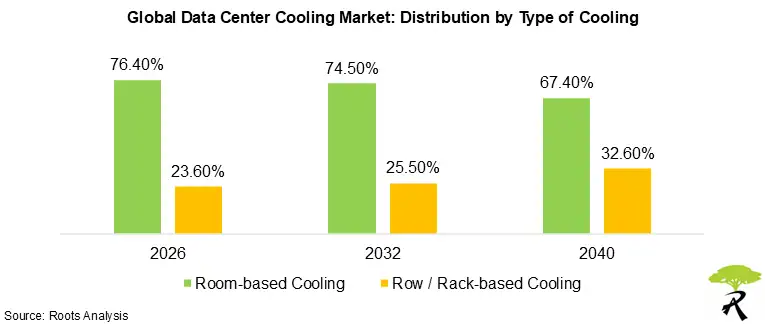
By the type of cooling, cooling room-based captures the maximum market share, anticipated to hold 61.70% of total current market size. This dominance is due to the fact that the data center cooling for room-based enhance the sustainability and reliability while extending the lifespan for cooling systems.
The demand for room-based cooling technique is driven by the increasing usage in organizations to migrate the cloud and more complex IT infrastructures. Further, room-based cooling is in demand as it specifically cool the space or room, rather than cooling the whole building or area which is a great way to effectively utilize the resource as per the given data center needs.
It is worth mentioning that row / rack-based cooling is accelerating in the market with a significant CAGR over the forecast period. As data centers evolve to support more powerful computing systems and handle larger volumes of data, the heat generated by these high-performance servers increases, making traditional cooling methods less effective. Therefore, there will be an increase in the demand for row / rack based cooling technologies in the upcoming years.
Regional Market Growth: North America Dominates the Current Data Center Cooling Industry
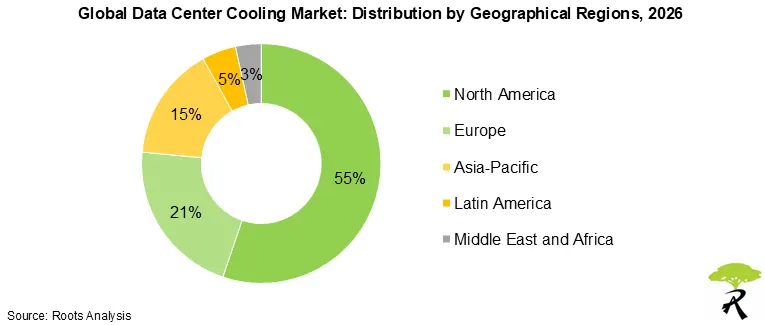
The industry is distributed across North America, Europe, Asia-Pacific, Latin America, and Middle East and Africa. Currently, North America dominates the data center cooling market by capturing 55.50% market share. This is due to the region’s rising adoption of high-performance computing and the escalating need for efficient cooling solutions to support advanced technologies such as artificial intelligence.
Want Information on Specific Region / Segment?
Asia-Pacific is expected to dominate with highest CAGR during the forecast period. This region is driven by the expansion of digital infrastructure. As more businesses embrace cloud computing, e-commerce, and artificial intelligence, the demand for data centers is increasing exponentially. There is an increasing focus on the maintenance of specific temperature ranges to ensure the proper functioning of servers and IT equipment contributing to the growth of the data center cooling market.
Market Dynamics
Key Market Drivers
- Rapid Growth in Data Generation and Cloud Services: The explosion of digital content, cloud computing, AI, and IoT has driven enormous data center expansion globally. Maintaining optimal temperature control in data centers is critical for server performance, fueling demand for advanced cooling solutions.
- Focus on Energy Efficiency and Power Usage Effectiveness Reduction: Operators seek to minimize Power Usage Effectiveness (PUE) to reduce operating costs and comply with energy efficiency by adopting immersion cooling technology (liquid cooling, free cooling, and heat reuse).
- Expansion of Hyperscale and Colocation Data Centers: North America and Europe are early adopters of next-generation data center cooling for hyperscale and edge computing facilities to manage capacity, reliability, and sustainability requirements.
Market Challenges
- Meeting Sustainability and Regulatory Requirements: Adhering to global and regional standards on eco-friendly data center cooling that requires constant innovation and compliance investments to meet the sustainable data center cooling market.
- Rapid Hardware Evolution and Future-readiness: Growing concerns regarding cooling system reliability and redundancy in data center infrastructure can adapt to higher densities, and new server technologies to be persistent for future-proofing investments.
- Balancing Cost and Performance Trade-offs: Manufacturers must continuously utilize long-term energy and water savings against upfront and maintenance costs, especially as the return of investment (ROI) for modular data center cooling solutions varies by organization data center size and location.
Key Market Insights
Competitive Landscape of Key Players in Data Center Cooling Market
The industry is fragmented and is experiencing intense competition and changing dynamics, with the presence of several mid-sized, large and enterprise size data center cooling companies. The industry is widely spread among regional players, as the demand for data center management is growing thus creating need for direct-to-chip cooling systems, managing heat, power and resource utilization.
The benefits of data center cooling solutions and sustaining their strong position in the global marketplace by cooling optimization for high density racks, advanced technologies to improvise immersion cooling methods for catering with the demands and provide high performance computing environments.
Large-size data center organizations dominate the current market, leveraging established distribution network security, manufacturing scale, and brand recognition across energy-efficient data center cooling providers by integration of AI and IoT in smart data center cooling management. On the other hand, small and mid-sized data center cooling companies are continuously improving their offerings to capture niche segments and specialized applications.
Major players in the data center cooling market include Airedale International Air Conditioning (acquired by Modine Manufacturing Company), Asetek, Asperitas, Carrier Global, Cool IT Systems (acquired by KKR), Daikin Industries, Dell, Eco Cooling, EVAPCO, Iceotope Technologies, Mitsubishi Electric, Munters, Nortek Air Solutions (acquired by Madison Industries), Rittal, Schneider Electric, Silent-Aire, STULZ, Vertiv (acquired by CoolTera), and ZutaCore.
For Instance, in November 2025, Vertiv and IIT Bombay collaborated to launch AI-driven data centers for improving cooling strategies and focus on thermal management technologies used in data centers to support high performance and workloads.
Increasing Partnerships and Mergers & Acquisitions Activity Shaping the Industry
Strategic partnerships in the data center cooling market are accelerating innovation and driving sustainable solutions. For instance, in November 2025, Mitsubishi Electric signed memorandum of understanding with Hon Hai Precision Industry to form an alliance to supply AI-data center solutions. With this collaboration it tends to leverage their networks together to supply hybrid cooling for data centers, energy efficient and highly reliable competitive solutions to data centers around the world.
Similarly, in December 2025, Trane Technologies acquired Stellar Energy Digital to provide data center cooling technologies and lead the liquid cooling data center market. With this transition of digital payment businesses are significantly leading growth and excellence in customer retention by providing them with expanded services and resources.
Key Market Trends in Energy-Efficient Data Center Cooling Solutions
Data center cooling market rapidly evolved and driven by energy efficient data centers that are focused on reducing carbon emissions, and increasing demand for AI, edge computing and advanced HVAC in data centers. The market growth is expanding through the adoption of liquid cooling data center technologies offering efficient and lower operational costs.
The cooling techniques which are dominating in the market to support global revenue growth are as follows:
- Liquid Cooling: In new data centers and high-rack density environments, liquid cooling technique is used to enable better heat dissipation making it ideal for high performance computing workloads.
- AI-Driven Cooling Control: With usage of artificial intelligence and machine learning integrated cooling systems for automatic optimization, improving efficiency and reducing energy. AI has advanced in providing easy and quicker solutions for controlling heat, eco-friendly environment management.
- Free Cooling and Retrofitting: Many operators are optimizing free cooling by leveraging external air, retrofitting legacy data centers with advanced cooling systems to reduce costs and energy consumption.
Regulatory Standards for Data Center Cooling Energy Consumption
Efficient energy and environmental performance regulate the demand for eco-friendly refrigerants in data center cooling to promote best practices like airflow containment and waste heat reuse. As there is large data stored in the systems of enterprise size data centers operators use (high electricity and power) that requires control on energy consumption, cooling solutions for smooth and efficient workflow without damage of data and resource optimization.
With the standard regulations for energy consumption American Source of Heating, Refrigerating and Air Conditioning Engineers (ASHRAE) recommends efficient cooling methods such as (hot / cold aisle configurations) and liquid cooling technologies. Date center has standardized designs to ensure efficiency and compliance.
- Accelerated Innovation: Regulations are pushing vendors and operators to develop and adopt more energy-efficient cooling solutions, such as liquid cooling and closed-loop systems, which maintain optimal temperature and humidity ranges to reduce energy waste.
- Cost Savings: Efficient cooling systems are driven by liquid cooling, air flow containment to ensure energy efficiency and lower energy bills by extending the lifespan of equipment, improving overall profitability in monitoring real time data.
Have Questions? Let’s Get Them Answered
Market Segmentation
Data Center Cooling Market: Scope of the Report
| Key Report Attributes | Details | |
| Historical Trend | Since 2022 | |
| Forecast Period | Till 2040 | |
| Market Size 2026 | $ 24.07 Billion | |
| Market Size 2040 | $ 147.08 Billion | |
| CAGR (Till 2040) | 13.80% | |
| Segments Covered |
|
|
| Key Players Profiled |
|
|
| PowerPoint Presentation (Complimentary) | Available | |
| Customization Scope | 15% Free Customization | |
| Excel Data Packs (Complimentary) |
|
|
Market Segments
Based on research, we have segmented the Data Center Cooling Market into type of material, type of installation, application area, type of enterprise, geographical regions, and key players.
Market Share by Component
- Services
- Consulting
- Installation and Deployment
- Maintenance and Support
- Solution
- Air Conditioner
- Chilling Unit
- Cooling Tower
- Economizer System
- Liquid Controlling System
- Others
Market Share by Type of Cooling
- Row / Rack-based Cooling
- Room-based Cooling
Market Share by Data Center Size
- Large Data Centers
- Mid-Sized Data Centers
- Small Data Centers
Market Share by Containment
- Raised Floors without Containment
- Raised Floors with Containment
- Hot Aisle Containment (HAC)
- Cold Aisle Containment (CAC)
Market Share by Cooling Technology
- Air-Based Cooling
- Liquid-Based Cooling
Market Share by End Use Industry
- BFSI
- Government & Defense
- Healthcare
- IT & Telecom
- Research & Academic
- Energy & Utility
- Others
Market Share by Geographical Regions
- North America
- US
- Canada
- Mexico
- Rest of North America
- Europe
- Austria
- Belgium
- Denmark
- France
- Germany
- Ireland
- Italy
- Netherlands
- Norway
- Russia
- Spain
- Sweden
- Switzerland
- UK
- Rest of Europe
- Asia- Pacific
- China
- India
- Japan
- Singapore
- South Korea
- Rest of Asia
- Latin America
- Brazil
- Chile
- Colombia
- Venezuela
- Rest of Latin America
- Middle East and North Africa (MENA)
- Egypt
- Iran
- Iraq
- Israel
- Kuwait
- Saudi Arabia
- UAE
- Rest of the MENA


