Diffractive Optical Element Market
Diffractive Optical Element Market, Till 2035: Distribution by Type of Product (Beam Splitter, Beam Shaper, and Homogenizer), Type of Application (Biomedical Devices, Communication, Laser Material Processing, LIDAR, Lithographic and Holographic, Lighting, and Optical Sensors), Type of Vertical (Automotive, Consumer Electronics, Defense and Aerospace, Healthcare, Industrial, Research and Development, Telecommunications), and Geographical Regions (North America, Europe, Asia, Latin America, and Middle East and North Africa and Rest of the World): Industry Trends and Global Forecast
-
Lowest Price Guaranteed
-
Slides
177 -
Last Updated
December 2024 -
View Count
12596 -
Diffractive Optical Element Market Overview
The diffractive optical element market size is projected to grow from USD 0.51 billion in 2024 to USD 1.66 billion by 2035, representing a CAGR of 11.39% during the forecast period till 2035.
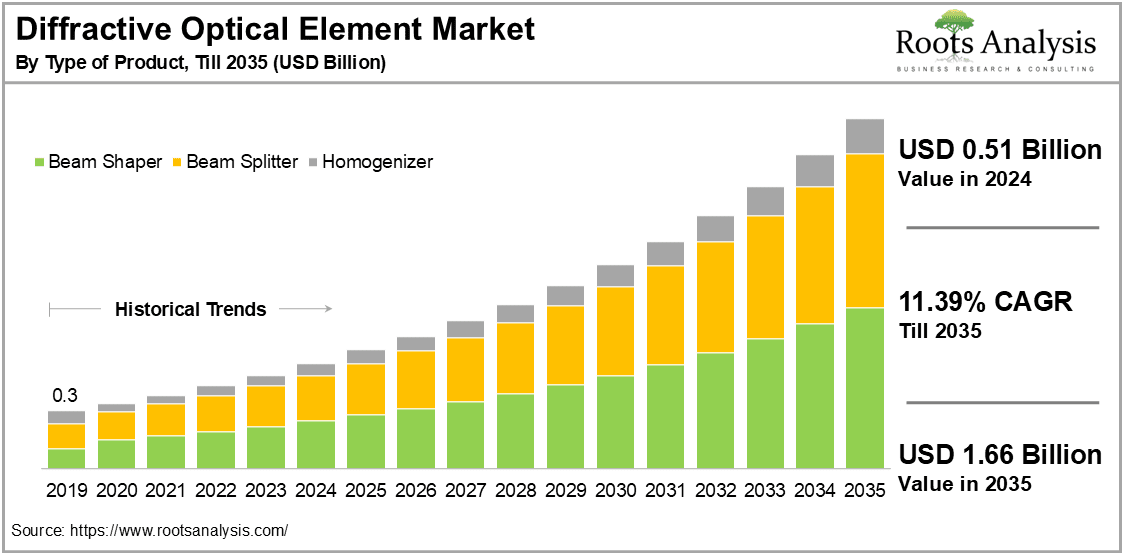 |
To learn more about this report, request a free sample copy
The new research study consists of diffractive optical element market and trends analysis, detailed market forecast analysis, and provide actionable strategic recommendations.
Diffractive optical element (DOE) refers to a specially designed optical component that uses the principle of diffraction to manipulate and control light. These components are compact, lightweight materials, and can be used solely or in combination with reflective elements for improved performance in optical systems. Unlike traditional lenses that rely on refraction or reflection, DOEs shape light through the micro-structured patterns on their surface to alter light’s phase, amplitude, or direction. These DOE features enhance their significance and allow them to attain complex optical functions in compact and lightweight designs.
As a consequence, the diffractive optical element market is rising exponentially driven by the expanding diffractive optical elements applications across various industries. Additionally, ongoing innovations in micro-structured surfaces for optics are driving advancements in light manipulation by enabling more precise and efficient optical systems for various applications, leading to more efficient and cost-effective laser systems for a wider range of applications. Furthermore, the development of high-speed optical communication networks including 5G chipset infrastructure and data centers is lifting the demand for diffractive optical elements in telecommunications.
Driven by these factors, the market is witnessing ample growth, creating lucrative opportunities for market players. As a result, more and more companies are investing in technological advancements to cater to diverse industrial needs. For example, in January 2024, HOLOEYE Photonics introduced 15 standard off-the-shelf diffractive optical elements made from fused silica glass. These elements are manufactured by using etching techniques that feature an anti-reflective coating on both sides of the glass. Besides this, the expansion of consumer electronic devices like smartphones, AR/VR headsets, and wearables that rely on DOEs for optical sensing and display promises a bright future of diffractive optical elements in AR/VR applications. Overall, considering these factors and emerging industry trends, the market is expected to thrive during this forecast period.
Diffractive Optical Element Market Share Insights
The diffractive optical element market report presents an in-depth analysis of the various companies that are involved in offering diffractive optical elements, across different segments, as defined in the table below:
Diffractive Optical Element Market: Report Attributes / Market Segmentations
| Key Report Attributes | Details | |
| Historical Trend | Since 2019 | |
| Forecast Period | Till 2035 | |
| Current Market Size | $ 0.51 Billion | |
| Market Size Value by 2035 | $ 1.66 Billion | |
| CAGR (Till 2035) | 11.39% | |
| Type of Product |
|
|
| Type of Application |
|
|
| Type of Vertical |
|
|
| Geographical Regions |
|
|
| Leading Market Players |
|
|
| PowerPoint Presentation (Complimentary) |
Available | |
| Customization Scope | 15% Free Customization | |
| Excel Data Packs (Complimentary) |
|
|
Diffractive Optical Element Market Segmentation
Market Share by Type of Product
This segment of the global diffractive optical element market features a variety of products such as beam splitters, beam shapers, and homogenizers. According to our analysis, the beam shaper segment is estimated to foster the market with the majority (45%) of the market share by 2035. The segment will likely dominate the market due to the extensive use of high-power lasers and the growing demand for customized beam profiles. Beam shapers are highly sought after because of their capability to enhance the efficiency and precision of laser-based systems, fueling the market demand.
However, beam splitters are also gaining traction in the industry owing to their specialized applications such as augmented reality (AR), virtual reality (VR), and autonomous vehicles. Splitters play a pivotal role in splitting light into multiple beams, thus, becoming critical for 3D imaging and laser-based systems. Hence, the beam splitter segment is anticipated to grow at a noteworthy CAGR of (12.05%) during this forecast period.
Market Share by Type of Application
This segmentation of the market underscores a wide range of applications such as biomedical devices, communication, laser material processing, lidar, lithographic and holographic, lighting, and optical sensors. According to Root's analysis, the laser material processing application is projected to drive the market with a maximum of (~48%) of the diffractive optical element market share by 2035. The key factor of this growth is accredited to the mounting adoption of high-power laser systems across various industries, especially, manufacturing where the need for precision and efficient processing technology like 3D printing is rising.
On the other hand, the soaring biomedical applications of diffractive optics are amplifying the market outlook owing to the bourgeoning demand for non-invasive medical treatments and innovation in medical technologies. Therefore, biomedical devices are likely to experience the fastest (13.02%) CAGR during this forecast period.
Market Share by Type of Vertical
Based on the type of vertical, the market is split into automotive, consumer electronics, defense and aerospace, healthcare, industrial, research and development, and telecommunications. As per market research, the industrial segment is predicted to augment the market with the highest (~43%) of the market share by 2035. The diverse applications in the industrial sector such as cutting, welding, marking, and engraving are contributing to bolster the segment growth. While the healthcare segment is expected to expand at a higher CAGR of (12.72%) over this forecast period. The growing advancements in imaging systems using diffractive optics are a key factor that can be attributed to the acceleration of this segment's growth.
Market Share by Geographical Regions
This segment highlights the distribution of the diffractive optical element market across various geographical regions, such as North America, Europe, Asia, Latin America, the Middle East and North Africa, and the rest of the world. In terms of revenue, North America is anticipated to lead the market with (~45%) of the market share of diffractive optical elements by 2035. Moreover, Asia is excelling in the market remarkably and is poised to grow at a noteworthy CAGR of (13.55%) throughout this forecast. This can be ascribed to the growth of the semiconductor industry and its positive impact on DOE production strengthening the market position. Asia is known for its vast semiconductor manufacturing industries that have various photonics-based applications such as lithography, inspection, and optical testing where DOEs are significantly used, thus, will likely elevate the market demand.
Diffractive Optical Element Market Key Insights
The “Diffractive Optical Element Market, Till-2035: Industry Trends and Global Forecasts “report features an extensive study of the current market landscape, market size and future opportunities within the diffractive optical element market, during the given forecast period. The market report highlights the efforts of several stakeholders involved in this rapidly emerging segment of the service providers industry. Key takeaways of the diffractive optical element market report are briefly discussed below.
Key Drivers of the Diffractive Optical Element Market
Numerous factors are propelling the diffractive optical element market growth. Firstly, the mounting demand for miniaturized efficient optical systems across various industries is mainly attributed to this growth. The need for compact, lightweight, high-performance optical systems in industries from consumer electronics and medical devices to telecommunications is uplifting the DOE demand due to its ability to achieve complex optical functions in a small form factor. Additionally, the increasing applications of diffractive optics in industrial processes are also contributing to fuel the market demand as laser material processing heavily relies on DOEs for beam shaping, splitting, and focusing. Moreover, technological innovation in photonics and the increasing popularity of medical laser treatments are further expected to fuel the demand for beam splitters and shapers which will likely excel the market potential during this projection period.
Diffractive Optical Element Market Competitive Landscape
The presence of global leading companies, emerging startups, and niche providers is reshaping the competitive landscape of the DOE sector through their specialized optical solutions for industrial, healthcare, and automotive applications. Some of the leading companies in the diffractive optical element industry such as Broadcom, Jenoptik, Holo/Or, HOLOEYE, and others dominate the market with their highest market revenue. These key players are adopting several competitive strategies in order to retain their market positions. They are investing heavily in R&D to develop advanced DOEs with higher efficiency and broader wavelength ranges. Additionally, they are focusing on partnerships, collaborations, mergers, and acquisitions that help them expand their geographical reach.
Market Challenges in Diffractive Optical Element Market
Along with key drivers, there are some impediments such as challenges in manufacturing DOEs due to the high cost of materials and technology which can confine the market evolution. Fabrication of DOEs incorporates advanced technologies such as photolithography and etching which need costly equipment and expertise. Also, the price of fused silica and other specialized coating materials increases the production costs, thereby, may limit the market expansion. However, efforts to improve manufacturing scalability and increase awareness of the advantages of diffractive optical elements can help overcome these challenges.
Regional Analysis: North America is Expected to Lead the Market with the Largest Diffractive Optical Element Market Share
With regard to diffractive optical element market regional insights, North America is expected to continue to dominate the market during this forecast period owing to its advanced research in optical technologies and the strong existence of industry players. Also, the robust end-use industries such as healthcare, telecommunication, and defense foster market growth with their high adoption of DOEs. The vital role of DOEs in laser technology for industrial applications is also contributing to the region’s positions. Besides, the advanced eco-system for R&D in North America allows research institutions and universities to continue working on optical innovation, and sustain the market demand. Moreover, government support by funding and investment in photonics and optical technologies through different national programs further boosts the market development in North America.
Leading Diffractive Optical Element Companies
Examples of key diffractive optical element companies involved in the diffractive optical element market (which have also been captured in this market report, arranged in alphabetical order) include Broadcom (US), Jenoptik (Germany), Laserglow (Canada), SUS MICROTECH (Germany), HOLO/OR (Israel), Light Trans (Germany), HOLOEYE (Germany), Laser Optical Engineering (UK), SILIOS Technologies (France), Nalux (Japan), Nissei Technology (Japan), Sintec Optronics (Singapore), and Zeiss (Germany). This market report includes an easily searchable excel database of all the companies who have adopted the diffractive optical element market.
Recent Developments In Diffractive Optical Element Market
- In March 2024, Broadcom expanded its optical interconnect solutions for AI and ML that allow high-speed links in large-scale generative AI computer clusters.
- In January 2024, Focuslight Technology acquired SUSS MicroOptics, a Switzerland-based precision micro-optics manufacturing company. Through this strategic move, Focuslight reinforces its position in the photonics industry and aids in expanding its capabilities in photon generation, control, and advanced photonics application.
- In August 2023, the US Department of Defense awarded a $14.9 million contract to the University of Rochester’s Laboratory for laser energetics.
Diffractive Optical Element Market Report Coverage
The market report presents an in-depth analysis, highlighting the capabilities of various companies engaged in this domain, across different segments. Amongst other elements, the market report includes:
- A preface providing an introduction to the full report diffractive optical element market, 2019-2023 (Historical Trends) and till-2035 (Forecasted Estimates).
- An outline of the systematic research methodology adopted to conduct the study on the diffractive optical element market providing insights on the various assumptions, methodologies, and quality control measures employed to ensure the accuracy and reliability of our findings.
- An overview of economic factors that impact the overall diffractive optical element market including historical trends, currency fluctuation, foreign exchange impact, recession, and inflation measurement.
- An executive summary of the insights captured during our research. It offers a high-level view on the current state of the diffractive optical element market and their likely evolution in the mid-long term.
- A detailed assessment of the diffractive optical element market landscape, based on several relevant parameters, including year of experience, company size, location of headquarters, and ownership structure.
- Elaborate profiles of prominent players engaged in the diffractive optical element market, featuring information on their year of establishment, location of headquarters, company size, company mission, company footprint, management team, contact details, financial information, operating business segments, diffractive optical element market portfolio, moat analysis, recent developments, and an informed future outlook.
- A qualitative assessment of the various megatrends ongoing in the diffractive optical element industry, including rising integration with AR/VR technologies, expanding advanced laser application, and increased use in holography and projection displays.
- An analysis highlighting the key unmet needs across the diffractive optical element market, featuring insights generated from real-time data on unmet needs as identified from social media posts, recent publications, industry blogs and the views of key opinion leaders expressed on online platforms.
- An in-depth analysis of various patents that have been filed / granted related to the diffractive optical element market and its components, based on various parameters, such as type of patent, patent publication year, patent age and leading players.
- A detailed analysis of recent developments in the diffractive optical element market domain, based on relevant parameters such as year of initiative, type of initiative (partnerships and collaborations, expansions, funding and product launches), geographical distribution and most active players (in terms of number of recent developments).
- Key winning strategies framework that helps in analyzing the level of competition within an industry, by tracing the key market activities including partnership, funding, expansion of leading players
- A qualitative analysis, highlighting the five competitive forces prevalent in diffractive optical element market, including threats for new entrants, bargaining power of suppliers, bargaining power of customers, threats of substitution and rivalry among existing competitors.
- A discussion on affiliated global diffractive optical element market trends, key drivers and challenges, under a SWOT framework, which are likely to impact the industry’s evolution, along with a Harvey ball analysis, highlighting the relative effect of each SWOT parameter on the overall diffractive optical element market.
- A value chain analysis featuring a discussion on various stakeholders involved in the development of the diffractive optical element market, from suppliers to end-users.
- A detailed estimate of the current market size and the future growth potential of the diffractive optical element market over the next decade. Based on multiple parameters we have provided an informed estimate on the market evolution during the forecast period 2024-2035. The report also features the likely distribution of the current and forecasted opportunity within the diffractive optical element market. Further, in order to account for future uncertainties and to add robustness to our model, we have provided three forecast scenarios, namely conservative, base, and optimistic scenarios, representing different tracks of the industry’s growth.
- Detailed projections of the current and future market across various types of products such as beam splitter, beam shaper, and homogenizer.
- Detailed projections of the current and future market across various types of application such as biomedical devices, communication, laser material processing, lidar, lithographic and holographic, lighting, and optical sensors.
- Detailed projections of the current and future market across various types of vertical such as automotive, consumer electronics, defense & aerospace, healthcare, industrial, research & development, and telecommunications.
- Detailed projections of the current and future diffractive optical element market across various geographical regions, such as North America (US, Canada, Mexico and other North American countries), Europe (Austria, Belgium, Denmark, France, Germany, Ireland, Italy, Netherlands, Norway, Russia, Spain, Sweden, Switzerland, UK and other European countries), Asia (China, India, Japan, Singapore, South Korea and other Asian countries), Middle East and North Africa (Egypt, Iran, Iraq, Israel, Kuwait, Saudi Arabia, UAE and other MENA countries), Latin America (Brazil, Chile, Colombia, Venezuela and other Latin American countries) and rest of the world (Australia, New Zealand and other countries).
Author: Ronit Sharma and Neha Kashyap
Customization Opportunities
At Roots Analysis, we genuinely care about your success and understand that your business requirements are unique. While our market research reports provide valuable insights, we recognize that they might not cover every aspect you need to make well-informed strategic decisions. To account for that, we offer 15% free report customization tailored to your specific needs. Whether you require additional quantitative analysis, qualitative insights, or any other information related to the diffractive optical element market, reach out us today at: support@rootsanalysis.com