
Lowest Price Guaranteed
Slides
234
Last Updated
August 2026
View Count
24934
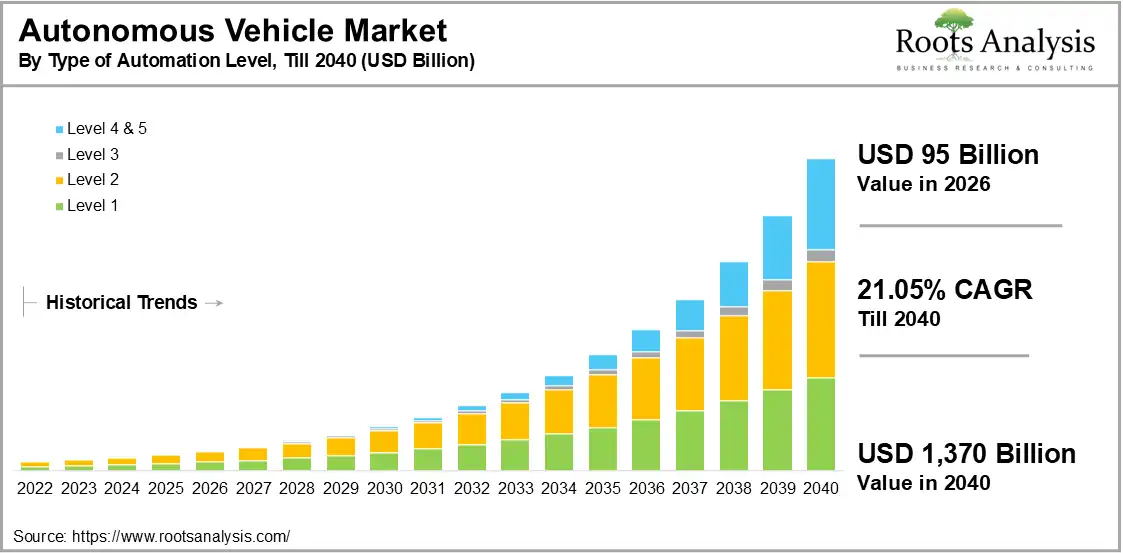
The autonomous vehicle market size is projected to grow from USD 95 billion in 2026 to USD 1,370 billion by 2040, representing a CAGR of 21.05%, during the forecast period till 2040.
To learn more about this report, request a free sample copy
The new research study consists of autonomous vehicle market and trends analysis, detailed market forecast analysis, and provide actionable strategic recommendations.
Vehicles equipped with advanced technology which can navigate and operate without human intervention are called autonomous vehicles. Autonomous vehicle or self-driving car works with a combination of advanced hardware and software technology which include sensors, cameras, radar, LiDAR or light detection and ranging with the integration of artificial intelligence and advanced control systems to observe their environment and make better decisions for driving tasks safety. Interestingly, the Society of Automotive Engineers has introduced a common automation system under which autonomous vehicles are classified into six levels of automation based on the level of human intervention.
Influenced by this, the autonomous vehicle market is expected to be the fastest-emerging industry. This driverless car innovation is becoming the most promising self-driving technology in terms of safety, efficiency, convenience, and cost reduction. Especially, autonomous vehicle safety features, such as minimizing human errors, which are one of the leading causes of traffic accidents, are attracting the consumers’ attention and setting new boundaries for automakers to capitalize on the bourgeoning demand for automated transportation solutions. Rapid processing capabilities provided by dedicated AI chips are essential for supporting complex decision-making in autonomous driving systems.
Stimulated by this, the increasing range of autonomous vehicle applications such as ride-hailing and robotaxi, logistic delivery, personal use, and public transport, is creating new opportunities for the ample growth of the autonomous industry. Moreover, the latest trends in autonomous driving technology focus on advancements in AI, sensor fusion, and 5G connectivity, which are driving improvements in vehicle safety, efficiency, and the scalability of fully autonomous systems, anticipated to enhance the market scope during this forecast period.
The autonomous vehicle market report presents an in-depth analysis of the various companies that are involved in offering autonomous vehicles, across different segments, as defined in the table below:
| Key Report Attributes | Details | |
| Historical Trend | Since 2022 | |
| Forecast Period | Till 2040 | |
| Market SizeValue in 2026 | $ 95 Billion | |
| Market Size Value by 2040 | $ 1,370 Billion | |
| CAGR (Till 2040) | 21.05% | |
| Type of Vehicle |
|
|
| Type of Automation Level |
|
|
| Type of Application |
|
|
| Type of Technology |
|
|
| Geographical Regions |
|
|
| Leading Market Players |
|
|
| PowerPoint Presentation (Complimentary) |
Available | |
| Customization Scope | 15% Free Customization | |
| Excel Data Packs (Complimentary) |
|
|
The autonomous vehicle market segmentation is categorized into commercial and passenger vehicles. As per this self-driving technology market forecast report, passenger vehicles are the dominating segment, holding over 65% current market share. This includes autonomous cars and robotaxis. Passenger vehicles are anticipated to lead the segment owing to extensive demand particularly, for testing and R&D purposes driven by companies increasing emphasis on the development of self-driving technology and smart mobility solutions. Furthermore, the commercial vehicle segment is estimated to boost market growth with the elevating demand for autonomous trucks and other delivery vehicles, including delivery vans which are gaining traction in logistics applications.
This global autonomous vehicle market features various types of automation such as level 1, level 2, level 3, and levels 4 &5. Based on market research on autonomous vehicles, level 2 and level 3 are projected to gain the largest market share owing to being commonly available and deployed automation levels based on advanced driver-assistance systems (ADAS) in the industry as the level 2 automated vehicle has the ability to control steering, acceleration and deceleration however, need human intervention. Additionally, level 4 & 5 are the most promising automation levels which represent fully automated vehicles that operate without human input or in certain conditions.
This latest market report on self-driving vehicles highlights the types of applications in the autonomous vehicle market which is split into defense and transportation. In this market report on self-driving vehicles, the transport segment is further categorized into commercial, industrial, and personal use vehicles, which drive market demand. This dominance of the segment can be accredited to the growing penetration of robotaxi or ridesharing trend as several leading companies are testing driverless taxis for on-demand transportation services. Also, logistics applications are adopting autonomous delivery trucks and automated long-haul freight transportation, elevating the market growth. Whereas the defense sector is also expected to witness explicit growth during this projection timeframe driven by a rise in demand for unmanned systems for surveillance and reconnaissance.
The global autonomous vehicle market is segmented into hardware and software technology. According to our latest self-driving car market report, the hardware segment is projected to uplift the market growth with the highest market share during this forecast period. The hardware segment leads the market due to its essential components such as sensors, cameras, GPS, and actuators which aid autonomous vehicles in perceiving their surroundings.
Furthermore, the software segment is expected to grow at the highest CAGR in the future owing to cruciality in navigation, path observation, and better decision-making which help these vehicles adapt to changing conditions. Of note, self-learning capabilities driven by adaptive AI are becoming foundational in autonomous navigation systems, especially under unpredictable driving conditions.
This segment highlights the distribution of autonomous vehicles across various geographical regions, such as North America, Europe, Asia, Latin America, Middle East and North Africa, and the rest of the world. According to recent autonomous vehicle sales statistics, North America is expected to capture the majority of the autonomous vehicle market share and will likely continue to hold this leadership in the global market. Furthermore, Asia is estimated to be the fastest growing region with an outstanding CAGR over this forecast period. The factor behind the boom of the market is vast automobile manufacturing sector in South Asian countries like China, Japan, and South Korea.
The global autonomous vehicle market insights reveal several key factors and trends that are attributed to escalating autonomous vehicle market growth. The continuous technological advancements in AI, machine learning algorithms, and neural networks that allow better decision making, object detection, and path planning in these vehicles, are the latest autonomous vehicle industry trend strengthening the market evolution. As well as high-speed connectivity such as 5G and vehicle-to-everything (V2X) communication, fortifying the market prospects. Further, the heightening demand for safety due to reduced human error and growing shift towards environmental sustainability, inflating the demand for autonomous vehicles around the world. As a result, the future of self-driving cars and electric autonomous vehicles market is bright which will likely boost the industry growth in the upcoming decade. Breakthroughs in self-directed aerial systems, such as those in the 3D printed drones, parallel the broader shift toward autonomous mobility solutions
The autonomous vehicle market competitive landscape is diverse with the presence of global industry leaders and emerging technology companies. These players are serving in the market and providing an inclusive range of electric and hybrid autonomous vehicles and services. According to this autonomous vehicle market share analysis, established companies like Tesla, Waymo, Cruise and others are the key players influencing the market with their continuous research and development efforts to advance connected vehicle technology and autonomous driving systems. Moreover, prominent automakers are changing the market dynamic with their new product launches and strategic collaborations with technology companies, software developers and semiconductor manufacturers and strive to secure a higher share in the global marketplace.
While the market is expected to witness remarkable growth driven by key factors, some market restraints can cause challenges for the potential growth of the market. Illustratively, the lack of consistent regulation and technological challenges particularly, in level 5 automation where vehicles can operate without human intervention which are complex and may create hurdles in extreme conditions. coupled with this, the high cost of vehicles is one of the undeniable autonomous vehicle market challenges that can hinder the market progress during this projection period.
With respect to regional autonomous vehicle market insights, North America is poised to maintain its leadership in the global market for autonomous vehicles due to the presence of major technology companies leading innovation in artificial intelligence, machine learning, and computer vision which are essential for the development of autonomous vehicles. In addition to this, high investment by North American companies in R&D related to self-driving technology fosters market growth in the region. The strong infrastructure and high level of urbanization have notably contributed to the high self-driving car adoption rates. Along with this, the robust automotive industry is one of the significant factors in the evolution of the electric and hybrid autonomous vehicles industry in the region.
Examples of key autonomous vehicle manufacturers involved in the autonomous vehicle market (which have also been captured in this market report, arranged in alphabetical order) include Aptiv (Ireland), Aurora Innovation (US), Baidu Apollo (China), Cruise (US), Ford Motor (US), Hyundai (South Korea), Mercedes-Benz (Germany), Mobileye Intel (Israel), Nuro (US), Renault (France), Tesla (US), Toyota (Japan), Uber (US), Valeo (France), Volkswagen (Germany), Volvo Car (Sweden), Waymo (US), Yandex Self-Driving (Russia), and Zoox (US). This market report includes an easily searchable excel database of all the companies who have adopted the autonomous vehicle market.