


 Download Free Sample
 Buy Now
Market Size
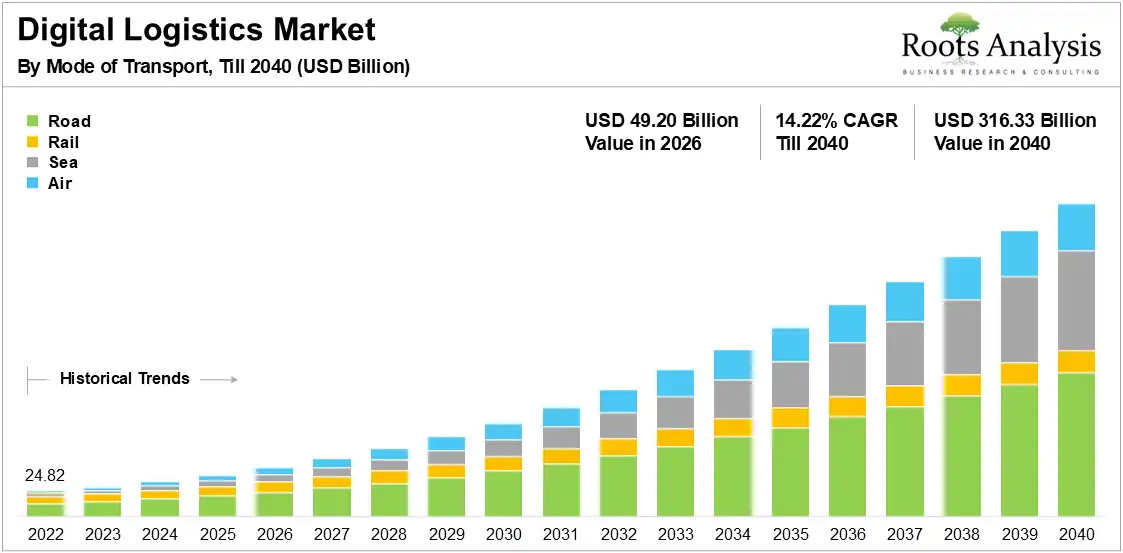
The global digital logistics market size is projected to grow from USD 49.20 billion in 2026 to USD 316.33 billion by 2040, representing a CAGR of 14.22% during the forecast period 2026 to 2040.
See What’s in the Full Report – Request Your Complimentary Insights!
Market Report: Key Takeaways
- Solutions lead the digital logistics market with a commanding 68.0% market share in 2026. Meanwhile, services represent the fastest-growing segment, expanding at a 17.4% CAGR, driven by rising demand for integration, managed services, and continuous optimization.
- Cloud computing and AI / ML technologies together dominate the market in 2026, driven by accelerating intelligent logistics adoption trends and their role as the foundational layer for SaaS-based tracking & monitoring, warehouse management, and order management systems.
- In terms of mode of transport, roads remain the leading segment, accounting for 49.2% market share in 2026. This is driven by its dominance in land freight and increasing adoption of autonomous last mile delivery solutions and services.
- Digital logistics systems market revenue distribution by deployment mode indicates the dominance of cloud deployment.
- Retail and e-commerce lead the digital logistics market with a 24.6% share in 2026, driven by their direct linkage between logistics performance and revenue growth.
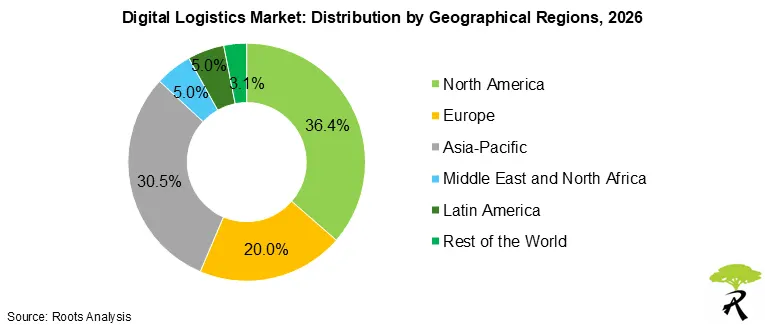
- In 2026, North America captures the largest global smart, digital logistics market share (36.4%), while the Asia-Pacific region is poised to experience an accelerated CAGR of 16.8% through 2040.
Market Overview
The digital logistics landscape is transitioning from fragmented legacy infrastructure to cloud-native, API-driven ecosystems prioritizing real-time operational visibility. This systemic modernization secures absolute real-time asset visibility and automates tedious manual documentation processing across highly complex global supply chains. Consequently, emerging mid-tier distributors now leverage the sophisticated predictive analytics and routing agility previously dominated by global Tier-1 enterprise giants.
Current market trends are fueled by a pressing need for operational resilience and the aggressive adoption of sustainable practices. Government initiatives, such as the European Union’s 2026 Electronic Freight Transport Information (EU eFTI) compliance milestones necessitate seamless digital documentation exchanges. Simultaneously, initiatives like Maersk’s EcoDelivery dashboard expansions provide critical, real-time emissions tracking for clients, addressing the escalating e-commerce demands for predictive inventory placement and eco-conscious fulfillment.
Looking ahead, the sector's long-term trajectory points toward autonomous logistics frameworks and the human-centric AI models that define Logistics 5.0. Ongoing pilot initiatives at Singapore’s automated Tuas Mega Port demonstrate how dedicated 5G network slicing successfully coordinates automated guided vehicles with inland trucking schedules. As these predictive, self-healing networks continue to mature, the industry will move well beyond reactive troubleshooting, making digital-first infrastructure not just an advantage, but a fundamental prerequisite for participating in global trade.
Digital Logistics Market Growth Drivers, Restraints, Challenges and Opportunities
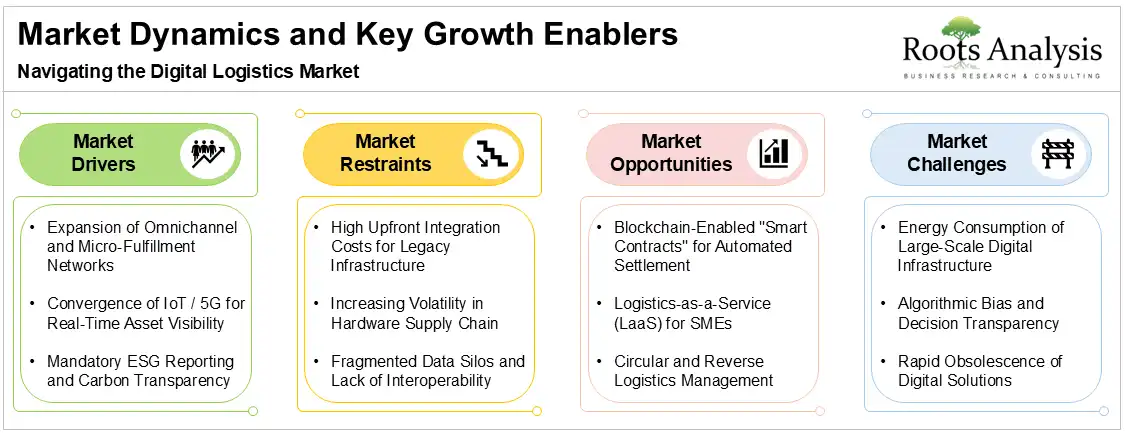
The digital logistics market is shaped by a complex interplay of structural drivers, restraints, opportunities, and challenges that collectively define its growth trajectory. IoT and 5G convergence is enabling unprecedented real-time location system growth, while mandatory ESG reporting is reshaping operational priorities at the enterprise level. However, high upfront integration costs and fragmented data silos continue to hinder seamless adoption. From a competitive standpoint, the rise of logistics-as-a-service models and blockchain-enabled smart contracts represent the most strategically significant opportunity to unlock scalable, interoperable and cost-efficient supply chain ecosystems.
Pay Only for What You Need – The Best Way to Optimize
Digital Logistics Market Size Estimation Methodology
- As a starting point, we established the market scope by defining digital logistics as the integration of web-based technologies, such as cloud computing, IoT, artificial intelligence, and blockchain, within traditional supply chain functions, including warehouse management, transportation, and workforce optimization.
- Then we examined the technology adoption cycles and macroeconomic variables, evaluating the transition speed from legacy paper-based systems to integrated digital platforms to understand varying digital maturity across enterprises, shifts toward SaaS subscription models, and the broader impact of e-commerce penetration and global trade volumes.
- Thereafter, we collected historical revenue data, average contract values, and implementation timelines through primary research with key industry stakeholders, including chief supply chain officers and logistics technology directors, and cross-validated these findings using secondary sources like vendor financial filings, regulatory reports, and supply-side portfolio analyses.
- Using these data and insights, we calculated the global digital logistics market size and projected the future market opportunity. This was achieved through a comprehensive triangulation approach that reconciled supply-side vendor estimates with demand-side buyer budgets, factoring in historical compound annual growth rates, expected enterprise IT spend, and anticipated technological breakthroughs like autonomous trucking and 5G-enabled IoT.
- The overall opportunity associated with the global market was further distributed across distinct market segments, allocating demand by solution type, deployment mode, end-user vertical (such as retail, manufacturing, and healthcare), and key geographic regions driven by infrastructure quality indices, internet penetration levels, and local mandates for digital trade documentation.
- Finally, in order to assess the sensitivity of our assumptions, we conducted a multivariate sensitivity and scenario analysis (base, optimistic, and conservative) on some of the most important parameters of our forecast methodology, evaluating the potential market impact of global supply chain disruptions, shifting fuel price volatility, and evolving data privacy regulations.
Digital Logistics Market Share Insights
Which Type of Digital Logistics Solution Dominates Market in 2026?
- Tracking & monitoring solutions structurally dominate digital logistics (with a 24.0% share in 2026) because global supply chain management requires absolute visibility to satisfy strict regulatory compliance and customer service agreements. This foundational infrastructure equips enterprise carriers with real-time location systems, rapidly reducing theft and securing total operational reliability.
- Highlighting this established dominance, recent 2026 procurement patterns reveal that supply chain visibility platforms represent the primary software investment for modernizing fleets. Carriers aggressively deploy these mature IoT networks to compress delivery delays by 20%, effectively outperforming regional competitors.
- Conversely, data management & analytics represents the fastest-growing market segment because commercial value rapidly shifts from basic location tracking toward intelligent network orchestration. Logistics providers now deploy predictive AI control towers to accurately forecast demand and autonomously optimize routing, establishing a formidable commercial advantage.
- Validating this aggressive market growth trajectory, 2026 industry data confirm AI-powered predictive tools consistently reduce enterprise inventory holding costs. This proven commercial return guarantees that advanced data analytics will scale significantly faster (with a CAGR of 18.4%) than foundational transaction systems through 2040.
Digital Logistics Market Share by Pharmaceutical and Healthcare Vertical
- Pharma and healthcare emerged as the fastest-growing end-use segment, expanding at a CAGR of 17.6% through 2040. The inherent risk profile of healthcare supply chains makes real-time visibility, condition monitoring, and auditable chain-of-custody non-negotiable, particularly as high-value biologics and cell and gene therapies scale beyond niche populations.
- Strict GxP distribution regulations act as a formidable market catalyst, compelling pharmaceutical supply networks to permanently upgrade from passive tracking toward active IoT-enabled cold chain 4.0 architectures. This mandatory integration empowers logistics providers to guarantee continuous thermal visibility, successfully securing highly profitable enterprise contracts for specialized biologic product distribution.
- Corroborating this structural shift, 2026 enterprise metrics from Controlant demonstrate how autonomous IoT platforms directly accelerate time-to-market by automating complex product release workflows. By utilizing predictive analytics to execute automated thermal auditing, leading carriers drastically reduce compliance overhead, thereby establishing a dominant commercial advantage across the highly complex global pharmaceutical freight transportation sector.
Digital Logistics Industry Forecast by Geographical Regions
North America Region to Capture Largest Share in 2026
- North America structurally commands the global digital logistics ecosystem, securing a definitive 36.4% market share in 2026. This dominant positioning is driven by aggressively capitalized cloud architecture and advanced enterprise AI integration. Ubiquitous 5G connectivity and the systemic deployment of cognitive transportation management frameworks establish a formidable infrastructural catalyst.
- Consequently, regional commercial operators execute highly scalable, data-driven supply chains, maintaining absolute market leadership and sustained operational superiority despite naturally moderating macro-growth trajectories.
Digital Logistics Market Growth Rate in Asia Pacific
- Asia-Pacific emerges as the fastest-growing regional segment driven by aggressive cross-border e-commerce expansion and manufacturer-led supply chain diversification. These structural forces intersect with heavily underpenetrated digital baselines, allowing operators to rapidly scale multimodal visibility platforms from isolated pilot programs into massive, mainstream commercial deployments, generating highly lucrative, sustained percentage growth.
- Validating this trajectory, regional governments aggressively fund smart transport corridors. Japan’s national Society 5.0 initiative systemically integrates industrial IoT across freight networks, while South Korea commits massive capital toward autonomous port infrastructure. These concrete enterprise signals confirm the territory has entered a rapid digitalization phase, outperforming major global logistics benchmarks.
Market Ecosystem Analysis
Digital Logistics Market Competitive Landscape
Competition in the digital logistics industry has intensified considerably in 2026, driven by AI adoption and shifting supply chain priorities. Enterprise giants like DHL Global Forwarding (a division of DHL Group), FedEx, and Maersk alongside agile, AI-native startups such as ZenithAI, Terravault, and Addverb Technologies, are actively deploying predictive logistics analytics to capture share across highly fragmented global supply networks. Recent initiatives and strategic developments across key digital logistics providers are outlined below.
- FedEx: Enhancing automated global trade compliance, FedEx consistently upgrades proprietary digital networks to eliminate cross-border friction. Executing this roadmap, the corporation announced during its February 2026 Investor Day plans to embed AI agents into 50% of core operational workflows by 2028.
- C.H. Robinson: Scaling autonomous freight orchestration, the logistics provider aggressively transitions manual brokerage processes into cognitive, machine-led workflows. Highlighting this capability, in January 2026, C.H. Robinson deployed dedicated AI quoting agents, radically reducing response times from roughly 20 minutes to under 32 seconds.
- DSV: Consolidating massive-scale enterprise architectures, DSV continuously prioritizes aggressive IT harmonization to rapidly capture operational synergies. Validating this strategy, in February 2026, the logistics provider announced an accelerated digital integration timeline to fully absorb DB Schenker's infrastructure by the end of 2026.
- Slip Robotics: Accelerating automated middle-mile infrastructure, the innovator continuously deploys scalable robotic ecosystems engineered for high-velocity distribution centers. Funding this expansion, in December 2024, Slip Robotics secured a $28 million Series B round to aggressively commercialize its high-speed trailer loading and unloading arrays.
- Addverb Technologies: Advancing intelligent warehousing operations, Addverb Technologies continuously engineers autonomous mobile robots tailored for complex inventory environments. Solidifying global reach, in August 2025, the robotics startup formed a strategic partnership with Siemens Xcelerator to integrate proprietary hardware directly with global industrial software networks.
Strategic Megatrends & Future Commercial Opportunities
Embedded FinTech & Automated Freight Settlement
Digital logistics platforms are rapidly evolving into integrated financial ecosystems. Rather than strictly managing physical freight, operators now embed digital payments, dynamic invoice factoring, and direct trade finance within their core software. By resolving chronic cash-flow delays for carriers, early adopters capture an aggressive commercial advantage. This evolution transforms legacy transportation software into a closed-loop transactional hub, allowing logistics providers to generate highly profitable alternative revenue streams through native financial services.
Impact of Generative AI on Digital Logistics Market: Agentic AI Orchestration & Autonomous Execution
The integration of generative AI fundamentally restructures digital logistics, transitioning the market from passive asset tracking to proactive, autonomous execution. Historically, global freight networks collapsed under the sheer volume of fragmented, text-heavy documentation, ranging from complex bills of lading to localized customs declarations. By deploying advanced Large Language Models, logistics operators now instantaneously ingest, translate, and standardize this disjointed data into unified commercial frameworks. This systemic technological upgrade immediately lowers administrative overhead while streamlining highly complex cross-border freight movements.
The definitive commercial opportunity lies in deploying agentic AI to construct predictive, self-healing supply chain networks. Enterprise platforms now utilize execution-focused algorithms that independently interrogate real-time inventory flows, negotiate spot-market freight rates, and autonomously trigger physical reallocation during structural transport disruptions. Validating this aggressive industry trajectory, in April 2026, Project44 acquired LunaPath.ai specifically to embed autonomous routing agents within its core infrastructure. This strategic evolution empowers global shippers to guarantee continuous operational continuity and successfully insulate institutional capital from extreme macroeconomic volatility.
Your Business is Unique – Why Shouldn’t Your Report Be?
Market Access Considerations
Geopolitical Data Fragmentation & Sovereign Localization Barriers
Escalating national mandates enforcing sovereign data residency currently establishes formidable market entry barriers for global digital freight providers. Treating supply chain telemetry as critical national infrastructure, strict regulatory frameworks, such as the newly enforceable 2025 EU Data Act and India’s recently operationalized DPDP Rules, compel operators to construct localized edge data centers rather than leveraging centralized cloud networks.
This regulatory fragmentation significantly inflates commercialization costs, directly stalling the deployment of universal platform architecture. Consequently, a distinct competitive moat emerges, heavily favoring well-capitalized incumbents equipped to architect jurisdiction-specific compliance infrastructures and dominate geographically segmented logistics landscapes.
Ecosystem Interoperability & Hardware Capital Intensity
The absence of universal data standards across multimodal transport networks creates severe structural bottlenecks for global platform commercialization. Bridging legacy electronic data interchange (EDI) frameworks with modern API environments requires exhaustive custom connector development. Furthermore, unlike pure software-as-a-service solutions, digital logistics demands profound physical integration, requiring extensive upfront capital expenditure for IoT sensors arrays and telematics hardware.
This high-friction deployment cycle actively shifts procurement preferences toward comprehensive OpEx-based hardware-as-a-service models. Consequently, market leadership heavily favors well-capitalized providers possessing extensive pre-integrated partnership networks, effectively marginalizing standalone software entrants unable to subsidize initial infrastructural rollout costs.
Cybersecurity Mandates & Zero-Trust Procurement Frameworks
Rapid digital-physical supply chain integration exponentially expands the operational surface area for catastrophic cyberattacks. In response, global enterprise procurement fundamentally transitions toward an “insurance-first” risk management posture, strictly prioritizing security resilience over innovative functionality. Stringent regulatory frameworks, such as the European Union’s fully enforced NIS2 Directive, legally mandate exhaustive supply chain risk assessments.
Consequently, market access relies entirely on demonstrating uncompromising compliance with standards like ISO 27001 and SOC 2. This rigorous vetting environment heavily privileges established vendors possessing deep cybersecurity budgets, effectively locking out emerging startups incapable of funding mandatory enterprise-grade threat mitigation infrastructure.
How Stakeholders Benefit from the Key Focus Areas of Our Digital Logistics Market Report
The global digital logistics ecosystem is rapidly accelerating as supply chain architectures pivot toward data-centric, automated environments. This comprehensive report on digital logistics market trends and analysis equips industry executives, institutional investors, and strategic planners with authoritative market drivers, granular forecasts, and actionable trend evaluations. By leveraging these verified structural insights, decision-makers can decisively navigate complex commercial dynamics, prioritize high-yield technological investments, and execute scalable growth strategies within highly fragmented global trade networks.
- Digital Logistics Market Landscape and Competitive Dynamics: The report provides a structured view of the competitive landscape, including market positioning, strategic capabilities, The report maps leading players, emerging startups, and evolving competitive strategies shaping the market landscape. By understanding positioning, capabilities, and strategic moves, stakeholders can benchmark performance and identify whitespace opportunities. This insight supports market entry strategies, partnership decisions, and competitive differentiation. It also enables organizations to anticipate shifts in the competitive landscape and respond proactively.
- Unmet Needs and Market Gaps in Digital Logistics Market: The report identifies critical inefficiencies in legacy logistics systems, fragmented data ecosystems, and underpenetrated digital solutions across emerging markets. These insights help stakeholders pinpoint high-value problem areas where innovation and differentiation can create competitive advantage. Strategy leaders can align product development with real demand gaps, while investors can target underserved segments with strong upside potential. This enables more precise commercialization and faster market traction.
- Technology Innovation and Adoption Trends: Detailed coverage of digital technologies such as AI-driven route optimization, IoT-enabled tracking, and cloud-based logistics platforms provides clarity on innovation trajectories. Decision-makers precisely evaluate which emerging solutions command actual commercial traction and deliver immediate operational efficiencies. This foundational foresight dictates authoritative technology roadmaps, ensuring enterprise digital transformation initiatives perfectly align with validated real-world adoption patterns and maximize long-term return on infrastructure investments.
- Funding and Investment Landscape in Smart Logistics Market: Comprehensive analysis of investment activity highlights capital flow trends, key funding hotspots, and emerging high-growth segments within digital logistics. Stakeholders gain clarity on where venture capital and private equity are concentrating, helping refine investment strategies and risk assessments. This visibility supports better allocation of capital toward scalable technologies and platforms with proven adoption drivers. It also enables early identification of disruptive players and consolidation opportunities.
- Partnership and Collaboration Trends in Digital Logistics Market: The smart logistics market research study examines high-impact strategic alliances, cross-industry consortia, and ecosystem expansion frameworks accelerating modern freight digitization. Corporate development teams utilize this deep analytical perspective to pinpoint synergistic partners capable of amplifying geographic reach and integrating complex service offerings. Understanding these collaborative patterns facilitates immediate go-to-market execution, allowing enterprises to rapidly unlock lucrative alternative revenue streams through intelligently shared technological resources.
- Digital Logistics Market Segmentation and Geographic Coverage: Granular segmentation analysis across types of solutions, services, deployment models, end use industries, and regions provides a clear view of demand patterns and growth outlook. Stakeholders can identify high-performing segments and regions with strong adoption drivers and expansion potential. This exhaustive data-driven foundation strictly guides tactical resource prioritization, ensuring targeted regional market entries and highly localized scaling operations execute flawlessly across emerging cross-border frontiers.
Have Questions? Let’s Get Them Answered.
Digital Logistics Market: Scope of the Report
| Key Report Attributes | Details | |
| Forecast Period | Till 2040 | |
| Market Size 2026 | USD 49.20 Billion | |
| Market Size 2040 | USD 316.33 Billion | |
| CAGR (Till 2040) | 14.22% | |
| Segments Covered |
|
|
| Geographical Regions Covered |
|
|
| Key Sections Covered |
|
|
Market Segmentation
The digital logistics market report presents an in-depth analysis, highlighting the capabilities of various stakeholders, based on different segments such as component, type of solution, mode of transport, type of technology, deployment mode, end use industry, geographical regions, and key players.
Market Share by Component
- Solution
- Services
Market Share by Type of Solution
- Data Management & Analytics
- Fleet Management
- Tracking & Monitoring
- Warehouse Management
- Others
Market Share by Mode of Transport
- Road
- Rail
- Sea
- Air
Market Share by Type of Technology
- IoT
- AI / ML
- Big Data Analytics
- Blockchain
- Cloud Computing
- Robotics
Market Share by Deployment Mode
- Cloud
- On-Premises
Market Share by End Use Industry
- Automotive
- Food & Beverage
- Manufacturing
- Oil & Gas / Energy
- Pharmaceutical & Healthcare
- Retail & E-commerce
- Others
Market Share by Geographical Regions
- North America
- US
- Canada
- Mexico
- Rest of North America
- Europe
- Austria
- Belgium
- Denmark
- France
- Germany
- Ireland
- Italy
- Netherlands
- Norway
- Russia
- Spain
- Sweden
- Switzerland
- UK
- Rest of Europe
- Asia-Pacific
- Australia
- China
- India
- Japan
- New-Zealand
- Singapore
- South Korea
- Rest of Asia-Pacific
- Latin America
- Argentina
- Brazil
- Chile
- Colombia
- Venezuela
- Rest of Latin America
- Middle East and North Africa (MENA)
- Egypt
- Iran
- Iraq
- Israel
- Kuwait
- Saudi Arabia
- UAE
- Rest of MENA
- Rest of the World


