


 Download Free Sample
 Buy Now
Autonomous Last Mile Delivery Market Overview
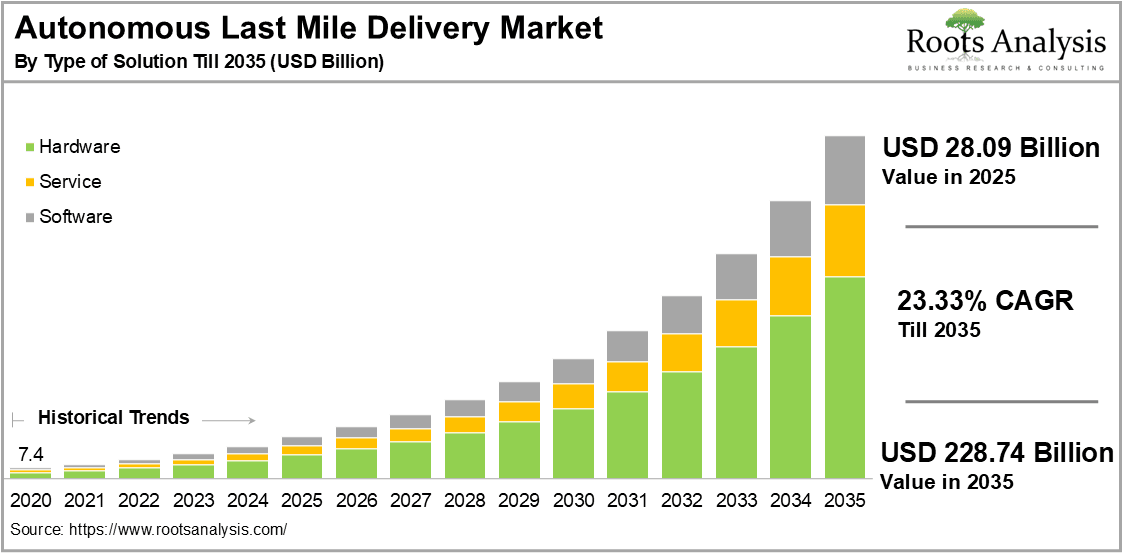
The global autonomous last mile delivery market, valued at USD 21.5 billion in 2024, is projected to reach USD 28.09 billion in 2025 and USD 228.74 billion by 2035, representing a CAGR of 23.33% during the forecast period.
 |
See What’s in the Full Report–Request Your Complimentary Insights!
The new research study consists of detailed autonomous last mile delivery market analysis, mega trends, patent analysis, porter's five forces, SWOT analysis, value chain analysis and other strategic frameworks.
Autonomous last-mile delivery (ALMD) involves deploying self-operating vehicles, drones, or robots to transport goods from local distribution hubs to customers’ doorsteps, addressing the most logistically challenging and expensive phase of supply chains. These systems utilize advanced technologies like artificial intelligence (AI), machine learning (ML), and sensor networks to autonomously navigate environments, avoid obstacles, and optimize routes without human intervention.
By automating this final delivery leg, businesses aim to minimize operational inefficiencies, lower labor costs, and enhance supply chain reliability. The market is projected to grow significantly, driven by rising investments in smart logistics and demand for faster, contactless delivery solutions.
This growth is fueled by technological advancements in delivery vehicles and the expanding e-commerce sector, which prioritizes rapid order fulfillment. Aerial drones, in particular, are gaining traction for their ability to access remote or geographically challenging areas where traditional vehicles struggle.
Major players like Amazon are pioneering innovations such as the Scout robot—a compact, sidewalk-navigating device designed to drop packages at customers’ homes—demonstrating the potential of autonomous solutions. Similarly, companies like JD.com and FedEx are testing self-driving vans and drones in the self-driving delivery market to improve delivery accuracy and scalability. These developments highlight the industry’s shift toward hybrid models that combine ground robots, drones, and AI-driven route optimization. The sector’s expansion is further propelled by consumer expectations for instant delivery and advancements in vehicle automation, including electric and sensor-equipped units that reduce environmental impact.
Autonomous Last Mile Delivery Market Segmentation Insights
The market report presents an in-depth analysis of the various companies that are involved in offering autonomous last mile delivery platforms and solutions, across different segments, as defined in the table below:
Autonomous Last Mile Delivery Market: Report Attributes / Market Segmentations
| Market Segmentations | Details | |
| Historical Trend | Since 2018 | |
| Forecast Period | Till 2035 | |
| Market Size 2025 | $ 28.09 Billion | |
| Market Size 2035 | $ 228.74 Billion | |
| CAGR till 2035 | 23.33% | |
| Areas of Application |
|
|
| Type of Solution |
|
|
| Type of Range |
|
|
| Type of Vehicle |
|
|
| Type of Enterprise |
|
|
| Geographical Regions |
|
|
| Leading Market Players |
|
|
| PowerPoint Presentation (Complimentary) |
Available | |
| Customization Scope | 15% Free Customization | |
| Excel Data Packs (Complimentary) |
|
|
Have Questions? Let’s Get Them Answered.
Autonomous Last Mile Delivery Market Share Insights
Market Share by Areas of Application
The market is segmented into various areas of application such as food & beverages, healthcare & pharmaceuticals, logistics, retail, and other applications. According to our autonomous last mile delivery growth forecast, the retail segment will augment the segment's growth with the largest market share of over 35.64% by the next decade.
The growth is attributed to the surge in e-commerce, which demands rapid, cost-effective solutions to fulfill orders. Retailers and logistics providers are increasingly adopting autonomous ground robots and drones to manage urban deliveries, reduce operational costs, and meet consumer expectations for same-day or instant delivery, particularly in densely populated areas.
Furthermore, the food and beverages segment is expected to witness a growth of CAGR of 24.84% during the forecast period. This growth is driven by the increasing consumer demand for quick, contactless delivery of perishable goods. The advancement of autonomous drones and rovers for delivery ensures quicker, efficient deliveries without compromising delivery freshness. The rapid rise of urban population and food delivery services is significantly impacting the rising popularity and increase in demand for speed and ease of delivery of meals and groceries. This is further fueling the market.
Market Share by Type of Solutions
The market is segmented into various types of solutions, such as hardware service and software. According to our analysis, the hardware segment will increase hold 54.68% market share of autonomous last mile delivery during the forecast period. This dominance is attributed to the technological advancements in sensors, LiDAR, cameras, and autonomous navigation systems that guarantee accurate delivery. These technologies offer safety, dependability, and effectiveness in the operation of autonomous vehicles; thus hardware systems and components are crucial to the design and implementation of delivery robots and drones in intricate environments.
Furthermore, the services segment is expected to witness the fastest CAGR of around 24.26% during the forecast period. This growth is driven by the growing demand for supporting autonomous delivery systems market with maintenance, fleet management, and software updates. This segment will further rise due to the increasing preference of autonomous technologies by retailers and logistics providers.
Market Share by Type of Range
The market is segmented into various types of range, such as long range (>20 km), short range (<20 km). According to our analysis, the short range (<20 km) segment will hold 84.67% autonomous last mile delivery market share during the forecast period. This growth is driven by the concentration of deliveries in urban and suburban areas, where most last-mile logistics occur between local hubs and customer doorsteps. Autonomous ground robots and drones excel in these environments, efficiently handling food, e-commerce, and medical deliveries within cities.
On the other hand, it is worth highlighting that the long range (>20 km) segment is expected to witness the fastest CAGR of around 25.78% during the forecasted period. This growth can be attributed to the rising demand for efficient and affordable parcel transportation over long distances. Moreover, the need to reduce carbon emissions & pollution in cities and the need for long-range autonomous ground robots is expected to further drive segment growth.
Market Share by Type of Vehicle
The market is segmented into various types of vehicles, such as aerial delivery drones, ground delivery bots, and self-driving trucks & vans. According to our analysis, the ground delivery bots segment will hold 64.69% market share of autonomous last mile delivery during the forecast period. This segment’s growth is being fueled by several significant issues being faced by the truck industry, including driver shortage and productivity. Furthermore, the execution of autonomous delivery robots is increasingly being influenced by continuously rising labor wages.
Furthermore, the aerial delivery drones segment is expected to witness the fastest CAGR of around 24.58% during the forecasted period. This growth is driven by their ability to deliver packages by avoiding traffic congestion and unnecessary barriers. Moreover, advancement in technologies, such as geospatial mapping, IoT, and machine learning in delivery drones results in higher accuracy in delivery, which is further expected to drive the segment growth.
Market Share by Type of Enterprise
The market is fragmented into two types of enterprises, namely large and small and medium enterprises. Currently, the large enterprise segment is expected to dominate the segment with 72.34% of the market share. However, small and medium enterprise segments are expected to witness a relatively higher (24.78%) growth rate until 2035. This is ascribable to their agility, innovation, focus on niche markets, and ability to adapt to changing customer preferences and market conditions.
Market Share by Geographical Regions
This segment highlights the distribution of autonomous last mile delivery market share by regions, such as North America, Europe, Asia, Latin America, Middle East and North Africa, and the rest of the world. According to our regional analysis, North America currently exhibits dominance with 34.13% of overall market share. The market is driven by the ongoing developments in autonomous delivery robots, leading to a large number of pilot projects in the region.
See What’s in the Full Report–Request Your Complimentary Insights!
Autonomous Last Mile Delivery Market Key Insights
The “Autonomous Last Mile Delivery Market, Till 2035: Industry Trends and Global Forecasts” report features an extensive study of the current market landscape, market size and future opportunity within market forecast period. The market report highlights the efforts of several stakeholders involved in this rapidly emerging segment of the service providers industry. Key takeaways of the global autonomous last mile delivery industry report are briefly discussed below.
Autonomous Last Mile Delivery Market Drivers
The global autonomous last mile delivery industry growth is expected to be driven by several key factors. The rapid growth of e-commerce has significantly increased demand for fast and efficient delivery services, prompting companies to adopt autonomous solutions like drones and ground robots to streamline logistics and reduce operational costs. Technological advancements in AI, machine learning, and sensor systems enhance the navigation and reliability of these autonomous vehicles, allowing them to operate effectively in complex urban environments.
Additionally, the need for contactless delivery, especially highlighted during the pandemic, has accelerated the adoption of autonomous systems. Furthermore, strategic partnerships between technology firms and logistics providers are fostering innovation and expanding the reach of autonomous delivery services across various regions, including urban and rural areas.
Competitive Landscape of Autonomous Last Mile Delivery Market
According to the autonomous last mile delivery competitive landscape analysis, with the presence of several small and large companies, the market is experiencing intense competition and changing market dynamics. From large multinational companies to local players, companies are striving to enhance their competitive edge. In terms of market share, large enterprises and multinational companies are dominating the market. The key players are using strategies such as partnerships, acquisitions, ventures, innovations, novel product launches, R&D and geographical expansions to solidify their position in the industry.
For instance, in October 2024, Uber expanded robot delivery and robotaxi offerings with Avride. In reference to this partnership with Avride, Uber stated that Avride has a unique advantage from developing and operating both autonomous cars and delivery robots that leverage mutually enhancing technologies. The company’s delivery robots are already making commercial deliveries in the U.S. and South Korea, while the autonomous cars are currently being tested on public roads.
Autonomous Last Mile Delivery Market Challenges
Despite the strong market growth projection, there are several last-mile delivery challenges. High initial investment and operational costs are significant barriers, as developing and deploying autonomous vehicles require substantial capital for advanced technologies like AI and sensor systems. Regulatory uncertainties regarding liability and safety also pose a challenge, particularly in densely populated areas where autonomous vehicles must navigate complex environments. Infrastructure limitations, such as the lack of dedicated lanes or charging stations, further complicate the deployment of autonomous delivery systems.
Additionally, ensuring safety and reliability in real-world conditions remains a technical challenge, as autonomous vehicles must accurately perceive and respond to various environmental conditions like weather and traffic. These challenges necessitate strategic partnerships and investments to overcome infrastructure and regulatory hurdles.
Regional Analysis: North America is Expected to Dominate the Market with the Largest Autonomous Last Mile Delivery Market Share
With respect to regional analysis of autonomous last mile delivery, North America is likely to dominate the market for the forecast period. This dominance is being fueled by advanced technological infrastructure, high investment in autonomous technology, and the presence of major players like Amazon, FedEx, and UPS actively developing and deploying autonomous delivery solutions.
The fast-growing demand for efficient order delivery by consumers in the region facilitates the faster uptake of independent delivery systems. Additionally, the favorable policies and regulations in North America together with the robust investments in research and development on autonomous vehicle technology and robotics in transportation create an environment that is favorable for innovations which cements the region’s dominance.
Unlock Deeper Insights–Schedule Your Personalized Workshop Today!
Leading Players in Autonomous Last Mile Delivery Market
Examples of leading autonomous last mile delivery players (which have also been captured in this market report, arranged in alphabetical order) include Airbus, Alibaba Group, Amazon, A2Z Drone Delivery, Boxbot, Continental, DHL International, DPD, Drone Delivery Canada, FedEx, Flirtey, Flytrex, JD.com, Kiwibot, Matternet, Marble Robot, Nuro, Ottonomy, Refraction AI, Relay Robotics, Robbie Technologies, Robomart, Relay Robotics, Serve Robotics, Shenzhen Yiqing Innovation Technology, SkyDrop, Starship, ST Engineering Aethon, TeleRetail, Udelv, United Parcel Service of America, Wing Aviation, and Zipline.
Recent Developments in Autonomous Last Mile Delivery Market
- In February 2025, Avride launched sidewalk delivery bots on Uber eats in Jersey City.
- In January 2025, Cainiao launched new autonomous delivery vehicle, the Cainiao Autonomous Vehicle GT Pro, for public roads.
- In December 2024, Dubai CommerCity partnered with Aramex and QuickBot Technologies to launch autonomous delivery robots trial.
- In October 2024, Starship Technologies and Bolt partnered together to launch eco-friendly robot powered grocery delivery service in Estonia.
- In September 2024, Alibaba’s courier unit Cainiao launched its level-4 fully autonomous robovans.
Autonomous Last Mile Delivery Market Report Coverage
The market report presents an in-depth analysis, highlighting the capabilities of various companies engaged in this domain, across different segments. Amongst other elements, the market report includes:
- A preface providing an introduction to the full report, autonomous last mile delivery market, 2020-2024 (Historical Trends) and 2025-2035 (Forecasted Estimates).
- An outline of the systematic research methodology adopted to conduct the study on the autonomous last mile delivery, providing insights on the various assumptions, methodologies, and quality control measures employed to ensure the accuracy and reliability of our findings.
- An overview of economic factors that impact the overall autonomous last mile delivery industry, including historical trends, currency fluctuation, foreign exchange impact, recession, and inflation measurement.
- An executive summary of the insights captured during our research. It offers a high-level view of the current state of the autonomous last mile delivery industry and its likely evolution in the mid-long term.
- A detailed assessment of the autonomous last mile delivery competitive landscape, based on several relevant parameters, including year of experience, company size, location of headquarters, and ownership structure.
- Elaborate profiles of prominent players engaged in the autonomous last mile delivery market, featuring information on their year of establishment, location of headquarters, company size, company mission, company footprint, management team, contact details, financial information, operating business segments, portfolio, moat analysis, recent developments, and an informed future of autonomous last mile delivery.
- A qualitative assessment of the various megatrends ongoing in the autonomous last mile delivery industry, including autonomous vehicles and drones, hybrid delivery models, and sustainability and eco-friendly solutions.
- An analysis highlighting the key unmet needs across autonomous last mile delivery, featuring market research on autonomous shipping industry insights generated from real-time data on unmet needs as identified from social media posts, recent publications, industry blogs and the views of key opinion leaders expressed on online platforms.
- An in-depth analysis of various patents that have been filed / granted related to autonomous last mile delivery solutions and software, based on various parameters, such as type of patent, patent publication year, patent age and leading players
- A detailed analysis of recent developments in the autonomous last mile delivery market, based on relevant parameters such as year of initiative, type of initiative (partnerships and collaborations, expansions, funding and product launches), geographical distribution and most active players (in terms of number of recent developments).
- Key winning strategies framework that helps in analyzing the level of competition within an industry, by tracing the key market activities including partnership, funding, expansion of leading players
- A qualitative analysis, highlighting the five competitive forces prevalent in autonomous last mile delivery industry, including threats for new entrants, bargaining power of suppliers, bargaining power of customers, threats of substitution and rivalry among existing competitors.
- A discussion on affiliated global autonomous last mile delivery market trends, key drivers and challenges, under a SWOT framework, which are likely to impact the industry’s evolution, along with a Harvey ball analysis, highlighting the relative effect of each SWOT parameter on the overall market for autonomous last mile delivery.
- A value chain analysis featuring a discussion on various stakeholders involved in providing autonomous last mile delivery, from suppliers to end-users.
- A detailed estimate of the current market size and the potential future of autonomous last mile delivery market initiatives over the next decade. Based on multiple parameters we have provided an informed estimate on the market evolution during the forecast period 2025-2035. The report also features the likely distribution of the current and forecasted opportunity within the autonomous last mile delivery market. Further, in order to account for future uncertainties and to add robustness to our model, we have provided three forecast scenarios, namely conservative, base, and optimistic scenarios, representing different tracks of the industry’s growth.
- Detailed projections of the current and future market across various areas of application such as food & beverages, healthcare & pharmaceuticals, logistics, retail, and other applications.
- Detailed projections of the current and future market across various types of solutions, such as hardware service and software.
- Detailed projections of the current and future market across various types of range, such as long range (>20 km), short range (<20 km).
- Detailed projections of the current and future market across various types of vehicles, such as aerial delivery drones, ground delivery bots, and self-driving trucks & vans.
- Detailed projections of the current and future market across various types of enterprises, such as large enterprises and small and medium enterprises.
- Detailed projections of the current and future autonomous last mile delivery market across various geographical regions, such as North America (US, Canada, Mexico and other North American countries), Europe (Austria, Belgium, Denmark, France, Germany, Ireland, Italy, Netherlands, Norway, Russia, Spain, Sweden, Switzerland, UK and other European countries), Asia (China, India, Japan, Singapore, South Korea and other Asian countries), Middle East and North Africa (Egypt, Iran, Iraq, Israel, Kuwait, Saudi Arabia, UAE and other MENA countries), Latin America (Brazil, Chile, Colombia, Venezuela and other Latin American countries) and rest of the world (Australia, New Zealand and other countries).
Want Information on Specific Region/Segment?
About Authors
Lead Author: Anmol Bali
Lead Reviewer: Prachi Bhalla
Chief Editor: Ronit Sharma
Customization Opportunities
At Roots Analysis, we genuinely care about your success and understand that your business requirements are unique. While our market research reports provide valuable insights, we recognize that they might not cover every aspect you need to make well-informed strategic decisions. To account for that, we offer 10% free report customization tailored to your specific needs. Whether you require additional quantitative analysis, qualitative insights, or any other information related to the autonomous last mile delivery market, reach out us today at: support@rootsanalysis.com


