
Lowest Price Guaranteed
Slides
183
Last Updated
July 2026
View Count
14394
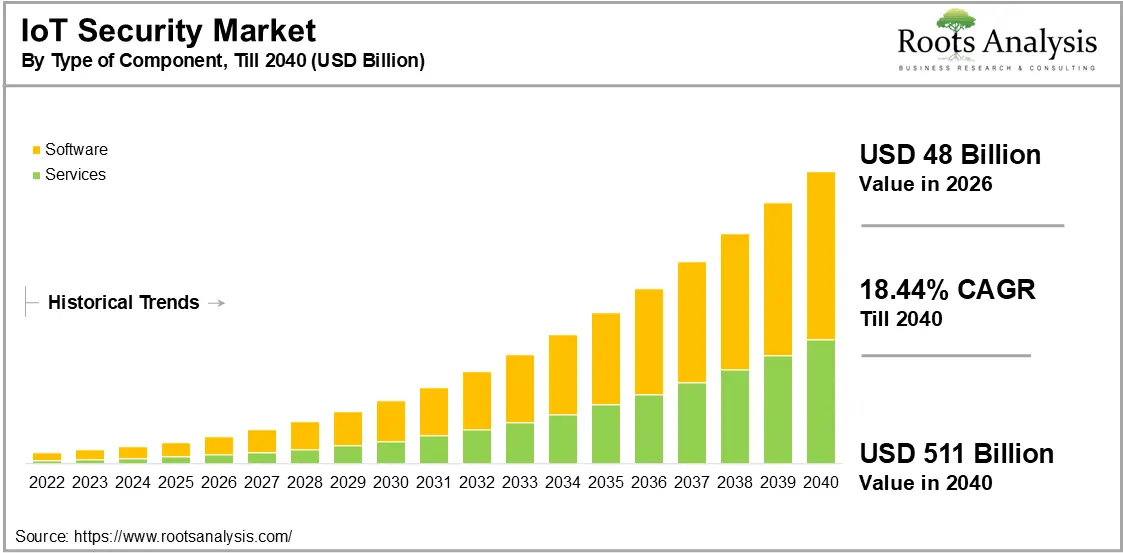
The global IoT security market size is projected to grow from USD 48 billion in 2026 to USD 511 billion by 2040, representing a CAGR of 18.44%, during the forecast period 2026-2040.
To learn more about this report, request a free sample copy
The new research study consists of IoT security trends 2025 analysis, detailed global IoT security growth forecast analysis, and providing actionable strategic recommendations.
IoT security is focused on safeguarding internet of things (IoT) devices and their networks from threats such as data theft and manipulation by hackers. A significant driver of market growth in this area is the increasing necessity to secure future internet-connected devices through the implementation of advanced security features, enhancing transparency, and providing users with the ability to opt out of data collection. The widespread adoption of IoT devices in both consumer and industrial sectors has significantly boosted the market.
The convenience and efficiency that IoT technology provides have led to its extensive use, with devices such as smart home systems, industrial sensors, and connected vehicles requiring sophisticated security solutions to prevent unauthorized access and data manipulation. Moreover, governments around the globe have acknowledged the critical importance of securing IoT infrastructure and have enacted stringent regulations to ensure compliance. These regulations often require the adoption of specific security standards and practices, further driving demand for IoT security solutions. Therefore, there is a highly positive impact of regulations on IoT security as its fueling the market growth.
The IoT security industry report presents an in-depth analysis of the various companies that are involved in offering IoT security solutions, across different segments, as defined in the table below:
| Key Report Attributes | Details | |
| Historical Trend | Since 2022 | |
| Forecast Period | Till 2026 | |
| Market Size Value in 2026 | $ 48 Billion | |
| Market Size Value by 2040 | $ 511 Billion | |
| CAGR (Till 2040) | 18.44% | |
| Type of Component |
|
|
| Type of Deployment |
|
|
| Type of Security |
|
|
| Areas of Application |
|
|
| Type of Product |
|
|
| Type of Professional Services |
|
|
| Type of Data Sensitivity |
|
|
| Company Size |
|
|
| Geographical Regions |
|
|
| Leading Market Players | ||
| PowerPoint Presentation (Complimentary) |
Available | |
| Customization Scope | 15% Free Customization | |
| Excel Data Packs (Complimentary) |
|
|
Based on the type of component, the global IoT security market is split into services and software. Among these categories, the software segment holds the highest market share (69%) in 2026. This highest dominance is largely because the immediate, baseline requirement for securing any IoT deployment involves licensing core protection tools like identity management, encryption, and endpoint security analytics to handle massive device volumes. The sudden, widespread enforcement of stringent global data compliance laws has forced enterprises to prioritize immediate, large-scale software rollouts to prevent devastating network breaches.
Conversely, the services segment is growing at a higher CAGR because the massive variety of multi-vendor IoT devices has made managing these complex networks overwhelming for standard in-house teams. As a result, businesses are aggressively shifting toward Managed Security Services (MSS) and external consultants to handle the complex integration of legacy infrastructure with cloud security, turning to outside experts to bridge the severe shortage of specialized cyber-talent.
The global IoT security market is segmented into various types of deployment, such as cloud and on-premises. According to our IoT security industry analysis, the cloud segment will augment the segment's growth with the largest market share of over 75.56% as well as the fastest CAGR of 28.98% by the next decade. According to the distribution IoT security market insights, this can be attributed to the scalability and flexibility that cloud solutions offer, allowing organizations to easily adjust resources based on demand, which is essential for managing large-scale IoT deployments. Along with this, its ease of implementation and reduced need for in-house infrastructure, also supports this rapid growth.
The global IoT security market is segmented into various types of security, such as application security, cloud security, endpoint security, network security, and others. According to our global IoT security solutions market analysis, the network security segment will augment the market's growth with a market share of 54.65% by 2040. This can be attributed to the increasing need for filtering and monitoring network traffic, protecting connected infrastructure, and implementing authentication protocols to prevent unauthorized access and data breaches. Furthermore, it is worth highlighting that the endpoint security segment is expected to witness the fastest growing CAGR of around 31.67% in the forecasted period. This growth can be owed to the significant increase in the number of IoT devices, which makes endpoint security crucial for protecting these devices from cyber threats. As organizations deploy more connected devices across various applications, the demand for comprehensive endpoint security solutions is rapidly rising.
The market is segmented into various areas of application, namely connected logistics, smart homes, smart manufacturing, and others. According to our IoT security market overview, the smart homes segment will augment the market's growth with a market share of 60.65% during the forecasted period. This smart home security solutions growth can be attributed to the increasing adoption of IoT devices in residential settings, such as smart locks, video surveillance cameras, and home automation systems. On the other hand, the connected logistics segment is expected to witness the fastest CAGR of about 28.56% during the forecast period. This growth is driven by the rising need for secure tracking and management of goods throughout the supply chain.
The market is segmented into various types of products, such as data encryption & tokenization, device authentication & management, identity access & management, intrusion detection system & intrusion prevention system. According to our IoT security market analysis, the device authentication & management segment is anticipated to gain the maximum market share of around 60.78% over this forecast period. This can be attributed to the segment’s critical role in ensuring secure access to IoT devices, preventing unauthorized entry, and maintaining data integrity. On the other hand, the identity access & management segment will witness the fastest CAGR of around 28.94% during the forecasted period. This can be attributed to the increasing demand for secure, scalable solutions that facilitate reliable user authentication and access control across various IoT devices and networks.
The market is segmented into various types of professional services, such as consulting, implementation, support and maintenance. According to our IoT security market analysis, the consulting segment is anticipated to gain the maximum market share of around 50.78% over this forecast period. This can be attributed to the increasing reliance of organizations on expert guidance to navigate the complexities of IoT security, including risk assessments, compliance with industry standards, and the development of tailored security strategies. This demand for specialized knowledge helps businesses effectively secure their IoT environments against evolving threats. On the other hand, the implementation segment will witness the fastest CAGR of around 27.94% during the forecasted period. This can be attributed to the growing recognition of the importance of robust IoT security frameworks.
The market is segmented into various types of data sensitivity, such as high-sensitive data, low and moderate sensitive data. According to our IoT security market analysis, the high-sensitive data segment is anticipated to gain the maximum market share of around 70.78% over this forecast period. This can be attributed to the critical need for stringent protection measures for data that has significant privacy, financial, or operational implications. Industries such as healthcare, finance, and government are particularly focused on securing high-sensitive data to prevent severe consequences from data breaches. On the other hand, the low and moderate-sensitive data will witness the fastest CAGR of around 27.94% during the forecasted period. This can be attributed to the increasing recognition of the importance of securing all types of data as IoT devices proliferate across various sectors.
The global IoT security market is fragmented into multiple types of enterprise namely large and small and medium enterprise. Currently, the large enterprise segment is anticipated to dominate the segment with 60.34% of IoT security market share. However, small and medium enterprise segments are expected to witness a relatively higher (30.27%) IoT security market growth rate until 2040. This is ascribable to their agility, innovation, focus on niche markets, and ability to adapt to changing customer preferences and market conditions.
This segment highlights the distribution of regional analysis of IoT security markets, such as North America, Europe, Asia, Latin America, Middle East and North Africa, and the rest of the world. According to our IoT security market regional outlook, Asia currently exhibits dominance with 37.69% of overall market share. This growth is owed to the expanding government initiatives, the rising demands for quick computing, virtualized environments, analytics, security, digitalization, high-volume networking, and the rising overall internet speed and responsiveness.
According to IoT security industry trends, the market is expected to be driven by growing concerns about critical infrastructure security. Hackers are increasingly targeting internet of things (IoT) devices, exploiting common vulnerabilities such as default passwords, default usernames, and static code backdoors. To curb these threats, stringent IoT security solutions are being implemented for safer transmission to automated processes in every sector, fueling the market growth. For instance, in April 2024, the UK introduced its first IoT security laws. In reference to this Viscount Camrose stated: "from today, consumers will have greater peace of mind that their smart devices are protected from cyber criminals, as we introduce world-first laws that will make sure their personal privacy, data, and finances are safe."
With the presence of several small and large IoT security manufacturing companies, the market is experiencing intense competition and changing IoT security market dynamics. From large multinational companies to local IoT security manufacturing players, companies are striving to enhance their competitive edge. In terms of market share, large enterprises and multinational companies are dominating the market. While small IoT security manufacturing players are continuously improving their products to cater to niche markets, or they are offering specialized solutions. These industry players are focusing on adopting competitive strategies, such as developing innovative IoT security solution techniques, forming strategic alliances and partnerships to expand their portfolios and global footprint, investing in recent developments and new feature launches to enhance their IoT security products offerings. For instance, in February 2024, MediaTek launched T300 5G RedCap platform for IoT.
Despite the strong market growth projection, there are several challenges in the IoT security market. The most common challenge is the high maintenance to manage the IoT devices. A significant challenge facing the IoT security market is the presence of unmanaged devices that are connected in a heterogeneous manner, allowing them to communicate using various protocols and backgrounds. When IoT devices within a network are not properly managed, they become susceptible to malware attacks from hackers. This vulnerability arises from weak security configurations, outdated firmware, and unresolved security flaws. Hackers can take advantage of these weaknesses to gain unauthorized access to the network and initiate attacks.
With respect to regional IoT security industry insights, Asia is likely to dominate the market for the forecasted period. The dominance of this region is majorly influenced by the rapid expansion of IT infrastructure and growing awareness of cybersecurity threats. Additionally, government initiatives and supportive policies promote digital transformation and innovation. The presence of numerous IoT manufacturers and the rising use of connected devices across various sectors, such as healthcare, transportation, and manufacturing, further accelerate market growth in the region.
Examples of key IoT security device manufacturers involved in the IoT security market (which have also been captured in this market report, arranged in alphabetical order) include Allot, Amazon Web Services, Atos SE, Broadcom, Cisco Systems, Forgerock, Fortinet, Gemalto, Google, HP, IBM, Infineon Technologies, Intel, Mocana, Microsoft, NortonLifeLock, New Sky Internet, SecuriThings, Symantec, Telefonaktiebolaget LM Ericsson, ZingBox.