
Lowest Price Guaranteed
Slides
174
Last Updated
July 2026
View Count
17697
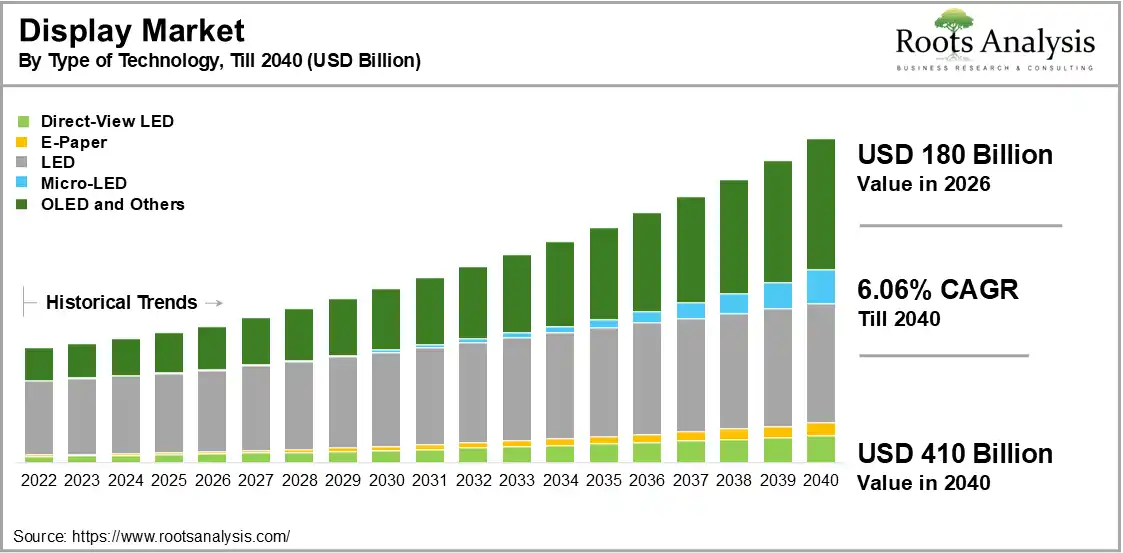
The display market size is projected to grow from USD 180 billion in 2026 to USD 410 billion by 2040, representing a CAGR of 6.06%, during the forecast period 2026-2040.
To learn more about this report, request a free sample copy
The new research study consists of industry trends, detailed market analysis, key market trends of display market, SWOT analysis and value chain analysis.
The transformation of digital technology in the display market has created unprecedented opportunities for businesses to attract and engage their target audiences. The growing trend of larger screens across diverse industries with emerging display technology from cutting-edge 3D displays to next-generation digital signage and video surveillance technologies is redefining human interaction with information and visual content. Displays are a type of device that presents information, data, images, and videos in visual or tactile form to users. Over time, the emergence of advanced technology has introduced a variety of forms and technologies that encompass liquid crystal displays (LCDs), light-emitting diode displays (LEDs), organic light-emitting diode displays (OLEDs), and others. Further, these displays are commonly used in a diverse range of devices, such as tablets, laptops, televisions, monitors, and digital signage.
Additionally, the significance of display in offering visual feedback and enabling interaction between users and electronic devices enhances user experience across different applications and industries, making it a popular choice among users and businesses. Also, the foldable displays, flat panels, and touchscreen feature appeal to consumers seeking high-quality displays for their commercial purposes. Moreover, the growing popularity of digital display solutions in the retail sector has created new opportunities for businesses to enhance their in-store experiences. As intelligent, data-driven retail displays offer customized product recommendations, real-time inventory updates, and seamless integration with e-commerce platforms, ultimately driving sales and customer loyalty. Considering such factors, industry players are embracing these cutting-edge display solutions to create a lasting impression and position their brand value for long-term success in the dynamic digital landscape which will likely expand the potential growth of the market during the forecast period 2026-2040.
The market report presents an in-depth analysis of key companies operating in the global display market, across different segments, as defined in the table below:
| Key Report Attributes | Details | |
| Historical Trend | Since 2022 | |
| Base Year | 2025 | |
| Forecast Period | Till 2040 | |
| Market Size value 2026 | $ 180 Billion | |
| Market Size value 2040 | $ 410 Billion | |
| Growth Rate | CAGR of 6.06% from 2026 to 2040 | |
| Type of Products |
|
|
| Type of Technology |
|
|
| Type of Feature |
|
|
| Panel Size |
|
|
| Type of End-User |
|
|
| Type of Resolution |
|
|
| Type of Aspect Ratio |
|
|
| Type of Touch Technology |
|
|
| Type of Brightness |
|
|
| Type of Viewing |
|
|
| Type of Power Consumption |
|
|
| Type of Durability |
|
|
| Geographical Regions |
|
|
| Leading Market Players |
|
|
| PowerPoint Presentation (Complimentary) |
Available |
|
| Customization Scope |
15% Free Customization |
|
| Excel Data Packs (Complimentary) |
|
|
The global display market features numerous types of products such as automotive displays, digital signage & large format displays (interactive kiosks, interactive monitors, interactive tables, interactive video walls, interactive whiteboards), PC monitors and laptops, smart wearables, tablets, television, and others. Smartphones hold the maximum display market shares, driven by the mounting adoption of OLED and flexible displays in smartphones due to exceptional color accuracy and vibrancy that offers richer and more lifelike images. Therefore, the smartphone segment is projected to dominate the market throughout the forecast period. However, the increasing popularity of wearables, such as fitness bands and smartwatches to track physical activities, steps, calories burned, and sleep patterns are helping users monitor their fitness goals, which largely require micro-display, boosting the growth of the market. Consequently, such factors are attributed to propel the wearable segment growth at a faster CAGR over this forecast period.
Market Share by Type of Technology
The segment highlights the distribution of the global display market based on the type of technology namely, direct-view LED, E-Paper / E-Ink, Liquid Crystal Display (LCD) (IPS LCD, TFT-LCD, VA LCD, Others), LED, Micro-LED, Organic Light-Emitting Diode (AMOLED, Micro-LED, Mini-LED, PMOLED), quantum dot display, and others. Primarily, OLED displays are obtaining the largest market share and are expected to drive market growth throughout the projection period. Due to the superior display quality and design flexibility, majorority of the OEMs increasingly adopt OLED displays for its superior color accuracy and flexibility. Whereas, the Micro-LED segment is poised to rise with an excellent CAGR owing to its benefits in providing energy efficiency, high brightness, longer lifespan, and better durability than OLED. Also, the high adoption of large signage displays and micro-LED is likely to foster the demand for the technology in the coming decade.
Market Share by Type of Features
Based on the type of features, the global display market is bifurcated into flat panel display, flexible panel display, non-touch display, touch display, and transparent panel display. According to market research, flat panels are gaining traction, capturing the highest market shares. Being a standard display, flat panels are extensively used for TVs, monitors, laptops, and tablets contributing to their market dominance. Besides, touchscreen displays are gaining traction and, thereby, are projected to grow at a notable growth rate during this forecast. This rise can be credited to the inflating demand for touchscreen for interactive displays, such as interactive tables, whiteboards, and monitors. Also, advances in capacitive and resistive touch technologies have enhanced touch sensitivity and accuracy which makes touch screens more reliable and user-friendly.
This segment explains the types of panels in the display market which include large display, medium display, micro-display, and small display. The micro display is likely to be the dominat segment with the majority of the market shares. Wearable devices like smartwatches and near-to-eye devices take full advantage of micro-display technology, benefiting from its compact size and high resolution as well as specialized medical equipment that uses micro displays, ascribed to fuel the market growth. Nevertheless, medium display panels will grow at a steady growth rate due to being a standard size of display, which is largely acquired by the majority of consumers due to the average size of TVs, monitors, laptops, and others.
This segment underscores the distribution of the display market based on the end-user which includes aerospace / defense, BFSI, consumer electronics, corporate / industrial enterprises, education, healthcare, retail, sports & entertainment, transport, and others. Consumer electronic segments capture the highest market shares and are likely to lead the market in the coming decade. This can be attributed to several factors, such as soaring demand for smartphones, rising consumers' preference for larger screens for a more immersive viewing experience, particularly, with the growing availability of high-definition and ultra-high-definition (4K and 8K) content along with gamers' inclination toward larger screens for immersive gameplay experiences. The sports and entertainment segment will grow at a faster CAGR with a growing number of stadiums, and movie theaters which require high resolutions and enhanced quality large displays.
The global display market offers a wide range of display resolutions, including full HD, 4K (ultra high definition), 8K (super high definition), and other resolutions. According to our projection, the 4K (ultra-high definition) segment holds the majority of the market share and is projected to be a leading segment throughout this forecast period. In the context of new TV purchases, the demand for 4K resolution displays, especially, for streaming services and content creation, is gaining popularity and contributing to the growth of the segment. Whereas, full HD resolution display is poised to witness a steady growth rate during this projection period due to being a standard resolution and still high in demand in several applications. As a result, continuous technological advancements in resolution technology are anticipated to fuel the growth of the display market.
Based on the type of aspect ratio, the global display market is categorized into 4:3, 16:9, 16:10, and others. As per market research, the 16:9 aspect ratio captures the maximum market shares and is expected to lead the market segment till 2040. The factor behind the growth of this segment is its basic standard which has been used for most consumer electronics, such as TVs, monitors, and smartphones. In addition, this is the most commonly supported aspect ratio for content consumption and production. Furthermore, the 16:10 aspect ratio is likely to grow at a substantial CAGR due to gaining traction for specific types of computers, laptops, and monitors which provide greater vertical space and enhanced task productivity. Therefore, the rising adoption of 16:10 aspect ratio displays is expected to push the growth of the market in the coming decade.
This segment describes different types of touch technology in the display market which incorporate capacitive touch, infrared touch, resistive touch, and other touch technologies. In the given technology, the capacitive touch segment obtains the major market share and dominates the market. The growth of consumer electronics for smartphones, computers, tablets, and other devices, which require superior performance in terms of touch sensitivity and user experience boosts the growth of the segment. Consequently, the segment is expected to grow at a steady growth rate throughout this forecast period.
The display market is fragmented into multiple types of brightness technology namely, high brightness (more than 500 cd/m²), low brightness (less than 200 cd/m²), and medium brightness (200-500 cd/m²). Medium brightness (200-500 cd/m²) is more prevalent in consumer electronics particularly, in TVs, mobiles, tablets, and iPads, which contributes to its dominance and gains the major market share. Moreover, its advantages in offering superior visibility in bright and outdoor environments, and enhanced high dynamic range (HDR) performance are likely to continue to grow at a significant CAGR during the forecast 2026-2040.
On the basis of the type of viewing, the display market is split into narrow viewing angles, ultra-wide viewing angles, and wide viewing angles. Wide viewing angles are prevalent in consumer electronics where shared viewing is common, and they command the largest segment share despite slightly lower color consistency compared to narrow-angle panels. Also, the demand for high-end and professional screens lifts the market demand. Further, ultra-wide viewing angles are expected to register notable growth mainly due to their importance in high-end and professional displays and rising demand from a large group and professional applications that need precise color accuracy.
Based on the type of power consumption, the display market is bifurcated into high power consumption (more than 5W), low power consumption (less than 1W), and medium power consumption (1-5W). Among these categories, medium power consumption (1-5W) is expected to lead the segment with the maximum share of the display market. Owing to their balance of performance and efficiency, making them ideal for most consumer electronics, and their designs to offer energy efficiency support them to force the growth of the market. Meanwhile, increasing purchases of gaming PCs, large monitors, and high-end televisions are projected to witness noteworthy growth over this forecast period.
This segment explains the category of durability in the display market, such as high durability (scratch-resistant, water-resistant), low durability, and medium durability. In terms of revenue, high-durability displays are dominating the market, acquiring the majority of the market share. This trend is unlikely to change due to the increasing consumer demand for strong reliable devices that can resist everyday use and accidental damage. Particularly, this feature is widely used in mobiles, wearables, and tablets as these devices are more at a risk of scratches and exposure to water. As a result, such factors are expected to continue to drive the growth of the segment with higher CAGR over this projection period.
This segment highlights the distribution of the display market across various geographical regions, such as North America, Europe, Asia, Latin America, Middle East, and North Africa and rest of the world. In terms of revenue, North America holds a significant position in the global display market with the largest acquisitions of market shares. This dominance can be attributed to the high demand for interactive displays in corporate, retail, and education sectors due to their high resolution and better audience interactions. Moreover, the existence of industry leaders with their extensive product portfolio, advances the growth of the market in the region.
Additionally, the Asia region is anticipated to grow at an outstanding CAGR primarily due to the rising number of display manufacturers in the region, specifically, China, Japan, Taiwan, and South Korea, which are known as hubs of display manufacturing companies, substantially leading the market demand. Also, the increasing number of smartphone users with large consumers, and rapid industrialization and urbanization are further fueling the need for smart displays across various end-use industries.
With several driving factors and emerging market trends, the display market has evolved exceptionally. One of the key driving factors for display market is continuous technological advancements in OLED displays, which continue to gain popularity owing to their higher color accuracy, contrast ratio, and energy efficiency. However, the trend of flexible and foldable displays is becoming more prevalent, particularly in smartphone and wearable devices as these displays allow for innovative form factors, such as foldable phones and rollable screens that deliver consumers with new functionalities and improved portability. Furthermore, 8K resolution displays are gaining traction in the television market due to the advanced feature of 8K resolutions that provide higher detail and clarity to consumers who seek the best possible viewing experience. Following the trends, In May 2024, leading OEMs (original equipment manufacturers) introduced new foldable smartphones to the market.
The landscape of the display market is highly competitive, facing intense competition with giant industry players and emerging tech companies. The majority of the market shares are obtained by the leading companies. Their strong brand recognition and extensive research and development capabilities support them to maintain their dominance in the global marketplace. To enhance their competitive edge, these companies significantly invest in OLED and flexible display technologies for smartphones and commercial displays. Moreover, to stay ahead of the market competition, key industry players are employing several competitive strategies, such as product diversification from high-end to budget-friendly to cater to diverse market segments. Also, through mergers and acquisitions, stakeholders are acquiring other companies or market shares that aid them in retaining their position in the market.
Advancements in the semiconductor industry, coupled with several other drivers, are expected to elevate growth of the display market. however, continuous technological advancement in display technologies, such as OLED QLED, micro-LED, and flexible displays, enhances display quality, energy efficiency, and design flexibility, are escalating the market growth as these advancements attract consumers and businesses to upgrade their devices. Additionally, widespread use of these displays in commercial settings, such as interactive kiosks, digital signage, advertising, and retail displays fuels market demand. Similarly, the high demand for medical monitors and control panels that need specialized displays is anticipated to push the market growth in the coming decade.
Across diverse regions, in terms of revenue, North America has been a strong region in the display market. This region is capturing the largest market shares with the higher demand for displays from large corporations, educational institutions, and government agencies, adopting advanced large displays to improve their communication and collaboration capabilities. Particularly, the expansion of the interactive display market, with an extensive demand for interactive displays, such as interactive video walls, interactive tables, interactive monitors, and interactive whiteboards from various key industries has propelled the market scope. Along with leading tech companies, research institutions are investing heavily in R&D for the development of innovative display technologies such as OLED, microLED, and quantum dot displays, substantially, contributing to the region’s leading position. Moreover, higher consumer demand for advanced electronics, including smartphones, televisions, laptops, and other display-centric devices is expected to continue to accelerate the growth of the display market in North America.
Examples of key display manufacturers involved in the display market (which have also been captured in this market report, arranged in alphabetical order) include AUO Corporation, BOE Technology Group, Box Light Corporation, Chi Mei Corporation, Innolux Corporation, Japan Display, Leyard Optoelectronic, LG Display, Marvel Technology, Minda Industries, Mitsubishi Electric, NEC CORPORATION, Panasonic Corporation, Samsung Electronics, Sharp Corporation, and Sony Corporation. This market report includes an easily searchable Excel database of all the companies who have adopted the display market.