
Lowest Price Guaranteed
Slides
217
Last Updated
July 2025
View Count
12657
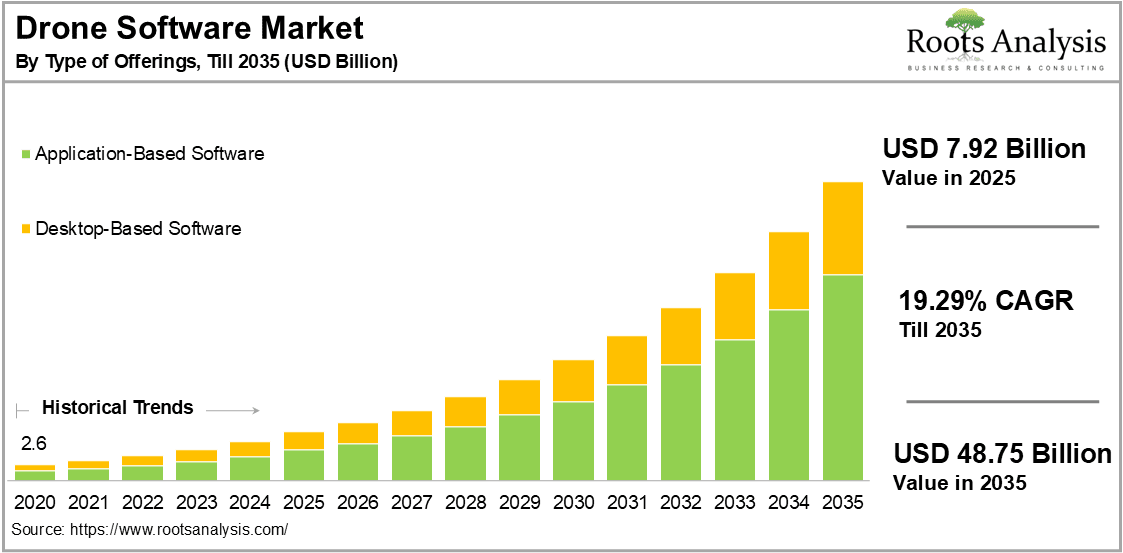
The global drone software market, valued at USD 7.92 billion in 2025 and expected to reach USD 48.75 billion by 2035, representing a CAGR of 19.92% during the forecast period.
 |
The new research study consists of global drone software analysis, detailed drone software market analysis, mega trends, patent analysis, porter five forces, SWOT analysis, value chain analysis and other strategic frameworks.
Drone software encompasses a variety of functionalities such as flight planning, real-time telemetry, waypoint navigation, and autopilot capabilities. It is essential for managing drone operations effectively. Data capture software enables operators to gather information from multiple sensors and cameras mounted on the drone. Subsequently, analysis software processes and interprets this data, providing valuable insights applicable to fields like agriculture, environmental monitoring, and infrastructure inspection.
Additionally, the software facilitates efficient mapping and surveying through advanced features that streamline data collection and enhance accuracy. By leveraging these technologies, organizations can make informed decisions more swiftly than traditional methods allow. Customized drone frames enabled by the 3D printed drones allow developers to fine-tune software for specific aerodynamic profiles.
The market for drone software is experiencing significant growth, primarily fueled by the increasing use of drones across various sectors. These areas include mapping, photography, agricultural monitoring, tracking, search and rescue operations, engineering applications, shipping, and delivery. The rising adoption of drones in these diverse industries is anticipated to further propel the demand for drone software in the coming years.
The drone software market report presents an in-depth analysis of the various companies that are involved in offering drone software solutions, across different segments, as defined in the table below:
| Key Report Attributes | Details | |
| Historical Trend | Since 2018 | |
| Forecast Period | Till 2035 | |
| Current Market Size | $ 7.92 Billion | |
| Market Size 2035 | $ 48.75 Billion | |
| CAGR (Till 2035) | 19.92% | |
| Type of Offering |
|
|
| Type of Architecture |
|
|
| Type of Deployment |
|
|
| Type of Software |
|
|
| Areas of Application |
|
|
| By End-Users |
|
|
| Type of Enterprise |
|
|
| Geographical Regions |
|
|
| Leading Market Players |
|
|
| PowerPoint Presentation (Complimentary) | Available | |
| Customization Scope | 15% Free Customization | |
| Excel Data Packs (Complimentary) |
|
|
The global drone software market is segmented into various types of offerings such as application-based software, and desktop-based software. According to our drone software industry analysis, the application-based software segment will augment the segment's growth with the largest market share of over 84.56% by the next decade. This prominence is largely due to ease-of-use application-based software offer to consumer-level consumers and professionals for managing drone operations including flight control and real-time video feeds. This segment is also particularly prominent due to its accessibility and functionality for various tasks.
On the other hand, it is worth highlighting that the desktop-based segment is expected to witness the fastest CAGR of around 20.7% during the forecast period. This rapid growth can be attributed to the high preference for desktop software for computers for data collection, processing, and analysis applications. The UAV software solutions are widely used for image mapping, information gathering and other objectives.
The market is segmented into various types of architecture such as closed source and open source. According to our drone software growth forecast, the open-source drone software market will augment the segment's growth with the largest market share of over 85.6% by the next decade. This dominance is driven by the wide acceptance of open-source software by the large consumer base. Several commercial users prefer the highly compatible system owing to it being user-friendly. Open-source architecture is easily available for users across the globe free of cost. These key benefits are projected to fuel growth.
Furthermore, the closed-source segment is expected to witness a growth of CAGR of 22.8% during the forecast period. This growth is fueled by the growing demand for secured and customized architecture in unmanned aerial vehicle software for commercial and military users is likely to fuel segment growth in the forthcoming years.
The market is segmented into various types of deployment, such as ground-based and onboard drones. According to our drone software market size forecast, the onboard drones segment will augment the market's growth with a market share of 85.8% during the forecast period. This dominance is largely due to its crucial role in autonomous drone navigation and control systems, and payload management, which are essential for efficient drone operations across various applications such as aerial photography, surveying and inspection.
Furthermore, the ground-based drone segment is expected to witness the fastest CAGR of around 22.6% during the forecasted period. This growth is driven by the increasing trend towards more sophisticated and autonomous drone technology that require advanced onboard computing capabilities to perform complex tasks without human intervention.
The market is segmented into various types of software, such as data analysis, flight management, imaging, mapping & surveying. According to our analysis, the data analysis segment will increase the market share of drone software by 54.6% during the forecasted period. This growth is driven by its critical role in processing and interpreting the vast amounts of data collected by drones. This software enables users to transform raw data from various sensors and cameras into actionable insights, which are essential for decision-making in applications such as agriculture, environmental monitoring, and infrastructure inspection.
Furthermore, the mapping and surveying segment is expected to witness the fastest CAGR of around 23.27% during the forecasted period. This growth is driven by the increasing use of drones for aerial mapping, surveying, and 3D modeling applications in industries such as construction, mining, and infrastructure. Mapping and surveying software allows users to build high-resolution maps, conduct site inspections, and track progress, making it an indispensable tool for drone operations in various industries.
The market is segmented into various drone software applications, such as filming and photography, inspection & maintenance, precision agriculture, surveillance & monitoring, search & rescue, and others. According to our drone software analysis, the filming & photography segment will augment the market's growth with a market share of 34.65% during the forecasted period. This dominance is largely due to the increasing numbers of events being held, such as weddings, sports and race events, and educational ceremonies which create a strong demand to capture high-quality photos and videos, further augmenting segment growth. Furthermore, drones also provide advantages to filming and photography with their small size, portability, maneuvering capabilities, and significantly low operational cost.
On the other hand, the precision agriculture segment is expected to witness the fastest CAGR of around 21.2% during the forecasted period. This growth is driven by the integration of advanced sensors and imaging technologies in drones, enabling the collection of diverse data about crops, soil conditions, and environmental factors.
Based on the type of end-users, the market is split into commercial, consumer, defense & government. Among these categories, the commercial drone software market is expected to dominate with a share of 65.8%. This growth is owed to the increasing enterprise application of drones across various industry verticals. Several drone manufacturers have been continually testing, inventing and upgrading software and services for diverse markets. Moreover, advancements in drone technology have reduced the cost of payloads and software systems resulting in the significant adoption of inspection, aerial photography, surveying, aerial mapping, and precision agriculture.
On the other hand, the consumer segment is expected to witness rapid growth at a significant CAGR of 22.23% during the forecast period. This growth can be attributed to the increasing exploration of drone benefits by the customers which enrich leisure activities and interests. Furthermore, technological innovations in consumer drones are also driving the segment growth.
The market is fragmented into multiple types of enterprises, namely large and small and medium enterprises. Currently, the large enterprise segment is expected to dominate the segment with 60.34% of the market share. However, small and medium enterprise segments are expected to witness a relatively higher (20.78%) growth rate until 2035. This is ascribable to their agility, innovation, focus on niche markets, and ability to adapt to changing customer preferences and market conditions.
This segment highlights the distribution of drone software market share by regions, such as North America, Europe, Asia, Latin America, Middle East and North Africa, and the rest of the world. According to our regional analysis, North America currently exhibits dominance with 37.69% of overall market share. The market is driven by the strong presence of major market players, along with strong drone-based infrastructure. Moreover, the growing trend of using drones as a hobby in the region is also expected to drive the market growth for drone software.
The “Drone Software Market, Till-2035: Industry Trends and Global Forecasts” report features an extensive study of the current market landscape, market size and future opportunity within the drone software market forecast period. The market report highlights the efforts of several stakeholders involved in this rapidly emerging segment of the service providers industry. Key takeaways of the global drone software market report are briefly discussed below.
The global drone software market growth is expected to be driven by several key factors. Firstly, the increasing adoption of drones for commercial purposes is actively fueling the demand for modern technology in aerial vehicles. Drones are fully capable of flying at diverse geographical locations regardless of range and altitude. These benefits are propelling the demand for unmanned aerial vehicles in several countries. Commercial applications such as precision agriculture, construction & infrastructure, transportation and insurance are majorly driving the drone software market growth.
Additionally, technological advancements and prominent developments in photogrammetric software technology are also fueling market growth. UAVs have emerged as a prominent weapon and medium for critical missions. Military drone technology is also emerging as an advanced real-time data provider in various locations. Several studies on drone software and innovation in aerial imaging are offering lucrative three-dimensional geospatial images in real time further propelling the market growth.
According to the drone software competitive landscape analysis, with the presence of several small and large companies, the market is experiencing intense competition and changing market dynamics. From large multinational companies to local players, companies are striving to enhance their competitive edge. In terms of market share, large enterprises and multinational companies are dominating the market. The key players are using strategies such as partnerships, acquisitions, ventures, innovations, novel product launches, R&D and geographical expansions to solidify their position in the industry.
For instance, in October 2024, Matternet entered the home delivery market to launch the first-ever drone delivery operation in Silicon Valley. In reference to this, Andreas Raptopoulos, founder and CEO of Matternet, stated that after years of advancing drone delivery in healthcare, we’re excited to launch our first ever home delivery operation in the heart of Silicon Valley. Raptopoulos adds that its so fast, it feels like magic and every delivery means one less trip by car- less congestion in our cities, and fewer emissions in the air we breathe.
Despite the strong market growth projection, there are several challenges in the drone software market. One of the primary challenges is the Regulatory hurdles are among the most pressing issues, as stringent government regulations often limit drone operations, particularly for larger drones and those flying beyond visual line-of-sight. This fragmented regulatory landscape complicates cross-border operations and creates uncertainty for businesses looking to invest in drone technology.
Safety and security concerns also pose substantial obstacles. The potential for hijacking and misuse of drones raises alarms about public safety, especially in sensitive areas such as airports and government buildings. The lack of effective identification systems for drones further exacerbates these risks, making it difficult to track and manage drone traffic effectively.
With respect to regional industry insights, North America is likely to dominate the market for the forecasted period. The dominance of this region is majorly influenced by the rising use of drones for commercial and defense purposes. Due to the exhaustive nature of operating a fleet of drones, carrying out automatic BVLOS flights, or keeping the necessary flight data log for compliance purposes without the proper software, drone software suppliers have recently concentrated on developing software that is efficient and affordable.
Examples of leading drone software manufacturers (which have also been captured in this market report, arranged in alphabetical order) include AeroVironment, AgEagle Aerial, AirMap, Airware, Altitude Angel, ALOFT Technologies, BRINC, Cleo Robotics, Corvus Robotics, Cyberhawk, Delair, DJI, DreamHammer, Drone Volt, DroneDeploy, Emesent, Environmental Systems Research Institute, Easy Aerial, EHang Holdings, Kratos Defense & Security Solutions, Kespry, MAVinci, Measure, Orqa, Parrot, Paras Defence and Space Technologies, PDW, Pix4D, PrecisionHawk, Propeller Aerobatics, RattanIndia, Schiebel, Sensefly, Skydio, Skycatch, Skyfish, Skyward, SNC Technologies, Unifly, Wingtra, Yuneec International.
The market report presents an in-depth analysis, highlighting the capabilities of various companies engaged in this domain, across different segments. Amongst other elements, the market report includes:
At Roots Analysis, we genuinely care about your success and understand that your business requirements are unique. While our drone software market research reports provide valuable insights, we recognize that they might not cover every aspect you need to make well-informed strategic decisions. To account for that, we offer 15% free report customization tailored to your specific needs. Whether you require additional quantitative analysis, qualitative insights, or any other information related to the drone software market, reach out us today at: support@rootsanalysis.com.