


 Download Free Sample
 Buy Now
Electric Vehicle Traction Motor Market Overview
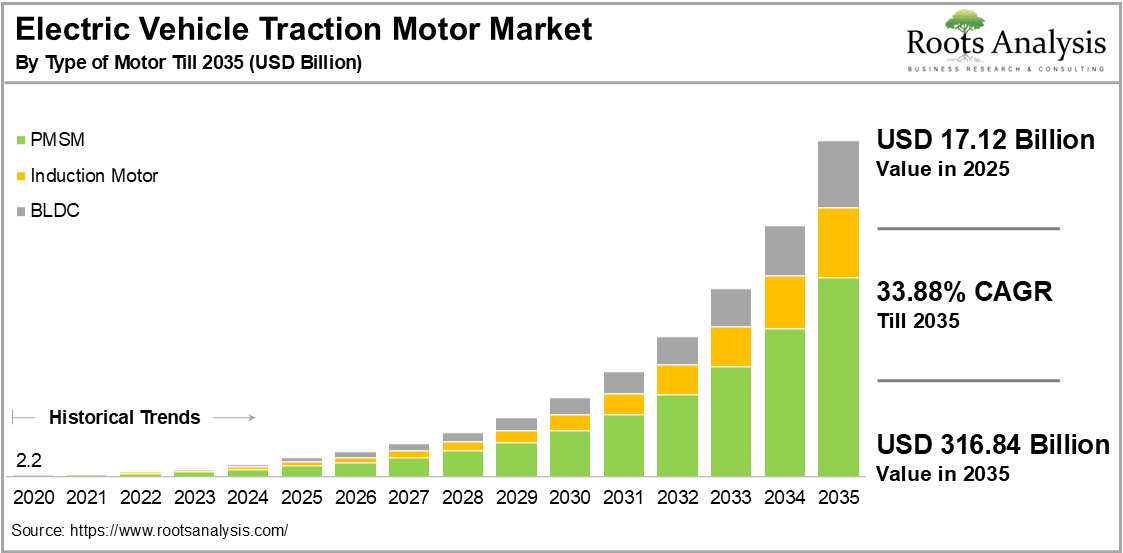
The global electric vehicle traction motor market, valued at USD 11.3 billion in 2024, is projected to reach USD 17.12 billion in 2025 and USD 316.84 billion by 2035, representing a CAGR of 33.88% during the forecast period.
 |
See What’s in the Full Report – Request Your Complimentary Insights!
The new research study consists of mega trends, patent analysis, porter five forces, SWOT analysis, value chain analysis and other strategic frameworks.
An electric vehicle traction motor refers to the motor that turns the wheel of a vehicle. Some vehicles use motor-generators for both driving and regeneration. It is used for converting electrical energy to mechanical energy in a method that propels the vehicle beyond aerodynamic drag. It delivers torque to wheels or axles, enabling movement, and is designed for high efficiency and power density, making it a crucial component in modern vehicle powertrains.
The rising demand for high-efficiency traction motors in the automotive industry is directly proportional to sales of electric vehicles. Traction motors enable EVs to optimize their acceleration performance, as the ability to instantly access maximum torque from a standstill allows smooth and rapid vehicle acceleration. These solutions tend to be more compact and lightweight when compared to internal combustion engines.
In recent years, the growing need to cater to diverse consumer requirements has encouraged EV manufacturers to invest in research & development initiatives to introduce more effective solutions. This, in return, results in increased electric vehicle manufacturing trends which is further fueling the EV traction motor market.
Electric Vehicle Motor Market Segmentation Insights
The EV traction motor market report presents an in-depth analysis of the various companies that are involved in offering electric mobility solutions across different segments, as defined in the table below:
Electric Vehicle Traction Motor Market: Report Attributes / Market Segmentations
| Key Report Attributes | Details | |
| Historical Trend | Since 2020 | |
| Forecast Period | Till 2035 | |
| Market Size 2025 | $ 17.12 Billion | |
| Market Size 2035 | $ 316.84 Billion | |
| CAGR till 2035 | 33.88% | |
| Type of Vehicle |
|
|
| Type of Motor |
|
|
| Type of Power Output |
|
|
| Type of Enterprise |
|
|
| Geographical Regions |
|
|
| Leading Market Players |
|
|
| PowerPoint Presentation (Complimentary) |
Available | |
| Customization Scope | 15% Free Customization | |
| Excel Data Packs (Complimentary) |
|
|
Have Questions? Let’s Get Them Answered.
Electric Vehicle Traction Motor Market Share Insights
Which Type of Vehicle Will Dominate the Electric Vehicle Traction Motor Market?
When it comes to the global EV traction motor market, the battery-electric vehicle (BEV) segment is set to take the lead, holding a significant market share of over 74.56% for the next decade. The BEV electric vehicle traction motor is growing largely as a result of the global push for clean energy, the rapid growth of the broader EV market, and advancements in electric motor technology. Increasing sales of BEVs have further encouraged companies to develop traction motors on a large scale, aiding market expansion.
What Type of Motor is Driving the Electric Vehicle Traction Motor Market?
As per our EV traction motor market analysis, the permanent magnet synchronous motor (PMSM) segment is expected to for the largest share of around 67.98% during the forecast period. Here’s why: electric vehicles manufacturers are increasingly adopting PMSM motors due to their benefits, such as high overload capability, efficiency, and compact size.
Furthermore, these motors offer high torque even at low speeds, along with minimal electrical losses, efficient heat dissipation, and low maintenance costs while also ensuring high durability and reliability. These properties are largely contributing to the permanent magnet traction motors market growth.
Which EVTM Power Output is Most Popular?
The market is segmented into various power outputs, such as 100 kW to 250 kW, less than 100 kW, and more than 250 kW. According to our analysis, the less than 100 kW segment is clearly the most popular choice. It’s expected to boost the market share of electric vehicle traction motor to an impressive 64.6% during the forecast period. This growth can be attributed to the rising adoption of electric scooters and mopeds, as well as favorable government policies on electric vehicles, incentives, and subsidies introduced to promote EV adoption.
Why is Asia Leading the Electric Vehicle Traction Motor Market?
According to our EV traction motor industry analysis, the Asian EVTM market currently exhibits dominance with 34.19% of overall market share. This is mainly because of the increasing adoption of electric vehicles as their components market is facing cost reduction, the rising environmental concerns, and rapid technological advancements in developing countries.
Consequently, the impact of government regulations on the electric vehicle traction motor market growth is also increasing the growth of the region. For instance, countries like China, Japan, and South Korea are providing subsidies and tax incentives along with implementing regulations to support the development and adoption of EVs and reduce greenhouse gas emissions and air pollution.
Want Information on Specific Region / Segment?
Electric Vehicle Traction Motor Market Key Insights
The “Electric Vehicle Traction Motor Market, Till 2035: Industry Trends and Global Forecasts” report features an extensive study on how to evaluate the growth of the electric vehicle traction motor market size and future opportunity within forecast period. The market report highlights the efforts of several stakeholders involved in this rapidly emerging segment of the automotive industry. Key takeaways of the market report are briefly discussed below.
What are the Key Drivers for EV Traction Motor Adoption in the Automotive Industry?
The global EV traction motor market is primarily driven by several factors. First, stricter environmental laws are pushing car manufacturers to move away from traditional gas engines and make more electric vehicles. Governments are also offering incentives, like tax breaks and subsidies, to encourage people to buy EVs.
Advances in battery technology have made electric cars more practical by improving how long they can run on a single charge and how quickly they can be charged. This increases the need for efficient traction motors, especially permanent magnet motors. Benefits of using permanent magnet motors in EV applications include their small size, high efficiency, and strong acceleration. Additionally, more investments in electric vehicle charging stations and manufacturing facilities are making it easier for people to own EVs by reducing concerns about running out of battery power. Overall, these factors are driving the growth of the EV traction motor market, with different types of motors offering specific advantages for electric vehicles.
What Strategies are Companies Using to Gain Electric Vehicle Traction Motor Market Share?
Companies in the EV traction motor market are using smart strategies to stay ahead. Big players are focusing on partnerships, acquisitions, joint ventures, and innovations to strengthen their position while also investing in R&D to bring innovative and novel products to the market. Launching new technologies, motors, such as stepper motor and expanding into regions with innovations in EV technology are the key moves helping them capture more market share.
What Are the Challenges Faced by EV Traction Motor Manufacturers?
One major issue is the lack of charging infrastructure, which limits the convenience of owning an electric vehicle and can discourage potential buyers. Without enough charging stations, people worry about running out of battery power, making them hesitant to switch from traditional gas-powered cars. Additionally, high production costs for traction motors can be a barrier for manufacturers, affecting their ability to scale up production and reduce prices.
Another challenge is overheating of the motors, which can lead to performance issues and even failures if not managed properly. Finally, there are ongoing concerns about the supply chain, particularly regarding the availability of raw materials needed for motor production, which can disrupt manufacturing processes and increase costs. Addressing these challenges is crucial for the continued growth and acceptance of electric vehicles in the market.
Unlock Deeper Insights – Schedule Your Personalized Workshop Today!
Who Are the EV Traction Motor Manufacturers?
Examples of leading electric vehicle traction motor manufacturers (which have also been captured in this market report, arranged in alphabetical order) include ABB, AB SKF, BorgWarner, Bharat Heavy Electricals, Continental, DENSO, Emerson Electric, General Electric, GKN Automotive, Hitachi, Hyundai Mobis, Jing-Jin Electric Technologies, Mahindra Electric Mobility, Magnetic Systems Technology, Mitsubishi Electric, Nidec, Parker-Hannifin, Regal Beloit, Robert Bosch, Siemens, TM4, Turntide, Valeo, WEG, YASA, ZF Friedrichshafen, Zytek.
Recent Developments in Electric Vehicle Traction Motor Market
- In December 2024, Toyota introduced its new electric vehicle, Toyota Urban Cruiser EV, which is all set to launch by mid-2025.
- In December 2024, JSW MG Motor announced the launch of its electric sports car ‘Cyberster’ in India.
- In October 2024, Nidec Motor Corporation and Ashok Leyland, announced a partnership agreement to accelerate the electrification of commercial vehicles in India which involves providing Nidec’s electric motor-controller system, E-Drive, to Ashok Leyland. This would further allow the companies to develop cutting-edge E-Drives for commercial vehicle programs launched by Ashok Leyland and its subsidiaries.
Glossary
- Aerodynamic Drag: The resistance faced by a vehicle as it moves through the air, which can significantly affect its efficiency and range.
- Battery Electric Vehicle (BEV): A vehicle that operates solely on electric power stored in batteries, without any internal combustion engine.
- Brushless DC Motor (BLDC): An electric motor that uses direct current electricity and does not have brushes, resulting in higher efficiency and lower maintenance compared to traditional motors.
- Fuel Cell Electric Vehicle (FCEV): An electric vehicle that generates electricity through a hydrogen fuel cell, which powers the electric motor.
- Hybrid Electric Vehicle (HEV): A vehicle that uses both an internal combustion engine and an electric motor. The battery is charged through regenerative braking and by the engine itself, and it cannot be plugged in for external charging.
- Induction Motor: A type of electric motor commonly used in electric vehicles, which operates using electromagnetic induction to produce torque.
- Permanent Magnet Synchronous Motor (PMSM): A type of synchronous motor that uses permanent magnets to create a magnetic field, often found in high-performance electric vehicles due to its efficiency and power density.
- Plug-in Hybrid Electric Vehicle (PHEV): A hybrid vehicle that combines a traditional internal combustion engine with an electric motor and battery, allowing for both electric-only driving and extended range using the combustion engine.
- Torque: The rotational force produced by the electric motor, which is crucial for vehicle acceleration and performance.
Electric Vehicle Traction Motor Market Report Coverage
The market report presents an in-depth analysis, highlighting the capabilities of various companies engaged in this domain, across different segments. Amongst other elements, the market report includes:
- A preface providing an introduction to the full report, electric vehicle traction motor market, 2020-2024 (Historical Trends) and 2025-2035 (Forecasted Estimates).
- An outline of the systematic research methodology adopted to conduct the study on the EV traction motor market, providing insights on the various assumptions, methodologies, and quality control measures employed to ensure the accuracy and reliability of our findings.
- An overview of economic factors that impact the overall electric vehicle traction motor industry, including historical trends, currency fluctuation, foreign exchange impact, recession, and inflation measurement.
- An executive summary of the insights captured during our research. It offers a high-level view of the current state of the EV traction motor market and its likely evolution in the mid-long term.
- A detailed assessment of the EV traction motor manufacturers landscape, based on several relevant parameters, including year of experience, company size, location of headquarters, and ownership structure.
- Elaborate profiles of prominent players engaged in the EV traction motor market, featuring information on their year of establishment, location of headquarters, company size, company mission, company footprint, management team, contact details, financial information, operating business segments, electric vehicle traction motor market portfolio, moat analysis, recent developments, and an informed future of electric vehicle traction motors.
- A qualitative assessment of the various megatrends ongoing in the electric vehicle traction motor industry, including increasing demand for electric vehicles, technological advancements and investment in charging infrastructure.
- An analysis highlighting the key unmet needs across electric vehicle traction motor market industry, featuring market research on electric vehicle traction motors industry insights generated from real-time data on unmet needs as identified from social media posts, recent publications, industry blogs and the views of key opinion leaders expressed on online platforms.
- An in-depth analysis of various patents that have been filed / granted related to electric vehicle traction motor and its components, based on various parameters, such as type of patent, patent publication year, patent age and leading players
- A detailed analysis of recent developments in the electric vehicle traction motor market, based on relevant parameters such as year of initiative, type of initiative (partnerships and collaborations, expansions, funding and product launches), geographical distribution and most active players (in terms of number of recent developments).
- Key winning strategies framework that helps in analyzing the level of competition within an industry, by tracing the key market activities including partnership, funding, expansion of leading players
- A qualitative analysis, highlighting the five competitive forces prevalent in EV traction motor market, including threats for new entrants, bargaining power of suppliers, bargaining power of customers, threats of substitution and rivalry among existing competitors.
- A discussion on affiliated global electric vehicle motor technology trends, key drivers and challenges, under a SWOT framework, which are likely to impact the industry’s evolution, along with a Harvey ball analysis, highlighting the relative effect of each SWOT parameter on the overall electric vehicle traction motor market.
- A value chain analysis featuring a discussion on various stakeholders involved in the development of the electric vehicle traction motors, from suppliers to end-users.
- A detailed estimate of the current market size and the potential future trends in high-efficiency motors for electric vehicles over the next decade. Based on multiple parameters we have provided an informed estimate on the market evolution during the forecast period 2025-2035. The report also features the likely distribution of the current and forecasted opportunity within the EV traction motor market. Further, in order to account for future uncertainties and to add robustness to our model, we have provided three forecast scenarios, namely conservative, base, and optimistic scenarios, representing different tracks of the industry’s growth.
- Detailed projections of the current and future market across various types of vehicle such as BEV, fuel cell electric vehicles, hybrid vehicles, and PHEV.
- Detailed projections of the current and future market across various types of motor such as BLDC, induction motor, and PMSM.
- Detailed projections of the current and future market across various types of power output, such as 100 kW to 250 kW, less than 100 kW, and more than 250 kW.
- Detailed projections of the current and future market across various types of enterprises such as large enterprises and small and medium enterprises.
- Detailed projections of the current and future electric vehicle traction motor market across various geographical regions, such as North America (US, Canada, Mexico and other North American countries), Europe (Austria, Belgium, Denmark, France, Germany, Ireland, Italy, Netherlands, Norway, Russia, Spain, Sweden, Switzerland, UK and other European countries), Asia (China, India, Japan, Singapore, South Korea and other Asian countries), Middle East and North Africa (Egypt, Iran, Iraq, Israel, Kuwait, Saudi Arabia, UAE and other MENA countries), Latin America (Brazil, Chile, Colombia, Venezuela and other Latin American countries) and rest of the world (Australia, New Zealand and other countries).
Pay Only for What You Need – The Best Way to Optimize
About Authors
Lead Author: Anmol Bali
Lead Reviewer: Prachi Bhalla
Chief Editor: Ronit Sharma
Customization Opportunities
At Roots Analysis, we genuinely care about your success and understand that your business requirements are unique. While our market research reports provide valuable insights, we recognize that they might not cover every aspect you need to make well-informed strategic decisions. To account for that, we offer 10% free customization tailored to your specific needs. Whether you require additional quantitative analysis, qualitative insights, or any other information related to the EV traction motor market, reach out us today at: support@rootsanalysis.com


