


 Download Free Sample
 Buy Now
Market Size
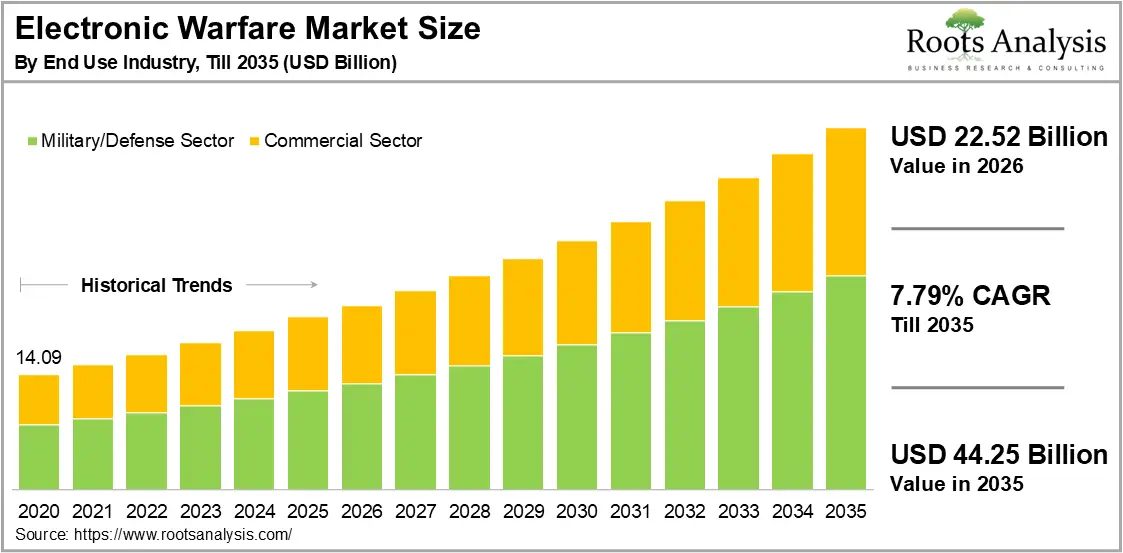
The global electronic warfare market, valued at USD 22.52 billion in 2026, is projected to reach USD 32.78 billion in 2030 and USD 44.25 billion by 2035, representing a CAGR of 7.79% during the forecast period.
See What’s in the Full Report - Request Your Complimentary Insights!
Market Overview
Electronic warfare refers to the use of electromagnetic spectrum, such as radio frequency and signals to jam, intercept or decipher signals. It is highly used in providing situational awareness to a country and its allies and helps them in taking defensive measures, get diplomatic insights, and prepare for offensive situations at every level prior to a conflict.
Geopolitical tensions, defense spending and modern warfare’s evolution are driving the demand for sophisticated electronic warfare systems with advanced capabilities, contributing to market growth during the forecast period. Further, the development of multilayered defensive systems with the help of technological advancements as well as the increased integration of electronics in military hardware are a few factors expected to strengthen market growth.
Recent Industry Developments
- In April 2025, Kyiv and Western partners launched an electronic warfare coalition in support of Ukraine during a meeting of the Ukraine Defense Contact Group in Brussels.
- In March 2025, RTX’s Raytheon launched a new Coyote variant, Coyote LE SR, which can successfully perform reconnaissance, surveillance and target acquisition; electronic warfare; precision strike; and communications.
- In February 2025, ADSB partnered with Hensoldt to develop radar and electronic warfare systems for naval fleet modernization.
- In January 2025, Saab announced to open a new range of Sirius Compact Electronic Warfare sensors facility in Tampere, Finland.
Pay Only for What You Need – The Best Way to Optimize
Market Share Insights
Which Type of Platform Will Dominate the Electronic Warfare Market?
When it comes to the global electronic warfare market, the airborne electronic warfare segment is set to take the lead, holding a significant market share of over 54.56% for the next decade. The airborne market growth is largely a result of unmatched versatility and mobility aircraft-based electronic warfare platforms offer.
These offerings are essential for countering evolving threats. EW provides vital functions like electronic countermeasure systems, radar jamming systems, and signal intelligence gathering. The constant modernization of air forces and prioritization of airborne defense capabilities by nations are significant factors of the rising demands of airborne electronic warfare.
However, it is worth highlighting that the space electronic warfare segment is likely to witness the fastest CAGR of around 7% during the forecasted period due to the rising investments in satellite-based spectrum monitoring.
Which Type of Capability Will Witness the Fastest Growth Rate?
When it comes to the types of capabilities, the electronic protection segment is likely to grow at a faster pace, with a projected CAGR of 7.2% during the forecast period. Electronic protection, as the name suggests, protects the nation’s assets, personnel and equipment from electronic attacks by enemy forces. As tensions between countries are on the rise and cyber-attacks are getting more advanced, the need for electronic protection segment is anticipated to witness a substantial growth.
On the other hand, it is worth highlighting that the electronic attack segment is expected to dominate with a market share of 65% during the forecasted period.
Which Type of Technology is Most Popular?
When it comes to types of technology for the electronic warfare market, the IR missile warning system segment is anticipated to dominate with a market share of 34.6% while also being the fastest growing segment (7.2%).
What makes this electronic warfare equipment the most popular is the widespread and evolving threat posed by infrared-guided missiles, particularly MANPADS and advanced air-to-air and surface-to-air missiles. These systems quickly detect incoming missiles and trigger defenses like flares or laser countermeasures. Since these missiles are common, cheap, and hard to dodge, the warning systems are critical for survival- especially for military planes and helicopters.
On the other hand, the directed energy weapon segment is expected to grow at the fastest CAGR of 7.4% during the forecasted period.
How are the Countermeasure Systems Dominating the Electronic Warfare Market?
According to our global electronic warfare market forecast, the countermeasure systems segment holds the leading place with a market share of 78.62%. These systems are highly vital for neutralizing hostile threats through electronic jamming and deception. Their supremacy results from the growing necessity of a defense against UAVs and sophisticated missile systems, which makes them indispensable to modern warfare and strategic superiority.
However, it’s worth highlighting that the directed energy weapon will be witnessing the fastest CAGR of 7.3% during the forecasted period.
Which End-User Industry is a Significant Segment in the Electronic Warfare Industry?
The market is segmented into various end-user industries. According to our analysis, the military/defense sector segment is likely to hold a significant market share of 84.6% as well as the fastest CAGR (7%) during the forecast period.
The military sector has a vital role in modern defense strategies. As the threats from electronic surveillance and cyberattacks keep on rising, militaries worldwide are heavily investing in advanced electronic warfare systems. These systems are capable of protecting the database with the help of military cybersecurity solutions including radar jamming, electronic countermeasures, and signal intelligence.
Why is North America Leading the Electronic Warfare Market?
According to our regional analysis, the North American electronic warfare market currently exhibits dominance with 37.69% of overall market share. This regional electronic warfare market growth is mainly because of the increasing factors such as territorial disputes, rising insurgencies, terrorism, unrest between neighboring countries, and political acrimonies.
In addition to this, the increasing military modernization initiatives, evolving cyber-electronic warfare integration, and demands for sophisticated signal intelligence systems are also fueling the regional market growth.
Want Information on Specific Region / Segment?
Key Market Insights
Market Drivers
- Evolving Threat Landscape: With technological advancement comes advanced threats. Drones, smart bombs, and enemy tech including advanced radar evasion technologies are all posing an increasing threat to the militaries. Electronic warfare systems are built to block or trick these threats.
- Cyber-Electronic Integration: Modern warfare is increasingly combining cyber and electromagnetic domains together. Fighting these require systems that can simultaneously counter hacking attempts and physical radio jamming and EW systems can do both.
- Geopolitical Instability: The rise of global tensions and asymmetric conflicts are pushing nations to invest more in electronic attack solutions and protection systems.
Market Challenges
- Cybersecurity threats to electronic warfare infrastructure: Most electronic warfare infrastructure is vulnerable to various cybersecurity threats, such as hacking, data breaches, and malware attacks.
- Rapid technological obsolescence: Constant need to upgrade systems to counter advanced threats like hypersonic missiles and AI-driven warfare.
- High R&D costs: Developing cutting-edge EW solutions requires massive investments in AI, quantum computing, and directed energy weapons.
What are the Key Strategies Used by Companies to Gain Electronic Warfare Market Share?
Companies in the electronic warfare market are using smart strategies to stay ahead. Big players are focusing on partnerships, acquisitions, joint ventures, and innovations to strengthen their position while also investing in R&D to bring innovative and novel products to the market.
Launching new technologies and expanding into regions with innovations like cognitive electronic warfare, as well as regions where technological advancements, and defense modernization programs are growing, are the key moves helping them capture more market share.
For instance, in February 2025, Saab signed a MoU with HAL to collaborate on the Electronic Warfare and land Laser Warning System-310 (LWS-310). In reference to this Mats Palmberg, Chairman & Managing Director at Saab India stated that this MoU reflects Saab’s commitment to localization and indigenization in India by identifying and collaborating with an Indian company. This ensures the longevity of the Security of Supply in supporting the Indian Armed Forces.
What are the future trends in AI integration for electronic warfare systems?
- Cognitive Electronic Warfare: AI systems autonomously analyze enemy signals, learn from them in real time, and deploy countermeasures without pre-programmed rules, enabling rapid adaptation to new threats like advanced radars or drones.
- AI-Driven Swarm Tactics: Networks of drones or jammers will use AI to coordinate attacks, overwhelm defenses, and perform distributed electronic attacks, such as synchronized jamming or decoy deployment across large areas.
- Autonomous Decision-Making: EW platforms will leverage AI to make split-second choices-like adjusting jamming frequencies or activating countermeasures-without human input, critical for countering hypersonic missiles or stealth aircraft detection.
Have Questions? Let’s Get Them Answered.
Electronic Warfare Market: Scope of the Report
| Key Report Attributes | Details | |
| Historical Trend | Since 2020 | |
| Forecast Period | Till 2035 | |
| Market Size 2026 | $ 22.52 Billion | |
| Market Size 2035 | $ 44.25 Billion | |
| CAGR till 2035 | 7.79% | |
| Type of Platform |
|
|
| Type of Capability |
|
|
| Type of Technology |
|
|
| Type of Product |
|
|
| Type of Frequency |
|
|
| End Use Industry |
|
|
| Type of Enterprise |
|
|
| Geographical Regions |
|
|
| Key Players Profiled |
|
|
| PowerPoint Presentation (Complimentary) | Available | |
| Customization Scope | 15% Free Customization | |
| Excel Data Packs (Complimentary) |
|
|


