
Lowest Price Guaranteed
Slides
202
Last Updated
July 2025
View Count
11081
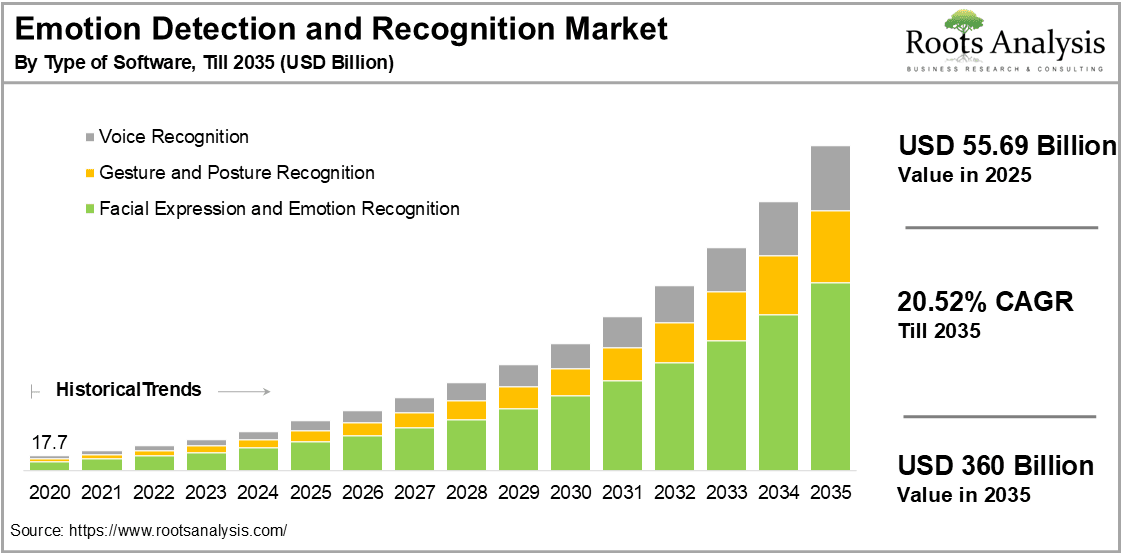
The global emotion detection and recognition market size is projected to grow from USD 55.69 billion in 2025 to USD 360 billion by 2035, representing a CAGR of 20.52%, during the forecast period till 2035.
 |
The new research study consists of emotion detection and recognition analysis, detailed market forecast analysis, and providing actionable strategic recommendations.
Knowing an individual’s sentiment seems to be science-fiction, but as technology advances it has become reality. Physical devices integrated with machine learning to analyze facial expression, vocal tone and gestures have originated emotion detection and recognition. These services promise reliable and accurate analysis of feelings. In addition. EDR is fast and provides real-time feedback making it a favorable choice in law enforcement and healthcare.
Emotion detection and recognition have non-verbal and non-intrusive approach that acquire rapid results by analyzing gestures and postures. In addition, advances in facial recognition technology such as frictionless authentication on airports have aided the expansion. Notably, the development of wearable devices for emotional monitoring such as eyewear and wristbands for real-time analysis and emergency reporting have contributed to the growth of the market. It is worth highlighting that integration of machine learning in emotion recognition will drive the market growth in the future as it can identify emotions swiftly and accurately. Further, small screen working and in-device working will be playing a pivotal role in emotional AI applications.
The global emotion detection and recognition market size is expected to grow significantly over the forecast period due to the rapid research and advancements in emotion recognition software solutions. Futuristic functions, such as behavioral biometrics and textual sentiments have accelerated market trends in emotion analytics. Notably, the healthcare department is benefiting by emotional response measurement tools for tracking patient’s recovery rates and emotional stability. Further, integration of emotion detection in customer service for detailed user preferences has made it ideal for usage in IT and telecom and BFSI.
Recently, Sean Betts, Chief Product and Technology Officer at Omnicom Media mentioned this is the first technology humanity has ever developed that not only understands emotions but can also respond with emotion.
The global emotion detection and recognition market research report presents an in-depth analysis of the various companies that are involved in offering emotion detection and recognition, across different segments, as defined in the table below:
| Key Report Attributes | Details | |
| Historical Trend | Since 2020 | |
| Forecast Period | Till 2035 | |
| Market Size Value by 2025 | $ 55.69 Billion | |
| Market Size Value by 2035 | $ 360 Billion | |
| CAGR (Till 2035) | 20.52% | |
| Type of Software |
|
|
| Type of Technology |
|
|
| Areas of Application |
|
|
| by End-User |
|
|
| Geographical Regions |
|
|
| Leading Market Players | ||
| PowerPoint Presentation (Complimentary) |
Available | |
| Customization Scope | 15% Free Customization | |
| Excel Data Packs (Complimentary) |
|
|
Based on the type of software, the global emotion detection and recognition market is split into facial expression and emotion recognition, gesture and posture recognition and voice recognition. Currently, according to our analysis, the facial expression and emotion recognition segment is augmenting the segment's growth with over 60% of the market share. This is attributed to their enhanced working and easy availability due to rapid market research on emotion recognition and advancements in prominent organizations.
However, gesture and posture are expected to grow with a relatively high CAGR of 23.65%. This can be due to their non-verbal and non-intrusive approach that allows it to easily analyze individual by body language. Further, AI in emotion detection for analyzing hand and eye-movement will play a pivotal role in the growth of emotion recognition technology market.
Based on the type of technology, the emotion detection and recognition market are split into bio sensors technology, feature extraction, machine learning, natural language processing, pattern recognition network and others. Currently, according to our emotion detection and recognition industry insights, the bio sensors technology segment is augmenting the segment's growth with over 35% of the market share. This can be attributed to the high usage of electrocardiogram (ECG) techniques in law, military, healthcare and entertainment. Small patches sticked to skin that measure heartbeat rates are one of the most reliable emotional data analytic tools. Further, biosensors are favored due to their high accuracy and cost-effectiveness.
However, machine learning is expected to grow with a relatively high CAGR of 21.74%. This can be ascribed to their fast and accurate detection and analysis of facial expression that forwardly boosts real-time emotion detection systems market growth. In addition, AI-driven emotion detection tools such as facial expression, vocal tones and textual sentiments analysis widened the applications in healthcare, VR experiences and Judiciary forwardly expanding global emotion detection market size.
Based on the areas of application, the global emotion detection and recognition market is split into entertainment and consumer electronics, law enforcement surveillance and monitoring, marketing and advertising and others. Currently, according to our analysis, the law enforcement surveillance and monitoring segment is augmenting the segment's growth with over 50% of the market share. This is attributed to their analysis of truthfulness and emotional stability during interrogation. In addition, these sentiment analysis technologies are used for detecting threats in crowd and public places to minimize crimes.
However, marketing and advertising is expected to grow with a relatively high CAGR of 20.95%. This can be ascribed to enhanced consumer insights and a personalized marketing approach that forwardly allows organizations to generate more relevant and effective ads. Further, real-time feedback achieved by facial or vocal analysis has played a major role in accelerating the use of emotion recognition in marketing.
On the basis of end-user, the emotion detection and recognition market are bifurcated into automotive, BFSI, education, healthcare and life sciences, IT and telecommunication, justice and law, media and entertainment and retail and e-commerce. The justice and law segment are expected to dominate the segment with more than 40% of market share in 2025. This can be attributed to their long ongoing usage in analyzing suspect and witness truthfulness and stability in sentiments. Additionally, behavioral recognition systems and ECG usage have aided in the expansion of domain.
On the other hand, the healthcare and life sciences segment is expected to witness a relatively faster (20.84%) emotion detection and recognition market growth rate by 2035. This can be attributed to rising customized plans that focus on physical, mental and emotional recovery. In addition, recording patient’s sentiments over a certain period for enhanced recovery rates and dynamic plans will leave an impact of emotion recognition in healthcare.
This segment highlights the distribution of the emotion detection and recognition market across various geographical regions such as North America, Europe, Asia, Latin America, Middle East, North Africa, and the rest of the world. According to our emotion detection and recognition market analysis, North America exhibits dominance in the market with over 40% of the market share in the global marketplace. This can be attributed to the presence of prominent players such as Google, Apple and IBM that drive the market through emotion detection and recognition market research and innovations.
However, Asia is projected to grow with a relatively higher CAGR of 21.63% in the forecasted period. Primary reasons for this growth include high government initiatives and rapid advancements in real-time sentiment analysis solutions.
The “Emotion Detection and Recognition Market, Till-2035: Industry Trends and Global Forecasts” report features an extensive study of the current market landscape, market size and future opportunity within emotion detection and recognition market, during the given forecast period. The market report highlights the efforts of several stakeholders involved in this rapidly emerging segment of the service providers industry. Key takeaways of the emotion detection and recognition market report are briefly discussed below.
An increasing demand for smart wearables for emotion detection is majorly driving the market such as eyewear that provides real-time emotion analysis. In addition, emotion detection and recognition have high accuracy and reliability, making them ideal for marketing, law and healthcare. Rising adoption of EDR in automotive for driver’s awareness has aided the expansion of the market. Notably, integration of AI in EDR for enhanced services will play a pivotal role in the expansion of the market.
With the presence of several small and large emotion detection service providers, the market is experiencing intense competition and changing market dynamics. From large multinational companies to local emotion detection and recognition players, companies are striving to enhance their competitive edge. In terms of market share, large enterprises and multinational providers are dominating the market share of emotion detection and recognition manufacturers. While small emotion detection and recognition players are continuously improving their products to cater to niche markets, or they are offering specialized services for enhanced emotion detection and recognition sales growth. These industry players are focusing on adopting competitive strategies, such as developing innovative solution techniques, forming strategic alliances and partnerships to expand their portfolios and global footprint, investing in recent developments and new feature launches to enhance their emotion detection and recognition offerings.
Despite strong market growth projection, the emotion detection and recognition market face numerous challenges. The most common challenge is the extremely high cost of manufacturing. Further, some cases of defective working hamper market growth. In addition, rising abandonment of EDR systems by firms has added more complexities.
North America currently holds a substantial share of approximately 40% in emotion detection and recognition market opportunities. This dominance can be attributed to several factors, including high internet penetration and rapid adoption of technological advancements. It is worth highlighting that the presence of prominent players such as Apple, Google and IBM have strengthened the market through innovation and development. Further, rising adoption of EDR in automotive for driving safety has framed the growth as they are used for detecting driver’s consciousness and awareness. In addition, the development of wearable EDR devices for real-time detection is majorly driving the market in the region. Consequently, the use of emotion detection and recognition for entertainment and healthcare will strengthen the future of emotion detection and recognition market.
Examples of key player involved in the emotion detection and recognition market (which have also been captured in this market report, arranged in alphabetical order) include Affectiva, Amazon, Apple, Ayonix, Beyond Verbal, Cognitec, Emotibot, Google, IBM, Imotions, Kairos, Noldus, NVISO, Realeyes and Sightcorp. This market report includes an easily searchable excel database of all the companies who have adopted the emotion detection and recognition market.
The market report presents an in-depth analysis, highlighting the capabilities of various companies engaged in this domain, across different segments. Amongst other elements, the market report includes:
At Roots Analysis, we genuinely care about your success and understand that your business requirements are unique. While our market research reports provide valuable insights, we recognize that they might not cover every aspect you need to make well-informed strategic decisions. To account for that, we offer 15% free report customization tailored to your specific needs. Whether you require additional quantitative analysis, qualitative insights, or any other information related to the emotion detection and recognition market, reach out us today at: support@rootsanalysis.com