Wearable Technology Market
Wearable Technology Market Distribution by Product (Wristwear, Headwear & Eyewear, Neckwear, and Wearable Cameras), Technology (IoT Based, AR and VR, and Sensors), Component (Control, Memory, Battery, Sensing, and Connectivity), Application (Fitness & Wellness, Consumer Electronics, and Healthcare), Company Size (Large Enterprises, Small and Medium Sized Enterprises), Business Model, End User, Geographical Regions and Leading Players – Trends and Forecasts 2026-2040
-
Lowest Price Guaranteed
-
Slides
256 -
Last Updated
July 2026 -
View Count
20484 -
Wearable Technology Market Overview
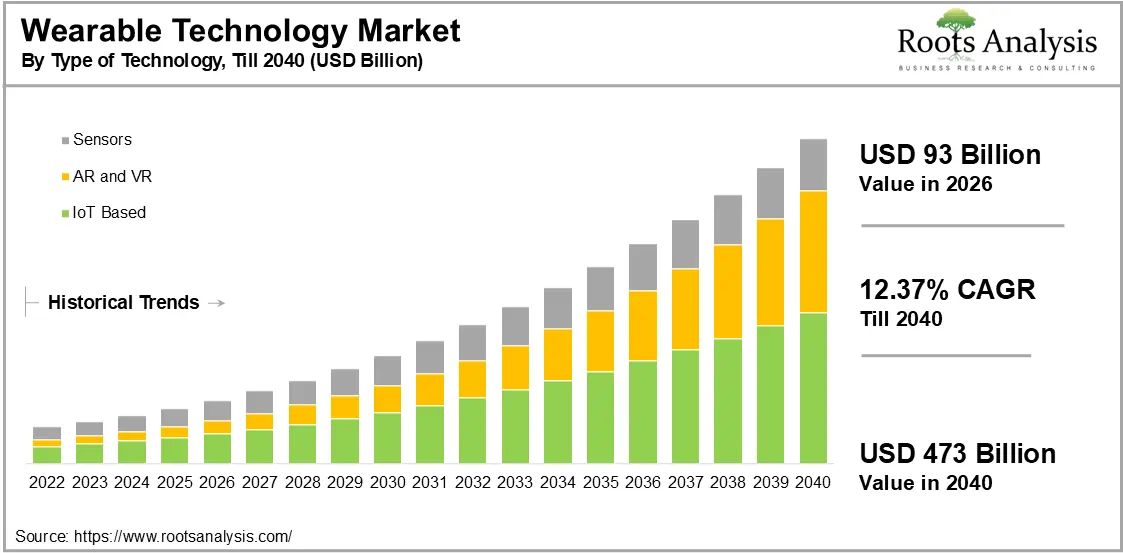
The global wearable technology market is valued at USD 93 billion in 2026 and is estimated to reach USD 473 billion by 2040, representing a higher CAGR of 12.37% during the forecast period.
To learn more about this report, request a free sample copy
The new research report presents valuable data on current industry size, market trends, growth scenarios, future opportunities, SWOT analysis, and value chain analysis.
The market for wearable technologies will continue to gain momentum during the upcoming years across various industrial sectors. With growing understanding about the importance of physical health, there has been a surge in the adoption rate of health monitoring wearables across the globe, which becomes a key driver for the market. The integration of sensors and connectivity into baby safety products is fueling growth in smart wearables for infant health and security.
These devices help in the collection of information about health parameters, such as cholesterol level, heart rate and oxygen level that are useful for designing treatment plans. In addition to health monitoring, these smart devices have also been widely used for security purposes of the workers specifically those working in harsh chemical industries. These wearable sensors can detect environmental conditions such as air quality and temperature which helps to take proactive measures to avoid potential risks. Furthermore, the gaming industry is also continuing the production of smart wearable gaming headsets by focusing on metaverse where augmented reality is combined with physical elements for a real-life gaming experience.
Driven by the ongoing trend of smart wearable devices, various established players like Apple, Samsung, Fitbit and Fossil Group landed into the smart wearable domain to provide unique health and fitness tracking solutions. It is worth highlighting here that industrial leaders are increasing their efforts to develop smart wearable technologies beyond healthcare and wellness tracking. Some of the latest updates to notice are Genesis AI (a potential hearing aid technology) developed by Starkey that features on-board deep neural network accelerator engine, and Genesis AI’s Edge Mode for optimizing sound without noise. The device will help the wearer in hearing words and speech with optimal clarity. Further, Garmin has launched its latest Epix Pro smartwatch that features active-matrix organic light-emitting diode display and LED flashlight. This smartwatch will act as a safety light for nighttime use. With a strong foothold on innovation and technologies upgrade, we believe the wearable technology market will continue to expand at a substantial rate during the forecast period.
Wearable Technology Market Segmentation Analysis
The report features a comprehensive analysis of the wearable technology industry growth and key players who are active in this market across various segments as mentioned in the table below.
Wearable Technology Market: Report Attributes / Market Segmentation
| Key Report Attributes | Details | |
| Historical Trend | Since 2022 | |
| Base Year | 2025 | |
| Forecast Period | 2026-2040 | |
| Market Size 2026 | $ 93 Billion | |
| Market Size 2040 | $ 473 Billion | |
| Market Growth Rate | CAGR of 12.37% from 2026.2040 | |
| Distribution by Product |
|
|
| Distribution by Technology |
|
|
| Type of Components |
|
|
| Type of Application |
|
|
| Company Size |
|
|
| By Business Model |
|
|
| By End User |
|
|
| Key Geographical Region |
|
|
| Key Companies Profiled |
(A full list of key companies captured is available in the report) |
|
| PowerPoint Presentation (Complimentary) |
Available | |
| Customization Scope | 15% Free Customization | |
| Excel Data Packs (Complimentary) |
|
|
Wearable Technology Market Share Insight
Market Share by Product Type
This segment highlights the distribution of global wearable technology market into wrist-wear, headwear & eyewear, neckwear, and wearable cameras based on the product type. In our market study, our researchers found that currently wristwear accounts for the highest share of the market. The highest share is likely to be the result of high demand for smartwatches and fitness tracking bands owing to their multifunctionality. Furthermore, the growing focus on health and fitness has further fueled the demand for wristwear, which is anticipated to be a key reason for the highest share of this segment. It is worth highlighting here that key players like Garmin, Xiaomi, Samsung and Apple are consistently focusing on adding innovative features along with connectivity options. With growing innovation in wristwear technology, we believe this segment will continue to grow at a higher CAGR during the forecast period. Notably, headwear & eye wear has also gained traction owing to the increasing demand in gaming and entertainment industry. These two segments would be highly investible during the upcoming years.
Market Share by Technology
Based on the type of technology, the wearable technology market is segmented into IoT based, AR and VR, and sensors. Among these technologies, currently IoT based technology holds the largest share of the growing market. This can be attributed to the fact that IoT technology has been integrated in various wearable devices including smartwatches, fitness bands, medical devices and gaming gadgets for better connectivity. Moreover, the growing emphasis on innovation in smart microelectronics and smart homes has further raised the demand for wearable IoT devices. However, the AR and VR technology will continue to expand at a steady CAGR during the upcoming years driven by the ongoing advancements in virtual display technology. Additionally, the gaming industry is continually leveraging AR & VR technology for delivering immersive realistic gaming experience that leads to the high demand for this technology, making it investible for upcoming years.
Market Share by Component Type
This segment highlights the distribution of global wearable technology market into control, memory, battery, sensing, and connectivity. Among these components, currently sensing components occupies the highest share of the market. The reason behind the highest share is sensing components act as an integral part of smart wearable technologies for tracking and monitoring physiological parameters.
In addition, there is a high demand for sensing technologies in the healthcare and fitness industry. Further, the ongoing technological innovations for the development of energy efficient sensing components has catered the attention of key stakeholders towards the consumer wearable technology industry which is anticipated to be the significant reason for highest share. However, in the long run, we believe the connectivity component will grow at a higher CAGR owing to the emerging demand for smart connectivity devices for seamless communication.
Market Share by Application Type
Based on the type of application, the global wearable technology market is segmented into fitness & wellness, consumer electronics, and healthcare. Among these applications, consumer electronics account for the highest share of the market. This dominance is attributed to the growing adoption of wearable electronic gadgets such as AR / VR headsets, ear devices, and smartwatches for clinical and non-clinical information. However, in the long run, healthcare segment continues to expand a faster CAGR during the projected period driven by the growing requirement for digital health technologies to access patient health data remotely.
Market Share by End User
This segment highlights the distribution of global wearable technology market into health and fitness, BFSI, gaming and entertainment, fashion, travel, education, and logistics & warehouse. Among these end users, health and fitness industry accounts for the highest share of the market owing to the growing emphasis on fitness and healthy lifestyle. These wearable technologies offer real-time information about vital health metrics that encourage people to take a proactive approach for achieving fitness goals. Moreover, the growing shift towards remote monitoring devices to track patient treatment progress and disease condition has further made this segment more investible during the upcoming years.
In the long run, we analyzed that gaming industry will continue to grow at a higher CAGR. This highest growth potential is likely to be the result of continuous innovation in AR / VR technology to improve graphics for interactive gaming experience and trend of e-sports. In upcoming years, the fashion industry is also adopting wearable technology to meet functional needs of individuals.
Market Share by Geographical Region
The global wearable technology market is distributed into North America, Europe, Asia-Pacific, Latin America, Middle East and North Africa and rest of the world on the basis of key geographical region. Based on our market analysis, our authors found that currently North America accounts for the highest share of the market. North America is the epicenter of well-established wearable technology developers who are currently accelerating their efforts for the development of advanced sensors, connectivity features and processors in smart wearable devices. Furthermore, the growing emphasize on the healthcare wearable devices for disease monitoring and treatment designing has propelled the demand for wearable technologies in this region.
On the other hand, the market for wearable technology in Asia-Pacific is estimated to grow at a higher CAGR during the projected period. This can be attributed to the robust penetration of smart gadgets integrated with wearable technologies in Asian countries. The increasing disposable incomes and growing shift towards 5G chipset technology incorporation in wearable devices has contributed towards the growth of the market in the region. Additionally, the Europe wearable technology market also hold a considerable amount of share owing to the growing demand for healthcare and fitness tracking devices, making it an investible region during the upcoming year.
Wearable Technology Market Dynamics Insights
Wearable Technology Market Competitive Landscape
Currently, the market features the presence of well-established and new entrants who are currently engaged in this field for driving innovations and technological advancements. In order to maintain a competitive edge, several industrial leaders are expanding their product portfolio and leveraging strategic initiatives such as partnerships, collaborations and acquisitions. Most modern wearables are powered by Bluetooth Low Energy to ensure seamless connectivity with extended battery life.
Overall, the wearable technology market seems highly competitive and fragmented into small, mid-sized and large players. Further, various leading players like Sony Corporation, Fossil Group and Xiaomi are launching upgraded versions of their wearable technologies to stay competitive in the industry. The growing competition in the market is also grabbing the attention of small and medium enterprises to upgrade their innovation strategies and enhance their portfolio.
Wearable Technology Market Growth Drivers
Advancements in Microelectronic Wearable Technology and Preferences for Compact Devices
With growing preferences for microelectronic wearable technology, leading players of industries are focusing with the development of compact size wearable devices specifically wristbands and smartwatches. The evolution of body area networks is fueling next-gen wearable devices capable of continuous physiological monitoring and real-time feedback. In addition, advancement in brain-computer interface is paving the way for cognitive wearables in both clinical and consumer applications.
Further, there is a surge in the demand for smart wearable implants and medical devices in healthcare industry that can easily integrate with healthcare applications for seamless monitoring of patient health data. In addition, the demand for handheld monitoring devices for disease diagnosing at home are the key wearable technology market driver which is poised to propel the industry during the forecast period.
Wearable Technology Market Restraints
Limited Battery Life and Security Concerns
Despite the massive growth, the wearable technology market is witnessing some challenges that may hinder the growth of this industry. Some of the potential challenges are limited battery life and cybersecurity issues. Smart wearable technology-based devices have limited battery life which makes it challenging to use for extended periods of time. In addition, these devices have been designed for sharing data through IoT networks which might be prone to data threats.
Wearable Technology Market Trends / Opportunities
Adoption of AR and VR Wearables, Improved 5G Connectivity and Focus on Battery Efficiency
Many next-gen wearables are integrating ambient intelligence to deliver personalized insights based on contextual data and user interaction. Some of the potential wearable technology market growth factors that are expected to drive this field during the upcoming years include growing adoption of AR and VR wearable technology and focus on battery efficiency. Currently, wearable devices are available with limited battery efficiency which creates a promising opportunity for industrial leaders to upgrade their smart sensor-based devices with extended battery life.
It is worth highlighting here that Xiaomi and Garmin are some of the well-established industrial leaders who are currently focusing on improving batter technologies, designing wearable devices with long-lasting battery life for up to 7 days on a single charge. In addition, wearable technology developers are continually leveraging 5G technology for enhanced connectivity and real-time updates which is anticipated to be a major wearable technology market growth factor.
Leading Companies in Wearable Technology Market
Examples of key players who are currently active in the wearable technology industry (which have also been captured in this market report, arranged in alphabetical order) include Alphabet, Apple, Adidas AG, Acer, Boat, Boult, Fitbit, Fossil, Garmin, Google, Huawei Technologies Group, INTELLITIX, Lenovo Corporation, Microsoft, Meta Store, Nike, Samsung Electronics, Sony Corp and Xiaomi. This market research report includes an easily searchable excel database of all the companies providing wearable technology products worldwide.
Recent Developments in Wearable Technology Market
Several recent developments have taken place in the wearable technology market. We have outlined some of these recent initiatives below. These developments, even if they took place post the release of our market report, substantiate the overall market trends that have been outlined in our analysis.
- June 2026: Snap officially launched its new Specs augmented reality glasses, a standalone wearable computing device with see-through AR displays, available for preorder and scheduled to ship in Fall 2026.
- June 2026: EssilorLuxottica and Applied Materials announced a collaboration to advance augmented reality optics platforms for next-generation smart glasses. The announcement was published on June 16, 2026.
- June 2026: Wearable Devices Ltd. announced that its Mudra Pro neural sensing wearable platform became available for pre-order for enterprise and OEM customers to accelerate AI and XR development programs.
- May 2026: Oura launched the Ring 5 smart ring, introducing a smaller form factor, enhanced battery life, and expanded health-monitoring capabilities as part of its wearable health ecosystem.
- May 2026: Wearable Devices Ltd. announced Mudra Pro, a next-generation neural sensing wearable platform designed for AI, XR, and advanced human-machine interaction applications. The announcement was issued on May 13, 2026.
- May 2026: Google introduced the Fitbit Air, a screenless wearable health and fitness tracker designed for continuous monitoring, with pre-orders opening on May 7, 2026.
- May 2026: Sony Electronics announced the REON POCKET PRO Plus, a wearable thermo device featuring upgraded cooling and heating technology for personal comfort applications. The launch was announced on May 12, 2026.
- May 2026: Huawei announced its WATCH FIT 5 Series, expanding its wearable portfolio with new smartwatch offerings ahead of its May 7, 2026 launch event in Bangkok.
- March 2026: Qualcomm Technologies introduced the Snapdragon Wear Elite platform, an AI-focused wearable chipset designed to support next-generation smartwatches, wearable AI devices, pins, pendants, and related form factors.