


 Download Free Sample
 Buy Now
Market Outlook
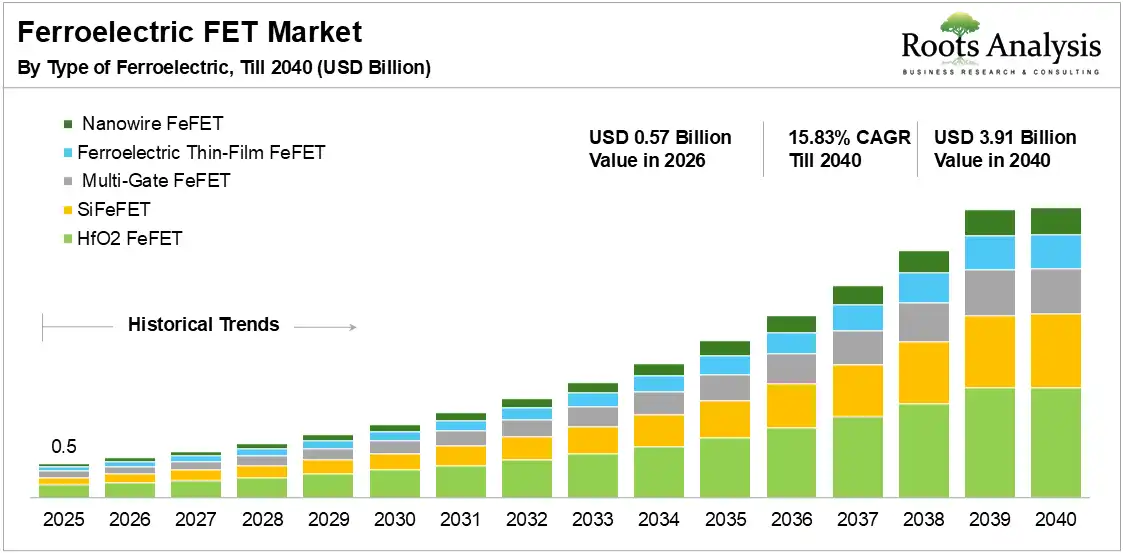
The global ferroelectric FET market, valued at USD 0.57 billion in 2026, is projected to reach USD 2.17 billion in 2035 and USD 3.91 billion by 2040, representing a CAGR of 15.83% during the forecast period 2026 to 2040.
See What’s in the Full Report - Request Your Complimentary Insights!
Ferroelectric materials refers to the class of substances that has spontaneous electric polarization property. This can also be reversed by applying an external electric field / magnetic field in opposite direction; hence it named ferrielectric. This defining characteristics of ferroelectric materials to retain polarization state without power source make them highly applicable for high-speed memory application or non-volatile memory or ferroelectric random access memory.
Owing to the growing usage of smartphones, wearable technology, and Internet of Things devices, there is a significant demand for ferroelectric FET technology for low-power memory applications. In addition, the growing focus on miniaturization technology has further underscored the demand for energy-efficient FeFET devices. With this emerging trend, several market players have shown active interest in the industry, undertaking initiatives to develop advanced technologies and leveraging partnerships.
For instance, in April 2025, Neumonda and Ferroelectric Memory Company (FMC) joined forces for the commercialization of FMC’s non-volatile DRAM+. Under this joint efforts, the FMC will commercialize a disruptive technology that with non-volatile properties of ferroelectric hafnium oxide (HfO2) with RAM to design a non-volatile DRAM memory for consumer, medical, automotive and industry applications. Likewise, several market players are aiming for ferroelectric transistor innovation, which is expected to maintain a long-term competitiveness in the ferroelectric FET market.
Key Takeaways
- Leading Players Competitive Footprint: The dominance players in the ferroelectric market includes, Texas Instruments, Fujitsu, Infineon Technologies, Toshiba, and Ferroelectric Memory Company. These market players holds robust position in the industry and securing funds to expand their product portfolio globally.
- Regional Market Expansion and Adoption Trends: Rapid adoption of miniature devices, such as smartphones and increasing industrialization in Asia-Pacific region is offering enormous opportunities to market players. Notably, the end use industries, such as electronics, automotives, and industrial infrastructure in Asian countries, such as China, India and South Korea is underscoring the demand for ferroelectric FETs in next-generation non-volatile memory.
- Expansion in Edge Computing, IoT, and Wearables: The significances of FeFET’s, such as ultra-low power non-volatile switching, fast and instantaneous data recall makes them attractive for the market players who are designing IoT devices, portable power electronics, medical implants, and edge nodes.
- Wearable Devices to Have Highest Share: With increasing shift towards wearable devices for health tracking and smart cards are driving the adoption of FeFET-based solutions. Owing to the increasing demand, several market players are aiming to develop high-speed FeFET memory solutions.
- Market Opportunities and Future Trends: The future focus will be addressing the growing demand for high performance and secured FeFET in neuromorphic computing solutions. This demand has been strengthened by the growing focus for hardware security, such as end-to-end encryption and computing-in-memory paradigms.
- Integration with AI Accelerators and In-memory Computing Platforms: As electronic and automotive industry is moving towards in-memory processing, there will be high demand for 3D ferroelectric FET integration to enhance scalability. Moreover, the future focus will be on the multi-bit, and low-power memory elements for deep learning, AI inference engines, and cognitive processors.
Pay Only for What You Need – The Best Way to Optimize
Recent Developments in Ferroelectric Industry
- In November 2025, Researchers team at Université Grenoble Alpes, Université Paris-Saclay (CNRS), and Université de Bordeaux developed a new memory device that combines ferroelectric capacitors (FeCAPs) and memristors to run artificial intelligence systems with higher accuracy.
- In April 2025, a research team from the National Synchrotron Radiation Research Center, Tamkang University, and National Cheng Kung University with the support of National Science and Technology Council and the Ministry of Education developed a reliable method for stacking-controlled van der Waals heteroepitaxy, demonstrating the development of epitaxial ferroelectric hexagonal boron nitride ultra-thin film for next-generation micro-scaled electronic devices.
- In May 2025, NUSRI Suzhou convened the Symposium on Ferroelectrics and Ferromagnets for emerging information technologies.
Market Dynamics
Key Market Drivers
- Demand for High-speed, Low-power and Non-volatile Memory: It is worth noting that FeFETs offer ultra-low power operations and fast switching speeds for non-volatile memory applications. These high-speed FeFET memory solutions are highly in demand for the data-centric computing solutions, such as smartphones, health monitoring gadgets, and Internet of Things security devices.
- Advancements in AI / ML Hardware and Neuromorphic Computing: The consistent technological innovations for next-generation AI, machine learning accelerators, and neuromorphic chips fueling the demand for FeFET in neuromorphic computing and AI-powered hardware technologies.
- Technological Maturity and Scaling Potential: The ongoing innovations for technological maturations, such as 2D / 3D ferroelectric materials, ferroelectric polarisation mechanisms, and ultra-thin memory devices has fueled the demand for ferroelectric materials. Notably, these advances have further enabled 3D ferroelectric FET integration with standard CMOS flows, making them ideal for sub-1o nm nodes and embedded memory in SoC designs.
Key Market Restraints
- Material and Reliability Challenges: It is important to note here that the stable ferroelectric materials with high retention and polarization are still under research and development process. Therefore, variability in materials and retention loss create technical hurdles for the market players to deploy FeFET commercially.
- Competition from Emerging Memory Technologies: The availability of mature technologies, such as RRAM, MRAM, and PCM along with emerging solutions, such as SOT-MAM and FRAM may limit its adoption across different industries. Moreover, the competition from emerging memory technology also create scalability challenges in ferroelectric FET mass production.
- High Initial R&D and Integration Costs: The development and integration of FeFET materials and integrating them into commercial chip platforms is highly cost intensive. Moreover, the requirement of nanofabrication, circuit design and qualification may further enhance the overall expenditure on the research and development activities.
Have Questions? Let’s Get Them Answered.
Market Share Insights
Market Share by Type of Ferroelectric: HfO2 HeFET Holds the Largest Share
According to the ferroelectric FET market forecast estimates, HfO2 HeFET dominate the market by securing maximum share. This dominance stems from the fact that HfO2 HeFET offer simple structure, better scaling and high density, specifically when used with CMOS-compatible materials, such as doped hafnium oxide. Owing to its greater compatibility, it is widely in demand for ferroelectric FETs in next-generation non-volatile memory.
It is worth mentioning that ferroelectric thin-film FeFET will register higher CAGR during the forecast period. The growing focus on miniature technology and ferroelectric FET technology for low-power memory applications are likely to fuel the demand for ferroelectric thin-film FeFET.
Market Share by Application Area: Non-Volatile Memory Dominates the Market
Based on our analysis, non-volatile memory holds the largest share of the ferroelectric FET market growth. This highest share is driven by the growing usage of non-non-volatile memory technology FeFET across diverse industries, specifically automotive and industrial automation. Notably, the FeRAM is used for non-volatile data logging in Advanced Driver Assistance Systems (ADAS), engine control units (ECUs), and infotainment systems due to its exceptional endurance (high read / write cycles) and reliable data retention in harsh environmental conditions.
On the other hand, the AI chips will show robust growth, anticipating holding highest CAGR during the forecast period. This lucrative growth is driven by the consistent focus of researchers into using FeFETs as artificial synapses for computing-in-memory architectures. This allows computing to happen right where the data is stored, dramatically improving energy efficiency for AI workloads.
Market Share by Geographical Regions: Asia-Pacific Dominates the Market
- According to the ferroelectric FET market report, Asia-Pacific dominates the market and is expected to remain dominant in the future.
- Several factors, such as robust electronics manufacturing base of consumer electronics and automotive systems are fueling the demand for ferroelectric materials.
- Moreover, the rapid industrial automation is driving the integration of ferroelectric FETs in advanced semiconductor devices.
- In North America, the FeFET memory market is likely to grow at a substantial CAGR during the forecast period. The increasing research initiatives, specifically for FeFET in neuromorphic computing, and 3D ferroelectric FET material, and next-generation memory technologies for automotive and defense applications are likely to fuel the market growth.
Want Information on Specific Region / Segment?
Market Ecosystem Insights
Leading Players in Ferroelectric FET Market
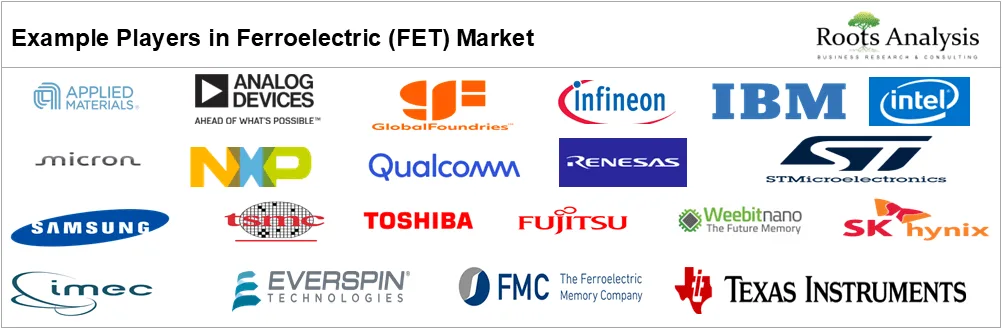
Leading players in the ferroelectric FET domain include industry giants, such as Applied Materials, Analog Devices, Everspin Technologies, Fujitsu Semiconductor, Ferroelectric Memory, GlobalFoundries, Infineon, IMEC, IBM, Intel, Micron, NXP, Qualcomm, Renesas, STMicroelectronics, Samsung, SK Hynix, Texas Instruments, TSMC, and Toshiba, Weebit Nano.
These market players are widely emphasizing on researching advance ferroelectric materials. For instance, in January 2025, researchers at Research Center for Materials Nanoarchitectonics have proposed a new method to create innovative ferroelectric-ferromagnetic materials. This research method is opening new gateway to advance memory devices and spintronics. These initiatives are compelling market players for innovations which is likely to maintain competitiveness in the market.
Funding and Investment Analysis
The ferroelectric FET market has witnessed robust funding and investment. These funds flow from seed funding rounds, venture capitalists, government and various other investment firms. The primary aim of raising funds is to expand the ferroelectric applications across diverse industries and development of lead-free materials and ferroelectric memory.
In November 2025, Ferroelectric Memory Company (FMC) successfully raised €100 million in Series C funding found in equity and subsidies. The primary goal of raising funds is to commercialize energy-efficient chips (FeRAM / DRAM+) for AI data centers and edge computing.
Likewise, government and public investors are offering funds for semiconductor research and materials development. For instance, European Innovation Council recently granted funds for the project, such as UPSPRING that focus on low-power FerroElectric Spin-Orbit (FESO) devices. These initiatives are offering long-term competitiveness to the market players.
Innovations In Eco-Friendly And Non-Toxic Concrete Sealer Formulations
Owing to the growing regulatory standards for VOC emissions in concrete sealers, market players are widely emphasizing on the development of eco-friendly and non-toxic concrete sealers formulations.
Market Segmentation
Ferroelectric FET Market: Scope of the Report
| Key Report Attributes | Details | |
| Historical Trend | Since 2020 | |
| Forecast Period | Till 2040 | |
| Market Size 2026 | $ 0.57 Billion | |
| Market Size 2040 | $ 3.91 Billion | |
| CAGR (Till 2040) | 15.83% | |
| Segments Covered |
|
|
Based on the research, we have segmented the Ferroelectric FET market into type of ferroelectric, application, end use industry, geographical regions, and key players.
By Type of Ferroelectic
- HfO2 FeFET
- SiFeFET
- Multi-Gate FeFET
- Ferroelectric Thin-Film FeFET
- Nanowire FeFET
By Application Area
- AI Chips
- IoT Devices
- Low-Power Logic
- Non-Volatile Memory
- Wearable Electronics
By End Use Industry
- Automotive
- Aerospace and Defense
- Consumer Electronics
- Telecommunication
- Others
By Geographical Regions
- North America
- US
- Canada
- Mexico
- Rest of North America
- Europe
- Austria
- Belgium
- Denmark
- France
- Germany
- Ireland
- Italy
- Netherlands
- Norway
- Russia
- Spain
- Sweden
- Switzerland
- UK
- Rest of Europe
- Asia-Pacific
- Australia
- China
- India
- Japan
- New-Zealand
- Singapore
- South Korea
- Rest of Asia-Pacific
- Latin America
- Brazil
- Chile
- Colombia
- Venezuela
- Rest of Latin America
- Middle East and Africa (MEA)
- Egypt
- Iran
- Iraq
- Israel
- Kuwait
- Saudi Arabia
- UAE
- Rest of MEA
Your Business is Unique – Why Shouldn’t Your Report Be?


