


 Download Free Sample
 Buy Now
Market Size
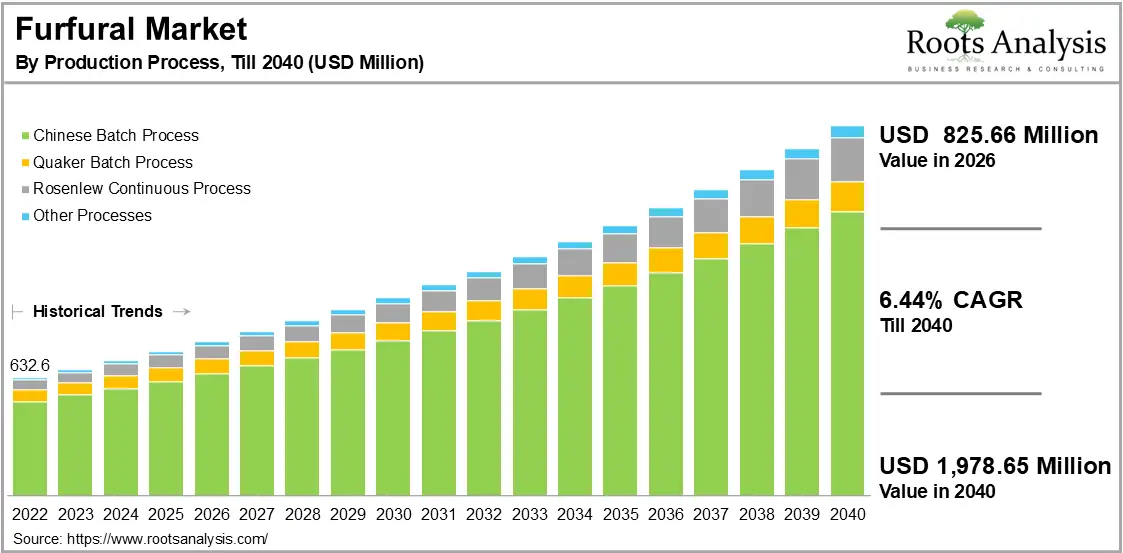
The global furfural market, valued at USD 772.47 million in 2025, is projected to reach USD 825.66 million by 2026 and USD 1,978.65 million by 2040, representing a CAGR of 6.44% during the forecast period 2026 to 2040.
See What’s in the Full Report – Request Your Complimentary Insights!
Market Report: Key Takeaways
- In terms of raw materials, corncob captures the majority (58.3%) of the current furfural market share while sugarcane bagasse is expected to grow at a higher CAGR during the forecast period.
- In terms of application, furfuryl alcohol dominates the global furfural industry, driven by its key role as a binder and post-2020 modernization of global foundry sector.
- Chinese batch process dominates the current furfural market, based on the production process.
- Currently, Asia dominates the industry by capturing the largest share within the global marketplace; further, it is also expected to grow at a faster CAGR through 2040.
- Paint & coating and refinery sectors drive the demand for furfural and related derivatives, thereby accelerating market growth till 2040.
Market Overview
Furfural is a liquid aldehyde produced from agricultural byproducts, including furfural from corn cobs and furfural from bagasse, through acid-catalyzed dehydration of pentose sugars in lignocellulosic biomass. The furfural manufacturing process involves hydrolysis at high temperatures, typically using sulfuric acid on sugarcane residues or oat bran. This yields a colorless oil with almond-like odor from plant hemicellulose.
Furfural applications in chemicals span solvents for refining lubricating oils, diesel fuels, and resins, along with intermediates for pharmaceuticals and agrochemicals. Industries including plastics, textiles, foundries, and biofuels rely on furfuryl alcohol derived from it for thermoset polymers and corrosion-resistant coatings. These furfural uses cover diverse sectors from solvents to biofuel additives.
Greener furfural manufacturing process innovations like biphasic reactors that boost yields above 80% from biomass hydrolyzates are shaping the global furfural market trends. Further, catalyst improvements reduce energy needs and humin byproducts, enhancing scalability. Such advances support bio-refinery integration for sustainable outputs.
In essence, furfural market growth is driven by rising demand for bio-based alternatives (amid fossil fuel shifts and emerging economy industrialization), while policy support for green energy chemicals and biomass utilization drives expansion in this domain. Cost-effective production scales further fuel furfural market opportunities worldwide.
Recent Developments
- In August 2025, Japan approved 60 billion yen in financing to support Assam’s bamboo-based biofuel and biochemical refinery project, strengthening bilateral green energy partnerships and accelerating commercialization of bamboo-derived ethanol and furfural.
- In July 2025, a PhD defence at the University of Twente presented research on enhancing furfural production via boronate esters, demonstrating higher selectivity and yields from biomass-derived feedstocks and contributing to greener catalytic process development.
- In February 2025, Sappi announced plans to invest about USD 60 million to build a 25,000 tonnes per annum furfural plant at its Saiccor Mill, targeting leadership in sustainable bio-based chemicals.
- In November 2024, Avantium started up the first part of its FDCA flagship plant in the Netherlands, using furans derived from carbohydrates as key building blocks for next-generation bio-based polymers and packaging materials.
Pay Only for What You Need – The Best Way to Optimize
Market Share Insights
Corncob Dominates the Current Market While Sugarcane Bagasse Poised for Fastest Growth
The corn cob sub-segment is expected to dominate the global furfural market, in terms of raw material, capturing 71.35% market share in current year. This is due to high pentosan concentration in corncobs, enabling superior conversion rates in the furfural manufacturing process. Further, their lignocellulosic composition supports efficient acid-catalyzed dehydration, yielding consistent furfural production quality and quantity.
Corncob’s abundant availability from grain processing, its high yielding capability, and established processing techniques (such as rotating digester system), make it an ideal raw material for commercial furfural production worldwide. Being agricultural byproducts, corncobs also offer cost advantages and sustainability benefits, supporting its widespread adoption across furfural manufacturers.
On the other hand, the sugarcane bagasse sub-segment is expected to witness a relatively higher CAGR during the forecast period. Furfural from bagasse benefits from exceptional cellulose and hemicellulose content, enabling high conversion efficiency in the furfural manufacturing process. This inherent composition enhances overall yield and productivity during synthesis compared to alternative feedstocks.
Bagasse-based furfural production accelerates through biorefinery integration models that valorize sugar industry residues. The segment’s expansion reflects circular economy principles where waste streams become feedstocks, reducing raw material procurement costs while supporting green energy chemicals objectives. Regional availability in sugarcane-producing nations (particularly Asia, Brazil, and India) provides logistical and cost advantages, driving adoption among manufacturers seeking sustainable feedstock diversification.
Market Share by Application: Furfuryl Alcohol Leads Current Market Growth
Furfuryl alcohol holds the largest share in the global marketplace, driven by its critical role as a foundry binder in metal casting applications. Further, the post-2020 recovery and modernization of global foundry sector underscore the increased demand for reliable, performance-proven binders like furfuryl alcohol due to its unique performance characteristics, including excellent green strength for mold retention, minimal gas evolution during casting, and exceptional thermal stability above 200°C.
Furan resin, the primary derivative of furfuryl alcohol, captures substantial market share as a critical chemical feedstock for coatings, adhesives, thermoset polymer matrix composites, and casting resin. The resin’s chemical stability, low VOC emissions, and compatibility with reinforced composites make it indispensable for advanced material applications. Recent industry movement toward eco-friendly solutions have accelerated furan resin adoption, particularly in aerospace and automotive composite manufacturing where regulatory pressure favors bio-based alternatives.
DynaChem South Africa’s 2024 launch of furfuryl alcohol-based binders for automotive castings exemplifies this shift, replacing traditional petrochemical resins with sustainable alternatives while maintaining performance standards. Such transitions underscore how furfuryl alcohol price trend competitiveness, combined with environmental compliance requirements, drives market consolidation around bio-derived solutions.
Furfural Market Regional Forecast: Asia-Pacific Drives Global Furfural Expansion Through Production Leadership and Rapid Industrialization
According to regional estimates of global furfural market forecast, Asia dominates the current industry, accounting for the largest market share while simultaneously exhibiting the fastest growth trajectory (high CAGR) throughout the forecast period. The region’s dual leadership reflects abundant feedstock availability, established manufacturing infrastructure, rapidly expanding end-use industries, and cost-efficient production capabilities.
Amongst the Asian countries, China operates as the world’s largest furfural producer and consumer, leveraging grain processing residues and corncob availability to support large-scale commercial furfural production. The country’s established batch process technology and rotating digester systems achieve 30-40% yields commercially, positioning China as the primary global supply source. Rapid industrialization across the nation drives sustained demand from petrochemical refineries, pharmaceutical manufacturers, and specialty chemical producers requiring furfural as a solvent, anti-corrosion coating agent, and chemical intermediate.
Besides robust market growth in China, India also demonstrates accelerating market momentum, with pharmaceutical and agricultural sectors driving rapid demand expansion. The pharmaceutical industry utilizes furfural extensively as a solvent and intermediate in drug synthesis, while the agrochemical sector demands furfural applications in chemicals for formulation development.
It is worth noting that initiatives by government and furfural manufacturers further accelerate region’s growth. For instance, India’s Ministry of New and Renewable Energy Biomass Program (2021-26) provides central financial assistance for biomass-based projects, supporting infrastructure for value-added biochemical production. Similarly, in July 2024, Hongye Holding Group announced a significant expansion of its furfural and furfuryl alcohol production capacity, specifically targeting elevated market demand.
Want Information on Specific Region / Segment?
Market Dynamics
Key Market Drivers
- Pharmaceutical Sector Demand for Bio-Based Solvents and Intermediates
Pharmaceutical R&D prioritizes furfural as sustainable solvent and intermediate in drug synthesis. Natural raw material sourcing in pharmaceutical applications drives adoption of furfural applications in chemicals over conventional petrochemical feedstocks, expanding market demand through green chemistry mandates.
- Environmental Regulations Mandating Petroleum Solvent Phase-Out
Global air quality standards restrict petroleum-based solvents like benzene in industrial applications. Furfural bio-based alternatives provide compliant solvent solutions for lubricating oil refinement and mineral extraction, creating regulatory-driven demand growth across paints, coatings, and refining sectors.
- Agricultural Waste Valorization Through Feedstock Availability
Abundant furfural from corn cobs and furfural from bagasse enable cost-efficient furfural production scaling. Agricultural sector’s emphasis on waste valorization supports circular economy objectives, providing consistent biomass feedstock for sustainable furfural manufacturing process operations globally.
- Government Support and Incentives for Bio-Based Chemical Adoption
National governments offer subsidies and tax incentives promoting renewable chemical transitions. Further, policy frameworks support renewable fuels and chemicals by thermal processing of biomass development, reducing production costs and accelerating commercial viability of bio-based alternatives. For instance, the Renewable Fuel Standard (RFS) Program by the US Environmental Protection Agency (EPA) promotes efficient, clean, and reliable power and thermal energy generation from single fuel sources, including biomass.
Market Challenges
- Low Furfural Yields and Decomposition During Production
The commercial manufacturing process for furfural yields less than 50%, primarily because of the compound's instability in various reaction mediums. Furfural decomposes into unwanted byproducts (humins), limiting process efficiency and profitability significantly. - Equipment Corrosion from Sulfuric Acid Catalysts
Traditional sulfuric acid catalysts cause severe equipment degradation and contamination. Mitigating corrosion requires expensive materials, increasing furfural production capital and operational costs substantially. - High Energy Consumption and Environmental Pollution
Commercial processes require approximately 400 kWh per ton of furfural produced. Additionally, acidic wastewater generation (COD 10,000-50,000 mg/L) creates environmental compliance burdens and remediation expenses. - Fluctuating Raw Material Costs and Supply Volatility
Climate variations and geopolitical events destabilize furfural from corn cobs and furfural from bagasse availability. Further, volatile feedstock pricing creates production cost uncertainty affecting market competitiveness. - Catalyst Recovery and Reusability Constraints
Metal chloride catalysts offer better yields but lack efficient recovery mechanisms. Difficulty separating catalysts from reaction mediums violates green chemistry principles and increases waste disposal costs.
Market Trends: Strategic Initiatives by Companies Studied in the Furfural Industry
Industry players prioritize technological advancement through R&D investments in catalytic innovation and yield optimization. Strategic alliances between producers and end-use industries accelerate furfural manufacturing process improvements and market adoption. Simultaneously, smaller specialized players differentiate through niche application expertise and customized green energy chemicals solutions, capturing segments underserved by multinational competitors.
- Assam Bio-Ethanol Private Limited (ABEPL), a joint venture promoted by Numaligarh Refinery Limited (NRL), Fortum, and Chempolis, achieved significant milestones in furfural production scaling through India-first bamboo-based biorefinery development:
- February 2024: Power Finance Corporation (PFC) signed a term loan agreement for Rs 3,037.50 crores with Assam Bio-Refinery Private Limited (ABRPL). The loan finances a 3 million tonnes per annum biorefinery plant, producing 49,000 tonnes per annum bioethanol, 19,000 tonnes per annum furfural, 11,000 tonnes per annum acetic acid, and 24 MW bio-coal-based captive power at a total project cost of Rs 4,200 crores.
- September 2025: Engineers India Limited (EIL) announced successful mechanical completion of ABEPL’s biorefinery at Numaligarh, achieving production capacity of 19,000 tonnes per annum furfural combined with other chemical entities.
- In September 2024, AM Green agreed to acquire Chempolis and related entities and invest around USD 1 billion over three years to build Alcohol-to-Jet SAF plants using 2G waste feedstocks and furfural-enabled biorefinery technology.
- In October 2023, Indian Oil outlined plans to invest roughly Rs 2,000 crore in a sustainable aviation fuel plant and advance bamboo-based ethanol and biofuel pathways as part of its broader green transition strategy.
Your Business is Unique – Why Shouldn’t Your Report Be?
Market Segmentation
Furfural Market: Scope of the Report
| Key Report Attributes | Details | |
| Historical Trend | Since 2022 | |
| Forecast Period | Till 2040 | |
| Market Size 2026 | $ 825.66 Million | |
| Market Size 2040 | $ 1,978.65 Million | |
| CAGR (Till 2040) | 6.44% | |
| Segments Covered |
|
|
| Key Players Profiled |
|
|
| PowerPoint Presentation (Complimentary) | Available | |
| Customization Scope | 15% Free Customization | |
| Excel Data Packs (Complimentary) |
|
|
Source: Roots Analysis
Market Segments
Based on research, we have segmented the furfural market into raw material, production process, application, end use sector, type of enterprise, geographical regions, and key players.
Market Share by Raw Material
- Corncob
- Rice Husk
- Sugarcane Bagasse
- Sunflower Hull
- Other Raw Materials
Market Share by Production Process
- Chinese Batch Process
- Quaker Batch Process
- Rosenlew Continuous Process
- Other Processes
Market Share by Application
- Decolorizing Agents
- Flavoring Agents
- Furfuryl Alcohol
- Intermediates
- Solvent
- Other Applications
Market Share by End Use Sector
- Agriculture
- Automotive & Transportation
- Chemical Manufacturing
- Food & Beverages
- Paint & Coatings
- Pharmaceutical & Healthcare
- Refineries
- Other Sectors
Market Share by Type of Enterprise
- Large Enterprise
- Small and Medium Enterprise (SMEs)
Market Share by Geographical Regions
- North America
- US
- Canada
- Mexico
- Rest of North America
- Europe
- Austria
- Belgium
- Denmark
- France
- Germany
- Ireland
- Italy
- Netherlands
- Norway
- Russia
- Spain
- Sweden
- Switzerland
- UK
- Rest of Europe
- Asia
- China
- India
- Japan
- Singapore
- South Korea
- Rest of Asia
- Latin America
- Brazil
- Chile
- Colombia
- Venezuela
- Rest of Latin America
- Middle East and North Africa (MENA)
- Egypt
- Iran
- Iraq
- Israel
- Kuwait
- Saudi Arabia
- UAE
- Rest of the MENA
- Rest of the World
- Australia
- New Zealand
- Other countries


