


 Download Free Sample
 Buy Now
GPS Tracking Device Market Size
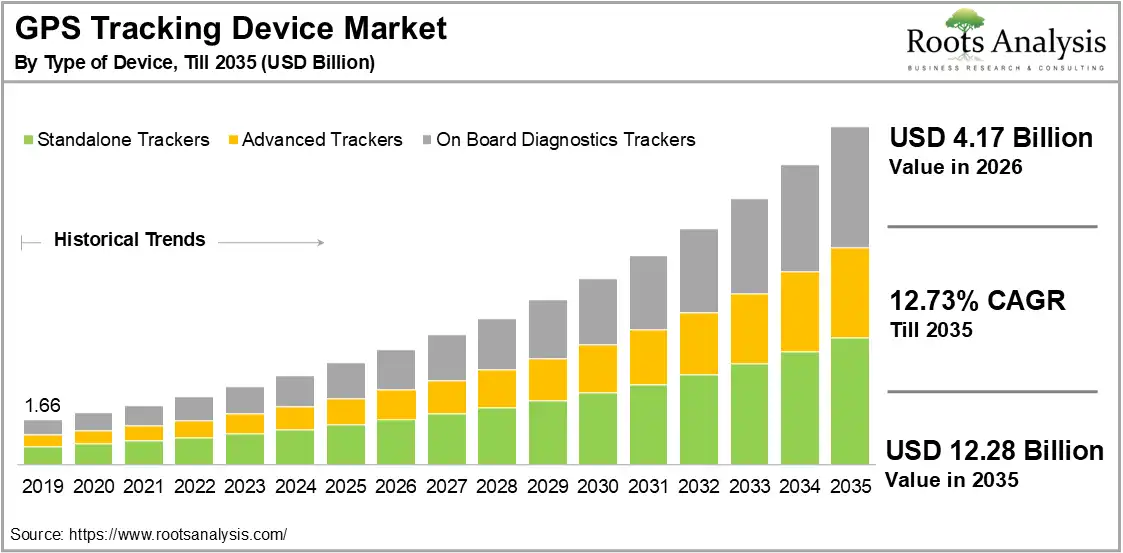
The global GPS tracking device market is projected to rise from USD 4.17 billion in 2026 to USD 12.28 billion by 2035, expanding at a robust CAGR of 12.73% during the forecast period of 2026-2035.
This rapid growth reflects the accelerating shift toward real-time fleet intelligence, asset visibility, and digitized mobility infrastructure across commercial, industrial, and government sectors. Adoption is rising fastest in logistics, last-mile delivery, construction fleets, and public-safety systems, where GPS devices support route optimization, predictive maintenance, driver behavior analytics, and operational safety.
See What’s in the Full Report - Request Your Complimentary Insights!
Key Takeaways from the Global GPS Tracking Device Market Analysis
- Standalone trackers lead device adoption due to their versatility, portability, and applicability beyond vehicle tracking, including personal safety, asset monitoring, and pet wearables.
- Demand for GPS trackers (as a component category) remains strongest, supported by widespread use in fleet management, theft prevention, and remote asset visibility.
- Commercial vehicle deployment dominates overall market share as fleet operators adopt GPS devices to improve routing efficiency, fuel management, regulatory compliance, and maintenance planning.
- The transportation and logistics sector is the largest end-user, supported by e-commerce growth, autonomous last-mile delivery optimization, and rising safety standards for drivers and cargo.
- Europe leads the global market due to strong regulatory frameworks, tachograph compliance mandates, and rapid integration of telematics across commercial fleets.
- Device innovation is accelerating through AI-enhanced tracking, advanced telematics features, tamper-proof hardware, and 5G-enabled real-time analytics.
- Falling device prices, higher battery efficiency, and the shift toward IoT-connected mobility ecosystems further strengthen the long-term market outlook.
Access Exclusive Insights - Request Your Free Sample Today!
Global GPS Tracking Device Market Overview and Industry Outlook
The GPS tracking device market is evolving into a core enabler of connected mobility, real-time fleet visibility, and intelligent asset management. Modern GPS devices extend far beyond basic location detection; they now integrate IoT connectivity, cloud telematics, AI-driven analytics, and 5G-ready communication modules to deliver continuous insights on vehicle health, driver behavior, asset utilization, and environmental conditions. As industries digitize their operations, GPS tracking has become essential infrastructure for logistics networks, emergency response systems, construction equipment monitoring, healthcare transport, and field-service automation.
Adoption is rising sharply due to the operational value GPS systems deliver. Fleet operators use GPS tracking to eliminate routing inefficiencies, reduce fuel consumption, and automate maintenance schedules. Construction and oil & gas firms rely on GPS to secure high-value equipment and improve compliance across large, distributed project sites. Healthcare and hospitality organizations employ tracking devices to streamline mobile operations and safeguard critical assets. Meanwhile, consumers increasingly use compact GPS devices for personal safety, pet monitoring, and vehicle security, broadening the market beyond enterprise use cases.
The rise of smart cities and connected transport ecosystems is another major catalyst. Governments and municipalities deploy GPS tracking to enhance traffic flow, monitor public transport fleets, support emergency response, and manage shared mobility services. As cities invest in digital infrastructure and expand sensor-based monitoring, GPS devices are becoming integrated nodes within broader urban intelligence frameworks.
Recent Developments in GPS Tracking Device Market
Several recent developments have taken place in the market, some of which have been outlined below.
- In August 2025, Queclink introduced a real-time micro asset/cargo tracker and Bluetooth beacon aimed at warehouse and last-mile logistics to improve inventory visibility and theft protection.
- In July 2025, CalAmp launched the edge-enabled LMU-4350LB telematics gateway (LTE Cat 1, BLE 5.2, dual CAN, multi-GNSS), designed to enable on-device logic and sensor fusion for smarter fleets.
- In March 2025, Queclink showcased new IoT solutions for smart cities and logistics, signaling a push into micro-asset and indoor / outdoor hybrid tracking.
- In May 2024, Meitrack collaborated with FMSiTrack to develop innovative technology to elevate the safety and efficiency of fleets, people, and mobile assets.
- In April 2024, Atrack, a well-established company in the telematic industry, introduced the latest GEO/LEO AI Telematics Box in-vehicle solutions at Embedded World 2024. This solution will address connectivity challenges in remote locations.
- In February 2024, Queclink launched a second-generation protocol called @Track Protocol Pro to revolutionize the integration of telematics devices.
- In January 2024, Garmin teamed up with Kawasaki to deliver a customized factory-installed solution for the center console of the all-new Kawasaki RIDGE side x sides. Garmin-powered display solution would offer smooth navigation and comprehensive vehicle system information.
GPS Tracking Device Market Trends Shaping the Future of Location Intelligence
AI-Driven Fleet Intelligence and Predictive Analytics
GPS tracking devices are rapidly evolving into intelligent mobility sensors as AI and machine-learning algorithms increasingly power predictive fleet insights, anomaly detection, fuel optimization, and driver safety scoring. Fleet operators now use AI to detect unusual vehicle movements, anticipate maintenance needs, and automate compliance reporting. This shift moves GPS hardware from simple location tools to analytics-enabled telematics endpoints, accelerating enterprise adoption across logistics, construction, and government fleets.
Rise of IoT-Enabled Tracking Across Assets, Vehicles, and Personnel
The integration of IoT modules, BLE beacons, NB-IoT, and LTE-M has unlocked new tracking use cases beyond vehicles. Businesses now deploy micro-trackers for pallets, containers, rental equipment, medical devices, and field tools, resulting in broader asset visibility ecosystems. This IoT expansion is especially strong in supply-chain, construction, and healthcare environments where uptime, traceability, and security are mission critical.
5G, Multi-GNSS, and Hybrid Positioning Transforming Accuracy
Next-generation GPS devices leverage 5G connectivity, multi-constellation GNSS (GPS + GLONASS + Galileo + BeiDou), and hybrid Wi-Fi/cellular positioning to achieve centimeter-level accuracy in dense urban zones. This enables ultra-reliable tracking for autonomous fleets, emergency response units, aviation ground operations, and high-value cargo. As more operators deploy private 5G networks, low-latency GPS tracking becomes a cornerstone of connected mobility infrastructure.
Growing Regulatory Push Toward Digital Compliance in Fleet Operations
Governments worldwide are reinforcing regulations related to electronic logging, driver hours, tachographs, vehicle inspection records, and emissions monitoring, leading to mandatory adoption of GPS-enabled telematics systems. Europe remains the strongest regulatory market, while North America and Asia are tightening compliance frameworks. These rules position GPS tracking devices as essential compliance tools, not optional add-ons.
Smart Cities Driving Public Sector and Infrastructure Deployments
Global investment in smart cities is accelerating deployments of GPS devices for public transport tracking, waste-management vehicles, emergency fleets, school buses, and municipal equipment. As cities adopt data-driven traffic management and real-time mobility monitoring, GPS hardware is being embedded into urban digital twins, enabling more responsive transport systems and safer streets.
Shift Toward Edge Processing and Tamper-Resistant GPS Hardware
Modern GPS devices now incorporate edge computing, enabling on-device data filtering, event triggering, and offline tracking to reduce cloud dependency. In parallel, fleet owners demand tamper-resistant enclosures, jamming detection, and fail-safe location logging for theft prevention and insurance compliance. These innovations are driving premium adoption across security-sensitive industries such as logistics, oil & gas, and defense.
Consumer and Small-Business Tracking Expands Rapidly
Affordable subscription models and compact form factors are boosting adoption among consumers and SMBs. Use cases, such as pet tracking, personal safety devices, motorcycle tracking, e-bike security, rental equipment monitoring, and travel asset tracking are becoming mainstream. This broadens market penetration beyond enterprise buyers, enlarging the total addressable market.
Sustainability and Fuel Efficiency Pressures Increasing GPS Adoption
As fleets aim to reduce emissions and fuel costs, GPS-enabled telematics support eco-driving analytics, idling reduction, route optimization, and CO2 tracking. Industries with high ESG scrutiny, transportation, retail logistics, last-mile delivery now treat GPS devices as sustainability enablers, integrating them with carbon reporting dashboards.
Pay Only for What You Need – The Best Way to Optimize
Global GPS Tracking Device Market Forecast Methodology
We have forecasted the GPS tracking device market using a hybrid top-down and bottom-up methodology. Our team has integrated macroeconomic indicators, fleet digitization trends, IoT connectivity forecasts, and device-level shipment data to produce a defensible long-term outlook to 2035. All assumptions have been validated against reputable industry sources, regulatory updates, and OEM / telematics provider disclosures.
Key Data Inputs
We have incorporated:
- Global fleet and vehicle parc datasets, including historical registrations, commercial fleet growth, and OEM telematics attach-rate intelligence.
- Aftermarket installation patterns, device replacement cycles, and retrofit adoption curves gathered from vendor reports and industry benchmarks.
- Connectivity evolution inputs, including NB-IoT, LTE-M, 4G, and 5G module adoption forecasts to calibrate long-term device penetration.
- Regulatory influence factors, such as ELD mandates, EU smart-tachograph requirements, and safety compliance rules that historically lifted device demand.
- Component supply and cost signals, including chipset availability, modem pricing, and ecosystem maturity, to model cost-driven adoption shifts.
Top-Down Modelling
We have converted macro drivers: GDP, freight movement, e-commerce growth, and smart-city investment into device intensity ratios, which established upper boundaries for addressable demand across vehicles, assets, and industrial equipment.
Bottom-Up Modelling
Our team has built segment-level forecasts from the ground up by aggregating:
- Embedded devices installed by OEMs (vehicle sales x telematics attach-rate).
- Aftermarket GPS tracking shipments adopted by commercial fleets and SMBs.
- IoT-enabled asset tracking devices deployed across logistics, construction, oil & gas, healthcare, and retail.
Shipment timing, ASP curves, and hardware mix assumptions have been aligned with quarterly disclosures, product releases, and connectivity roadmaps.
Scenario and Sensitivity Analysis
We have run three scenarios: Base, Upside, and Downside to test sensitivity across EV penetration, fleet modernization speed, IoT deployment maturity, and potential supply-chain constraints. Each scenario has been probability-weighted based on historical evidence and current market signals.
Validation and Cross-Checks
All model outputs have been cross-validated with:
- OEM and telematics-provider shipment data
- Vehicle registration statistics
- IoT module forecasts from global connectivity analysts
- Documented regulatory enforcement timelines
Any deviations have been corrected through conservative reweighting. Further, we have incorporated SIM and module price trends, chipset supply fluctuations, and connectivity transition effects (3G sunset → LTE-M/NB-IoT→ 5G) to refine short-term adoption curves.
We have provided annual revenue and shipment forecasts through 2035, along with regional installed-base models, pricing trajectories, and segment-level opportunity mapping. The model has been structured for periodic updates as new regulations, OEM telematics initiatives, or supply-chain developments emerge.
Your Business is Unique - Why Shouldn't Your Report Be?
GPS Tracking Device Market Segmentation Analysis and Regional Insights
Market Segmentation Analysis by Device Type: Which Segments Lead and Which Grow Fastest
Largest Market Share: Standalone Trackers (~46% in 2025)
Standalone GPS trackers accounted for the highest share because they dominate the aftermarket, support B2C + SMB use cases, and represent the bulk of low-cost, high-volume shipments across North America, Europe, and Asia. Their ability to support personal safety, pet tracking, portable asset tracking, and non-OEM fleet installations keeps them structurally ahead.
Fastest Growth: Advanced Trackers (15.12% CAGR)
Advanced AI/edge-enabled telematics devices grow the fastest as fleets upgrade to multi-sensor, CAN-bus, OBD-II, and driver-behavior analytics–capable hardware. Adoption accelerates in logistics, construction, utilities, and regulated fleets seeking predictive maintenance.
Market Segmentation Analysis by Component Type: Strongest Demand Pockets
Largest Market Share: Integrated GPS Trackers (~54%)
Integrated tracker devices, covering OEM-embedded modules and aftermarket fleet devices hold the largest share because they combine GPS, cellular connectivity, accelerometers, and battery management into one unit, making them the backbone of global fleet telematics.
Fastest Growth: GPS Data Pushers and Edge Gateways (16.64% CAGR)
Enterprises increasingly deploy push-based trackers (automatic data transmission) and edge gateways for real-time decisioning, geofencing, cold-chain monitoring, and theft-risk reduction. These components benefit from the shift to 5G-ready, low-latency, always-on architectures.
Market Segmentation Analysis by Deployment: Commercial vs Passenger vs Asset Tracking
Largest Market Share: Commercial Vehicles (~49%)
Commercial fleets continue to dominate deployments due to high telematics penetration in logistics, last-mile delivery, utilities, waste management, and public transport. Compliance requirements (ELD, tachograph, driver-hour monitoring) make GPS tracking mission-critical.
Fastest Growth: Asset Tracking (16.23% CAGR)
Asset trackers (micro-asset, pallets, containers, trailers, tools) scale rapidly as supply chains digitize and IoT devices become cheaper. Growth is led by e-commerce fulfillment, cold chain, warehousing, and construction-equipment monitoring.
Market Segmentation Analysis by End-User: Who Buys the Most and Who is Accelerating Fastest
Largest Market Share: Transportation and Logistics (~47%)
Transportation and logistics represent the biggest demand pool because GPS tracking directly impacts fleet utilization, fuel efficiency, safety, route planning, and theft recovery, all critical KPIs in a margin-sensitive industry.
Fastest Growth: Construction & Healthcare (13.56% CAGR)
Construction accelerates due to real-time monitoring of heavy machinery, tools, and hired equipment.
Healthcare grows due to tracking of ambulances, medical assets, and temperature-sensitive pharmaceuticals across hospital networks and cold-chain logistics.
Market Segmentation Analysis by Region: Supply-Demand Balance, Leaders and Fastest Adopters
Largest Market Share: Europe (~33%)
Europe leads due to strong regulatory enforcement, including tachograph compliance, fleet digitalization mandates, and rapid telematics adoption by commercial fleets. High OEM telematics embed rates in Germany, UK, Nordics, and the Netherlands reinforce the region’s leadership.
Fastest Growth: Asia Pacific (~15.48% CAGR)
APAC experiences the strongest expansion due to smart city initiatives, massive growth in e-commerce logistics, and regulatory frameworks such as India’s AIS-140 mandate. China, India, Japan, and Southeast Asia drive bulk device shipments.
North America (~28% Share): High Value, High ARPU Market
North America remains a premium market driven by high OEM telematics adoption, large commercial fleets, and strong penetration in construction, utilities, and long-haul trucking.
LATAM, MENA & Africa: Selective High-ROI Markets
These regions show concentrated demand from mining, oil & gas, public safety, and government fleets, often in high-risk, high-value, mission-critical deployments.
GPS Tracking Device Market: Scope of the Report
| Key Report Attributes | Details | |
| Historical Trend | Since 2019 | |
| Forecast Period | 2026-2035 | |
| Market Size Value in 2026 | $ 4.17 Billion | |
| Market Size Value by 2035 | $ 12.28 Billion | |
| CAGR (2026-2035) | 12.73% | |
| Key Players |
|
|
| PowerPoint Presentation (Complimentary) | Available | |
| Customization Scope | 15% Free Customization | |
| Excel Data Packs (Complimentary) |
|
|
GPS Tracking Device Market Segments
Overall graphite market has been distributed across following market segments.
GPS Tracking Device Market, by Type of Device
- Advanced Trackers
- On Board Diagnostics Trackers
- Standalone Trackers
GPS Tracking Device Market, by Type of Component
- GPS Data Pullers
- GPS Data Pushers
- GPS Loggers
- GPS Trackers
GPS Tracking Device Market, by Type of Deployment
- Asset Tracking
- Commercial Vehicles
- Passenger Vehicles
GPS Tracking Device Market, by Type of End User
- Aviation
- Construction
- Government & Defense
- Healthcare
- Hospitality
- Oil & Gas
- Retail
- Transportation & Logistics
- Others
GPS Tracking Device Market, by Geographical Regions
- North America
- US
- Canada
- Mexico
- Other North American countries
- Europe
- Austria
- Belgium
- Denmark
- France
- Germany
- Ireland
- Italy
- Netherlands
- Norway
- Russia
- Spain
- Sweden
- Switzerland
- UK
- Other European countries
- Asia
- China
- India
- Japan
- Singapore
- South Korea
- Other Asian countries
- Latin America
- Brazil
- Chile
- Colombia
- Venezuela
- Other Latin American countries
- Middle East and North Africa
- Egypt
- Iran
- Iraq
- Israel
- Kuwait
- Saudi Arabia
- UAE
- Other MENA countries
- Rest of the World
- Australia
- New Zealand
- Other countries


