


 Download Free Sample
 Buy Now
Market Outlook
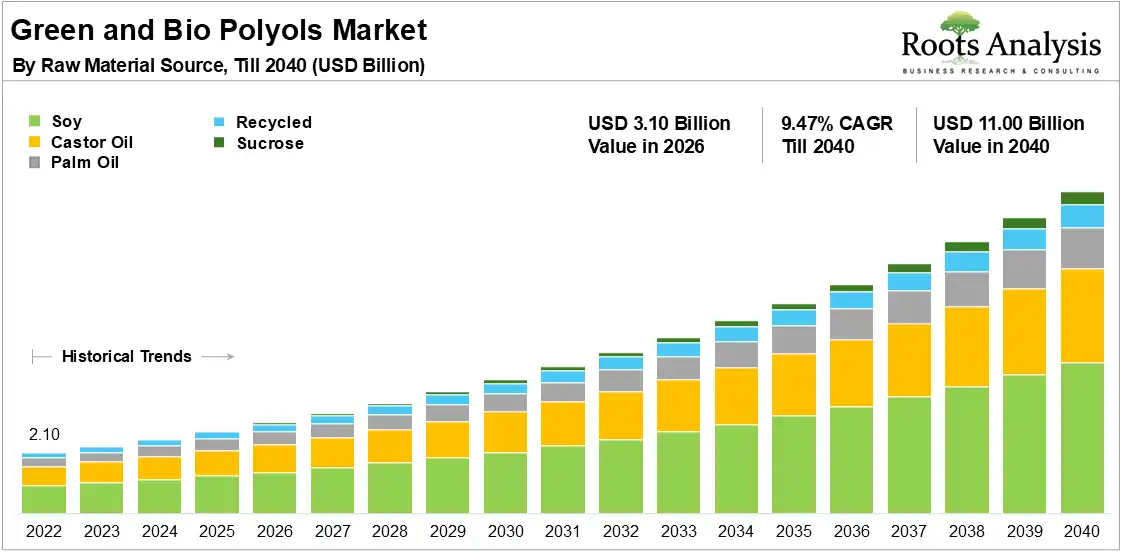
The global green and bio polyols market is projected to reach USD 3.10 billion in 2026 and USD 11.00 billion by 2040, representing a CAGR of 9.47% during the forecast period 2026 to 2040.
See What’s in the Full Report – Request Your Complimentary Insights!
The green and bio polyols market represents a critical shift toward sustainable chemical building blocks derived from renewable feedstocks like vegetable oils, agricultural residues, and algae. These advanced materials serve as direct replacements for conventional petroleum-based polyols, primarily functioning as essential precursors in the manufacturing of polyurethane. By integrating these bio-derived alternatives, industries (such as construction, automotive, and coatings) can significantly lower their carbon footprints while advancing material circularity. This transition establishes a more resilient supply chain that aligns industrial output with long term environmental stewardship and resource efficiency.
Global expansion is currently fuelled by rigorous environmental mandates and corporate environmental, social, and governance (ESG) commitments that prioritize the reduction of indirect scope 3 emissions. The demand for bio-based solutions is accelerating within the construction sector for rigid foam insulation and throughout the automotive industry for sustainable interior components. Market momentum is further sustained by the rising adoption of circular economy models across the coatings, adhesives, sealants, and elastomers segment.
Global green polyols industry outlook remains highly optimistic, supported by increasing cross-industry collaboration and sustainability-driven innovation. For instance, automotive OEMs have entered strategic partnerships to incorporate substantial volumes of bio-based materials into vehicle manufacturing in support of their ambitious decarbonization goals. Future market growth depends on achieving cost performance parity with fossil fuel incumbents through sophisticated catalysis and streamlined process optimization. Research and development are increasingly focused on valorising industrial byproducts and waste streams to ensure a diversified and scalable feedstock supply.
Market Report: Key Takeaways
- Leading Players Competitive Footprint: Leading players such as Arkema, BASF, Cargill, Covestro, Dow, Evertis, Evonik, Huntsman, Koch, LyondellBasell, Mitsui Chemicals, Piedmont Chemical Industries, PolyGreen, Global Chemical, ReNew15, Repsol, Reverdia, Sekisui, and Stepan hold strong market positions with extensive geographic presence in various regions.
- Startup Ecosystem and Innovation Hotspots: Early-stage companies are focusing on biotech innovations for sustainable, bio-based polyols as petroleum-free alternatives amid regulatory pressures. These startups advance microbial fermentation, algae derived feedstocks, and plant-based processes to produce high performance polyols for foams, coatings, and adhesives.
- Regional Penetration and Adoption Trend: North America is witnessing strong adoption of green and bio polyols driven by strict environmental regulations, advanced infrastructure, and demand in sectors such as (automotive, construction, and furniture). China and India dominate the regional market supported by biopolymers in construction and manufacturing.
- Factors Propelling Furniture & Bedding Market Segment: Market research report on green and bio polyols industry indicates that, in terms of market distribution by end use industry, furniture & bedding accounts for the largest market share 38.00%, while automotive segment is expected to grow at fastest CAGR of 11.00%. This dominance is supported by the aggressive "decarbonization of interiors" mandates and the need for low-VOC (volatile organic compound) materials to meet rising interior air quality standards in electric vehicles (EV).
- Opportunities in Green and Bio Polyols are driven by waste-derived feedstocks, EV material integration, green building demand, and advanced bio-conversion technologies improving cost, scalability, and performance accelerating adoption across industries.
Recent Industry Developments
- October 2025: Covestro announced the launch of a new range of sustainable bio-based polyols for rigid foams aimed at improving insulation performance and reducing environmental impact in construction applications.
- September 2025: Dow introduced new bio-based polyols under its VORATRON portfolio specifically designed for high-performance applications in the automotive and construction sectors emphasizing sustainability and circularity.
- August 2025: BASF and Univar Solutions finalized a joint development agreement to create new bio-based polyurethane systems utilizing BASF's polyols for high-performance industrial coatings.
- June 2025: Cargill expanded its product portfolio with a new series of bio-polyols designed for sustainable coatings and adhesives, delivering improved performance while supporting carbon footprint management.
Pay Only for What You Need – The Best Way to Optimize
Market Dynamics
Key Market Drivers
- Stringent Decarbonization Mandates and Regulatory Alignment: Global regulatory frameworks, including the EU green deal and North American sustainability directives, are compelling downstream sectors to mitigate scope 3 emissions. Bio-polyols provide a strategic mechanism for the automotive and construction industries to reduce embodied carbon within foams, coatings, and adhesives ensuring compliance while securing a competitive advantage in a carbon constrained market.
- Shift in Consumer Sentiment Toward Value Chain Transparency: Increasing consumer advocacy for environmental accountability is reshaping B2B procurement strategies in the sectors (furniture, footwear, and electronics) placing greater emphasis on building sustainable polyols supply chain. This pressure is compelling brand owners to prioritize bio-based inputs over conventional petrochemicals with bio-polyols emerging as a key differentiator to meet stringent sustainability audits and evolving retail expectations.
- Macroeconomic Advantage Amidst Petrochemical Volatility: The evolving green and bio polyols market trends and drivers reflect a notable shift in cost dynamics, as the historic price for bio-based chemicals continues to narrow amid persistent geopolitical tensions and supply-chain volatility in crude oil markets. By leveraging renewable agricultural feedstocks such as (castor and soybean oil) manufacturers can improve cost predictability and protect margins from the price fluctuations typical of fossil fuel dependent value chains.
Market Challenges
- Fragmentation of Global Regulatory and Sustainability Standards: The lack of a harmonized global definition for sustainable or bio-based materials is a key consideration in sustainable chemistry market analysis that creates a complex operating environment for international manufacturers. Divergent regional regulations and certification frameworks hinder product standardization, increase administrative burdens, and introduce uncertainty pursuing multi-regional market entry and expansion strategies.
- Competitive Pressure from Chemically Recycled Polyols: The rise of the circular economy has positioned recycled polyols (R-polyols) derived from the chemical recycling of polyurethane waste, as a direct competitor. In certain markets, R-polyols may offer a more cost-effective or preferred solution for waste reduction targets, potentially siphoning investment away from renewable, and bio-based feedstock development.
- Long Term Performance Validation and Compliance Management: Producers face the challenge of guaranteeing the multi-decadal durability of bio-polyols in structural applications, where long term material integrity is non-negotiable. Simultaneously, the burden of maintaining evolving certifications such as ISCC or USDA Bio Preferred adds layers of operational complexity and cost, necessitating continuous monitoring of the entire upstream and downstream value chain.
Market Share Insights
Market Share by Type of Product: Polyether Polyols Hold the Largest Market Share
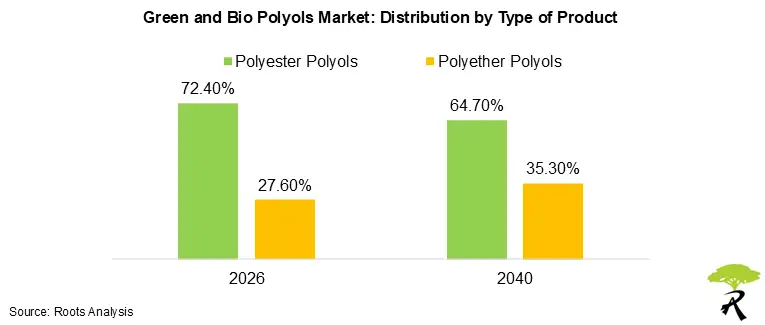
- The structural reallocation of market share within the bio-polyol sector is shifting from polyether toward polyester variants and is primarily dictated by the disparate maturity levels of their respective renewable feedstock supply chains and the resulting impact on the cost curve.
- In 2026, the polyether polyols remain the high-volume incumbent (capturing a market share of 72.4%) due to their ubiquity in flexible polyurethane foams for the automotive and furniture sectors, their growth is constrained by the technical and capital-intensive hurdles associated with scaling bio-propylene oxide. Consequently, their CAGR of 8.3% trails the overall market as manufacturers struggle to achieve price parity with fossil-based equivalents without significant scale-up of direct oxidation technologies. .
- On the other hand, polyester polyols are gaining significant share and are projected to grow at a relatively faster pace (CAGR of 11.10%) through 2040, bolstered by the commercial stabilization of building blocks like bio-succinic acid, bio-sebacic acid, and bio-BDO, which allow for a more competitive total cost of ownership in high-performance elastomers and rigid insulation. This shift is further catalyzed by the January 2025 implementation of the EU’s updated Ecodesign for Sustainable Products Regulation (ESPR), which has specifically tightened green content requirements for construction materials, favoring the rapid adoption of bio-polyester rigid foams for thermal efficiency.
Market Share by Geographical Regions: North America to Dominate the Industry and Asia Pacific Grow Rapidly through 2040
- The regional analysis suggests that North America is expected to hold the largest green and bio polyols market share of 34.00%, while Asia Pacific is expected to witness the fastest CAGR.
- North America’s dominance is driven by strong manufacturing infrastructure, stringent environmental regulations, and high adoption of sustainable materials in key end use industries such as (automotive, construction, and furniture).
- The Asia Pacific region is experiencing the fastest growth in the green and bio polyols market due to rapid industrial development, increasing emphasis on sustainability, and expanding production capacities, particularly in China and India. At the same time, rising demand for renewable applications such as (lightweight materials and energy-efficient insulation) is accelerating the adoption of green and bio polyols within the automotive industry.
Want Information on Specific Region / Segment?
Market Ecosystem Insights
Leading Players Competitive Footprint
Competitive analysis of green and bio polyols manufacturers include giants, such as Arkema, BASF, Cargill, Covestro, Dow, Evertis, Evonik, Huntsman, Koch, LyondellBasell, Mitsui Chemicals, Piedmont Chemical Industries, PolyGreen, Global Chemical, ReNew15, Repsol, Reverdia, Sekisui, and Stepan, which hold strong market positions through their extensive product portfolios and global reach.
Collaborations, partnerships, product launch and expansions remain key growth strategies, with players like Cargill launching a new line of bio-based polyols derived from a proprietary vegetable oil source targeting application in (coatings, adhesives, sealants, and elastomers).

Startup Activity and Innovation Hotspots
The green and bio polyols market competitive landscape is rapidly evolving, marked by a surge in early-stage startup activity, particularly among Germany and Netherlands that are focusing on scaling up production and supply chain enhancements for bio-based chemicals. These companies are developing natural and bio-based alternatives to address regulatory pressures, rising demand for end use industry such as (construction, automotive and furniture & bedding).
Recent start up launches include examples, such as Evertis launching a new line of bio-based resins derived from renewable feedstocks and waste materials, targeting sustainable packaging and construction materials including polyol derivatives. Similarly, Reverdia focused on bio-succinic acid production and continued to expand its application focus by offering bio-based building blocks for polyol synthesis in coatings and adhesives. Innovation hub spots are expanding rapidly mainly in North America driven by established production and supply chains with major chemical manufacturers.
Funding and Investment Momentum
The green and bio polyols market has seen robust funding and investment momentum. Investment flows primarily from sustainability regulations, corporate venture capital, and strategic private equity. These funds cater to the expanding demand for strong market growth projections and supportive policies rather than a primary focus on bio-based polyols.
Key investors, including companies such as Global Chemical invested in ReNew15 to scale production of advanced recycling polyols derived from waste plastics. For instance, Covestro secured government funding in Germany for research and development to further optimize its technology for producing polyols from carbon dioxide.
Overall, sustained government initiatives and grant funding are strengthening the momentum of sustainability driven investment in the green and bio polyols market. Europe’s focus on green chemistry, North America’s support for R&D through sustainability programs like DOE’s bio-energy technologies, and Asia-Pacific’s capital deployment toward manufacturing scale-up amid surging demand for bio-based polyurethanes accelerating growth and a robust investment outlook for the sector.
Your Business is Unique – Why Shouldn’t Your Report Be?
Green and Bio Polyols Market: Scope of the Report
| Key Report Attributes | Details | |
| Historical Trend | Since 2022 | |
| Forecast Period | Till 2040 | |
| Market Size 2026 | $ 3.10 Billion | |
| Market Size 2040 | $ 11.00 Billion | |
| CAGR (Till 2040) | 9.47% | |
| Segments Covered |
|
|
Market Segmentation
Based on research, we have segmented the green and bio polyols market into type of product, raw material source, application, end use industry, geographical regions, and key players.
Market Share by Type of Product
- Polyether Polyols
- Polyester Polyols
Market Share by Raw Material Source
- Castor Oil
- Palm Oil
- Recycled
- Soy
- Sucrose
Market Share by Application
- Adhesives
- Coatings
- Elastomers
- Flexible Foam
- Rigid Foam
- Sealants
Market Share by End Use Industry
- Automotive
- Construction
- Footwear
- Furniture and Bedding
- Packaging
Market Share by Geographical Regions
- North America
- US
- Canada
- Mexico
- Rest of North America
- Europe
- Austria
- Belgium
- Denmark
- France
- Germany
- Ireland
- Italy
- Netherlands
- Norway
- Russia
- Spain
- Sweden
- Switzerland
- UK
- Rest of Europe
- Asia-Pacific
- Australia
- China
- India
- Japan
- New-Zealand
- Singapore
- South Korea
- Rest of Asia-Pacific
- Latin America
- Brazil
- Chile
- Colombia
- Venezuela
- Rest of Latin America
- Middle East and Africa (MEA)
- Egypt
- Iran
- Iraq
- Israel
- Kuwait
- Saudi Arabia
- UAE
- Rest of MEA


