


 Download Free Sample
 Buy Now
Hot Melt Adhesives Market Size and Outlook
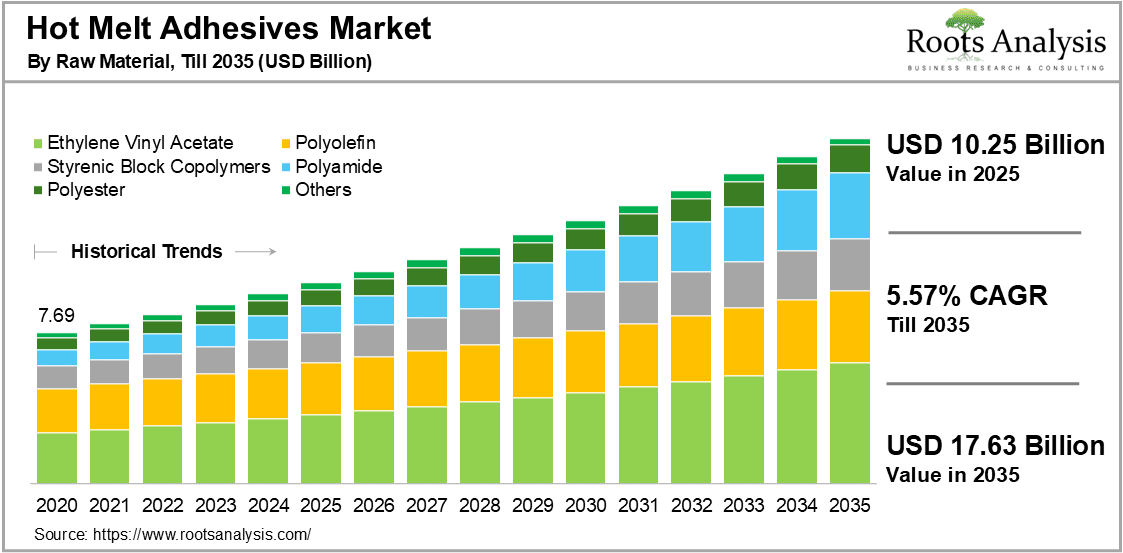
The global hot melt adhesives market size is expected to rise from USD 10.25 billion in 2025 to USD 14.19 billion by 2030, and USD 17.63 billion by 2035, representing an overall CAGR of 5.57% till 2035.
See What’s in the Full Report – Request Your Complimentary Insights!
Hot melt adhesives are a class of adhesives that are applied in a molten-hot state and rapidly solidify upon cooling to create strong bonds between various substrates. Characterized as thermoplastic materials, they do not contain solvents or water carriers, which allow them to bond surfaces efficiently with minimal environmental impact.
These adhesives find extensive use across diverse industries due to their versatility and rapid bonding properties. Their ability to quickly form durable and solvent-free bonds makes them essential for various applications, including high-speed production lines, automated manufacturing systems, including hot melt adhesive innovations in electronics manufacturing, packaging, woodworking, construction, bookbinding, and footwear.
The growth of the hot melt adhesives market is driven primarily by technological advancements and increasing sustainability concerns. Innovation in high-performance hot melt bonding as well as increasing demand for sustainable and bio-based hot melt adhesives is pushing manufacturers to develop adhesives with lower volatile organic compounds (VOCs) in compliance with global environmental regulations.
For instance, in February 2025, Power Adhesives launched new biodegradable bulk adhesive named Tecbond 110B-PR, which comes from the family of low-viscosity, high-speed packaging adhesives designed for high-speed case sealing and carton closing.
In context to this launch, Brendan Colgan, chief executive officer of Power Adhesives, said, “The launch of Tecbond 110B-PR is an exciting step in expanding our biodegradable adhesive offering. Designed for high-speed packaging lines, it combines the efficiency and cost benefits of bulk adhesives while giving customers an environmentally responsible solution that performs exceptionally while supporting their sustainability goals.”
Recent Developments in the Hot Melt Adhesives Market
- In August 2025, Henkel launched a hot melt adhesive, Technomelt EM 335 RE, for PET bottle labelling.
- In August 2025, Baumer HHS introduced Xmelt fusion range for hot melt applications, enabling customers to optimize their processes in packaging industry.
- In June 2025, Researchers from Beijing Forestry University developed a hot-melt adhesive derived from xylan and industrial leftovers, which outperformed commercial adhesives.
Hot Melt Adhesives Market Segmentation Insights
The hot melt adhesives market report presents an in-depth analysis of the various companies that are involved in offering hot melt adhesives across different segments, as defined in the table below:
Hot Melt Adhesives Market: Report Attributes / Market Segmentations
| Key Report Attributes | Details | |
| Historical Trend | Since 2020 | |
| Forecast Period | Till 2035 | |
| Market Size in 2025 | $10.25 Billion | |
| Market Size in 2035 | $17.63 Billion | |
| CAGR (Till 2035) | 5.57% | |
| Raw Material |
|
|
| Application |
|
|
| Geographical Regions |
|
|
| Leading Market Players |
|
|
| PowerPoint Presentation (Complimentary) | Available | |
| Customization Scope | 15% Free Customization | |
| Excel Data Packs (Complimentary) |
|
|
Pay Only for What You Need – The Best Way to Optimize
Hot Melt Adhesives Market Share Insights
Hot Melt Adhesives Market Forecast Estimates Suggest the Dominance of Ethylene Vinyl Acetate Sub-Segment
The Ethylene-vinyl Acetate (EVA) sub-segment is set to have the highest market share of 35.70% and a CAGR of 7.55% in the current global market. The EVA hot melt adhesives market’s growth is driven by its excellent adhesion properties and flexibility, making it suitable for use in various applications.
Industries, such as footwear, packaging, automotive, and construction are increasingly opting for EVA-based adhesives due to their effectiveness and reliability. For instance, in May 2025, Borealis introduced a renewables-based ethylene vinyl acetate (EVA) grade designed for shoe wear midsoles.
Other than that, the styrenic block copolymers (rubber) sub-segment is expected to show the highest growth rate during the forecast period, fueled by unique combination of flexibility, resilience, strength, and durability in these materials. They are particularly used to improve the performance of hot melt adhesives in products, such as labels and tapes which require pressure sensitive hot melt adhesives.
Which Application of the Hot Melt Adhesive Market will have the Fastest Growth?
According to hot melt adhesives industry analysis, the nonwoven sub-segment will have the fastest growth during the forecast period.
The nonwoven hot melt adhesives market growth can be attributed to the growing concerns regarding personal hygiene and increasing disposable income, which is leading to higher demand for hot melt adhesives for hygiene products, such as diapers and feminine hygiene items.
On the other hand, the packaging adhesives market is expected to have the highest market share. This large revenue share is driven by the extensive use of hot melt adhesives in various packaging applications, including polyolefin-based hot melt adhesives for labeling, case and carton sealing, tray forming, and labeling.
Additionally, the increasing demand for biodegradable hot melt adhesives for sustainable packaging, driven by the growth of e-commerce, is also significantly contributing to the growth trend of packaging hot melt adhesives.
Asia-Pacific to Lead the Hot Melt Adhesives Market with the Highest Market Share
The hot melt adhesives market in Asia-Pacific accounted for the highest share (49.02%) during the current market year.
Asia-Pacific (APAC) region benefits from the ongoing rapid industrialization and a strong presence of manufacturers in packaging, automotive, and construction sectors. The expanding middle class population in APAC is also simultaneously driving the demand for consumer goods, increasing the need for effective adhesive solutions.
Want Information on Specific Region/Segment?
Hot Melt Adhesives Market Trends and Key Takeaways
The “Hot Melt Adhesives Market: Industry Trends and Global Forecasts, Till 2035” report features an extensive study of the current market landscape, market size, and future opportunity within the global hot melt adhesives market, during the forecast period. Key takeaways of the market report are briefly discussed below.
Competitive Landscape of Hot Melt Adhesives Market Players
The hot melt adhesives market is highly competitive, with major global players leading through strong R&D, innovation, and sustainability initiatives. The market is characterized by continuous technological advancements in eco-friendly, low-temperature, and reactive adhesives, with strategic expansions focused on fast-growing regions like Asia-Pacific.
For instance, in October 2024, Henkel invested EUR 20 million in the expansion and modernization of the adhesive plant in Bopfingen. In reference to this Sven Trzcielinski explained, “With these investments, we want to improve the infrastructure in a targeted way and also expand our production capacities. In the coming months, we will manufacture a variety of new products here to meet the increasing demands of our customer industries.”
Hot Melt Adhesives Market Dynamics
What are the Key Drivers of the Hot Melt Adhesives Market?
The hot adhesives market growth is due to several key drivers. Here are some significant factors contributing to this expansion:
- Surge in Packaging and E-commerce Demand: Hot melt adhesives play a critical role in packaging, case and carton sealing, labels, and flexible packaging, segments that are experiencing robust growth due to the global expansion of e-commerce.
- Automotive, Electronics, and Construction Expansion: Hot melt adhesives in electronics assembly are valued for bonding, potting, and component encapsulation due to their low VOC, solvent-free properties. Continued infrastructure and building activity boost HMA use in flooring, insulation, and window / door assemblies.
- Technological Advancements in Formulations: Innovations in polymer chemistry, such as metallocene, polyolefin, bio-based HMAs, and PUR hot melt adhesives technologies have improved adhesion, heat / moisture resistance, open time, and sustainability. New low-temperature and high-performance grades expand addressable applications, including food-safe, medical, and low-VOC hot melt adhesives for hygiene products.
What are the Key Challenges in Manufacturing Hot Melt Adhesives?
The current market outlook suggests that players active in this domain are striving to overcome various obstacles in market growth, which are as follows:
- Volatility in Raw Material Prices: HMAs depend on polymers, resin, and waxes, many derived from petrochemicals. Price fluctuations and supply chain dynamics in hot melt adhesives industry impact costs, especially for smaller converters and regional players with limited procurement power.
- Performance Limitations in High-Temperature or Load-Bearing Applications: HMAs have inherent thermal thresholds and typically lower load / creep resistance than epoxies or other reactive hot melt adhesives. This restricts their use in applications demanding high strength or extreme temperature durability.
- Competition from Alternative Adhesive Technologies: Reactive, waterborne, and solvent-based adhesives may outperform HMAs in specialty or legacy applications, with some segments resistant to change due to qualification burdens or cost perceptions.
Reactive Hot Melt Adhesives for Woodworking and Furniture
Reactive hot melt adhesives, especially PUR-based, are widely used in woodworking and furniture for their strong initial tack, rapid setting, and excellent durability and resistance to moisture and heat. These adhesives provide long-lasting bonds to wood, laminates, and composite materials, enabling efficient assembly and production processes.
They also provide flexibility in applications, ensuring structural integrity of assembled furniture pieces and allowing precise alignment before curing and tolerance to temperature variations and vibration.
Hot Melt Adhesives Market Trends in Bookbinding Applications
Bookbinding hot melt adhesives are being widely adopted due to their quick set, efficient application, and strong bonding to paper and cardboard in both hardcover and softcover books, magazines, and catalogs.
These adhesives are emerging as preferred materials of choice as they enable high-speed production, reduce manufacturing times while ensuring the structural integrity of the bound materials. Their excellent adhesion to various paper types, including coated and glossy sheets, contributes to the durability and longevity of finished products.
Hot Melt Adhesives for Nonwoven Fabric Laminations
Hot melt adhesives are widely applied in nonwoven fabric laminations using coating or dot application methods, enabling fast, efficient, and environmentally friendly bonding without drying equipment. Hot melt lamination adhesives are preferred for hygiene products, medical disposables, and apparel due to their flexible, soft bond and strong peel strength.
Additionally, hot melt adhesives accommodate high-speed production processes, adapting well to the lightweight and breathable nature of nonwoven fabrics. Their solvent-free composition also reduces emissions and energy consumption, aligning with increasing regulatory and sustainability demands.
Unlock Deeper Insights – Schedule Your Personalized Workshop Today!
Hot Melt Adhesives Market Report Coverage
The market report presents an in-depth analysis, highlighting the capabilities of various stakeholders in the hot melt adhesives industry, across different geographies. Amongst other elements, the market report includes:
- An Infographic Executive Summary
- Market Landscape of Leading Players
- Company Competitiveness Analysis
- Startup Ecosystem Analysis
- Value Chain Analysis
- Company Profiles
- Key Winning Strategies
- In-depth View of Recent Developments
- Mega Trends
- Unmet Needs Analysis
- Patent Analysis
- Market Forecast and Opportunity Analysis
- Porter’s Five Forces Analysis
- SWOT Analysis


