Medical Disposables Market
Medical Disposables Market: Industry Trends and Global Forecast, Till 2035- Distribution by Type of Product (Wound Management Products, Drug Delivery Products, Diagnostic and Laboratory Disposables, Dialysis Disposables, Incontinence Products, Respiratory Supplies, Sterilization Supplies, Non-Woven Disposables, Disposables Masks, Disposables Eye Gear, Disposables Gloves, and Hand Sanitizers), Type of Raw Material, Application Area, End-User, Geographical Regions, and Leading Players
-
Lowest Price Guaranteed
-
Pages
199 -
Last Updated
June 2025 -
View Count
13845 -
Medical Disposables Market Overview
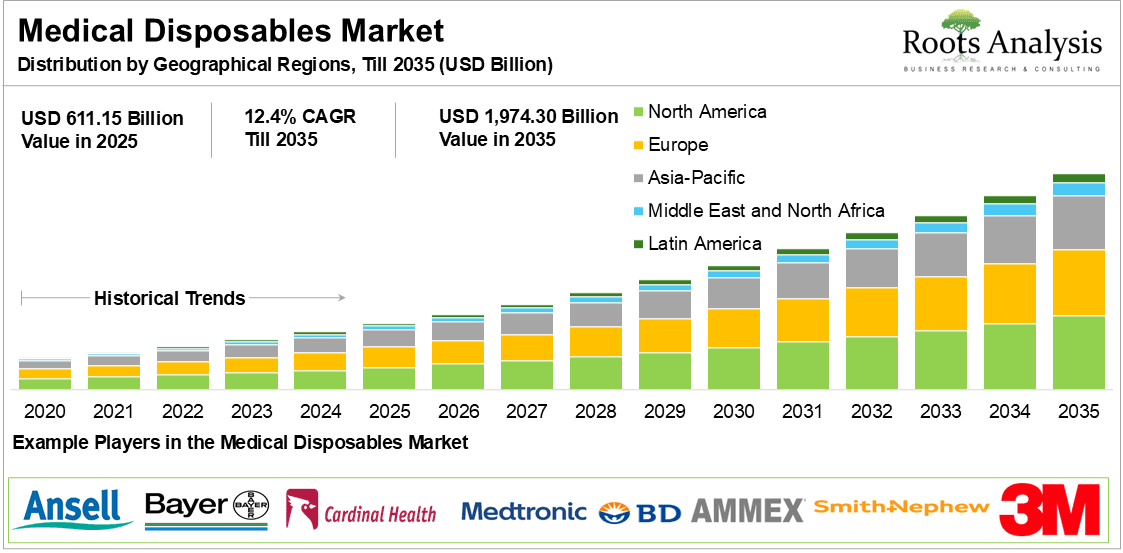
The medical disposables market is estimated to grow from USD 530.20 billion in 2024 to reach USD 611.15 billion in 2025 and USD 1974.30 billion by 2035, representing a higher CAGR of 12.4% during the forecast period.
 |
To learn more about this report, request a free sample copy
Medical disposables refers to the objects and equipment used in healthcare sector to deliver drugs, perform surgeries and other treatment task. These disposables items cover needles, medical syringes, disposable medical gloves, masks, gowns, surgical equipment, catheters, medical shoe covers and other supplies. With growing concern of hospital acquired infection, there is a surge in the demand for medical disposables to maintain hygiene and prevent infection transmission to patients.
As per the stats published in World Congress on Infectious Diseases, hospital acquired infection affects around every one out of ten patients hospitalized to the hospital that further leads to prolong hospital stay and mortality. Medical disposables play a significant role in mitigating the risk of hospital acquired infection, improving patient and healthcare staff safety during treatment.
It is important to mention that currently there is a large pool of geriatric patients experiencing chronic conditions, such as diabetes and cardiovascular disorders. According to the WHO statistics, the number of people above the age of 60 years worldwide is estimated to reach 1.4 billion by 2030. With growing age, there is a high risk of acquiring non-communicable / chronic diseases. Therefore, the growing geriatric population further necessitated the demand for medical disposables supplies to deliver efficient preventive treatment to patients.
Owing to the ongoing demand, presently, the market players are focusing on increasing their product portfolio and innovating medical disposables ranges. However, the current focus is on the development of disposables insulin patch pumps, disposables glucose monitors, disposables medical testing kits and other insulin pens.
Notable, several market players are leveraging technological advancements to develop innovative medical disposables supply range. For instance, in April 2025, Medtronic announced the approval of Simplera™ Sync Sensor to use with MiniMed 780G system. This system will offer flexibility for insulin delivery to patients and features meal detection technology. These consistent innovation and ongoing demand is likely to grow the medical disposables market at a steady pace during the forecast period.
Medical Disposables Market: Report Attributes
| Key Report Attributes | Details | |
| Historical Trend | Since 2020 | |
| Forecast Period | Till 2040 | |
| Market Size 2025 | USD 611.15 Billion | |
| Market Size 2035 | USD 1,974.30 Billion | |
| CAGR (Till 2035) | 12.4% | |
One of the key objectives of the medical disposables market report was to estimate the current size, opportunity, and the market growth potential, over the forecast period, till 2035. We have provided informed estimates on the likely evolution of the market for the forecast period.
The global market analysis report also features the likely distribution of the current and forecasted opportunity within the market across various segments, such as type of product, type of raw material, application area, end user, geographical regions, and leading players.
In order to account for future uncertainties associated with some of the key parameters and to add robustness to our model, we have provided three medical disposables market forecast scenarios, namely conservative, base, and optimistic scenarios, representing different tracks of industry’s evolution.
Medical disposables industry is currently skyrocketing due to the high demand for disposables gloves, syringes, and drug delivery systems. The current focus of industrial player will remain on enhancing the development of medical disposables sensors, needles, and other delivery systems.
Smart Implants Market: Market Segmentation
| Market Segmentations | Details | |
| Type of Product |
|
|
| Type of Raw Material |
|
|
| Application Area |
|
|
| End User |
|
|
| Geographical Regions |
|
|
| Market in North America |
|
|
| Market in Europe |
|
|
| Market in Asia-Pacific |
|
|
| Market in Middle East and North Africa |
|
|
| Market in Latin America |
|
|
The global market for medical disposables is widely influenced by the heightened demand for single use medical device, and instruments. Some of the significant trends that are shaping industrial growth includes, rising shift on sustainability, development of advanced single use drug delivery systems and technological innovations.
What Industry Experts Says On Medical Disposables Market?
Medical disposables industry is witnessing a remarkable turning point during the forecast period. Several market players are aiming to develop advanced technology integrated medical disposables to enhance disease monitoring and treatment.
Abbott, Dexcom, Insulet, Medtronic and more are developing next-gen sensors, pumps, and algorithms to offer new options for hundreds of millions of diabetes patients.
“We have much work to do as an industry to really bring to the type 2 population the technologies and brands that are pretty well covered and supplied into that smaller type 1 population,” Abbott EVP of Diabetes Care Chris Scoggins said as his company pushed forward with type 2 tech last year.
Recent Developments in Medical Disposables Market
Several recent developments have taken place in the field of medical disposables. We have outlined some of these recent initiatives below.
- In March 2025, Visby Medical™ announced that the FDA has granted De Novo authorization to its Visby Medical Women’s Sexual health test. This single use at-home testing kit enable rapid and reliable testing for sexually transmitted disease, such as Gonorrhea, Chlamydia and Trichomoniasis.
- In March 2025, Johnson & Johnson initiated a program that allow recycling of MedTech single-use products portfolio across the UK.
- In February 2025, Rockwell Medical announced that company has signed a distribution services agreement with a leading manufacturer of medical disposables products, equipment, including hemodialysis machines and automated fluid balance systems. Under this agreement, Rockwell Medical will distribute its newly launched single-use bicarbonate cartridge to its customers at hospital-based outpatient centers, dialysis centers and nursing facilities.
- In February 2025, Embola Medical developed a microstructure catheter that mimics the snake’s evolutionary advantage to improve the retrieval of blood clots that cause stroke. Its patent-pending platform known as TRAP (Thrombus Retrieval Aspiration Platform) mimics a boa constrictor’s teeth arrangement in its biometric design to grip onto blood clots without tearing them.
Medical Disposables Market Share Insights
Market Share by Type of Product: Sterilization Supplies Holds the Highest Share
- Based on the type of product, the global market is segmented into wound management products, drug delivery products, diagnostic and laboratory disposables, dialysis disposables, incontinent products, respiratory supplies, sterilization supplies, non-woven disposables, disposables masks, disposables eye gear, disposables gloves for medical use, and hand sanitizers.
- Presently, sterilization supplies segment holds 13% of the medical disposables market share. Sterilization supplies are essential to sterilize medical equipment and instrument that are consistently used for patient treatment. These sterilization supplies ensure that equipment are safe to use and pathogen free.
- However, it is worth noting that diagnostic and laboratory disposables segment is anticipating registering a higher CAGR during the forecast period. The growing number of diagnostics procedures to detect disease has increased the demand for diagnostic and laboratory disposables supplies.
Market Share by Type of Raw Material: Plastic Resin Holds the Maximum Share
- The global market is bifurcated across different type of raw material, such as plastic resins, nonwoven material, rubber, paper and paperboard, metals, glass, and others. According to the medical disposables market analysis, presently plastic resins segment is dominating the market, and the trend is likely to remain unchanged over the forecast period. Plastic resin, such as polyethylene, polyvinyl chloride and polypropylene are widely used for the production of medical disposables and medical equipment.
- In the long run, nonwoven material segment is likely to register a higher CAGR during the forecast period. Nonwoven material has shown significant efficiency in preventing bacterial transmission. Furthermore, nonwoven material based surgical disposable products, such as surgical gowns, drapes, disposable medical shoe covers and masks are also widely used to reduce the chances of cross-contamination in hospitals.
Market Share by Application Area: Cardiovascular Segment Holds the Largest Share
- On the basis of application area, the global market is categorized across cardiovascular, cerebrovascular, dental, laparoscopy, gynecology, urology, orthopedics, and other applications. According to the medical disposables market forecast, cardiovascular segment is dominating the market driven by the growing usage of medical disposables for diagnosis diseases and requirement of regular disease monitoring.
- It is worth mentioning that cardiovascular segment will continue to expand at a steady CAGR during the forecast period, driven by the high demand for disposables monitoring kits, surgical disposable products for determining disease progress.
Market Share by End User: Hospitals Segment is Dominating the Market
- Based on the end user, the global market is further sub-segmented into hospitals, home healthcare, outpatient/primary care facilities, and other end users. According to the market analysis, currently hospitals segment holds the significant medical disposables market share (over 55%). This is likely to be the result of high consumption of medical disposables supplies in hospitals to prevent the risk of hospital acquired infection.
- However, it is worth mentioning that home healthcare segment is anticipated to show lucrative growth during the forecast period. The rising preferences for remote patient monitoring and growing aging population who require constant monitoring for managing diseases are the key growth factors of this segment.
Market Share by Geographical Regions
- The global market is distributed across different geographical regions, such as North America, Europe, Asia-Pacific, Middle East and North Africa, and Latin America. According to our projection, North America is dominating the industry by holding 34.27% of the medical disposables market share. Several factors, such as growing incidence of chronic conditions, hospital acquired infection and heightened demand for advanced solutions to reduce hospital acquired infection risk are the key factors of this region.
- In Asia-Pacific, the market for medical disposables is experiencing a higher CAGR during the forecast period. The high demand for medical disposable supplies to safeguard patients from catching hospital acquired infections are the key factors fueling the market growth in this region.
Medical Disposables Market: Report Deliverables
| Report Deliverables | Details | |
| Excel Data Packs (Complimentary) |
Available | |
| Key Medical Disposables Companies Profiled | (A complete list of companies captured is available in the report) | |
| PowerPoint Presentation (Complimentary) |
Available | |
| Customization Scope | 15% Free Customization | |
Medical Disposables Market Major Takeaways
The “Medical Disposables Market: Industry Trends and Global Forecasts, till 2035” market report features an extensive study of the current market landscape, market size, market share, market growth, market trends, market value, market forecast, market outlook, statistics, and future opportunities for medical disposable companies. The market research report lays emphasis on the medical disposables that are being developed. Key takeaways of the market report are briefly discussed below.
How is the Market Landscape for Medical Disposables is Fragmented?
Notably, the current market landscape of medical disposable companies is well-fragmented, featuring the presence of several small, mid-sized and large industrial players. Majority of the industrial players, such as Abbott Laboratories, Medtronic and B. Braun, are increasing the research and development activities to develop single use medical supplies for disease diagnosis and treatment. In order to leverage competitive edge, several industrial players are undertaking strategic initiatives, such as latest product launch, collaborations, and partnerships.
For instance, in April 2025, Abbott and Medtronic signed a collaboration agreement aiming to develop continue glucose monitoring technology that will use FreeStyle Libre sensors (disposables sensor) from Abbott and work seamlessly with Medtronic’s smart insulin delivery systems and software.
How big is the Opportunity for Medical Disposable Companies?
The medical disposables market size is estimated to reach USD 1974.30 billion by 2035, representing CAGR of 12.4% during the forecast period. Majority of this growth will be driven by North America, essentially owing to an established healthcare system that focuses on improving efficiency of healthcare delivery. The market for medical disposables, specifically gloves, masks and PPE kits also saw a multi-fold increase during the COVID-19 pandemic.
What are the Major Medical Disposables Market Drivers?
Heightened Demand for Single-Use Medical Devices
The growing preferences for single-use medical devices across healthcare personnel to minimize the risk of hospital acquired infection are the key growth driver of the market for medical disposables. Additionally, industrial players are focusing on the manufacturing of disposable medical sensors for disease monitoring and tracking, which is further expected to be a key driver for the market.
Growing Incidence of Chronic Condition
It is worth mentioning that the rising incidence of chronic conditions, such as diabetes, and cardiovascular diseases are proliferating the demand for single-use medical devices to avoid the risk of infection during treatment.
What are the Challenges in the Medical Disposables Industry?
High Waste Generation
Medical disposables specifically for single use generate enormous amounts of wastage. Large amount of medical disposables waste may create a significant impact on the environment. Thus, high waste generation is a major concern for market players.
Regulatory Hurdles
Furthermore, complex guidelines for the approval of medical disposables may hinder the market progress during the forecast period. In order to accelerate the approval process, industrial players are required to adhere with regulatory guidelines.
What are the Key Trends of the Medical Disposables Market?
Introduction of Smart Medical Disposables
Despite challenges, the disposable medical devices market is continually growing driven by several factors. Currently, the market players are focusing on the development of smart and connected disposables. The integration of IoT sensors, AI technology and biosensors helps to track patient data in real time for precise care. For instance, recently launched medical disposables glucose monitoring devices, namely Simplera feature Simplera Sync™ sensor that helps to manage diabetes by offering real-time glucose parameters.
Moreover, the industrial players are aiming to develop smart autoinjectors for self-administration of doses. In addition, the current smart autoinjectors market players are integrated AI and IoT sensors to enhance dosage precision, thereby reducing the requirement of healthcare personnel for dosage administration.
Advanced Sterilization Disposables and Single Use Kits
Moreover, the industrial players are consistently focusing on the development of single-use disposables kits, single-use medical sensors and disposables insulin delivery devices and disposables insulin pens. These single use kits help to reduce the chances of infection during drug delivery and diagnosis.
Medical Disposables Report Coverage
The market report presents an in-depth analysis, highlighting the capabilities of various stakeholders in the medical disposables industry, across different geographies. Amongst other elements, the market report includes:
- An Infographic Executive Summary
- Market Landscape of Medical Disposables Providers
- Company Competitiveness Analysis
- Company Profiles
- SWOT Analysis
- Market Impact Analysis
- Market Forecast Analysis
From the Author’s Desk
Author’s View on Medical Disposables Market
Medical disposables industry is rapidly growing due to the unprecedented demand for single-use medical supplies. Several factors that are driving the industry includes rising technological innovations to make single-use medical kits, surgical disposable products more advanced and sustainability. Furthermore, the consistent efforts of industrial players, such as Johnson & Johnson and Medtronic are developing innovative single use drug delivery systems and are the key factors driving industrial growth.
Glossary
- Medical Disposables: These are equipment and medical supplies, such as catheters, single-use medical kits, gloves, needles, and mask designed to reduce the risk of hospital acquired infection during patient treatment.
- Single-Use Medical Kits: It covers a broad range of products, such as single use bandage, prefilled syringes, masks and diagnosing kits specifically designed to diagnose disease, and treat injuries.