Market Size
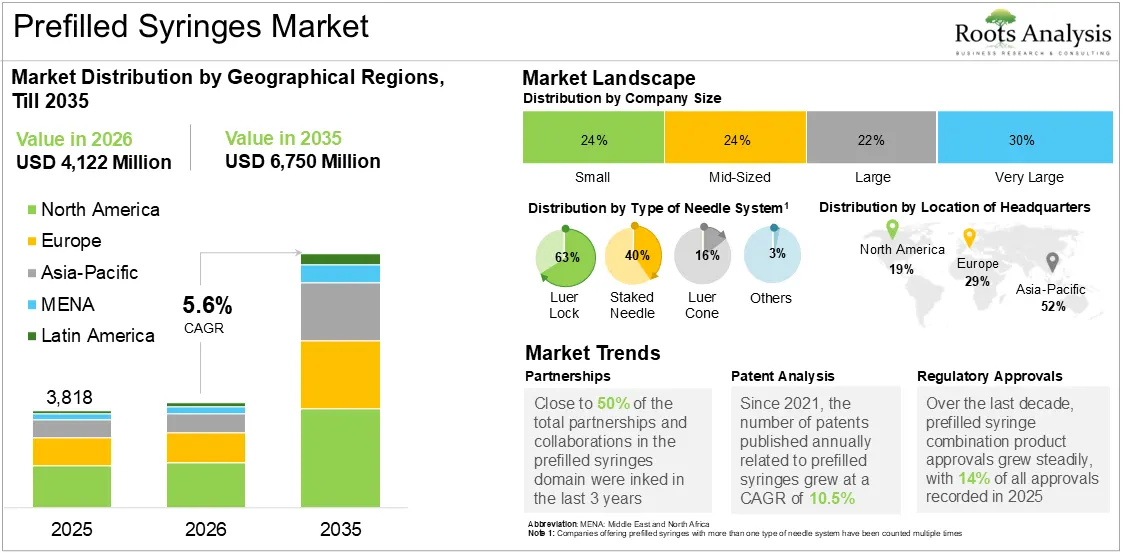
The global prefilled syringes market, valued at USD 3,818 million in 2025, is projected to reach USD 4,122 million in 2026 and USD 6,750 million by 2035, representing a CAGR of 5.6% during the forecast period 2026 to 2035.
To learn more about this report, request a free sample copy
Market Report: Key Takeaways
- Driven by the rising demand for self-administered treatments for chronic conditions, therapeutic syringes currently capture the highest share, securing close to 60% of the global prefilled syringes market.
- In terms of type of molecule, antibodies hold the highest share, capturing more than 60% of the current market, driven by the increasing development and adoption of monoclonal antibodies for targeted therapies.
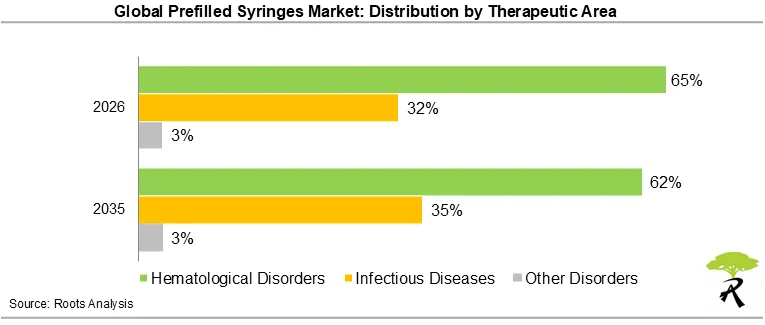
- In terms of therapeutic area, the market for hematological disorders is likely to capture the highest share (more than 65%) of the global prefilled syringes industry in 2026 due to the high volume of anticoagulants and blood stimulants standardized for delivery via prefilled formats.
- Based on the type of barrel fabrication material, glass prefilled syringes account for nearly more than 85% of the current market mainly due to their superior barrier properties and long-term stability with sensitive biologics
- Considering the number of chambers, single chamber currently hold the higher share (around 70%) of the market, owing to their lower manufacturing complexity and established compatibility with liquid formulations.
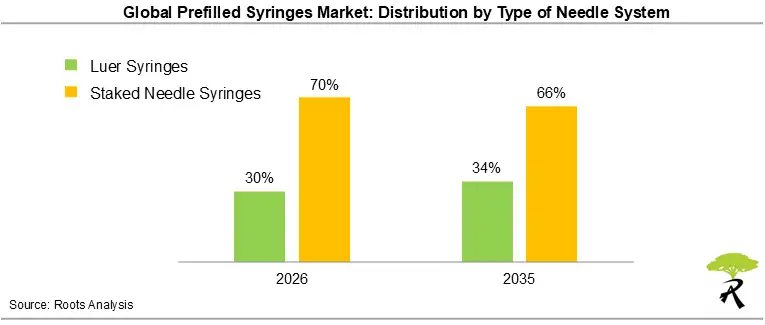
- In terms of type of needle system, staked needle syringes dominate the current market, capturing 70% of the prefilled syringes market share as they provide more convenient, pre-attached design that minimizes drug wastage and ensures easier administration for end-users.
- Based on usability of the syringe, disposable syringes are likely to account for a higher market share (~80%) by 2035, driven by the increasing clinical emphasis on patient safety and the widespread adoption of single-use devices for self-administration.
- In terms of type of syringes, safety syringes hold the higher share by securing more than 65% of the current market share, driven by stringent regulatory mandates aimed at reducing needle-stick injuries and rising demand for integrated safety features in self-administered therapies.
- With respect to the type of packaging, nested syringes hold a higher share, capturing more than 80% of the overall market share 2026, driven by the increasing demand for ready-to-fill formats that streamline the manufacturing process.
- In terms of geographical regions, Europe currently holds the highest share by securing close to 35% of the market share, driven by a widespread adoption of injectable biologics along with a well-established healthcare infrastructure in this region.
Market Overview
The administration of injectable therapies has undergone a significant transformation in recent years, driven by the need for safer, more convenient, and patient-centric drug delivery systems. Traditional vial-and-syringe methods, while widely used, often involve multiple preparation steps, increasing the risk of dosing errors and contamination. In response, pre-filled syringes have emerged as an efficient alternative, offering ready-to-use pharmaceutical packaging that simplifies administration and enhances reliability across both clinical and home care settings.
The prefilled syringes market size is expanding steadily, supported by the increasing requirement for self-administration and the rising prevalence of chronic conditions. The growing incidences of diabetes, rheumatoid arthritis, and cardiovascular diseases necessitate long-term injectable therapies. Further, demographic shifts toward aging populations increase the number of patients requiring treatment in home care settings.
Pre-filled syringes have become the preferred primary packaging format for biologics and GLP-1 obesity therapeutics among major pharmaceutical manufacturers. Moreover, industry players are integrating smart technologies such as radio-frequency identification (RFID) tags for inventory management and large volume formats to accommodate emerging large dose therapies.
Recent Developments
- In January 2026, Becton, Dickinson and Company announced an investment worth USD 110 million to expand its manufacturing operations in Nebraska aiming to increase the production capacity for high-quality prefillable syringes specifically designed for biologic drugs.
- In January 2026, Credence MedSystems entered into a commercial supply agreement with a major global pharmaceutical company for its Credence Companion safety syringe system.
- In January 2026, West Pharmaceutical Services launched the West Synchrony S1 prefillable syringe system to provide a fully verified drug delivery platform for biologics and vaccines.
- In December 2025, Fresenius Kabi expanded its Simplist portfolio with the introduction of two new ready-to-administer prefilled syringes for critical care medications.
Prefilled Syringes Market Trends
- Partnerships and Collaborations: The prefilled syringes industry is witnessing several partnerships, which is driving growth in this market. For instance, market players, such as Credence MedSystems and Becton, Dickinson and Company, are increasing collaborations to expand their portfolio. Likewise, several market players are entering into collaborations for development and manufacturing of prefilled syringes.
- Recent Expansions: In recent years, prefilled syringe manufacturers have undertaken several expansions to strengthen their portfolios, with majority of the expansions focused on increasing their manufacturing capacities. For instance, Becton, Dickinson and Company executed a series of expansions at its facility in Nebraska, including a USD 35 million investment in August 2025 to scale up production for its PosiFlush prefilled flush syringes, followed by a 110 million USD investment in January 2026 to introduce local manufacturing for its Neopak glass prefillable syringe platform.
- Growing Emphasis on Plastic Syringes: The adoption of plastic prefilled syringes made from cyclic olefin polymers (COP) and cyclic olefin copolymers (COC), is steadily increasing due to their enhanced break resistance and superior chemical compatibility for sensitive biologics.
- Technological Innovation: The industry has several ongoing technological advancements aimed at optimizing drug stability and patient compliance. For instance, plungerless prefilled syringes are being developed that eliminate conventional plunger rods to minimize silicone oil reliance and lower contamination risks. Likewise, several innovations are emerging in this market, such as dual-chamber systems for the automated reconstitution of lyophilized biologics and the integration of smart connectivity features for precise dosage tracking. Within the broader cluster, biologics fill finish manufacturing services are relevant through the direct outsourced downstream operation, making this paragraph an appropriate contextual placement for the internal link.
- Current Global Demand for Prefilled Syringes Exceeds 4.8 Billion Units: This is due to the increasing prevalence of chronic diseases requiring long-term injectable therapies, a growing shift toward self-administration in home care settings, and the rapid expansion of the biologics and biosimilar market.
Industry Experts on Prefilled Syringes Market
The drug delivery landscape remains heavily anchored in established primary packaging formats, as the technical and regulatory complexities of validating novel closure systems often conflict with the industry's need for efficient clinical timelines. Jesse Fourt (Senior Portfolio Director, IDEO) highlights this trend stating: “I think that the inertia in this domain is likely to continue to motivate industry stakeholders to use prefilled syringes over other containers. Given the development timelines of the pharmaceutical companies, it is often challenging to bring a new container-closure system for a new drug molecule.”.
Discussions with multiple stakeholders in this domain influenced the opinions and insights presented in this study. The market report includes detailed transcripts of interviews conducted with the following individuals:
- Founder and Chief Technology Officer, Mid-sized Organization, United Kingdom
- Chief Operating Officer, Very Large Organization, India
- Chief Executive Officer, Small-sized Medical Device Company
- Former Chief Commercial Officer, Large Organization, Germany
- Senior Director, Product Technology Services and Former Director, Pharmaceutical Delivery Systems Marketing, Very Large Organization, United States
- Former Head of R&D and Product Strategy, Mid-Sized Organization, Switzerland
- Senior Portfolio Director, Large Organization, United States
In addition, the market report includes transcripts of the following other third-party discussions:
- Founder, President and Chief Executive Officer; Chief Commercial Officer, Small Company, US
- Executive Director, Small Company, Canada
- President; Chief Commercial Officer, Mid-sized, US
- President and Co-founder, Small Company, US
- Director of Scientific Affairs, Large Company, US
- Senior Director of Drug Product Compliance, Large Company, South Korea
- Vice President of Global Operations; Vice President of Global Market Development, Very Large Company, US
- Head of Portfolio Strategy and Management, Small Company, US
- Senior Manager Regulatory Affairs, Very Large Company, US
- Technical Product Manager, Very Large Company, US
Market Drivers
- Increasing Demand for Biologics and Biosimilars: The pharmaceutical industry is experiencing a significant shift toward large molecule therapies that require specialized primary packaging for stability. Prefilled syringes ensure optimal drug-container compatibility for sensitive biological drugs while minimizing the need for overfill compared to traditional vials. This efficiency in drug utilization and compatibility with complex protein formulations is likely to act as a pivotal driver for sustained market expansion throughout the forecast period.
- Growing Preference for Self-Administration: There is a rising trend toward home-based healthcare among patients living with chronic conditions such as diabetes and rheumatoid arthritis. Prefilled syringes simplify the injection process and reduce the risk of dosing errors or contamination associated with manual preparation. Consequently, healthcare providers are increasingly adopting these delivery systems to improve patient adherence and reduce the operational burden on clinical facilities.
Market Segmentation Analysis
Rising Adoption of Dual Chamber Prefilled Syringes
- According to the prefilled syringes market forecast, the overall market is segmented into single and dual chamber prefilled syringes. Based on our estimates, single chamber sub-segment account for 70% of the global market.
- This is due to their streamlined manufacturing processes and cost-effective production, making them ideally suited for stable liquid formulations such as vaccines, insulin, and various biologics that do not require reconstitution or mixing prior to administration. However, the dual chamber prefilled syringes market is anticipated to grow at a CAGR of 7.5%
Staked Needle Syringes Set to Lead the Pre-filled Syringes Market
- The global prefilled syringes market is split across different types of needle systems, namely staked needle syringes, and luer syringes. The staked needle syringes account for 70% of the current market share.
- This is due to the fact that these syringes offer convenience, pose low risk of needle detachment and healthcare providers prefer them in emergency medical conditions. However, the market for luer syringe is expected to grow at a faster pace in comparison to staked needle syringes in the near future.
Hematological Disorders to Drive Growth in the Prefilled Syringes Industry
- The global market is segmented across different therapeutic areas. According to our market analysis, the market for hematological disorders is likely to dominate the current market, and this trend is unlikely to change in the foreseen future.
- This can be attributed to the high volume of biologics and monoclonal antibodies used in treating various hematological conditions, such as hemophilia and blood-related malignancies. Prefilled syringes are the preferred delivery format for these complex large molecules because they ensure precise dosage, minimize the risk of contamination, and offer enhanced safety features for patients who require frequent or long-term administration.
Market Regional Insights
Europe Dominates the Market
In 2026, Europe accounts for 35% of the overall market share. This growth is primarily due to the region’s mature pharmaceutical infrastructure and favorable regulatory frameworks that support the commercialization of complex drug-device combination products within the region.
Asia Pacific Prefilled Syringes Market Outlook
The market in Asia-Pacific is likely grow at a CAGR of 7.2% during the forecast period. Notable examples of very large companies providing prefilled syringes based in Asia-Pacific include Nipro and WEGO Prefills. The detailed methodology across the global pre-filled syringes market and revenue generated across various segments is available in the full report.
Prefilled Syringes Market: Scope of the Report
| Key Report Attributes |
Details |
| Historical Trends |
Since 2022 |
| Forecast Period |
Till 2035 |
| Market Size 2026 |
USD 4,122 Million |
| Market Size 2035 |
USD 6,750 Million |
| CAGR (Till 2035) |
5.6% |
| Key Players Profiled |
- Becton Dickinson and Company
- Credence MedSystems
- West Pharmaceutical Services
- Medefil
- MedXL
- Pfizer
- Gerresheimer
- SCHOTT Pharma
- Stevanato
- B. Braun
- Terumo Pharmaceutical Solutions
- Vetter Pharma
- Nipro
- Shandong Zibo Minkang Pharmaceutical
- Taisei Kako
- J.O. Pharma
- Shandong Pharmaceutical Glass
- WEGO Prefills
(Full list of 40+ companies captured is available in the report) |
| Segments Covered |
- Purpose of Syringe
- Type of Molecule
- Therapeutic Area
- Type of Barrel Fabrication Material
- Number of Barrel Chamber
- Type of Needle System
- Usability of Syringe
- Type of Syringe
- Type of Packaging
- Geographical Regions
|
Excel Data Packs
(Complimentary) |
- Market Landscape: Prefilled Syringe Manufacturers
- Market Landscape: Prefilled Syringe Combination Products
- Product Competitiveness Analysis
- Likely Drug Candidates Analysis
- Big Pharma Activity
- Recent Developments Analysis
- Patent Analysis
- KOL Analysis
- Market Forecast and Opportunity Analysis
|
PowerPoint Presentation
(Complimentary) |
|
| Customization Scope |
|
Market Segments
Based on research, we have segmented the Prefilled Syringes Market Report by purpose of syringe, type of molecule, therapeutic area, type of barrel fabrication material, number of barrel chamber, type of needle system, usability of syringe, type of syringe, type of packaging and geographical regions.
By Purpose of Syringe
- Specialty Prefilled Syringes
- Therapeutic Prefilled Syringes
- Cosmetic Prefilled Syringes
By Type of Molecule
- Antibodies
- Vaccines
- Proteins
- Small Molecules
- Other Molecules
By Therapeutic Area
- Hematological Disorders
- Infectious Diseases
- Other Disorders
By Type of Barrel Fabrication Material
- Glass Syringes
- Plastic Syringes
By Number of Barrel Chamber
- Single Chamber Syringes
- Dual Chamber Syringes
By Type of Needle System
- Staked Needle Syringes
- Luer Syringes
By Usability of Syringe
- Disposable Syringes
- Reusable Syringes
By Type of Syringe
- Safety Syringes
- Conventional Syringes
By Type of Packaging
- Nested Syringes
- Bulk Syringes
By Geographical Regions
- North America
- Europe
- Germany
- France
- UK
- Italy
- Spain
- Rest of Europe
- Asia-Pacific
- China
- Japan
- India
- South Korea
- Rest of Asia-Pacific
- Latin America
- Brazil
- Argentina
- Rest of Latin America
- Middle East and North Africa
- Saudi Arabia
- UAE
- Israel
- Rest of Middle East and North Africa
Frequently Asked Questions
How big is the market for prefilled syringes?
The current market size is valued at USD 4,122 million, growing at a CAGR of 5.6% till 2035.What is the standard for prefilled syringes?
The primary international standard for prefilled syringes is ISO 11040, which specifies requirements for the design, manufacturing, and testing of various components and finished prefilled syringe systems. What is the outlook for prefilled syringes market?
The global market is likely to reach USD 6,750 million by 2035.Who are the top 3 prefilled syringe manufacturers?
Key prefilled syringe manufacturers include Becton Dickinson, Nipro, and Terumo Pharmaceutical Solutions.Which region leads the market for prefilled syringes?
Europe holds the majority of the prefilled syringes market share (35%).Are prefilled syringes more expensive?
While prefilled syringes typically have a higher unit cost than traditional vials, they are more cost-effective overall. This is primarily due to the significant reduction of drug overfill waste, labor preparation time, and potential medication errors.Which barrel fabrication material dominates the prefilled syringes market?
Glass remains the dominant barrel fabrication material, accounting for more than 85% of the global market.