Monoclonal Antibody Market Overview
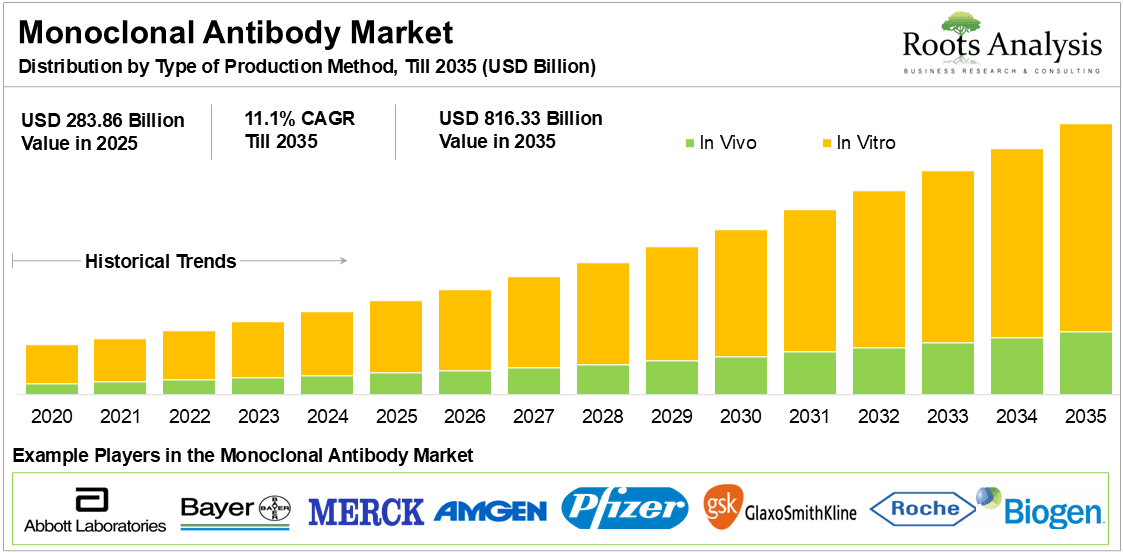
The global monoclonal antibody market size, valued at USD 249.95 billion in 2024, is projected to reach USD 283.86 billion in 2025 and USD 816.33 billion by 2035, representing a CAGR of 11.1% during the forecast period.
To learn more about this report, request a free sample copy
Monoclonal Antibody Market: In Summary
- The rising approval of the monoclonal antibodies therapies by the FDA to treat wide range of disease indication is likely to gain physicians confidence in prescribing mAbs, which further leads to drive its demand in future.
- Industrial players are making massive investments to develop monoclonal antibodies. For instance, in May 2025, Pfizer invested USD 1.25 billion for in-licensing a bispecific antibody (next generation of monoclonal antibody) drug for cancer. This drug has been developed by China-based 3SBio to target and block the proteins PD-1 and VEGF.
- In terms of applications area, the oncology segment captures the highest market share (nearly 50%) of monoclonal antibody market.
- As per the regional analysis, North America holds 47% monoclonal antibodies mabs market share.
- In Asia-Pacific, the market for monoclonal antibodies is expected to show lucrative growth in the future. Factors, such as high prevalence of chronic conditions and government initiatives to support the development of advanced targeted therapies are driving growth in this region.
- Technological convergence, such as antibody-nanoparticle conjugates, and nanotechnology applications to improve therapeutic efficacy are the key trends of the mAB market.
The market for monoclonal antibody is witnessing an upsurge driven by the rising adoption for the treatment of chronic conditions. Plasma Fractionation provides the separation and purification steps required to recover albumin, immunoglobulins and other therapeutic plasma proteins. Monoclonal antibodies (mAbs) are highly specialized, engineered proteins that precisely target specific molecules and cells within the body. Unlike polyclonal antibodies, which are a mixture of antibodies targeting multiple sites, mAbs are derived from a single, cloned immune cell, ensuring they bind to a single or unique epitope (a specific part of an antigen). In parallel, glycan analysis characterizes glycosylation patterns that influence biologic stability, activity and immunogenicity.
Notably, the rising awareness of biologics as precision medicine to target diseases is driving the demand for monoclonal antibodies to target diseases. It is worth mentioning that cancer has been considered a major cause of concern for healthcare experts. According to the National Institute of Health, in 2025, 2,041,910 cases of cancer will be diagnosed and around 6,18,120 deaths with cancer are solely projected in the US. In order to mitigate the concern, healthcare personnel are encouraging the adoption of monoclonal antibodies to treat patients with higher precision.
It is important to highlight here that monoclonal antibodies offer several significances, such as high target specificity, and better immune response. Moreover, it offers minimal side effects in comparison to conventional treatment available for cancer. To date, several monoclonal antibodies have received approval from the FDA to target wide range of diseases. Some examples are Trastuzumab (Herceptin®) for breast cancer, Rituximab (Rituxan®) to target CD20 on B-cells in leukemia, and Cetuximab (Erbitux®) to target EGFR, in colorectal, and head and neck cancer. Competition in anti-VEGF antibody treatment also includes bevacizumab biosimilars, developed against the Avastin reference product.
Owing to the growing demand, several industrial players are encouraging the development of advanced monoclonal antibodies to target various disease indication. For instance, in January 2025, Eisai and Biogen announced that the FDA has approved LEQEMBI® (lecanemab-irmb) IV maintenance dosing to treat patients with early Alzheimer's disease. This rapid regulatory approval, alongside ongoing industry efforts to leverage advanced technologies like artificial intelligence and high-throughput screening for increased monoclonal antibody discovery and expanded therapeutic applications, collectively positions the monoclonal antibody market for sustained competitive growth. Autoimmune skin diseases such as bullous pemphigoid also illustrate the relevance of targeted antibody development beyond oncology.
Monoclonal Antibody Market: Report Attributes
| Key Report Attributes |
Details |
| Historical Trend |
Since 2020 |
| Forecast Period |
Till 2035 |
| Market Size 2025 |
USD 283.86 Billion |
| Market Size 2035 |
USD 816.33 Billion |
| CAGR (Till 2035) |
11.1% |
One of the key objectives of the monoclonal antibody market report was to estimate the current size, opportunity, and the market growth potential, over the forecast period, till 2035. We have provided informed estimates on the likely evolution of the market for the forecast period.
The global monoclonal antibody market analysis report also features the likely distribution of the current and forecasted opportunity within the market across various segments, such as type of source, type of production method, application area, end user, geographical regions, and leading players.
In order to account for future uncertainties associated with some of the key parameters and to add robustness to our model, we have provided three market forecast scenarios, namely conservative, base, and optimistic scenarios, representing different tracks of industry’s evolution.
Recent Developments in Monoclonal Antibody Market
Several recent developments in the field of monoclonal antibody industry have occurred, and we outlined some of these below.
- In April 2025, Amgen announced that the FDA has approved UPLIZNA® (humanized monoclonal antibody), the first-of-its-kind therapy to treat adults with immunoglobulin G4-related disease (IgG4-RD).
- In April 2025, Johnson & Johnson’s IMAAVY™ (nipocalimab-aahu), a human FcRn-blocking monoclonal antibody to has been approved by the FDA to treat patients with generalized myasthenia gravis (gMG).
- In March 2025, Genentech (a member of the Roche Group) announced that the FDA has accepted supplemental Biologics License Application for Gazyva® (obinutuzumab) to treat lupus nephritis.
- In January 2025, Climb Bio entered into an exclusive license agreement with Mabworks Biotech to develop and commercialize anti-A proliferation-induced ligand monoclonal antibody, CLYM116 (formerly known as MIL 116). Under this license agreement, MabWorks will get an upfront payment of USD 9 million from Climb Bio.
- In December 2024, TigaTx received award of up to USD 33.5 million in funding by the Advanced Research Projects Agency for Health and a separate two-year USD 2 million Direct to Phase II Small Business Innovation Research (SBIR) grant from the National Cancer Institute (NCI) of the US. The grants will enable TigaTx to move its primary candidate, TIGA-001 (an IgA anti-EGFR neutrophil engager), into human trials and collect clinical proof-of-concept data for its innovative IgA platform.
Monoclonal Antibody Market Segmentation Insights
The market report provides comprehensive information on monoclonal antibody developers who are currently active across various segments of the industry as mentioned in the table below.
Monoclonal Antibody Market: Market Segmentation
| Market Segmentation |
Details |
| Type of Source |
- Murine
- Chimeric
- Humanized
- Human
|
| Type of Production Method |
|
| Application Area |
- Oncology
- Autoimmune Diseases
- Infectious Diseases
- Neurological Diseases
- Others
|
| Distribution Channel |
- Hospital Pharmacy
- Online Pharmacy
- Retail Pharmacy
|
| End User |
- Hospitals
- Specialty Centers
- Others
|
| Geographical Regions |
- North America
- Europe
- Asia-Pacific
- Middle East and North Africa
- Latin America
|
| Market In North America |
|
| Market In Europe |
- France
- Germany
- Italy
- Spain
- UK
- Rest of Europe
|
| Market in Asia-Pacific |
- China
- India
- Japan
- South Korea
- Rest of the Asia-Pacific
|
| Market in Middle East and North Africa |
- Egypt
- Saudi Arabia
- United Arab Emirates
|
| Market in Latin America |
|
Monoclonal Antibody Market Share Insights
Market Share by Type of Source: Human Segment Holds the Largest Share
- The global market is distributed across different types of sources, such as murine, chimeric, humanized and human. According to the monoclonal antibody market report, presently, the human segment holds the largest share (53%) of the market. This can be attributed to the human mAbs are less immunogenic and ensuring efficient modulation in effector functions in comparison to other sources. Moreover, human antibodies can be produced by using hybridoma technologies.
- It is worth mentioning that humanized sources are expected to register a higher CAGR during the forecast period. Humanized monoclonal antibodies are broadly used to target a wide range of antigens, such as immunosuppressors and cancer cells. Moreover, the lower immunogenicity of humanized antibodies, compared to fully murine antibodies, is increasing the demand for antibody humanization services and technologies.
Market Share by Type of Production Method: In Vitro Segment Holds the Largest Share
- Based on the type of production method, the global market is segmented into in vivo and in vitro. Currently, in vitro production method segment holds the highest share (77%) of monoclonal antibody market growth. This dominance is due to the widespread usage of semi-permeable membrane-based systems for the production of monoclonal antibodies.
- In the long run, in vivo production segment is expected to show lucrative growth, anticipated to register a higher CAGR during the forecast period. In vivo production is cost-effective and possesses the ability to develop a high concentration of monoclonal antibodies.
Market Share by Application Area: Oncology Occupies the Highest Share
- The market is distributed across different application areas, such as oncology, autoimmune disorders, infectious diseases, neurological diseases, and others. Among these, oncology is the highest share (nearly 50%) holder of monoclonal antibody market growth. This dominance is due to the growing approval of the monoclonal antibodies based drugs to treat cancer patients. Additionally, the growing application of monoclonal antibodies to target a wide range of cancers (breast cancer, and lung cancer) is likely to maintain the dominance of this segment.
- It is worth mentioning that the autoimmune disorders segment is likely to register the highest CAGR during the forecast period. This is potentially due to the increasing application of monoclonal antibodies to treat patients with autoimmune disease, such as rheumatoid arthritis. In addition, researchers have identified cytokine proteins in inflammatory pathways that can be targeted to treat autoimmune disorders.
Market Share by Distribution Channel: Hospital Pharmacy Holds the Largest Share
- This segment highlights the distribution of global market across different distribution channels, such as hospital pharmacy, online pharmacy, retail pharmacy. Currently, the hospital pharmacy segment holds the highest share of monoclonal antibody market size. This can be attributed to the rising pool of patients in hospitals and ease of access to advanced monoclonal antibodies through hospital pharmacies to treat patients in healthcare settings.
- In the long run, online pharmacy segment is likely to grow at a higher CAGR during the forecast period. This lucrative growth is driven by the growing acceptance of online pharmacies and telemedicine platforms to manage prescriptions of patients remotely. Furthermore, the expanding biosimilars monoclonal antibodies market to manage chronic conditions is further fueling the growth of online pharmacies.
Market Share by End User: Hospitals Segment Hold the Highest Share of the Market
- Based on the end user, the global market is bifurcated into hospitals, specialty centers and others. According to the monoclonal antibody market forecast, hospitals are dominating by holding 40.77% of the Mab market. This dominance is due to the availability of superior healthcare infrastructure, specialized drug professionals, and increasing investment in advanced cancer treatment using monoclonal antibody drugs. These factors collectively strengthen their market leadership.
- Furthermore, specialty centers are expected to show robust growth during the forecast period, anticipated to register a higher CAGR during the forecast period. This can be attributed to the increasing support from government organizations to accelerate treatment of patients.
Market Share by Geographical Regions: North America Holds Dominating Position
- The global market is distributed across different geographical regions, such as North America, Europe, Asia-Pacific, Middle East and North Africa, and Latin America. Presently, North America holds 47% of the monoclonal antibody market size. Several factors, such as the high prevalence of chronic conditions and increasing research on monoclonal antibodies are driving growth of market in this region. Additionally, the robust FDA fast-track guidelines for drug approval are driving initiatives of industrial players in this region.
- In Asia-Pacific, the monoclonal antibody market is likely to grow at a higher CAGR during the forecast period. This can be attributed to several factors, such as increasing healthcare investments, expanding patient populations, and improving regulatory frameworks. It is worth mentioning that China's biotechnology sector is developing rapidly, and its regulatory framework is undergoing modification to streamlining drug approval processes, aligning with international standards, and encouraging innovation in the pharmaceutical and biotechnology sectors. These two factors are collectively creating substantial market potential for monoclonal antibody therapeutics. India and Japan's advanced healthcare system and aging population drives demand for innovative therapeutic options.
Monoclonal Antibody Market: Report Deliverables
| Report Deliverables |
Details |
Excel Data Packs
(Complimentary) |
Available |
| Key Monoclonal Antibody Drug Development Companies Profiled |
- Amgen (US)
- Abbott Laboratories (US)
- AstraZeneca (UK)
- Bayer (Germany)
- Bristol Myers Squibb (US)
- Biogen (US)
- Daiichi Sankyo Company (Japan)
- Eli Lilly (US)
- GlaxoSmithKline (UK)
- Johnson & Johnson (US)
- Merck (US)
- Novartis (Switzerland)
- Novo Nordisk (Denmark)
- Pfizer (US)
- Roche (Switzerland)
- Sanofi (France)
- Thermo Fisher Scientific (US)
- Viatris (US)
(A complete list of companies captured is available in the report) |
PowerPoint Presentation
(Complimentary) |
Available |
| Customization Scope |
15% Free Customization |
Monoclonal Antibody Market Major Takeaways
The “Monoclonal Antibody Market Report: Industry Trends and Global Forecasts, till 2035” market report features an extensive study of the current market landscape, market size, market share, market growth, market trends, market value, market forecast, market outlook, statistics, and future opportunities for monoclonal antibody developers. The market research report lays emphasis on the monoclonal antibodies that are being developed. Key takeaways of the market report are briefly discussed below.
Monoclonal Antibody Market Competitive Landscape
The current market landscape for monoclonal antibody manufacturing is highly competitive, witnessing the presence of a wide array of small and large industrial players. Notably, the key players operating in this industry are undertaking strategic initiatives to expand product portfolio and expand their research on monoclonal antibodies. Notably, several industrial players, such as Novartis, Pfizer and Amgen are partnering for the production of biosimilars and monoclonal antibodies to treat a wide range of disease indications.
Monoclonal Antibody Market Size Analysis
In 2025, the monoclonal antibody market is currently valued at USD 283.86 billion and is poised to reach USD 816.33 billion by 2035, representing a CAGR of 11.1% during the forecast period. This unprecedented market growth potential is due to the rising demand for monoclonal antibodies to treat wide range of diseases. Furthermore, the market players are raising investments and research activities to develop monoclonal antibodies. which is expected to maintain a long term competitiveness in this industry.
It is important to highlight here that, last year, CatalYm raises USD 150 million in series D funding round led by investors already involved in the company, such as Novartis Venture Fund or Jeito Capital, Canaan Partners, Bioqube Ventures, Omega Funds, Forbion Growth Fund, and Gilde Healthcare. The funding will be utilized to tackle cancer resistance through its lead candidate, visugromab (a monoclonal antibody).
Partnerships and Collaboration Analysis
Pharmaceutical companies are continually increasing their partnership to access innovative platforms and development capabilities. International expansion through partnership strategies enables global market access while navigating regulatory complexities. For instance, in January 2025, Cleveland Clinic and LifeArc signed a 10 years (MAS) Master Services Agreement to develop advanced monoclonal antibody therapeutics for patients with unmet medical needs. Under this agreement, LifeArc will offer its expertise in humanization of mABs (monoclonal antibodies) for targeting drivers of various disease conditions identified by Cleveland Clinic, including complement-mediated diseases and cancer.
Furthermore, industrial players are making massive investments to strengthen their product portfolio. For instance, in May 2025, Pfizer promises to invest USD 1.25 billion for in-licensing a bispecific antibody (next generation of monoclonal antibody) drug for cancer that China-based 3SBio has designed to block the proteins PD-1 and VEGF.
Monoclonal Antibody Market Drivers: Rising Incidence of Cancer and Demand for Targeted Therapies
The monoclonal antibody therapeutics market is driven by the rising incidence of chronic diseases, specifically cancer and autoimmune disorders. Blockbuster Drugs often emerge when strong clinical differentiation combines with broad adoption and exceptional commercial performance. Notably, the FDA has approved several monoclonal antibodies therapies to treat wide range of disease indications. Some notable examples of the approved drugs are atopotamab deruxtecan (Datroway®) for HR-positive / HER2-negative breast cancer, and telisotuzumab vedotin (Emrelis®) for non-squamous non-small cell lung cancer.
Furthermore, the rising demand for targeted therapies has further risen the demand for monoclonal antibodies. It is worth noting that industrial players are exploring monoclonal antibodies to treat a wide range of conditions, such as inflammatory bowel disease, rheumatoid arthritis, and psoriasis, which is expected to drive this market during the forecast period.
Monoclonal Antibody Market Challenges: High Cost and Stringent Regulatory Guidelines
High cost associated with development of commercialization of monoclonal antibody based drugs may hinder the market growth. Furthermore, the expenses across research phases, preclinical studies, clinical trials, and large-scale antibody manufacturing costs are frequently transferred to patients and healthcare systems, limiting treatment accessibility and affordability.
In addition, the complexity of monoclonal antibody production and requirement for advanced manufacturing technologies may affect market growth; consequently, developers increasingly engage providers operating in the antibody contract manufacturing space to access scalable infrastructure, technical expertise and GMP-compliant production capabilities.
Monoclonal Antibody Market Trends: Personalized Medicine Monoclonal Antibody Therapy Market Opportunities (Targeted Therapies, Pharmacogenomics Integration, and Technology Convergence)
Currently, healthcare experts are focusing on a personalized approach for treating a wide range of diseases. The rising trend of personalized medicine has created significant opportunities for monoclonal antibody market players. Additionally, pharmaceutical industries are aiming to integrate pharmacogenomics that enable dosage optimization to enhance therapeutic efficacy profiles.
Furthermore, industrial players are leveraging artificial intelligence and computational models that enable optimization of monoclonal antibodies to meet individual patient requirements. In addition to mab manufacturing, market players are focusing on nanotechnology applications to enhance therapeutic efficacy. Notably, antibody-nanoparticle conjugates enable tissue-specific targeting while reducing systemic exposure and adverse effects. These technological convergences create competitive advantages for innovative companies while expanding therapeutic possibilities, offering numerous monoclonal antibody market opportunities.
Monoclonal Antibody Market Report Coverage
The market report presents an in-depth analysis, highlighting the capabilities of various stakeholders in the monoclonal antibody industry, across different geographies. Amongst other elements, the market report includes:
- An Infographic Executive Summary
- Market Landscape of Monoclonal Antibody Developers
- Competitive Landscape
- Company Competitiveness Analysis
- Company Profiles
- Partnerships and collaborations
- Mergers and Acquisitions
- Clinical Trial Analysis
- Market Impact Analysis
- Market Opportunity Analysis
- Market Forecast Analysis
From the Author’s Desk
Author’s View on Monoclonal Antibody Market
Based on the key discussions, the market for monoclonal antibody is likely to demonstrate exceptional growth potential driven by increasing disease prevalence, technological innovations, and expanding therapeutic applications. It is worth noting that, North American monoclonal antibody market leadership provides stability while European and Asia-Pacific markets offer significant growth opportunities through expanding healthcare investments and improving regulatory frameworks. However, the strategic success in this market requires addressing fundamental challenges including development costs, upstream processing of monoclonal antibody, clinical attrition, and market access barriers while capitalizing on emerging opportunities in personalized medicine, technology convergence, and biosimilar development.
Glossary
- Monoclonal Antibody: It refers to the proteins that are designed using recombinant technology to mimic the natural antibodies. These antibodies are specifically engineering to bind specific antigen, making them precise in the targeted action.
- Auto-Immune Disease: It is a form of disease when an individual’s immune system starts attacking its own cells and fails to recognize foreign elements in the body.
- Immunoglobulin: It is a Y-shaped protein molecule also known as antibody produced by plasma cells. These immunoglobulins help to neutralize the pathogens attack by binding at the specific antigens presence on the pathogen cells.
Frequently Asked Questions
What are monoclonal antibodies?
Monoclonal antibodies refer to the immunoglobulins that are derived from a monoclonal cell line and have defined specificity to target disease cells.What is the current market size of monoclonal antibody?
The current monoclonal antibody market size is likely to be USD 283.86 billion in 2025.What is the CAGR of monoclonal antibody market analysis?
The global market for monoclonal antibody is likely to grow at a CAGR of 11.1% till 2035.Which geographical segment is likely to capture majority share in the monoclonal antibody industry, by 2035?
North America is presently dominating the market driven by the high demand for monoclonal antibodies to treat patients with cancer.How big is the monoclonal antibody industry?
The global market size for monoclonal antibody is likely to reach USD 816.33 billion in 2035.Which are the leading companies in the monoclonal antibody market?
Amgen (US), Abbott Laboratories (US), Bayer (Germany), Bristol Myers Squibb (US), Biogen (US), Daiichi Sankyo Company (Japan), GlaxoSmithKline (UK), Johnson & Johnson (US), Merck (US), Novartis (Switzerland), Novo Nordisk (Denmark), Pfizer (US), Roche (Switzerland), Thermo Fisher Scientific (US), and Viatris (US) are some of the leading monoclonal antibody manufacturing companies.What are the factors driving the market for monoclonal antibody?
Growing incidence of oncology, increasing research on monoclonal antibodies to explore more applications and rising approval of monoclonal antibody based therapies.What are the 4 types of monoclonal antibodies?
Chimeric, murine, human monoclonal antibodies, murine, and humanized monoclonal antibodies are the main types of cancers targeted by monoclonal antibodies.