


 Download Free Sample
 Buy Now
Biosimilars Market Outlook: USD 130.1 Billion by 2035 at a 16.7% CAGR
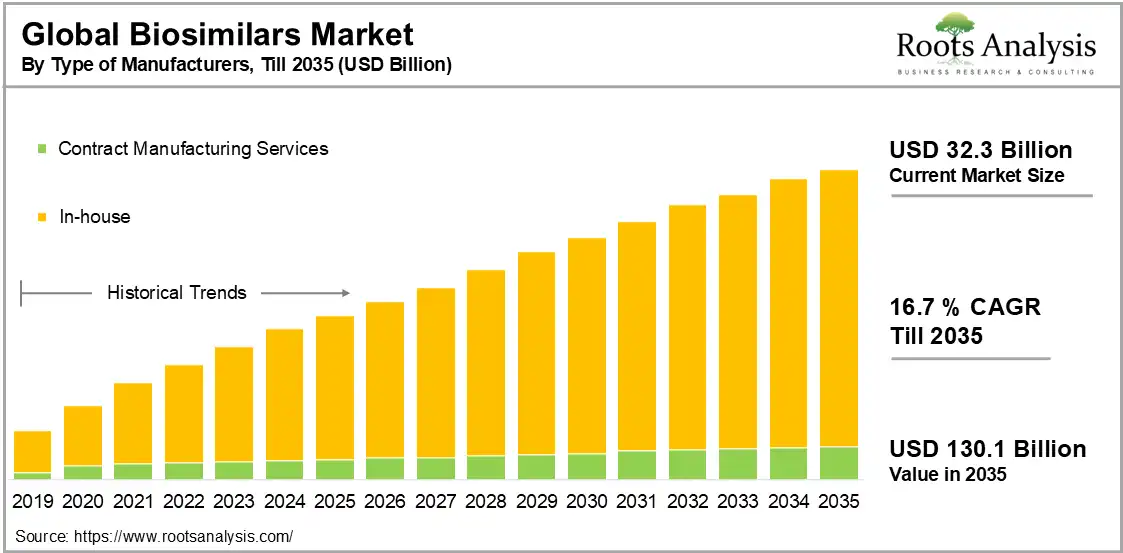
The global biosimilars market, valued at USD 28.0 billion in 2025, is projected to reach USD 32.3 billion in 2026 and USD 130.1 billion by 2035, representing a CAGR of 16.7% during the forecast period 2026 to 2035.
See What's in the Full Report – Request Your Complimentary Insights!
Market Report: Key Takeaways
Market Size & Trends
- Monoclonal antibodies currently hold the highest share of the biosimilars market.
- The oncological disorders segment dominates (~40%) the current market.
- Based on the type of manufacturer, in-house developers capture the largest share of the market.
- The hospital pharmacies segment is currently dominating (nearly 45%) the biosimilars market.
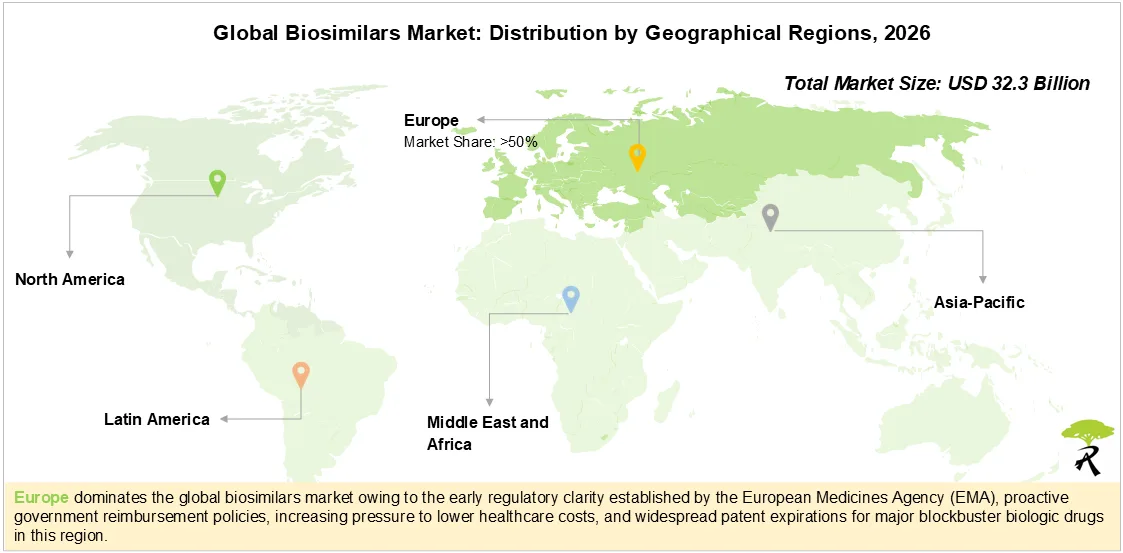
- Europe currently holds the highest market share (over 50%).
Key Market Statistics
- Market Size in 2026: $32.3 Billion
- Estimated Market Size in 2035: $130.1 Billion
- CAGR (2026-2035): 16.7%
- Europe: Largest market in 2026
- North America: Fastest growing region
What is Driving the Biosimilars Market Growth Through 2035?
Biosimilars market growth over the next decade is expected to be driven primarily by the increasing number of biologics approaching patent expiry, leading to the development of biosimilars that are clinically similar to their reference biologics. A reference biologic, also referred to as an originator biologic, is the originally approved biologic against which a biosimilar is compared. Biosimilar development relies on comparative analytical, pharmacokinetic and, where appropriate, pharmacodynamic biomarker evidence to demonstrate high similarity and no clinically meaningful differences in safety, purity and potency.
In recent years, the biologics industry has witnessed robust expansion, driven by the effectiveness of biologic therapies across chronic and complex disorders. However, the high cost of biologics places a significant economic burden on patients, payers and healthcare systems. As demand for biologics continues to rise, biosimilar developers are pursuing more affordable alternatives while maintaining comparable quality, safety and efficacy. Patent cliffs affecting established reference products, including biologics associated with Enbrel® (etanercept), Neupogen® (filgrastim) and Avastin® (bevacizumab) continue to broaden the addressable opportunity for biosimilar competition.
Recent activity in the broader follow-on peptide market includes generic liraglutide products and the development of semaglutide follow-on candidates. These products should be analyzed separately from biosimilars unless they are submitted through an applicable biosimilar regulatory pathway. Over the past few years, the domain has also witnessed increased investment and collaborative activity among biosimilar developers. Regulatory advancements and streamlined approval procedures have supported the development and commercialization of oncology biosimilars.
Manufacturing complexity remains an important barrier in the biosimilars market. Biosimilars are generally produced through recombinant production systems using living cells, and variations in cell lines, upstream and downstream processing, purification or scale-up can influence critical quality attributes. As a result, developers increasingly focus on manufacturing quality, process efficiency, regulatory compliance and reproducibility when transferring or scaling biosimilar processes.
Pharmacovigilance and post-market surveillance are also important after biosimilar launch. Regulators, manufacturers and healthcare providers continue to monitor real-world safety, immunogenicity and product performance to confirm that the biosimilar's benefit-risk profile remains consistent with the evidence generated during development and approval.
As demand for more affordable biologic alternatives grows, both in-house biosimilar development and outsourced development and manufacturing activity are expected to increase. This trend is poised to present attractive growth opportunities for biosimilar developers.
How is the Biosimilars Market Segmented?
Based on the research, the biosimilars market report is segmented by drug class, therapeutic area, type of manufacturer, distribution channel, geographical regions, and leading players. This segmentation enables investors, business development teams, hospital decision-makers and healthcare providers, R&D teams, and procurement teams, to assess the market opportunity most relevant to their strategic and operational priorities.
- By Drug Class: Monoclonal Antibodies, Proteins, Peptides, and Others
- By Therapeutic Area: Oncological Disorders, Autoimmune and Inflammatory Disorders, Hematological Disorders, Metabolic Disorders, and Other Disorders
- By Type of Manufacturer: Contract Manufacturers and In-house Developers
- By Distribution Channel: Hospital Pharmacies, Retail Pharmacies, and Online Pharmacies
- By Geographical Regions: North America (US, Canada, and Mexico), Europe (France, Germany, Italy, Spain, UK, and Rest of Europe), Asia-Pacific (China, India, Japan, South Korea, New Zealand, and Rest of the Asia-Pacific), Middle East & Africa (Egypt, Iran, Iraq, Israel, Saudi Arabia, South Africa, and United Arab Emirates), and Latin America (Argentina and Brazil)
Your Business is Unique – Why Shouldn't Your Report Be?
Biosimilars Pipeline and Developer Landscape: Key Insights
Biosimilars Pipeline Overview: Over 440 Biosimilars are Approved across the Globe
The market landscape features the presence of more than 900 biosimilars targeting a wide range of chronic disorders; of these, more than 170 biosimilars are currently being evaluated in different phases of clinical trials. Further, over 245 biosimilars are currently in the preclinical and discovery stage of development, indicating rising need for these therapies and substantial research and development activity.
Global Biosimilar Developers Landscape: Asia-Pacific Emerges as a Key Hub
The market landscape features the presence of more than 170 players, with different company sizes including, very large, large, mid-sized, small and very small. Close to 35% of these biosimilar developers were established pre-1990, demonstrating the presence of well-established stakeholders in the biosimilar's domain. Over 60% of the biosimilar companies are based in Asia-Pacific, followed by Europe, North America and the rest of the world. Within Asia-Pacific, India and China have emerged as major hubs for biosimilar development.
Key Market Drivers: Impending Patent Expiry of Blockbuster Biologics and Uptake of Biosimilars to Drive Market Growth
The biosimilars market size is estimated to be worth USD 32.3 billion in 2026. The market is expected to grow at a CAGR of 16.7% from 2026 to 2035, driven by the patent expiry of blockbuster biologics and increasing demand for biosimilars as a cost-effective alternative. It is worth noting that several biologics are anticipated to fall off the patent cliff in the near future. Positive biosimilar market trends have been noticed lately, reflected by sales data published by the biosimilar developers. For instance, in the first half of 2025, Sandoz biosimilars achieved sales of USD 1,496 million, a 12% increase in constant currency, driven by robust growth in Europe and international markets.
Recent Developments in the Biosimilars Industry
- In February 2026, the US FDA accepted Dr. Reddy's 351(k) Biologics License Application for DRL_AB, a proposed interchangeable intravenous biosimilar to ORENCIA® (abatacept), for review.
- In January 2026, Samsung Epis Holdings announced that Samsung Bioepis was adding six biosimilar candidates to its development pipeline, covering immunology, oncology and other therapeutic areas.
- In October 2025, Hikma and Celltrion partnered to broaden access to six biosimilar treatments across the Middle East and North Africa (MENA) region. Under this partnership, Hikma holds exclusive commercialization rights in MENA while Celltrion handles development, manufacturing, and supply of biosimilars.
- In June 2025, Alvotech and Dr. Reddy's entered into a collaboration and licensing agreement to co-develop, manufacture and commercialize AVT32, a proposed biosimilar to KEYTRUDA® (pembrolizumab), for global markets.
- In March 2025, the US FDA approved Fresenius Kabi's denosumab biosimilars CONEXXENCE® and BOMYNTRA® for all indications of their respective reference products, Prolia® and Xgeva®.
Scope, Methodology and Industry Expert Interviews
The findings in this report were developed through a structured methodology combining secondary research, proprietary databases and primary interviews. Secondary research included company disclosures, regulatory databases, clinical-trial registries, peer-reviewed publications, patent records, pricing and reimbursement sources, and relevant market-access information. The biosimilars market is expected to continue expanding through 2035, supported by upcoming biologic patent expiries, regulatory streamlining and increasing adoption across major healthcare markets.
Commenting on the evolving biosimilars landscape, Dr. Stefan Glombitza, Chief Executive Officer of Formycon, stated, "In the evolving landscape of biologics, biosimilars have emerged from a regulatory concept to a critical solution addressing both patient access and healthcare sustainability. With the growing pressures on global healthcare systems and the imminent patent expiries of many biologics, the opportunity to provide effective, affordable treatment options has never been clearer. At Formycon, we are not just developing biosimilars, we are committed to leading this transformation, partnering with regulators and stakeholders to ensure these therapies reach patients worldwide and improve lives."
The biosimilars market report includes transcripts of the following other third-party discussions:
- Senior VP and Head of Therapeutic Area Biosimilars, Large Company in the UK
- Professor, University, Netherlands
- Vice Chancellor, University, India
Kindly note that Roots Analysis is an independent market research and consulting firm. The report is not affiliated with, endorsed by or sponsored by any company, regulator or individual named or quoted in this report; company names and expert perspectives are included solely for factual and analytical context.
Pay Only for What You Need – The Best Way to Optimize
Market Share Insights
Which Drug Class Accounts for the Largest Share of the Biosimilars Industry?
The monoclonal antibodies segment currently captures the majority of the market share and is expected to remain dominant during the forecast period. The peptides therapeutics segment is expected to register the highest growth rate during the forecast period. There are over 70 peptide-based therapies available worldwide, and an increase in prescription-based peptide drugs is anticipated as many biologics approach potential patent expiry, leading to a rise in generic versions.
Will In-house Developers Continue to Hold the Largest Market Share?
The in-house developers currently capture the majority of the biosimilars market. The biosimilar contract-development and manufacturing services market is estimated to grow at a CAGR of 18.1% from 2026 to 2035.
Regional Analysis: Which Regions are Showing the Fastest Growth in Biosimilars Industry?
Europe: Dominating the Market by Securing Highest Share
Europe accounts for more than 50% of the biosimilars market, supported by demand for biologic treatments for chronic conditions, established biosimilar policies and increasing adoption among healthcare providers and patients. This growth is fueled by proactive government policies promoting biosimilar adoption, stringent regulatory guidelines from the European Medicines Agency (EMA), and increasing investments in research and development.
Countries such as France, Germany, Italy, Spain, and the UK are leading contributors, benefiting from heightened disease burden and patent expiries of major biologics. At its September 2025 meeting, EMA's Committee for Medicinal Products for Human Use adopted positive opinions for nine biosimilar medicines, including seven denosumab products, one golimumab product and one ustekinumab product.
US Biosimilars Market
In the US, the rapid expansion of biosimilars market size is driven by several key factors, including a supportive regulatory environment established by the USFDA, which has streamlined the approval process for biosimilars and enhanced market access. Development, commercialization and partnership activity involving companies such as Amgen, Biocon, Viatris and Samsung Bioepis is supporting biosimilar competition and adoption in the US. Government policies, including the Inflation Reduction Act (IRA), promote biosimilar use, especially in Medicare. Payer demand and pharmacy benefit manager (PBM) incentives further support market growth.
The shifting distribution of biosimilars from hospitals to retail and specialty pharmacies is also fostering greater patient accessibility. In the US, biosimilar interchangeability refers to an additional regulatory designation that can permit pharmacy-level substitution for the reference product, subject to applicable state laws and dispensing requirements. Interchangeable biosimilars referencing products such as Humira and Stelara are expected to support broader adoption. For products suitable for subcutaneous administration, specialty and retail pharmacy channels can also influence site-of-care patterns and patient convenience. This growth is underpinned by ongoing innovation related to biosimilar technology, increased physician and patient acceptance, and strategic partnerships among stakeholders facilitating broader biosimilar adoption across the US healthcare system.
Get an Instant Quote in 10 Minutes. Lowest Price Guaranteed
Key Companies Engaged in Biosimilars Market
Examples of key biosimilar developers that have been profiled in the full report, arranged in alphabetical order, include Amgen, BIOCAD, Biocon, Celltrion, Coherus BioSciences, Dr. Reddy's Laboratories, Eli Lilly, Fresenius Kabi, Intas Pharmaceuticals, Pfizer, Sandoz, STADA, Teva Pharmaceutical. This market report includes an easily searchable excel database including all the drug developers that are engaged in the development of biosimilars.
Report Deliverables and Customization
Alongside the core market report, clients receive complimentary Excel data packs covering market landscape analysis, company competitiveness analysis, demand analysis, and market sizing and opportunity analysis. A complimentary PowerPoint presentation summarizing the full report is also included, and 15% free customization scope is available on request.
Report Authorship
This report was authored by Simriti Gupta, a member of the Roots Analysis healthcare and pharmaceutical research practice. Her work focuses on drug discovery and development, therapeutic-market assessment, competitive intelligence, clinical-pipeline analysis and market forecasting.
Independence and Non-Affiliation
This report is an independent work of market research and analysis published by Roots Analysis. It is not affiliated with, sponsored by, endorsed by, or reviewed by Amgen, BIOCAD, Biocon, Celltrion, Coherus BioSciences, Dr. Reddy's Laboratories, Eli Lilly, Fresenius Kabi, or any other pharmaceutical company, drug brand, or regulatory body referenced within it. No content in this report should be construed as medical advice. Roots Analysis maintains its own proprietary primary research process and does not receive compensation from any company profiled within the report, in exchange for inclusion or favorable characterization.


