Oncology Biosimilars Market: In Summary
- The global oncology biosimilars market is gaining traction due to the increasing cancer burden globally, patent expirations of blockbuster biologics, and the pressing need for cost-effective cancer treatments.
- Steady progress in the approval of oncology biosimilars including biosimilars of bevacizumab (Avastin®), trastuzumab (Herceptin®), and rituximab (Rituxan®) are providing hope to healthcare experts to reduce cost of cancer treatment.
- Recent developments in oncology biosimilars industry and growing focus on the development of cost-effective treatment for cancer are encouraging industrial players to escalate their research and development activities to develop more oncology biosimilars in the upcoming years.
- Several oncology biosimilars developing companies, such as Abbott, Pfizer, Biocon Biologics and Samsung Bioepis are currently engaged in the development of oncology biosimilars and accelerating their partnerships to strengthen their product portfolio.
- mAb biosimilars represent the largest segment, targeting blockbuster biologics, such as trastuzumab (Herceptin), bevacizumab (Avastin®) and rituximab (Rituxan®). These products form the backbone of many modern cancer treatment regimens and offer significant cost-saving opportunities through biosimilar versions.
- North America, particularly the US, is expected to dominate the oncology biosimilars market over the forecast period. Despite later market entry compared to Europe, the region has seen rapid growth. Several factors, such as a robust regulatory framework, substantial healthcare expenditure, and a growing emphasis on cost reduction in cancer care are contributing to the unprecedented growth of the market in this region.
- The oncology biosimilars market is expected to witness an upward trajectory with an upcoming wave of cancer biosimilars and rising focus on biologics. Notably, biosimilars for Yervoy® (ipilimumab) and Perjeta® (pertuzumab) are expected in the near term, followed by those for immune checkpoint inhibitors Opdivo (nivolumab) and Keytruda (pembrolizumab) anticipated in 2028 and beyond.
Oncology Biosimilars Market Overview
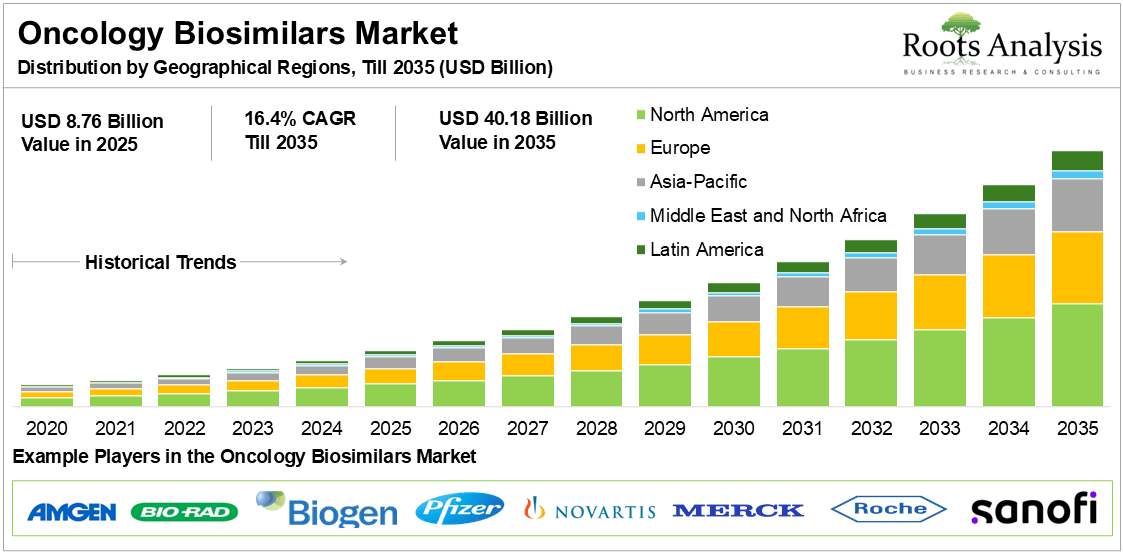
The global oncology biosimilars market size, valued at USD 7.25 billion in 2024, is projected to reach USD 8.76 billion in 2025 and USD 40.18 billion by 2035, representing a CAGR of 16.4% during the forecast period.
To learn more about this report, request a free sample copy
The market for oncology biosimilars is growing phenomenally driven by the rising global cancer burden and demand for cost-effective cancer treatments. With healthcare industry seeking sustainable cancer treatment, oncology biosimilars emerged as a potential and cost-efficient alternative to the targeted therapies. Biosimilars refers to the biopharmaceutical products that resemble to the existing biologics drugs used for cancer treatment. These drugs are similar to branded drugs in terms of efficacy, safety and quality, however still not identical, hence names biosimilars.
Some of the notable examples of biosimilars that are broadly used in cancer treatment are monoclonal antibodies, immune modulators, and supportive agents, such as epoetin α, filgrastim, and pegfligrastim. It is important to highlight here that the USFDA has also approved numerous cancer biosimilar products for cancer treatment, such as bevacizumab, rituximab and trastuzumab. Notably, biosimilars of bevacizumab (Avastin®) are presently available with brand name, Alymsys®, Avzivi®, Jobevne™, Mvasi®, Vegzelma® and Zirabev®.
Driven by the demand for biosimilars to treat cancer, several industrial players have shown active interest in this field. For instance, in April 2025, Sandoz and Shanghai Henlius Biotech (Henlius) entered into the partnership to commercialize biosimilar drugs of oncology therapy, ipilimumab (biosimilar of Yervoy). This biosimilar drug will be used to treat numerous types of cancer, such as melanoma, colorectal cancer, hepatocellular carcinoma and renal cell carcinoma. As more market players continue to initiate collaborative efforts to manufacture biosimilars and make considerable investments, we believe that oncology biosimilars market will continue to grow at a steady pace during the forecast period.
Oncology Biosimilars Market: Report Attributes
| Key Report Attributes |
Details |
| Historical Trend |
Since 2020 |
| Forecast Period |
Till 2035 |
| Market Size 2025 |
USD 8.76 Billion |
| Market Size 2035 |
USD 40.18 Billion |
| CAGR (Till 2035) |
16.4% |
One of the key objectives of oncology biosimilars market report was to estimate the current size, opportunity and the market growth potential, over the forecast period, till 2035. We have provided informed estimates on the likely evolution of the market for the forecast period.
The global oncology biosimilars market analysis report also features the likely distribution of the current and forecasted opportunity within the market across various segments, such as type of cancer, type of drug class, route of administration, end user, distribution channel, geographical regions and leading players.
In order to account for future uncertainties associated with some of the key parameters and to add robustness to our model, we have provided three market forecast scenarios, namely conservative, base, and optimistic scenarios, representing different tracks of industry’s evolution.
Oncology Biosimilars Market Recent Developments
Several recent developments in the field of oncology biosimilars industry have occurred, and we outline some of these below.
- In April 2025, Biocon Biologics announced that the FDA has granted approval for Jobevne™ (bevacizumab-nwgd), a biosimilar of Bevacizumab intended to treat cancer. Jobevne™ is a form of recombinant monoclonal antibody which is designed to treat wide range of cancers, such as metastatic colorectal cancer, and non-squamous non-small cell lung cancer.
- In April 2025, Accord BioPharma (the US specialty division of Intas Pharmaceuticals) announced the Intas Pharmaceuticals has completed the acquisition of UDENYCA® (pegfilgrastim-cbqv) business from Coherus BioSciences. As the biosimilar to Neulasta® (pegfilgrastim), UDENYCA® will enhance the FDA approved portfolio and strengthen its position in oncology field.
- In March 2025, Fresenius announced the FDA Biologics License Application approval for denosumab biosimilars Conexxence® and Bomyntra®. Additionally, Fresenius has reached a global settlement with Amgen that allows the launch of denosumab biosimilar candidates in the US and Europe and continues to provide patient high quality biological medicines across the globe.
- In March 2025, Celltrion’s Steoboclo and Osenvelt (CT-P41; denosumab-bmwo) biosmilars reference to product (Prolia and Xgeva) received FDA approval to treat bone metastases and osteoporosis.
- In January 2025, Abbott and Shanghai Henlius entered into the product license and supply agreement to commercialize for biosimilars and one innovative biologics developed by Abbott in Asia, Latin America, Middle East and Africa.
- In September 2024, Accord Biopharma announced that Trastuzumab-strf, a trastuzumab biosimilar, at 420 mg has been approved by the FDA to treat HER2-overexpressing cancers, including metastatic breast and gastric/gastroesophageal junction cancers.
- In April 2024, Shanghai Henlius Biotech announced the FDA approval for HERCESSI™ (HLX02, trastuzumab-strf), a biosimilar to Herceptin®, through its business partner Accord BioPharma. HERCESSI™ is a biosimilar approved to treat HER2-overexpressing breast cancer, metastatic gastric cancer, and gastroesophageal junction adenocarcinoma.
Oncology Biosimilars Market Segmentation Insights
The market report provides comprehensive information on oncology biosimilars who are currently active across various segments of the industry as mentioned in the table below
Oncology Biosimilars Market: Market Segmentation
| Market Segmentations |
Details |
| Type of Cancer |
- Breast Cancer
- Lung Cancer
- Colorectal Cancer
- Cervical Cancer
- Blood Cancer
- Others
|
| Type of Drug Class |
- Monoclonal Antibodies
- Granulocyte Colony-Stimulating Factor
- Erythropoiesis-Stimulating Agents
- Immune Modulators
- Others
|
| Route of Administration |
- Intravenous
- Subcutaneous
- Others
|
| End User |
- Hospitals
- Specialty Clinics
- Homecare
- Other End Users
|
| Distribution Channel |
- Hospital Pharmacy
- Retail Pharmacy
- Online Pharmacy
- Others
|
| Geographical Regions |
- North America
- Europe
- Asia-Pacific
- Middle East and North Africa
- Latin America
|
| Market in North America |
|
| Market in Europe |
- France
- Germany
- Italy
- Spain
- UK
- Rest of Europe
|
| Market in Asia-Pacific |
- China
- India
- Japan
- South Korea
- Rest of the Asia-Pacific
|
| Market in Middle East and North Africa |
- Egypt
- Saudi Arabia
- United Arab Emirates
|
| Market in Latin America |
|
Industry Experts on Oncology Biosimilars Market
Oncology biosimilars industry is rapidly growing due to the growing expiration of patented drugs, which necessitated the demand for biosimilar drugs for patient treatment.
"At Accord BioPharma, we are deeply committed to helping patients gain access to the medicines they need, and we will continue our efforts to help all stakeholders recognize the promise of biosimilars," said Chrys Kokino, US president of Accord. "Although each patient with cancer is unique, the cost of oncologic therapies often adds a significant burden on top of other existing challenges. We strive to respond to those needs with biosimilars like trastuzumab-strf.”
Oncology Biosimilars Market Share Insights
Market Share by Type of Cancer: Breast Cancer Holds the Largest Share
- Based on the type of cancer, the global market is segmented into breast cancer, lung cancer, colorectal cancer, cervical cancer, blood cancer, and others. According to the oncology biosimilars market forecast, breast cancer holds the largest share of the market. This can be anticipated due to high incidence of breast cancer and growing requirement for target specific biologics.
- In the long run, segments, such as lung cancer segments is likely to show robust growth, anticipating registering higher CAGR during the forecast period. The high prevalence of lung cancer and continuous research on biosimilars to treat lung cancer are some of the key factors for lucrative growth. Additionally, the ongoing focus to make lung cancer treatment more sustainable is further fueling the growth of this segment in future.
Market Share by Type of Drug Class: Monoclonal Antibodies Holds the Highest Share
- This segment highlights the distribution of global market based on type of drug class into monoclonal antibodies, granulocyte colony-stimulating factor, erythropoiesis-stimulating agents, immune modulators and others. According to the oncology biosimilars market report, monoclonal antibodies segment is dominating the market by holding 45.58% of the overall revenue share. Biosimilar monoclonal antibodies for lung cancer have shown significant potential in targeting cancerous cells and slower down progression of cancer. Furthermore, several monoclonal antibodies based biosimilars have been approved by the USFDA to treat cancer, which is further expected to be a key driver for this segment.
- Notably, it is worth mentioning that granulocyte colony-stimulating factor segment is expected to grow at a higher CAGR during the forecast period. Granulocyte colony-stimulating factor is widely accepted to treat neutropenia (low white blood cell count) in patients who are presently taking chemotherapy to treat cancer.
Market Share by Route of Administration: Intravenous is Dominating the Market
- On the basis of the route of administration, the global market is segmented into intravenous, subcutaneous and others. Among these, intravenous segment is holding maximum oncology biosimilars market share. Intravenous is a widely applicable route of drug administration owing to the complexity of oncology biologics. Moreover, intravenous route of drug administration offer systematic delivery of biosimilars at targeted sites.
- It is important to highlight here that the ongoing preferences of intravenous by healthcare experts to deliver oncology biosimilars this segment will continue to grow at a higher CAGR during the forecast period. However, it is worth mentioning that subcutaneous administration segment is expected to gain traction owing to its convenience and self-administration abilities.
Market Share by End User: Hospitals Segment Holds the Largest Share
- Based on the end user, the global market is segmented into hospitals, specialty clinics, homecare, and other end users. Currently, the hospitals segment holds the highest share of oncology biosimilars market size. This dominance is due to the availability of expert oncologist, advanced healthcare infrastructure and patients preferences to get treatment in hospitals.
- It is worth noting that the hospitals’ segments will continue to gain traction, anticipated to register a higher CAGR during the forecast period. This is primarily due to the increasing cancer patient admission that necessitated the demand for advanced oncology biosimilars for patient treatment.
Market Share by Distribution Channel: Hospital Pharmacy Holds the Highest Share
- The global market is further categorized across different type of distribution channel, such as hospital pharmacy, retail pharmacy, online pharmacy, and others. According to our oncology biosimilars market analysis, hospital pharmacy segment holds the highest share of the market. This can be attributed to the fact that hospital pharmacies are the primary distributor of cancer biosimilars to treat patients.
- It is worth noting that the hospital pharmacy segment will continue to grow at a higher CAGR during the forecast period. This is potentially due to the trust factor and dependency of hospitals on direct distributors of oncology biosimilars.
Market Share by Geographical Regions: North America is the Largest Share Holder
- The global market is distributed across different geographical regions, such as North America, Europe, Asia-Pacific, Middle East and North Africa, and Latin America. It is worth mentioning that currently North America is holding the highest market share (over 40%) for oncology biosimilars. The increasing prevalence of cancer has necessitated the demand for biosimilars to treat cancer patients in this region.
- Notably, the Asia-Pacific region is expected to show dynamic growth in the future, anticipated to grow at a higher CAGR during the forecast period. This can be attributed to the increasing demand for cost-effective cancer treatment and expending initiatives by industrial players to develop cancer biologics in this region.
Recently Approved Oncology Biosimilars
The oncology biosimilars market has witnessed a flurry of regulatory approval in early 2025 and late 2024 year, indicating a continued positive trends. This comprehensive report details the recent FDA approval, mechanism of action, and specific cancer indications for this vascular endothelial growth factor (VEGF) inhibitor. The approval expands treatment options for patients with various cancer types, continuing the trend of increasing access to biosimilar alternatives of established cancer therapies.
Jobevne™ (bevacizumab-nwgd)
The FDA has granted approval for Jobevne™ (bevacizumab-nwgd) in April 2025, as announced by Biocon Biologics to treat patients with metastatic colorectal cancer. This approval marks Biocon Biologics' seventh biosimilar authorized in the United States, significantly expanding their oncology portfolio.
Jobevne is a recombinant humanized monoclonal IgG1 antibody that functions as a vascular endothelial growth factor (VEGF) inhibitor. The drug works by binding to VEGF and blocking its interaction with receptors, thereby inhibiting angiogenesis-the formation of new blood vessels.
Conexxence® and Bomyntra® (Denosumab-bnht)
The FDA has approved Fresenius Kabi’s denosumab biosimilars, Conexxence® (denosumab-bnht) and Bomyntra® (denosumab-bnht) for cancer-related bone complications and therapy-induced bone loss. Denosumab is a RANK ligand (RANKL) inhibitor that prevents bone resorption, a critical process in cancer-related bone disease and osteoporosis.
Osenvelt® and Stoboclo® (denosumab-bmwo)
Both Osenvelt® and Stoboclo® (denosumab-bmwo), developed by Celltrion has received FDA approval in March 2025 as biosimilars to Xgeva® (denosumab) and Prolia® (denosumab). Both these biosimilars are designed to treat cancer-related bone diseases, specifically multiple myeloma, bone metastases from solid tumors.
Trastuzumab-strf (Hercessi) 420 mg
Trastuzumab-strf is a biosimilar to trastuzumab (Herceptin) and is approved for the treatment of HER2-overexpressing cancers, specifically, HER2-overexpressing breast cancer. Notably, trastuzumab-strf is used as part of adjuvant therapy (following surgery and chemotherapy) and for metastatic disease, often in combination with other chemotherapeutic agents.
Oncology Biosimilars Market: Report Deliverables
| Report Deliverables |
Details |
Excel Data Packs
(Complimentary) |
Available |
| Key Oncology Biosimilars Companies Profiled |
- Amgen
- Allergan
- Apotex
- Biogen
- BIOCAD
- Biocon Biologics
- Celltrion Healthcare
- Coherus Biosciences
- Cipla
- Dr. Reddy’s Laboratories
- GlaxoSmithKline
- Intas Pharmaceuticals
- Mylan
- Merck
- Momenta Pharmaceuticals
- Novartis
- Pfizer
- Roche
- STADA Arzneimittel
- Sandoz International
- Sanofi
- Teva Pharmaceutical
(A complete list of companies captured is available in the report) |
PowerPoint Presentation
(Complimentary) |
Available |
| Customization Scope |
15% Free Customization |
Oncology Biosimilars Market Major Takeaways
The “Oncology Biosimilars Market Report: Industry Trends and Global Forecasts, till 2035” market report features an extensive study of the current market landscape, market size, market share, market growth, market trends, market value, market forecast, market size and future opportunities within the oncology biosimilars industry, during the forecast period.
Is Oncology Biosimilars Market Competitive?
With consistent demand for cost-effective cancer treatment and increasing focus on oncology biosimilars, the current market landscape is highly competitive. Overall, the market is witnessing the presence of wide array of small, mid-sized and large companies who are expanding their product portfolio to strengthen their position in oncology field.
Market players, such as Pfizer, Abbott, Sandoz and Novartis are continually taking strategic initiatives to develop cancer biologics. Notably, some of the latest approved biosimilars for oncology includes bevacizumab® and trastuzumab® biosimilars. In order to leverage competitive edge, several market players are entering into the partnerships and collaborations which further makes this market immensely competitive.
Market Size Analysis: Which Region Will Grow at the Fastest CAGR During the Forecast Period?
The global oncology biosimilars market size is valued at USD 8.76 billion in 2025 and is projected to reach USD 40.18 billion by 2035. The market for oncology biosimilars in Asia-Pacific is expected to grow at a higher CAGR during the forecast period. Notably, the rising prevalence of cancer is expected to drive the demand for oncology biosimilars in this region. Additionally, several market players are aiming to expand oncology biosimilars drug production, which is further driving growth in this region.
Market Drivers: What are the Key Oncology Biosimilars Market Drivers?
Some of the promising drivers that are propelling the market includes escalating burden of cancer worldwide and rising demand for cost-effective treatment. According to the National Institute of Health, in 2025, around 2,041,910 new cancer cases are projected to occur in the United States. This alarming increase of cancer worldwide has necessitated the demand for advanced oncology biosimilars.
Furthermore, the demand for cost-effective oncology drugs to treat patients and increasing expiration of patented drugs for cancer is likely to fuel the demand for oncology biosimilars.
Market Challenges: What are the Top Oncology Biosimilars Market Challenges?
Despite significant market potential, biosimilar developers face stringent regulatory requirements that can slow market entry. Since the day of the first oncology biosimilar approval by the FDA in 2015, a limited number of biosimilars has received the FDA approval, which illustrate the complexity of regulatory pathway which delays the drug commercialization process. Moreover, the safety and efficacy concerns associated with cancer biosimilars may limit its adoption for patient treatment.
Market Trends: What are the Major Oncology Biosimilars Market Trends?
Expanding partnerships and growing focus on the development of robust oncological biosimilars are the key trends of the market for oncology biosimilars. Notably, several industrial players are focusing on taking strategic initiatives to escalate the approval of biosimilars. As of February 2025, the FDA accepted the BLA for HLX11, a pertuzumab (Perjeta®) biosimilar for HER2-positive breast cancer. However, the approval is pending and has not finalized as of May 2025. Similarly, several industrial players are aiming to develop advance biosimilars in the upcoming years, which is expected to maintain a competitive edge in the market for a long time.
Oncology Biosimilars Market Report Coverage
The market report presents an in-depth analysis, highlighting the capabilities of various stakeholders in the oncology biosimilars industry, across different geographies. Amongst other elements, the market report includes:
- An Infographic Executive Summary
- Market Landscape of Oncology Biosimilars Providers
- Company Competitiveness Analysis
- Company Profiles
- SWOT Analysis
- Market Impact Analysis
- Market Forecast Analysis
From the Author’s Desk
Author’s View on Oncology Biosimilars Market
Oncology biosimilars industry is gaining traction due to the ongoing demand for cost-effective cancer treatment, and expiration of patented drugs. These drugs show similar therapeutic efficacy and gradually take lesser time for drug commercialization due to its similar profile to patented drugs. Moreover, the ongoing initiatives of industrial players to manufacture biosimilar drugs and rising support from the FDA is likely to fuel oncology biosimilars market growth in the future.
Glossary
- Oncology biosimilars: It refers to the drugs that resembles the structure and function of biologics medicines that are approved for the treatment cancer patients.
- Follow-On Biologics: It refers to the type of biosimilar product that is an identical copy of an original drug developed by the company.
- Metastasis: It refers to the spread of cancer cells from the original tumor site to other body parts. These cancerous cells travel through the blood or lymphatic system to locate at different parts of the body in different tissues or organs.
Frequently Asked Questions
What are oncology biosimilars?
Oncology biosimilars refers to the type of drug class that are similar to the patented or the FDA approval drugs. What is the market potential for oncology biosimilars?
The oncology biosimilars market size is likely to be USD 8.76 billion in 2025.What is the CAGR of market for oncology biosimilars?
The global market for oncology biosimilars is likely to grow at a CAGR of 16.4% till 2035.Which geographical segment is likely to capture majority share in the global oncology biosimilars market?
North America is likely to capture over 40% of the market share in the next decade.How big is the oncology biosimilars industry?
The oncology biosimilars market size is likely to reach USD 40.18 billion in 2035.Which are the key players in the domain of oncology biosimilars?
Amgen, Allergan, Apotex, Biogen, BIOCAD, Biocon Biologics, Celltrion Healthcare, Coherus Biosciences, Cipla, Dr. Reddy’s Laboratories, GlaxoSmithKline, Intas Pharmaceuticals, Mylan, Merck, Momenta Pharmaceuticals, Novartis, Pfizer, STADA Arzneimittel, Roche, Sanofi, Sandoz International and Teva Pharmaceutical.What are the major growth factors of oncology biosimilars market analysis?
Expanding research on biosimilars for cancer treatment and rising incidence of cancer across the globe are the key factors of oncology biosimilars industry.